Physics Helpline
L K Satapathy
Modern Physics - 1
-Decay of Nucleus
79
β2
β1
Au198

Hg
1.088 MeV
0.412 MeV
12 0
80
198
-Decay of Nucleus
Physics Helpline
L K Satapathy
Modern Physics - 1
-Decay of Nucleus
79
1β
β2
Au198

80 Hg198
1.088 MeV
0.412 MeV
12

Question :
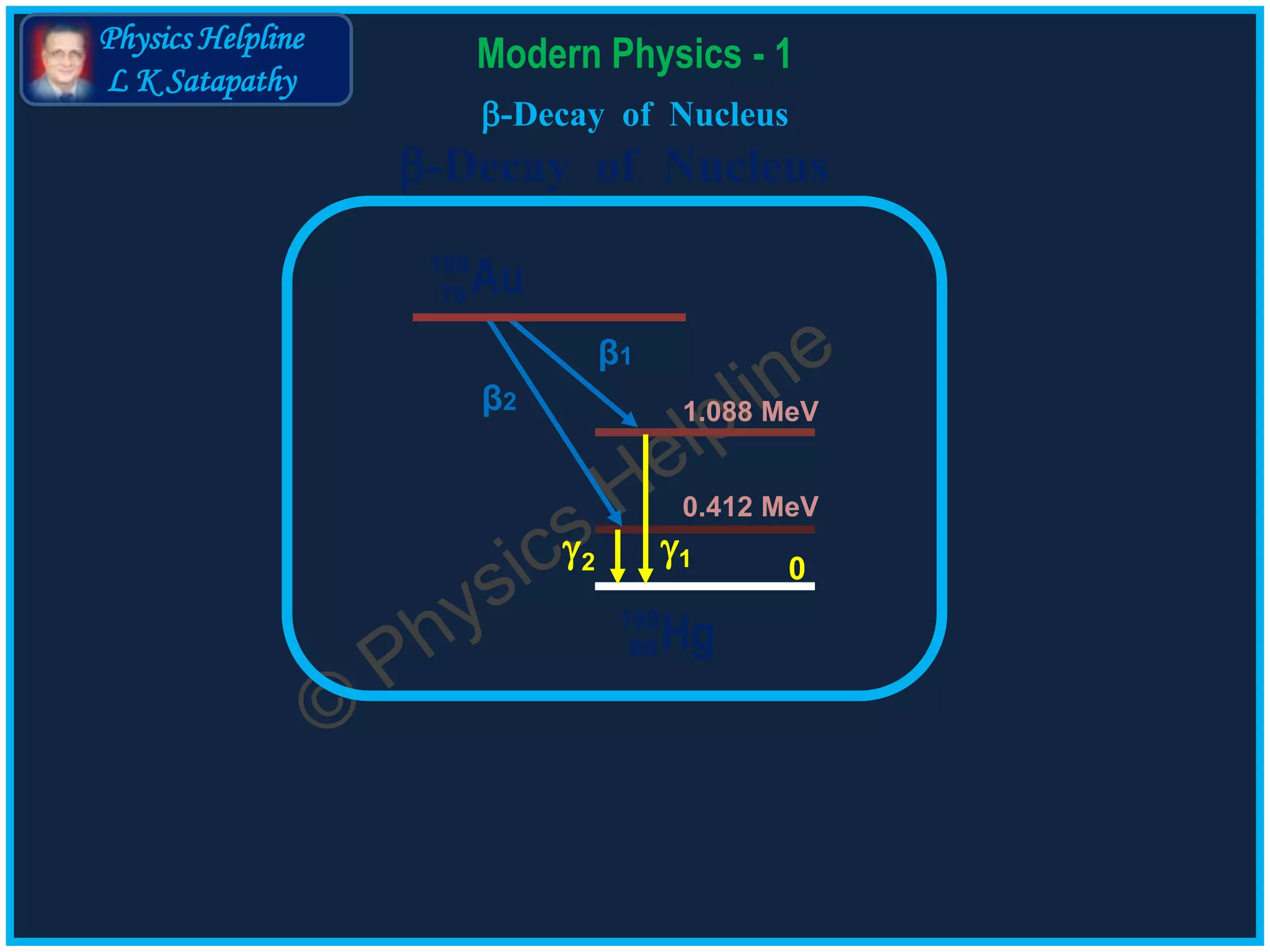
Two gold nuclei undergo β-decay and
convert to mercury in ground state
through different excited states with
subsequent emission of -rays as per the
decay scheme shown in the figure. Find
(a) The maximum possible kinetic
energies of the β - particles
(b) the frequencies of the  - rays.
Given : The atomic masses are
198
79( ) 197.968233m Au u
198
80( ) 197.966760m Hg uand
Physics Helpline
L K Satapathy
Modern Physics - 1
-Decay of Nucleus
Concepts
Eqn. for β – decay [electron emission] :  
  1
A A
Z ZX Y
Energy is released when ( Final Mass ) < ( Initial Mass )
Decrease in 1 amu of mass releases 931.5 MeV of energy
Decrease in mass = Initial mass – Final mass ( = ∆m )
 Energy released = ∆m  931.5 MeV
Planck’s constant 
  34
6.625 10 .h J s
Physics Helpline
L K Satapathy
Modern Physics - 1
-Decay of Nucleus
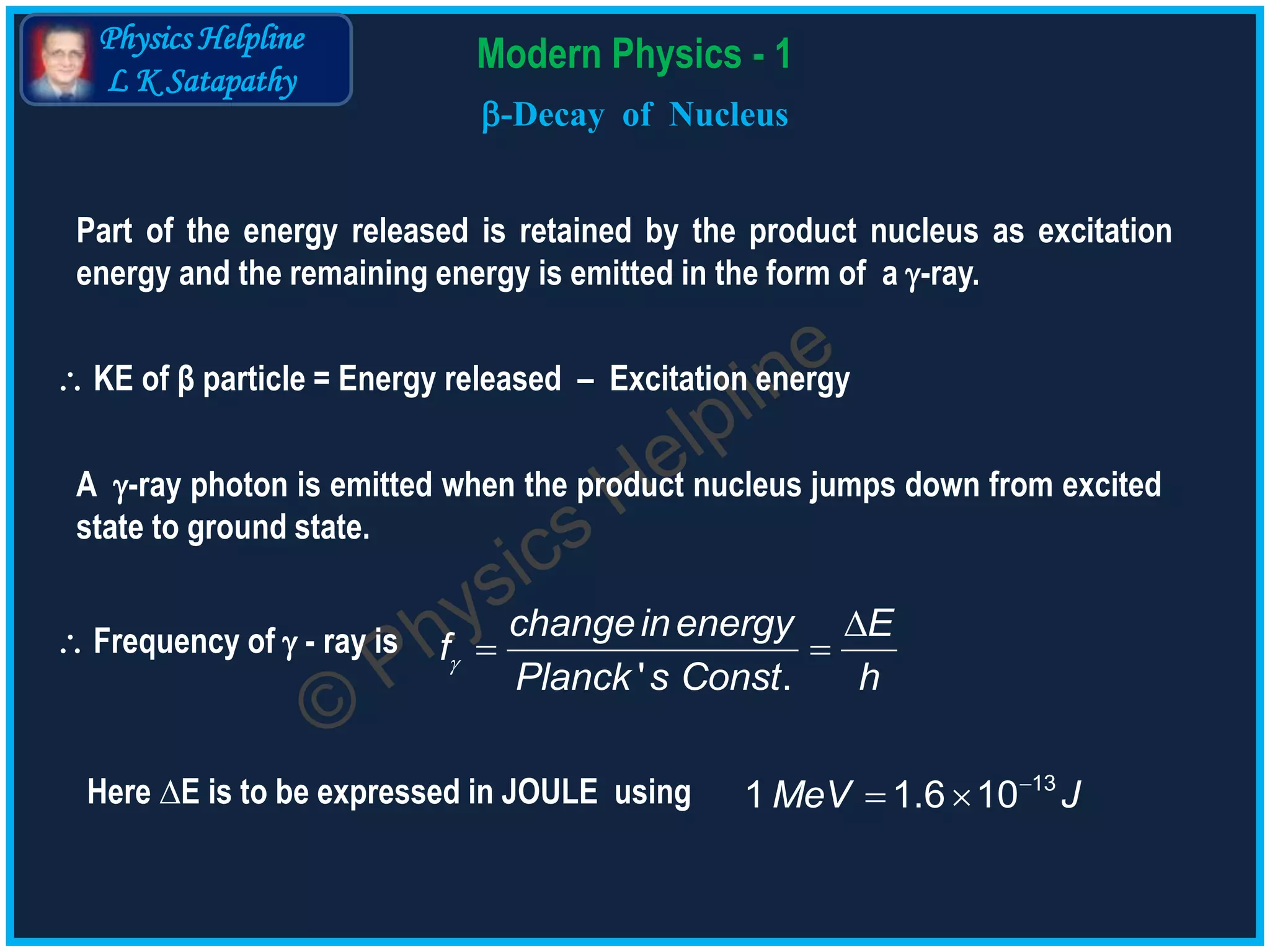
 KE of β particle = Energy released – Excitation energy
Here ∆E is to be expressed in JOULE using
Part of the energy released is retained by the product nucleus as excitation
energy and the remaining energy is emitted in the form of a -ray.
A -ray photon is emitted when the product nucleus jumps down from excited
state to ground state.
 Frequency of  - ray is 

 
' .
changeinenergy E
f
Planck s Const h

  13
1 1.6 10MeV J
Physics Helpline
L K Satapathy
Modern Physics - 1
-Decay of Nucleus
Initial mass = mass of the decaying nucleus
     198 198
79 80[ ( ) 79 ] [ ( ) 80 ]e e em m Au m m Hg m m
  197.968233 197.966760 0.001473u
 Energy released = 0.001473  931.5 = 1.372 MeV
 198 198
79 80( ) ( )m Au m Hg
For both nuclei , the decrease in mass is the same
Final mass = mass of the product nucleus + mass of -particle
 198
79( ) 79 em Au m
  198
80( ) 80 e em Hg m m
Physics Helpline
L K Satapathy
Modern Physics - 1
-Decay of Nucleus
For the 1st nucleus energy released = 1.372 MeV


  
   

13
20
1 34
1.088 1.6 10
2.627 10
6.62
[
5 10
]
E
f Hz Ans
h
 KE of β1 = 1.372 – 1.088 = 0.284 MeV [Ans]
Its excitation energy = 1.088 MeV
When the nucleus jumps down to ground state ,
energy of the emitted -ray = the excitation energy
 Frequency of the emitted -ray is given by
Physics Helpline
L K Satapathy
Modern Physics - 1
-Decay of Nucleus
 KE of β2 = 1.372 ─ 0.412 = 0.960 MeV [Ans]


  
   

13
20
2 34
0.412 1.6 10
0.995 10
6.62
[
5 10
]
E
f Hz Ans
h
For the 2nd nucleus also, energy released = 1.372 MeV
Its excitation energy = 0.412 MeV
When the nucleus jumps down to ground state ,
energy of the emitted -ray = the excitation energy
 Frequency of the emitted -ray is given by
Physics Helpline
L K Satapathy
For More details:
www.physics-helpline.com
Subscribe our channel:
youtube.com/physics-helpline
Follow us on Facebook and Twitter:
facebook.com/physics-helpline
twitter.com/physics-helpline

Nuclear Physics 1

  • 1.
    Physics Helpline L KSatapathy Modern Physics - 1 -Decay of Nucleus 79 β2 β1 Au198  Hg 1.088 MeV 0.412 MeV 12 0 80 198 -Decay of Nucleus
  • 2.
    Physics Helpline L KSatapathy Modern Physics - 1 -Decay of Nucleus 79 1β β2 Au198  80 Hg198 1.088 MeV 0.412 MeV 12  Question : Two gold nuclei undergo β-decay and convert to mercury in ground state through different excited states with subsequent emission of -rays as per the decay scheme shown in the figure. Find (a) The maximum possible kinetic energies of the β - particles (b) the frequencies of the  - rays. Given : The atomic masses are 198 79( ) 197.968233m Au u 198 80( ) 197.966760m Hg uand
  • 3.
    Physics Helpline L KSatapathy Modern Physics - 1 -Decay of Nucleus Concepts Eqn. for β – decay [electron emission] :     1 A A Z ZX Y Energy is released when ( Final Mass ) < ( Initial Mass ) Decrease in 1 amu of mass releases 931.5 MeV of energy Decrease in mass = Initial mass – Final mass ( = ∆m )  Energy released = ∆m  931.5 MeV Planck’s constant    34 6.625 10 .h J s
  • 4.
    Physics Helpline L KSatapathy Modern Physics - 1 -Decay of Nucleus  KE of β particle = Energy released – Excitation energy Here ∆E is to be expressed in JOULE using Part of the energy released is retained by the product nucleus as excitation energy and the remaining energy is emitted in the form of a -ray. A -ray photon is emitted when the product nucleus jumps down from excited state to ground state.  Frequency of  - ray is     ' . changeinenergy E f Planck s Const h    13 1 1.6 10MeV J
  • 5.
    Physics Helpline L KSatapathy Modern Physics - 1 -Decay of Nucleus Initial mass = mass of the decaying nucleus      198 198 79 80[ ( ) 79 ] [ ( ) 80 ]e e em m Au m m Hg m m   197.968233 197.966760 0.001473u  Energy released = 0.001473  931.5 = 1.372 MeV  198 198 79 80( ) ( )m Au m Hg For both nuclei , the decrease in mass is the same Final mass = mass of the product nucleus + mass of -particle  198 79( ) 79 em Au m   198 80( ) 80 e em Hg m m
  • 6.
    Physics Helpline L KSatapathy Modern Physics - 1 -Decay of Nucleus For the 1st nucleus energy released = 1.372 MeV           13 20 1 34 1.088 1.6 10 2.627 10 6.62 [ 5 10 ] E f Hz Ans h  KE of β1 = 1.372 – 1.088 = 0.284 MeV [Ans] Its excitation energy = 1.088 MeV When the nucleus jumps down to ground state , energy of the emitted -ray = the excitation energy  Frequency of the emitted -ray is given by
  • 7.
    Physics Helpline L KSatapathy Modern Physics - 1 -Decay of Nucleus  KE of β2 = 1.372 ─ 0.412 = 0.960 MeV [Ans]           13 20 2 34 0.412 1.6 10 0.995 10 6.62 [ 5 10 ] E f Hz Ans h For the 2nd nucleus also, energy released = 1.372 MeV Its excitation energy = 0.412 MeV When the nucleus jumps down to ground state , energy of the emitted -ray = the excitation energy  Frequency of the emitted -ray is given by
  • 8.
    Physics Helpline L KSatapathy For More details: www.physics-helpline.com Subscribe our channel: youtube.com/physics-helpline Follow us on Facebook and Twitter: facebook.com/physics-helpline twitter.com/physics-helpline