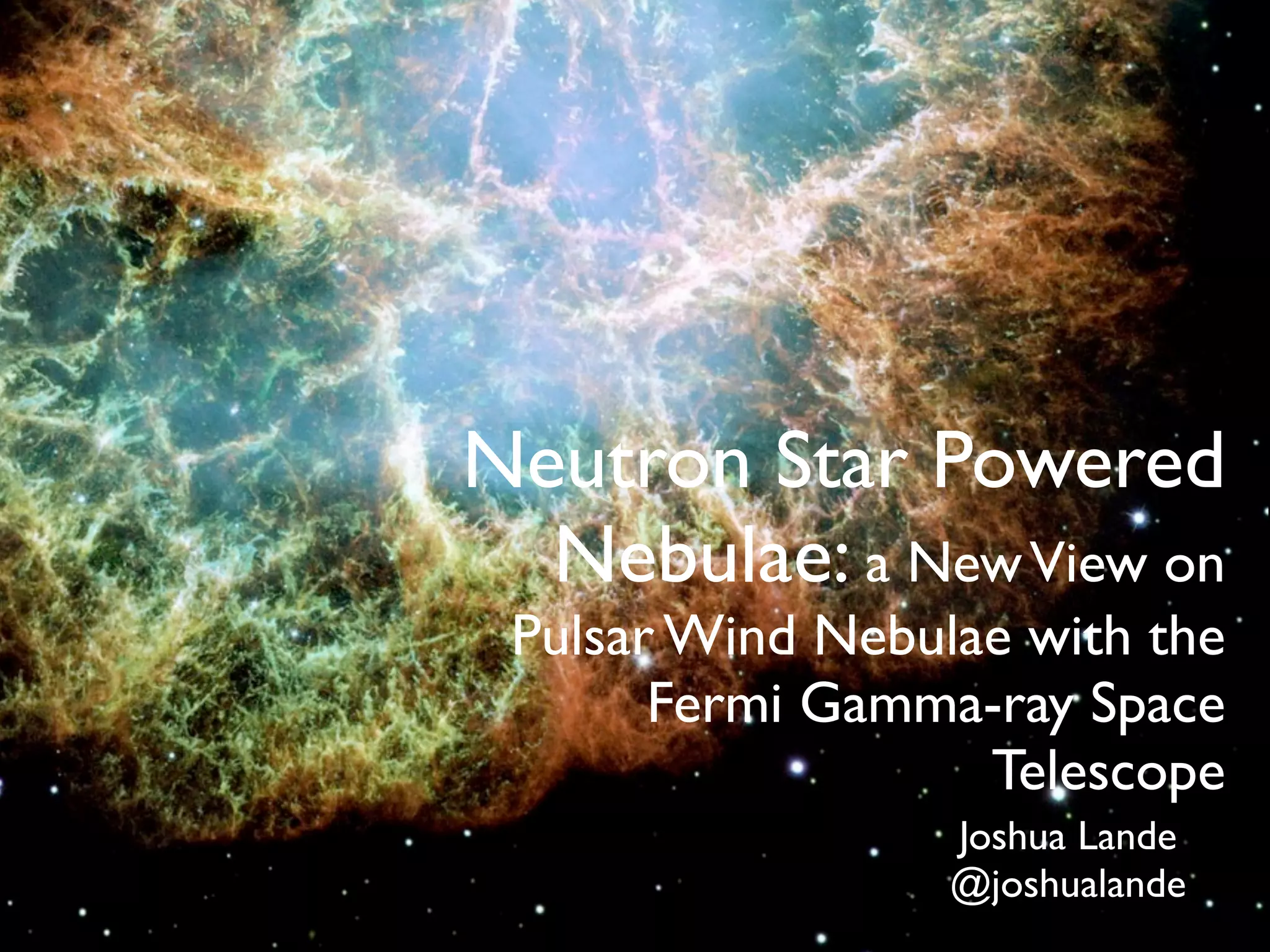
Neutron Star Powered
Nebulae: a NewView on
Pulsar Wind Nebulae with the
Fermi Gamma-ray Space
Telescope
Joshua Lande
@joshualande
Please ask questions!!
Why do we do
astronomy?
Nabta Playa 5th century BC
Liberal Arts
The Trivium
•grammar
•logic
•rhetoric
The Quadrivium
•arithmetic
•geometry
•music
•astronomy
Multiwavelenth
astronomy
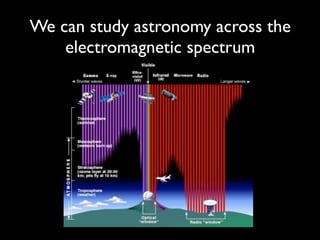
We can study astronomy across the
electromagnetic spectrum
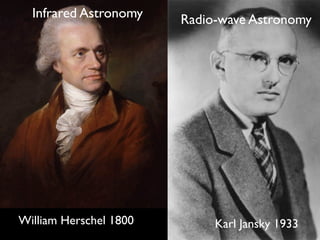
William Herschel 1800
Infrared Astronomy Radio-wave Astronomy
Karl Jansky 1933
ultraviolet - 1946
X-ray - 1949
Gamma-ray
Astrophysics
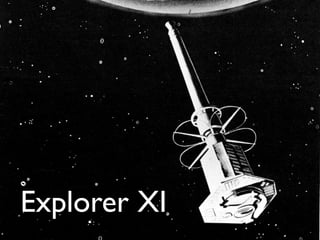
Explorer XI
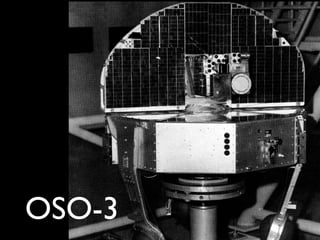
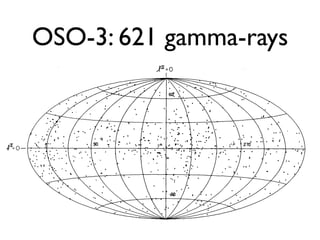
OSO-3
OSO-3: 621 gamma-rays
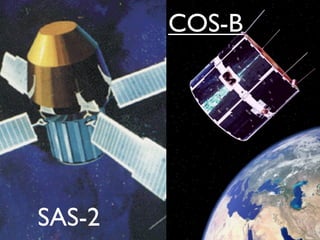
COS-B
SAS-2
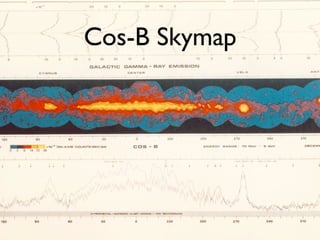
Cos-B Skymap
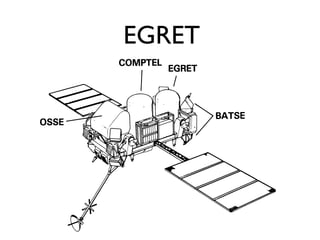
EGRET
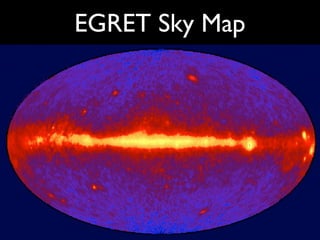
EGRET Sky Map
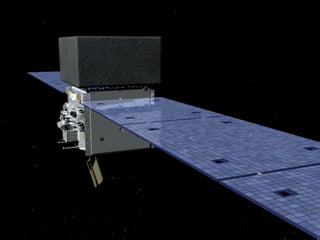
The Fermi Gamma-ray
Space Telescope
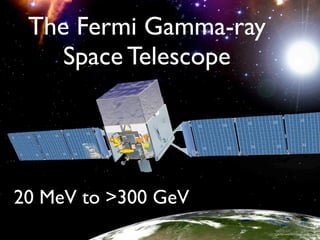
The Fermi Gamma-ray
Space Telescope
20 MeV to >300 GeV
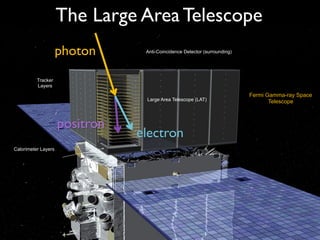
The Large Area Telescope
Tracker
Layers
Calorimeter Layers
Anti-Coincidence Detector (surrounding)
Large Area Telescope (LAT)
Fermi Gamma-ray Space
Telescope
photon
positron
electron
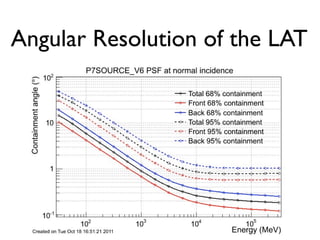
Angular Resolution of the LAT
Blastoff!
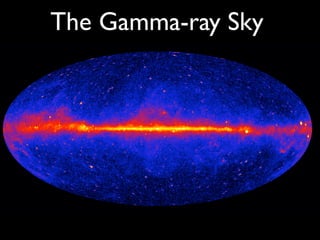
The Gamma-ray Sky
Very High Energy
Astrophysics
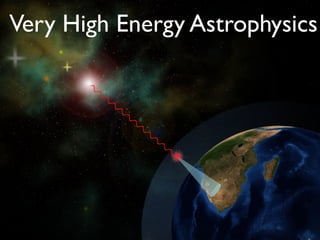
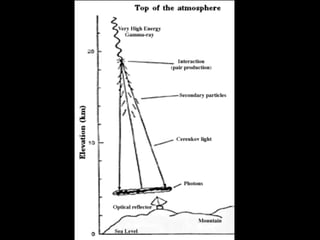
Very High Energy Astrophysics
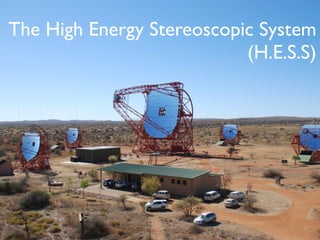
The High Energy Stereoscopic System
(H.E.S.S)
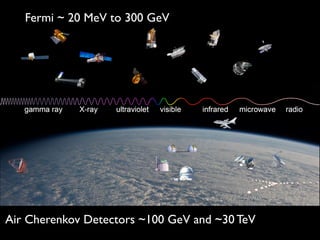
Fermi ~ 20 MeV to 300 GeV
Air Cherenkov Detectors ~100 GeV and ~30 TeV
Astrophysical Sources
of Gamma-rays
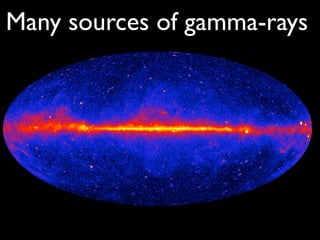
Many sources of gamma-rays
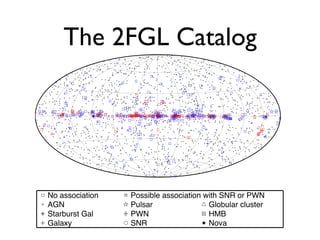
The 2FGL Catalog
No association Possible association with SNR or PWN
AGN Pulsar Globular cluster
Starburst Gal PWN HMB
Galaxy SNR Nova
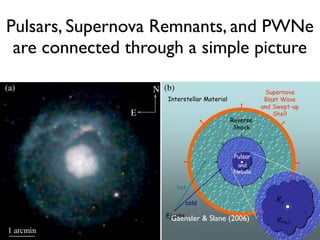
Pulsars, Supernova Remnants, and PWNe
are connected through a simple picture
Gaensler & Slane (2006)
Supernova
are new stars
that appear in
the sky.
~L|F
Left: SN 1054
(Crab Nebula)
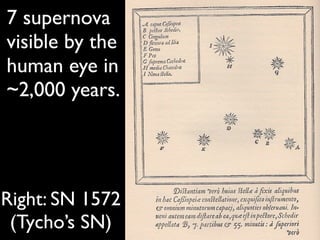
7 supernova
visible by the
human eye in
~2,000 years.
Right: SN 1572
(Tycho’s SN)
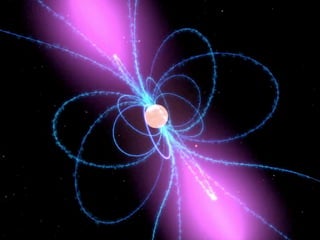
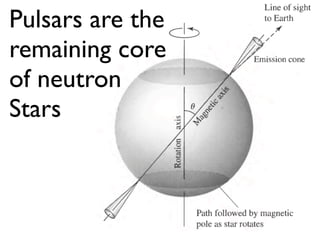
Pulsars are the
remaining core
of neutron
Stars
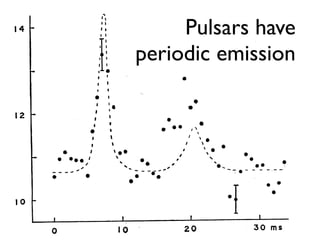
Pulsars have
periodic emission
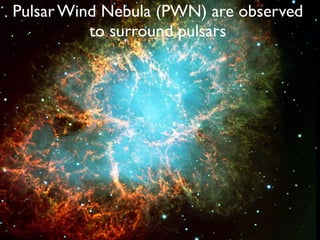
Pulsar Wind Nebula (PWN) are observed
to surround pulsars
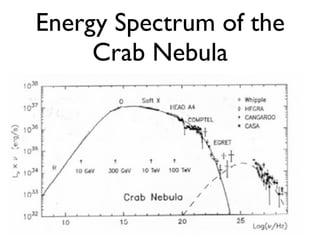
Energy Spectrum of the
Crab Nebula
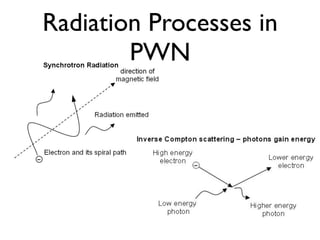
Radiation Processes in
PWN
Gamma-ray
Observations
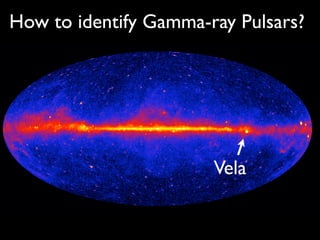
How to identify Gamma-ray Pulsars?
Vela
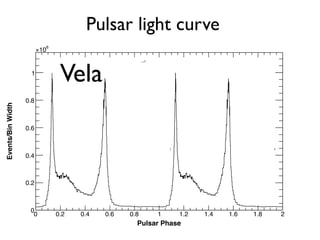
Pulsar Phase
0 0.2 0.4 0.6 0.8 1 1.2 1.4 1.6 1.8 2
Events/BinWidth
0
0.2
0.4
0.6
0.8
1
6
10×
0.12 0.13 0.14
0.6
0.65
0.7
0.75
0.8
0.85
0.9
0.95
1
6
10×
0.54 0.56 0.58
0.6
0.7
0.8
0.9
1
6
10×
Pulsar light curve
Vela
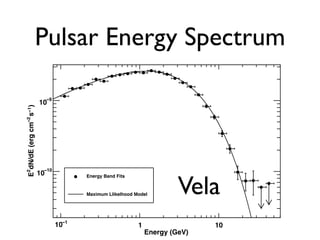
Energy (GeV)
−1
10 1 10
)−1
s−2
dN/dE(ergcm2
E
−10
10
−9
10
Energy Band Fits
Maximum Llikelhood Model
Pulsar Energy Spectrum
Vela
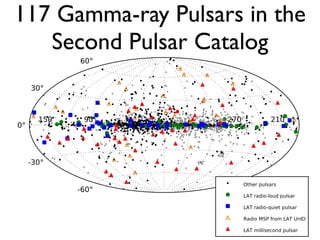
117 Gamma-ray Pulsars in the
Second Pulsar Catalog
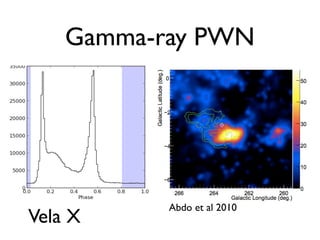
Gamma-ray PWN
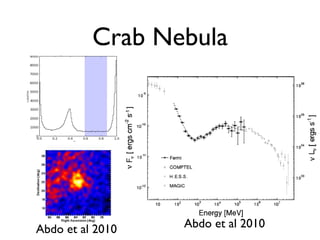
Crab Nebula
Vela X
Abdo et al 2010
Abdo et al 2010
Crab Nebula
:26 (8pp), 2012 April 10 Buehler et al.
Pulsar phase
0.4 0.6 0.8
Pulsar phase
0.4 0.6 0.8 Figure 2. Spectral energy distribution for the Crab Nebula averaged over the
first 33 months of Fermi observations. The axis on the right side indicates the
1260 ABDO ET AL. Vol. 708
Figure 4. Counts maps (arbitrary units) presenting the pulsed (top row) and nebular (bottom row) emission, in three energy bands. Each panel spans 15◦ × 15◦ in
equatorial coordinates and is centered on the pulsar radio position. Left: 100 MeV < E < 300 MeV; middle: 300 MeV < E < 1 GeV; right: E > 1 GeV.
(A color version of this figure is available in the online journal.)
Abdo et al 2010 Abdo et al 2010
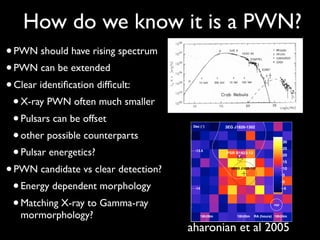
How do we know it is a PWN?
aharonian et al 2005
•PWN should have rising spectrum
•PWN can be extended
•Clear identification difficult:
•X-ray PWN often much smaller
•Pulsars can be offset
•other possible counterparts
•Pulsar energetics?
•PWN candidate vs clear detection?
•Energy dependent morphology
•Matching X-ray to Gamma-ray
mormorphology?
L26 F. A. Aharonian et al.: The association of HESS J1825–137 with G 18.0–0.7
1. Introduction
PSR B1823–13 (also known as PSR J1826–1334) is a 101 ms
evolved pulsar with a spin-down age of T = 2.1 × 10⁴
years
(Clifton et al. 1992) and in these properties very similar to the
Vela pulsar. It is located at a distance of d = 3.9 ± 0.4 kpc
(Cordes & Lazio 2002) and ROSAT observations of this source
with limited photon statistics revealed a compact core, as well
as an extended diffuse nebula of size ∼5 south-west of the pul-
sar (Finley et al. 1998). High resolution XMM-Newton obser-
vations of the pulsar region confirmed this asymmetric shape
and size of the diffuse nebula, which was hence given the name
G 18.0–0.7 (Gaensler et al. 2003). For the compact core with
extent RCN ∼ 30 (CN: compact nebula) immediately sur-
rounding the pulsar, a photon index of ΓCN = 1.6+0.1
−0.2 was mea-
sured with a luminosity of LCN ∼ 9d2
4 × 1032
erg s−1
in the 0.5
to 10 keV range for a distance of 4d4 kpc. The corresponding
pulsar wind shock radius is Rs ≤ 15 = 0.3d4 pc. The com-
pact core is embedded in a region of extended diffuse emission
which is clearly one-sided, revealing a structure south of the
pulsar, with an extension of REN ∼ 5 , (EN: extended nebula)
whereas the ∼4 east-west extension is symmetric around the
north-south axis. The spectrum of this extended component is
-5
0
5
10
15
20
25
30
-14
-13.5
18h24m18h26m18h28m
PSR B1823-13
RA (hours)
)°Dec ( 3EG J1826-1302
PSF
HESS J1825-137
Fig. 1. Excess map of the region close to PSRB1823–13 (marked with
a triangle) with uncorrelated bins. The best fit centroid of the γ-ray
excess is shown with error bars. The black dotted circle shows the
LettertotheEditor
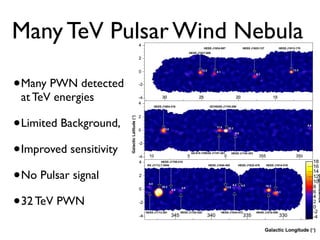
Many TeV Pulsar Wind Nebula
•Many PWN detected
at TeV energies
•Limited Background,
•Improved sensitivity
•No Pulsar signal
•32 TeV PWN
Harder at Gamma-ray
energies
•Limited Angular Resolution
•Large Galactic Background
•Non-linear Detector response
•Emission could be from the pulsar.
•Crowded gamma-ray sky
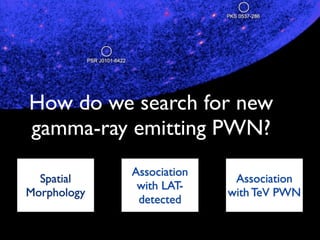
How do we search for new
gamma-ray emitting PWN?
Association
with LAT-
detected
Association
with TeV PWN
Spatial
Morphology
Extended Fermi
Sources
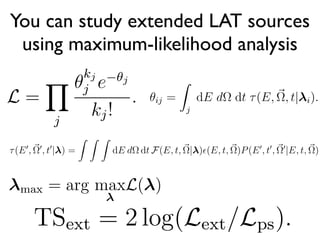
You can study extended LAT sources
using maximum-likelihood analysis
ering events). The likelihood function
d emission:
L =
Y
j
✓
kj
j e ✓j
kj!
.
tion and energy bins, kj are the counts
ts predicted in the same bin.
re computed by integrating the di↵ere
~⌦0
at a time t0
. The dispersion is written as P(E0
, t0
, ~⌦0
|E, t, ~⌦). It repre
probability and is therefore normalized such that
Z Z Z
dEd⌦dtP(E0
, t0
, ~⌦0
|E, t, ~⌦) = 1
Therefore, P(E0
, t0
, ~⌦0
|E, t, ~⌦) has units of 1/energy/SA/time
The convolution of the model a source with the IRFs produces the expec
ferential counts (counts per unit energy/time/SA) that are reconstructed to
energy E0
at a position ~⌦0
and at a time t0
:
⌧(E0
, ~⌦0
, t0
| ) =
Z Z Z
dE d⌦ dt F(E, t, ~⌦| )✏(E, t, ~⌦)P(E0
, t0
, ~⌦0
|E, t, ~⌦)
Here, this integral is performed over all energies, SAs, and times.

For LAT analysis, we conventionally make the simplifying assumption t
Here, j refers to a sum over position and energy bins, kj a
bin j, and ✓j are the model counts predicted in the same b
The model counts in bin j are computed by integrat
counts over the bin:
✓ij =
Z
j
dE d⌦ dt ⌧(E, ~⌦, t| i).
Here, j represents the integral over the jth position/energ
source, i refers to the parameters defining the ith source, a
1 0
plicated hypothesis and H0 th
mpare the likelihood when ass
ended spatial model:
TSext = 2 log(Lext/Lps).
n be written as:
L = L( ).
ysis, one typically fits parameters of a model
ction of the parameters of the model.
max = arg maxL( )
0◦
0.◦
1 0.◦
2 0.◦
3 0.◦
4 0.◦
5 0.◦
6
Extension
10000
10200
10400
10600
10800
11000
11200TestStatistic
(a)
102
103
104
105
Energy (MeV)
0
50
100
150
200
TSext
(b)
0.0 0.1 0.2 0.3 0.4 0.5
∆θ2
([deg]2
)
101
102
103
Counts
(c)
Disk
Point
Counts
(d)
2◦
3◦
b
188◦
189◦
l
0
500
1000
1500
2000
2500
3000
3500
counts[deg]−2
Extended
Source IC 443
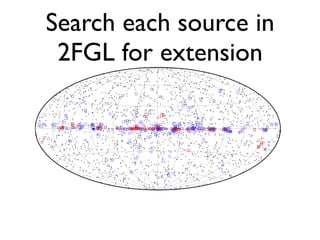
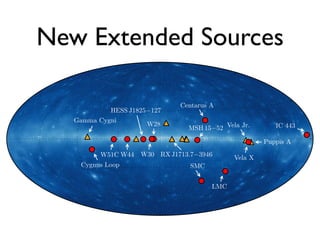
Search each source in
2FGL for extension
IC 443
Puppis A
W44
MSH 15−52
W51C
W28
SMC
Gamma Cygni
Vela X
Cygnus Loop
Vela Jr.
LMC
RX J1713.7−3946
HESS J1825−127
W30
Centarus A
New Extended Sources
0
1b
2526
l
0
25
50
75
100
125
150
175
200
225
counts/[deg]2
HESS J1837-069
1 000
0 300
0 000
0 300
b
331 300
332 000
332 300
333 000
l
0
30
60
90
120
150
180
210
240
270
counts/[deg]2
HESS J1616−508
1
0
1
b
336337
l
0
30
60
90
120
150
180
210
240
270
counts/[deg]2
HESS J1632-478
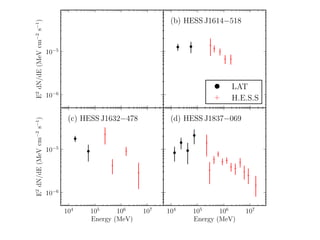
10−6
10−5
E2
dN/dE(MeVcm−2
s−1
)
(a) HESS J1616−508 (b) HESS J1614−518
LAT
H.E.S.S
104
105
106
107
Energy (MeV)
10−6
10−5
E2
dN/dE(MeVcm−2
s−1
)
(c) HESS J1632−478
104
105
106
107
Energy (MeV)
(d) HESS J1837−069
PWN Search in the
Off-Peak
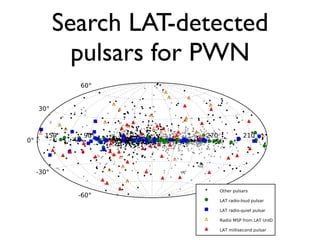
Search LAT-detected
pulsars for PWN
0.0 0.2 0.4 0.6 0.8 1.0
0
100
200
300
400
500
600
700
800
Counts
0.0 0.2 0.4 0.6 0.8 1.0
0
100
200
300
400
0.0 0.2 0.4 0.6 0.8 1.0
0
50
100
150
200
250
300
350
Counts
0.0 0.2 0.4 0.6 0.8 1.0
0
100
200
300
400
500
0.0 0.2 0.4 0.6 0.8 1.0
Phase
0
100
200
300
400
500
600
700
Counts
0.0 0.2 0.4 0.6 0.8 1.0
Phase
0
5
10
15
20
25
30
35
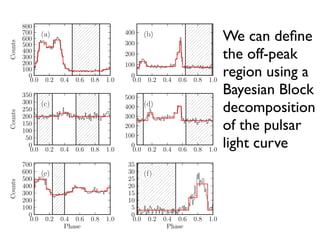
We can define
the off-peak
region using a
Bayesian Block
decomposition
of the pulsar
light curve
Is it a pulsar or a PWN?Grondin et al.
Energy [MeV]
3
10 4
10
5
10
6
10 7
10
]-1s-2
dN/dE[ergcm2
E
-12
10
-11
10
-10
10
pectral energy distribution of HESS J1825−137 in gamma-rays. The LAT spectral points (in red) are obtained using the maximum likelihood
described in section 4.2 in 6 logarithmically-spaced energy bins. The statistical errors are shown in red, while the black lines take into account both
nd systematic errors as discussed in section 4.2. The red solid line presents the result obtained by fitting a power-law to the data in the 1 – 100 GeV
using a maximum likelihood fit. A 95 % C.L. upper limit is computed when the statistical significance is lower than 3 σ. The H.E.S.S. results are
blue (Aharonian et al. 2006).
pulsar, we fix the initial spin period at 10 ms and
ex at 2.5, yielding an age of 26 kyr for the sys-
simple injection spectrum slightly underestimates
ata but the overall fit is still reasonable. For the
of 26 kyr, we require a power-law index of 1.9,
57 TeV and a magnetic field of 4 µG. The corre-
sult is presented in Figure 4 (Top).
option to fit the multi-wavelength data is adopting
tic Maxwellian plus power-law tail electron spec-
sed by Spitkovsky (2008). For this injection spec-
sume a bulk gamma-factor (γ0) for the PWN wind
f the termination shock. At the termination shock
t pressure balances the wind pressure, fully ther-
e wind; in this case the downstream post-shock
= (γ0 − 1)/2. One could also interpret this as
e temperature kT of mec2
(γ0 − 1)/2. Per the
of Spitkovsky (2008), a power-law tail begins at
mec2
γ0, and suffers an exponential cutoff at some
The Fermi LAT Collaboration acknowledges generous ongoing support
from a number of agencies and institutes that have supported both the de-
velopment and the operation of the LAT as well as scientific data analysis.
These include the National Aeronautics and Space Administration and the
Department of Energy in the United States, the Commissariat `a l’Energie
Atomique and the Centre National de la Recherche Scientifique / Institut Na-
tional de Physique Nucl´eaire et de Physique des Particules in France, the
Agenzia Spaziale Italiana, the Istituto Nazionale di Fisica Nucleare, and the
Istituto Nazionale di Astrofisica in Italy, the Ministry of Education, Culture,
Sports, Science and Technology (MEXT), High Energy Accelerator Research
Organization (KEK) and Japan Aerospace Exploration Agency (JAXA) in
Japan, and the K. A. Wallenberg Foundation and the Swedish National Space
Board in Sweden. Additional support for science analysis during the opera-
tions phase from the following agencies is also gratefully acknowledged: the
Instituto Nazionale di Astrofisica in Italy and the Centre National d’´Etudes
Spatiales in France.
The Nanc¸ay Radio Observatory is operated by the Paris Observatory, associ-
ated with the French Centre National de la Recherche Scientifique (CNRS).
The Lovell Telescope is owned and operated by the University of Manchester
as part of the Jodrell Bank Centre for Astrophysics with support from the
Science and Technology Facilities Council of the United Kingdom.
The Parkes radio telescope is part of the Australia Telescope which is funded
– 37 –
Energy (MeV)
2
10
3
10
4
10
]-1
s-2
dN/dE[ergcm2
E
-11
10
-10
10
1
]-1
s-2
dN/dE[ergcm2
E
-12
10
-11
10
Energy (MeV)
2
10
3
10 10
]-1
s-2
dN/dE[ergcm2
E
-12
10
-11
10
4 Grondin et al.
HESS J1825-137
(Grondin et al 2011)
PSR J2021+4026
Ackermann et al 2010
HESS J1825-137
(Grondin et al 2011)
Spectral Shape:
• Pulsars are cutoff
• PWN rising spectrum
Morphology
• Pulsars are point sources
• PWN could be extended
10 13
10 12
10 11
10 10
10 9
10 13
10 12
10 11
10 10
E2
dN/dE(ergcm2
s1
)
10 13
10 12
10 11
10 10
10 9
10 1
100
101
102
Energy (GeV)
10 1
100
101
102
Energy (GeV)
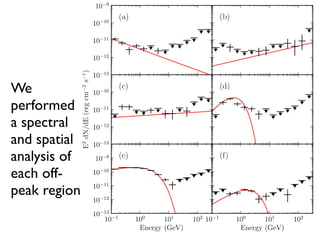
We
performed
a spectral
and spatial
analysis of
each off-
peak region
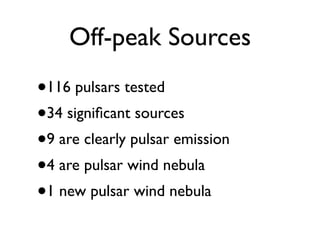
Off-peak Sources
•116 pulsars tested
•34 significant sources
•9 are clearly pulsar emission
•4 are pulsar wind nebula
•1 new pulsar wind nebula
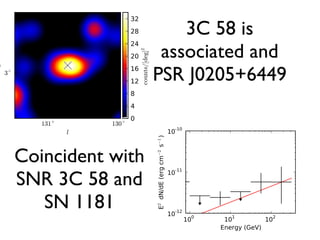
3C 58 is
associated and
PSR J0205+6449
Coincident with
SNR 3C 58 and
SN 1181
Search for TeV PWN
HESS J1303-613
1
0
1
b
262728
l
0
20
40
60
80
100
120
140
160
180
counts/[deg]2
HESS J1841-055
1
0
b
292293
l
0
10
20
30
40
50
60
70
80
90
counts/[deg]2
HESS J1119-614 HESS J1356-645
0
1
b
313314
l
0
25
50
75
100
125
150
175
200
225 counts/[deg]2
HESS J1420-607
PWN Detected by LAT
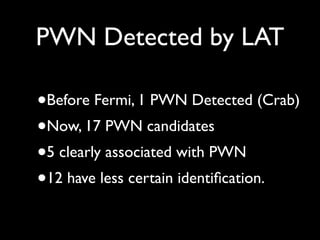
•Before Fermi, 1 PWN Detected (Crab)
•Now, 17 PWN candidates
•5 clearly associated with PWN
•12 have less certain identification.
PWN Population Study
102
103
104
105
106
107
108
109
1010
1011
⌧C [years]
1028
1029
1030
1031
1032
1033
1034
1035
1036
1037
1038
1039
˙E[ergs1
]
LAT Detects
PWN from
young and
highly-
energetic
pulsars
1034
1035
1036
1037
1038
1039
˙E
1032
1033
1034
1035
1036
LGeV
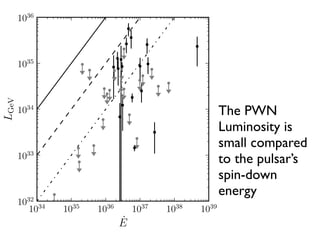
The PWN
Luminosity is
small compared
to the pulsar’s
spin-down
energy
1033
1034
1035
1036
LGeV(ergs1
)
103
104
105
Age (yr)
100
101
102
LGeV/LTeV
1035
1036
1037
1038
1039
˙E (erg s 1
)
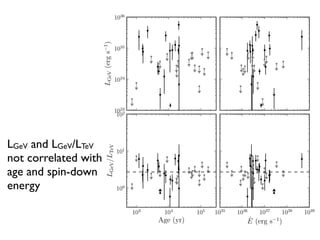
LGeV and LGeV/LTeV
not correlated with
age and spin-down
energy
1031
1032
1033
1034
1035
1036
1037LX(ergs1
)
103
104
105
Age (yr)
10 2
10 1
100
101
102
103
104
LGeV/LX
1035
1036
1037
1038
1039
˙E (erg s 1
)
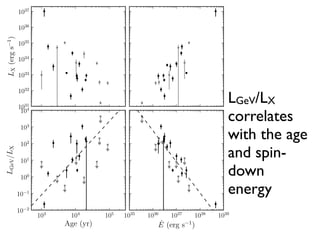
LGeV/LX
correlates
with the age
and spin-
down
energy
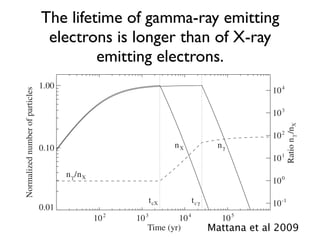
The lifetime of gamma-ray emitting
electrons is longer than of X-ray
emitting electrons.EVOLUTION OF THE γ - AND X-RAY LUMINOSITIES OF PWNe
102
103
104
105
Time (yr)
0.01
0.10
1.00
Normalizednumberofparticles
nγnX
tcγtcX 10-1
100
101
102
103
104
Rationγ/nX
nγ /nX
Mattana et al 2009
Conclusions
Acknowledgments
Stanford Physics
The LAT Collaboration
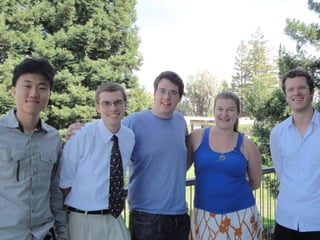
Big thanks to my
defense committee!
The Funk
Group
Thanks to my family!
Thanks to the
administrators!
Finally, thanks for
coming!
Questions?

Neutron Star Powered Nebulae

  • 1.
    Neutron Star Powered Nebulae:a NewView on Pulsar Wind Nebulae with the Fermi Gamma-ray Space Telescope Joshua Lande @joshualande
  • 2.
  • 3.
    Why do wedo astronomy?
  • 4.
    Nabta Playa 5thcentury BC
  • 6.
    Liberal Arts The Trivium •grammar •logic •rhetoric TheQuadrivium •arithmetic •geometry •music •astronomy
  • 7.
  • 8.
    We can studyastronomy across the electromagnetic spectrum
  • 9.
    William Herschel 1800 InfraredAstronomy Radio-wave Astronomy Karl Jansky 1933
  • 10.
  • 11.
  • 12.
  • 13.
  • 14.
  • 15.
  • 16.
  • 17.
  • 18.
  • 19.
  • 20.
    The Fermi Gamma-ray SpaceTelescope 20 MeV to >300 GeV
  • 21.
    The Large AreaTelescope Tracker Layers Calorimeter Layers Anti-Coincidence Detector (surrounding) Large Area Telescope (LAT) Fermi Gamma-ray Space Telescope photon positron electron
  • 23.
  • 25.
  • 26.
  • 27.
  • 28.
    Very High EnergyAstrophysics
  • 30.
    The High EnergyStereoscopic System (H.E.S.S)
  • 31.
    Fermi ~ 20MeV to 300 GeV Air Cherenkov Detectors ~100 GeV and ~30 TeV
  • 32.
  • 33.
    Many sources ofgamma-rays
  • 34.
    The 2FGL Catalog Noassociation Possible association with SNR or PWN AGN Pulsar Globular cluster Starburst Gal PWN HMB Galaxy SNR Nova
  • 35.
    Pulsars, Supernova Remnants,and PWNe are connected through a simple picture Gaensler & Slane (2006)
  • 36.
    Supernova are new stars thatappear in the sky. ~L|F Left: SN 1054 (Crab Nebula)
  • 37.
    7 supernova visible bythe human eye in ~2,000 years. Right: SN 1572 (Tycho’s SN)
  • 38.
    Pulsars are the remainingcore of neutron Stars
  • 40.
  • 41.
    Pulsar Wind Nebula(PWN) are observed to surround pulsars
  • 42.
    Energy Spectrum ofthe Crab Nebula
  • 43.
  • 45.
  • 46.
    How to identifyGamma-ray Pulsars? Vela
  • 47.
    Pulsar Phase 0 0.20.4 0.6 0.8 1 1.2 1.4 1.6 1.8 2 Events/BinWidth 0 0.2 0.4 0.6 0.8 1 6 10× 0.12 0.13 0.14 0.6 0.65 0.7 0.75 0.8 0.85 0.9 0.95 1 6 10× 0.54 0.56 0.58 0.6 0.7 0.8 0.9 1 6 10× Pulsar light curve Vela
  • 48.
    Energy (GeV) −1 10 110 )−1 s−2 dN/dE(ergcm2 E −10 10 −9 10 Energy Band Fits Maximum Llikelhood Model Pulsar Energy Spectrum Vela
  • 49.
    117 Gamma-ray Pulsarsin the Second Pulsar Catalog
  • 50.
    Gamma-ray PWN Crab Nebula VelaX Abdo et al 2010 Abdo et al 2010
  • 51.
    Crab Nebula :26 (8pp),2012 April 10 Buehler et al. Pulsar phase 0.4 0.6 0.8 Pulsar phase 0.4 0.6 0.8 Figure 2. Spectral energy distribution for the Crab Nebula averaged over the first 33 months of Fermi observations. The axis on the right side indicates the 1260 ABDO ET AL. Vol. 708 Figure 4. Counts maps (arbitrary units) presenting the pulsed (top row) and nebular (bottom row) emission, in three energy bands. Each panel spans 15◦ × 15◦ in equatorial coordinates and is centered on the pulsar radio position. Left: 100 MeV < E < 300 MeV; middle: 300 MeV < E < 1 GeV; right: E > 1 GeV. (A color version of this figure is available in the online journal.) Abdo et al 2010 Abdo et al 2010
  • 52.
    How do weknow it is a PWN? aharonian et al 2005 •PWN should have rising spectrum •PWN can be extended •Clear identification difficult: •X-ray PWN often much smaller •Pulsars can be offset •other possible counterparts •Pulsar energetics? •PWN candidate vs clear detection? •Energy dependent morphology •Matching X-ray to Gamma-ray mormorphology? L26 F. A. Aharonian et al.: The association of HESS J1825–137 with G 18.0–0.7 1. Introduction PSR B1823–13 (also known as PSR J1826–1334) is a 101 ms evolved pulsar with a spin-down age of T = 2.1 × 10⁴ years (Clifton et al. 1992) and in these properties very similar to the Vela pulsar. It is located at a distance of d = 3.9 ± 0.4 kpc (Cordes & Lazio 2002) and ROSAT observations of this source with limited photon statistics revealed a compact core, as well as an extended diffuse nebula of size ∼5 south-west of the pul- sar (Finley et al. 1998). High resolution XMM-Newton obser- vations of the pulsar region confirmed this asymmetric shape and size of the diffuse nebula, which was hence given the name G 18.0–0.7 (Gaensler et al. 2003). For the compact core with extent RCN ∼ 30 (CN: compact nebula) immediately sur- rounding the pulsar, a photon index of ΓCN = 1.6+0.1 −0.2 was mea- sured with a luminosity of LCN ∼ 9d2 4 × 1032 erg s−1 in the 0.5 to 10 keV range for a distance of 4d4 kpc. The corresponding pulsar wind shock radius is Rs ≤ 15 = 0.3d4 pc. The com- pact core is embedded in a region of extended diffuse emission which is clearly one-sided, revealing a structure south of the pulsar, with an extension of REN ∼ 5 , (EN: extended nebula) whereas the ∼4 east-west extension is symmetric around the north-south axis. The spectrum of this extended component is -5 0 5 10 15 20 25 30 -14 -13.5 18h24m18h26m18h28m PSR B1823-13 RA (hours) )°Dec ( 3EG J1826-1302 PSF HESS J1825-137 Fig. 1. Excess map of the region close to PSRB1823–13 (marked with a triangle) with uncorrelated bins. The best fit centroid of the γ-ray excess is shown with error bars. The black dotted circle shows the LettertotheEditor
  • 53.
    Many TeV PulsarWind Nebula •Many PWN detected at TeV energies •Limited Background, •Improved sensitivity •No Pulsar signal •32 TeV PWN
  • 54.
    Harder at Gamma-ray energies •LimitedAngular Resolution •Large Galactic Background •Non-linear Detector response •Emission could be from the pulsar. •Crowded gamma-ray sky
  • 55.
    How do wesearch for new gamma-ray emitting PWN? Association with LAT- detected Association with TeV PWN Spatial Morphology
  • 56.
  • 57.
    You can studyextended LAT sources using maximum-likelihood analysis ering events). The likelihood function d emission: L = Y j ✓ kj j e ✓j kj! . tion and energy bins, kj are the counts ts predicted in the same bin. re computed by integrating the di↵ere ~⌦0 at a time t0 . The dispersion is written as P(E0 , t0 , ~⌦0 |E, t, ~⌦). It repre probability and is therefore normalized such that Z Z Z dEd⌦dtP(E0 , t0 , ~⌦0 |E, t, ~⌦) = 1 Therefore, P(E0 , t0 , ~⌦0 |E, t, ~⌦) has units of 1/energy/SA/time The convolution of the model a source with the IRFs produces the expec ferential counts (counts per unit energy/time/SA) that are reconstructed to energy E0 at a position ~⌦0 and at a time t0 : ⌧(E0 , ~⌦0 , t0 | ) = Z Z Z dE d⌦ dt F(E, t, ~⌦| )✏(E, t, ~⌦)P(E0 , t0 , ~⌦0 |E, t, ~⌦) Here, this integral is performed over all energies, SAs, and times. For LAT analysis, we conventionally make the simplifying assumption t Here, j refers to a sum over position and energy bins, kj a bin j, and ✓j are the model counts predicted in the same b The model counts in bin j are computed by integrat counts over the bin: ✓ij = Z j dE d⌦ dt ⌧(E, ~⌦, t| i). Here, j represents the integral over the jth position/energ source, i refers to the parameters defining the ith source, a 1 0 plicated hypothesis and H0 th mpare the likelihood when ass ended spatial model: TSext = 2 log(Lext/Lps). n be written as: L = L( ). ysis, one typically fits parameters of a model ction of the parameters of the model. max = arg maxL( )
  • 58.
    0◦ 0.◦ 1 0.◦ 2 0.◦ 30.◦ 4 0.◦ 5 0.◦ 6 Extension 10000 10200 10400 10600 10800 11000 11200TestStatistic (a) 102 103 104 105 Energy (MeV) 0 50 100 150 200 TSext (b) 0.0 0.1 0.2 0.3 0.4 0.5 ∆θ2 ([deg]2 ) 101 102 103 Counts (c) Disk Point Counts (d) 2◦ 3◦ b 188◦ 189◦ l 0 500 1000 1500 2000 2500 3000 3500 counts[deg]−2 Extended Source IC 443
  • 59.
    Search each sourcein 2FGL for extension
  • 60.
    IC 443 Puppis A W44 MSH15−52 W51C W28 SMC Gamma Cygni Vela X Cygnus Loop Vela Jr. LMC RX J1713.7−3946 HESS J1825−127 W30 Centarus A New Extended Sources
  • 61.
  • 62.
    1 000 0 300 0000 0 300 b 331 300 332 000 332 300 333 000 l 0 30 60 90 120 150 180 210 240 270 counts/[deg]2 HESS J1616−508
  • 63.
  • 64.
    10−6 10−5 E2 dN/dE(MeVcm−2 s−1 ) (a) HESS J1616−508(b) HESS J1614−518 LAT H.E.S.S 104 105 106 107 Energy (MeV) 10−6 10−5 E2 dN/dE(MeVcm−2 s−1 ) (c) HESS J1632−478 104 105 106 107 Energy (MeV) (d) HESS J1837−069
  • 65.
    PWN Search inthe Off-Peak
  • 66.
  • 67.
    0.0 0.2 0.40.6 0.8 1.0 0 100 200 300 400 500 600 700 800 Counts 0.0 0.2 0.4 0.6 0.8 1.0 0 100 200 300 400 0.0 0.2 0.4 0.6 0.8 1.0 0 50 100 150 200 250 300 350 Counts 0.0 0.2 0.4 0.6 0.8 1.0 0 100 200 300 400 500 0.0 0.2 0.4 0.6 0.8 1.0 Phase 0 100 200 300 400 500 600 700 Counts 0.0 0.2 0.4 0.6 0.8 1.0 Phase 0 5 10 15 20 25 30 35 We can define the off-peak region using a Bayesian Block decomposition of the pulsar light curve
  • 68.
    Is it apulsar or a PWN?Grondin et al. Energy [MeV] 3 10 4 10 5 10 6 10 7 10 ]-1s-2 dN/dE[ergcm2 E -12 10 -11 10 -10 10 pectral energy distribution of HESS J1825−137 in gamma-rays. The LAT spectral points (in red) are obtained using the maximum likelihood described in section 4.2 in 6 logarithmically-spaced energy bins. The statistical errors are shown in red, while the black lines take into account both nd systematic errors as discussed in section 4.2. The red solid line presents the result obtained by fitting a power-law to the data in the 1 – 100 GeV using a maximum likelihood fit. A 95 % C.L. upper limit is computed when the statistical significance is lower than 3 σ. The H.E.S.S. results are blue (Aharonian et al. 2006). pulsar, we fix the initial spin period at 10 ms and ex at 2.5, yielding an age of 26 kyr for the sys- simple injection spectrum slightly underestimates ata but the overall fit is still reasonable. For the of 26 kyr, we require a power-law index of 1.9, 57 TeV and a magnetic field of 4 µG. The corre- sult is presented in Figure 4 (Top). option to fit the multi-wavelength data is adopting tic Maxwellian plus power-law tail electron spec- sed by Spitkovsky (2008). For this injection spec- sume a bulk gamma-factor (γ0) for the PWN wind f the termination shock. At the termination shock t pressure balances the wind pressure, fully ther- e wind; in this case the downstream post-shock = (γ0 − 1)/2. One could also interpret this as e temperature kT of mec2 (γ0 − 1)/2. Per the of Spitkovsky (2008), a power-law tail begins at mec2 γ0, and suffers an exponential cutoff at some The Fermi LAT Collaboration acknowledges generous ongoing support from a number of agencies and institutes that have supported both the de- velopment and the operation of the LAT as well as scientific data analysis. These include the National Aeronautics and Space Administration and the Department of Energy in the United States, the Commissariat `a l’Energie Atomique and the Centre National de la Recherche Scientifique / Institut Na- tional de Physique Nucl´eaire et de Physique des Particules in France, the Agenzia Spaziale Italiana, the Istituto Nazionale di Fisica Nucleare, and the Istituto Nazionale di Astrofisica in Italy, the Ministry of Education, Culture, Sports, Science and Technology (MEXT), High Energy Accelerator Research Organization (KEK) and Japan Aerospace Exploration Agency (JAXA) in Japan, and the K. A. Wallenberg Foundation and the Swedish National Space Board in Sweden. Additional support for science analysis during the opera- tions phase from the following agencies is also gratefully acknowledged: the Instituto Nazionale di Astrofisica in Italy and the Centre National d’´Etudes Spatiales in France. The Nanc¸ay Radio Observatory is operated by the Paris Observatory, associ- ated with the French Centre National de la Recherche Scientifique (CNRS). The Lovell Telescope is owned and operated by the University of Manchester as part of the Jodrell Bank Centre for Astrophysics with support from the Science and Technology Facilities Council of the United Kingdom. The Parkes radio telescope is part of the Australia Telescope which is funded – 37 – Energy (MeV) 2 10 3 10 4 10 ]-1 s-2 dN/dE[ergcm2 E -11 10 -10 10 1 ]-1 s-2 dN/dE[ergcm2 E -12 10 -11 10 Energy (MeV) 2 10 3 10 10 ]-1 s-2 dN/dE[ergcm2 E -12 10 -11 10 4 Grondin et al. HESS J1825-137 (Grondin et al 2011) PSR J2021+4026 Ackermann et al 2010 HESS J1825-137 (Grondin et al 2011) Spectral Shape: • Pulsars are cutoff • PWN rising spectrum Morphology • Pulsars are point sources • PWN could be extended
  • 69.
    10 13 10 12 1011 10 10 10 9 10 13 10 12 10 11 10 10 E2 dN/dE(ergcm2 s1 ) 10 13 10 12 10 11 10 10 10 9 10 1 100 101 102 Energy (GeV) 10 1 100 101 102 Energy (GeV) We performed a spectral and spatial analysis of each off- peak region
  • 70.
    Off-peak Sources •116 pulsarstested •34 significant sources •9 are clearly pulsar emission •4 are pulsar wind nebula •1 new pulsar wind nebula
  • 71.
    3C 58 is associatedand PSR J0205+6449 Coincident with SNR 3C 58 and SN 1181
  • 72.
  • 74.
  • 75.
    PWN Detected byLAT •Before Fermi, 1 PWN Detected (Crab) •Now, 17 PWN candidates •5 clearly associated with PWN •12 have less certain identification.
  • 76.
  • 77.
  • 78.
  • 79.
  • 80.
    1031 1032 1033 1034 1035 1036 1037LX(ergs1 ) 103 104 105 Age (yr) 10 2 101 100 101 102 103 104 LGeV/LX 1035 1036 1037 1038 1039 ˙E (erg s 1 ) LGeV/LX correlates with the age and spin- down energy
  • 81.
    The lifetime ofgamma-ray emitting electrons is longer than of X-ray emitting electrons.EVOLUTION OF THE γ - AND X-RAY LUMINOSITIES OF PWNe 102 103 104 105 Time (yr) 0.01 0.10 1.00 Normalizednumberofparticles nγnX tcγtcX 10-1 100 101 102 103 104 Rationγ/nX nγ /nX Mattana et al 2009
  • 82.
  • 83.
  • 84.
  • 86.
  • 87.
    Big thanks tomy defense committee!
  • 88.
  • 90.
    Thanks to myfamily!
  • 91.
  • 92.
  • 93.