Physics Helpline
L K Satapathy
Wave Motion Theory 2
Path difference and Phase difference
Speed of sound in a gas
Temperature coeff. of velocity of sound
Intensity of a wave
Superposition of waves / Interference
Physics Helpline
L K Satapathy
Wave Motion Theory 2
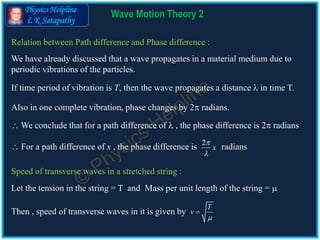
Relation between Path difference and Phase difference :
Speed of transverse waves in a stretched string :
We have already discussed that a wave propagates in a material medium due to
periodic vibrations of the particles.
If time period of vibration is T, then the wave propagates a distance  in time T.
Also in one complete vibration, phase changes by 2 radians.
 We conclude that for a path difference of  , the phase difference is 2 radians
 For a path difference of x , the phase difference is radians
2
x


Let the tension in the string = T and Mass per unit length of the string = 
Then , speed of transverse waves in it is given by
T
v


Physics Helpline
L K Satapathy
Wave Motion Theory 2
Speed of sound in a gas [ Newton’s formula ]
Newton assumed that , propagation of sound in a gas is an isothermal process
.PV const
Also Bulk Modulus
.V dP
B P B
dV
   
 Speed of sound in a gas is
B P
v v
 
  
 For air at NTP
5
1.01 10
280
1.293
o
o
P
v m s


  
Experimental value of speed of sound in air = 332 m/s
 There is error in the formula
[ P = pressure  = density ]
 For an isothermal process , we have
Physics Helpline
L K Satapathy
Wave Motion Theory 2
Laplace correction :
Laplace argued that , propagation of sound in a gas is an adiabatic process
1
. . . 0PV const V dP P V dV  
 
    
 Bulk Modulus
.V dP
B P
dV
  
 Speed of sound
B P
v v

 
  
For air ,  = 1.41  Speed of sound at NTP
1.41 280 332o
o
P
v m s


    [ agrees with experimental result]
1
V dP VdP
P
V dV dV


 
    
Physics Helpline
L K Satapathy
Wave Motion Theory 2
Effect of temperature :
Effect of Pressure :
P PV RT
v v T
V M
  
 
    
Effect of Density :
P RT
v
M
 

 
Effect of Humidity :
1P
v v

 
  
m d m dv v   
[ Speed of sound increases with increase in temperature ]
[ Speed of sound is independent of Pressure at const. temp.]
[ Speed of sound decreases with increase in density ]
[ Speed of sound increases with increase in humidity ]
Physics Helpline
L K Satapathy
Wave Motion Theory 2
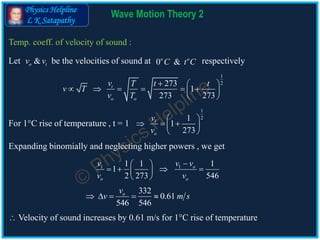
Temp. coeff. of velocity of sound :
1
2273
1
273 273
t
o o
v T t t
v T
v T
  
      
 
332
0.61
546 546
ov
v m s    
For 1C rise of temperature , t = 1
Let be the velocities of sound at respectively&o tv v 0 &o o
C t C
1
2
1 1
1
273o
v
v
 
   
 
11 1 1 1
1
2 273 546
o
o o
v vv
v v
 
    
 
Expanding binomially and neglecting higher powers , we get
 Velocity of sound increases by 0.61 m/s for 1C rise of temperature
Physics Helpline
L K Satapathy
Wave Motion Theory 2
Intensity of wave (I) : I = Power / unit area
S
dx
Consider a wave propagating in the +ve x-direction with speed v .
Eqn. of wave is sin( )y A t kx 
Consider a cylindrical element of length dx and area of cross section S
 Volume of the element
If  be the density , then mass of element dm Sdx
Sdx
Total energy of element  2 2 2 2 2 2 21 1
2 2
2 2
dE dm A Sdx A Sdx f A f         
Power of element [ since ]2 2 2 2 2 2
2 2
dE dx
P S f A Sv f A
dt dt
     
Intensity 2 2 2
2
P
I v f A
S
  
dx
v
dt

Physics Helpline
L K Satapathy
Wave Motion Theory 2
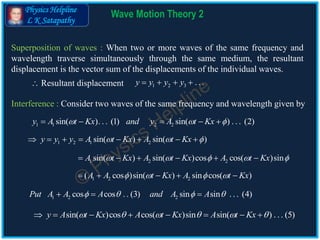
Superposition of waves : When two or more waves of the same frequency and
wavelength traverse simultaneously through the same medium, the resultant
displacement is the vector sum of the displacements of the individual waves.
 Resultant displacement
Interference : Consider two waves of the same frequency and wavelength given by
1 2 3 . . .y y y y   
1 1 2 2sin( ). . . (1) sin( ) . . . (2)y A t Kx and y A t Kx      
1 2 1 2sin( ) sin( )y y y A t Kx A t Kx         
1 2 2sin( ) sin( )cos cos( )sinA t Kx A t Kx A t Kx         
1 2 2( cos )sin( ) sin cos( )A A t Kx A t Kx       
1 2 2cos cos . . (3) sin sin . . . (4)Put A A A and A A     
sin( )cos cos( )sin sin( ) . . . (5)y A t Kx A t Kx A t Kx            
Physics Helpline
L K Satapathy
Wave Motion Theory 2
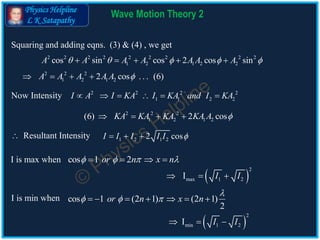
2 2 2 2 2 2 2 2 2
1 2 1 2 2cos sin cos 2 cos sinA A A A A A A        
Squaring and adding eqns. (3) & (4) , we get
2 2 2
1 2 1 22 cos . . . (6)A A A A A    
Now Intensity 2 2 2 2
1 1 2 2I A I KA I KA and I KA     
2 2 2
1 2 1 2(6) 2 cosKA KA KA KA A    
1 2 1 22 cosI I I I I   
I is max when cos 1 2or n x n      
I is min when cos 1 (2 1) (2 1)
2
or n x n

        
 Resultant Intensity
 
2
min 1 2I I I  
 
2
max 1 2I I I  
Physics Helpline
L K Satapathy
For More details:
www.physics-helpline.com
Subscribe our channel:
youtube.com/physics-helpline
Follow us on Facebook and Twitter:
facebook.com/physics-helpline
twitter.com/physics-helpline

Wave Motion theory-2

  • 1.
    Physics Helpline L KSatapathy Wave Motion Theory 2 Path difference and Phase difference Speed of sound in a gas Temperature coeff. of velocity of sound Intensity of a wave Superposition of waves / Interference
  • 2.
    Physics Helpline L KSatapathy Wave Motion Theory 2 Relation between Path difference and Phase difference : Speed of transverse waves in a stretched string : We have already discussed that a wave propagates in a material medium due to periodic vibrations of the particles. If time period of vibration is T, then the wave propagates a distance  in time T. Also in one complete vibration, phase changes by 2 radians.  We conclude that for a path difference of  , the phase difference is 2 radians  For a path difference of x , the phase difference is radians 2 x   Let the tension in the string = T and Mass per unit length of the string =  Then , speed of transverse waves in it is given by T v  
  • 3.
    Physics Helpline L KSatapathy Wave Motion Theory 2 Speed of sound in a gas [ Newton’s formula ] Newton assumed that , propagation of sound in a gas is an isothermal process .PV const Also Bulk Modulus .V dP B P B dV      Speed of sound in a gas is B P v v       For air at NTP 5 1.01 10 280 1.293 o o P v m s      Experimental value of speed of sound in air = 332 m/s  There is error in the formula [ P = pressure  = density ]  For an isothermal process , we have
  • 4.
    Physics Helpline L KSatapathy Wave Motion Theory 2 Laplace correction : Laplace argued that , propagation of sound in a gas is an adiabatic process 1 . . . 0PV const V dP P V dV           Bulk Modulus .V dP B P dV     Speed of sound B P v v       For air ,  = 1.41  Speed of sound at NTP 1.41 280 332o o P v m s       [ agrees with experimental result] 1 V dP VdP P V dV dV         
  • 5.
    Physics Helpline L KSatapathy Wave Motion Theory 2 Effect of temperature : Effect of Pressure : P PV RT v v T V M           Effect of Density : P RT v M      Effect of Humidity : 1P v v       m d m dv v    [ Speed of sound increases with increase in temperature ] [ Speed of sound is independent of Pressure at const. temp.] [ Speed of sound decreases with increase in density ] [ Speed of sound increases with increase in humidity ]
  • 6.
    Physics Helpline L KSatapathy Wave Motion Theory 2 Temp. coeff. of velocity of sound : 1 2273 1 273 273 t o o v T t t v T v T             332 0.61 546 546 ov v m s     For 1C rise of temperature , t = 1 Let be the velocities of sound at respectively&o tv v 0 &o o C t C 1 2 1 1 1 273o v v         11 1 1 1 1 2 273 546 o o o v vv v v          Expanding binomially and neglecting higher powers , we get  Velocity of sound increases by 0.61 m/s for 1C rise of temperature
  • 7.
    Physics Helpline L KSatapathy Wave Motion Theory 2 Intensity of wave (I) : I = Power / unit area S dx Consider a wave propagating in the +ve x-direction with speed v . Eqn. of wave is sin( )y A t kx  Consider a cylindrical element of length dx and area of cross section S  Volume of the element If  be the density , then mass of element dm Sdx Sdx Total energy of element  2 2 2 2 2 2 21 1 2 2 2 2 dE dm A Sdx A Sdx f A f          Power of element [ since ]2 2 2 2 2 2 2 2 dE dx P S f A Sv f A dt dt       Intensity 2 2 2 2 P I v f A S    dx v dt 
  • 8.
    Physics Helpline L KSatapathy Wave Motion Theory 2 Superposition of waves : When two or more waves of the same frequency and wavelength traverse simultaneously through the same medium, the resultant displacement is the vector sum of the displacements of the individual waves.  Resultant displacement Interference : Consider two waves of the same frequency and wavelength given by 1 2 3 . . .y y y y    1 1 2 2sin( ). . . (1) sin( ) . . . (2)y A t Kx and y A t Kx       1 2 1 2sin( ) sin( )y y y A t Kx A t Kx          1 2 2sin( ) sin( )cos cos( )sinA t Kx A t Kx A t Kx          1 2 2( cos )sin( ) sin cos( )A A t Kx A t Kx        1 2 2cos cos . . (3) sin sin . . . (4)Put A A A and A A      sin( )cos cos( )sin sin( ) . . . (5)y A t Kx A t Kx A t Kx            
  • 9.
    Physics Helpline L KSatapathy Wave Motion Theory 2 2 2 2 2 2 2 2 2 2 1 2 1 2 2cos sin cos 2 cos sinA A A A A A A         Squaring and adding eqns. (3) & (4) , we get 2 2 2 1 2 1 22 cos . . . (6)A A A A A     Now Intensity 2 2 2 2 1 1 2 2I A I KA I KA and I KA      2 2 2 1 2 1 2(6) 2 cosKA KA KA KA A     1 2 1 22 cosI I I I I    I is max when cos 1 2or n x n       I is min when cos 1 (2 1) (2 1) 2 or n x n            Resultant Intensity   2 min 1 2I I I     2 max 1 2I I I  
  • 10.
    Physics Helpline L KSatapathy For More details: www.physics-helpline.com Subscribe our channel: youtube.com/physics-helpline Follow us on Facebook and Twitter: facebook.com/physics-helpline twitter.com/physics-helpline