Physics Helpline
L K Satapathy
Electrostatics-5
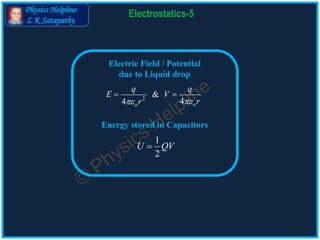
Electric Field / Potential
due to Liquid drop
Energy stored in Capacitors
1
2
U QV
2
&
44 oo
q q
E V
rr 
 
Physics Helpline
L K Satapathy
Cells in Parallel
Electrostatics-5
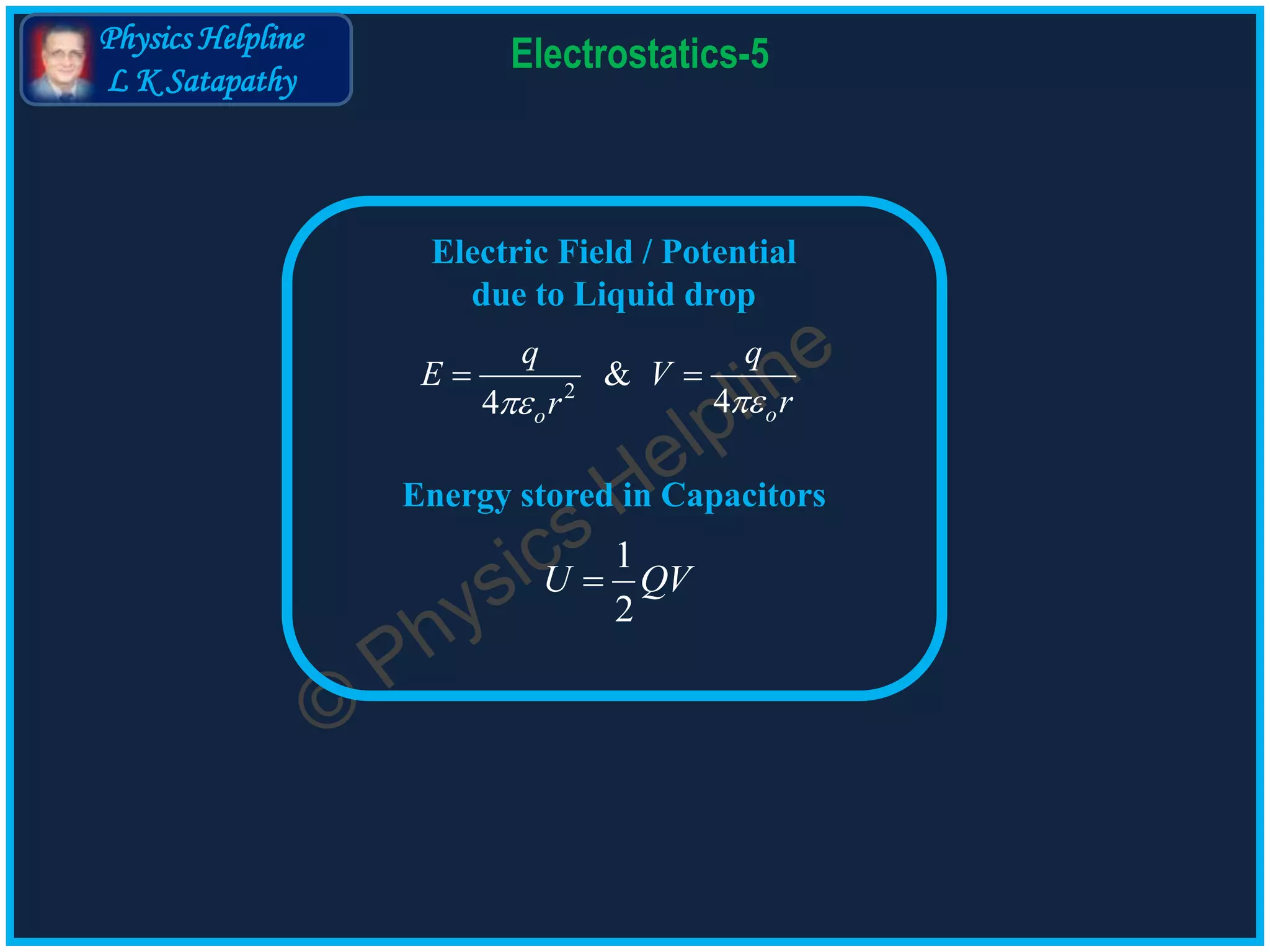
Q1. A capacitor of capacitance 12F is charged to 200V. After disconnecting from
source , it is connected to another identical uncharged capacitor in parallel.
Determine the electrostatic potential energy lost by the system in the process.
Answer :
41 1
(24 10 )(200) 0.24
2 2
U QV J
   
4
24 10Q CV C
  
0.24iU J
For the 1st capacitor , C = 12 F and V = 200 volts
 Charge on it is given by
 Energy stored is given by
For the 2nd capacitor , C = 12 F (not charged)  Energy stored = zero
 Initial Energy stored in the system is
Physics Helpline
L K Satapathy
Cells in Parallel
Electrostatics-5
6
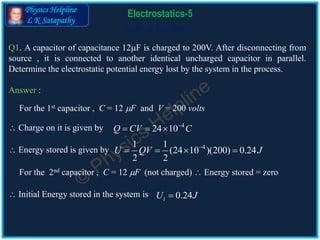
2 24 10C C F
   
4
24 10Q Q C
   
41 1
24 10 100 0.12
2 2
fU Q V J
      
 Loss in PE 0.24 0.12 0.12 [ ]i fU U U J Ans     
4
6
24 10
100
24 10
Q
V V
C


 
   
 
When the two are in parallel , the net capacitance is
Conservation of charge gives
 PD across the system is
 Final Energy stored in the system is given by
Understanding the method :
(i) Initial charge = final charge (Q = Q)
(ii) Using Q = C V , Capacitance (C=2C)  Pot. Diff. (V = ½ V)
(iii) U = ½ QV  U = ½ U  U = ½ U
Physics Helpline
L K Satapathy
Cells in Parallel
Electrostatics-5
Q2. Two concentric conducting spherical shells A
and B of radii R and 2R , are given charges Q and 2Q
respectively as shown in the figure. Determine at
which of the surfaces , electric potential is greater .
Concepts :
Centre at O , radius = R & charge on it = q
A
B
Q
2Q
R
2R
Point P is at a distance (x) from O  OP = x O
q
R
P
(i) When P is outside ( x  R ) : 2
&
44 oo
q q
E V
xx 
 
(ii) When P is on surface ( x = R ) : 2
&
44 oo
q q
E V
RR 
 
(iii) When P is inside ( x  R ) : 0 & ( .)
4 o
q
E V const
R
  
Consider the spherical shell shown in the fig.
[Same as on surface]
Physics Helpline
L K Satapathy
Cells in Parallel
Electrostatics-5
Answer : Potential at A due to Q on A (on surface)
Here r = R & q = Q
1 2
. . . (1)
4
A
o
Q
V
R
 
   
 
1 3
. . . (2)
4 2
B
o
Q
V
R
 
   
 
1
4 o
Q
R
 
  
 
Potential at A due to 2Q on B (inside )
Same as potential on surface B
1 2 1
4 2 4o o
Q Q
R R 
   
    
   
Potential at B due to Q on A (outside)
Here r = 2R & q = Q
1
4 2o
Q
R
 
  
 
Potential at B due to 2Q on B (on surface)
Here r = 2R & q = 2Q
1 2 1
4 2 4o o
Q Q
R R 
   
    
   
 Electric Potential is greater at surface (A) [ Ans ]
Physics Helpline
L K Satapathy
Cells in Parallel
Electrostatics-5
Q3. A 5F capacitor is charged to 100V. After disconnecting from source, it is
connected in parallel to another uncharged capacitor of capacitance C. The PD
across the combination is found to be 20V. Determine the value of C.
Answer :
5 100 500 . . . (1)F V C   
(5 ) 20 20(5 ) . . . (2)C F V C C     
(1) & (2) 20(5 ) 500 5 25C C C C      
20 [ ]C F Ans 
For the 1st capacitor , capacitance = 5 F , PD = 100 V
 Charge on it
Capacitance of the 2nd capacitor = C ( uncharged )
For parallel combination , capacitance = (5 + C) F , PD = 20V
 Charge on it
Physics Helpline
L K Satapathy
Cells in Parallel
Electrostatics-5
Q4. The capacitance of a liquid drop is C. Now 27 such drops coalesce to form a
large drop. Determine the capacitance of the large drop.
Answer :
Volume of a small drop of radius r
4 o
q
C r
V
 
34
3
r
Volume of 27 small drops 3 34
27 36
3
r r   
If the radius of the large drop = R , then its volume 34
3
R
3 3 3 34
36 27 3
3
R r R r R r      
4 4 (3 ) 3 [ ]o oC R r C Ans    
Potential of a drop of radius r having charge q :
4 o
q
V
r

 Capacitance of the drop :
Volume of 27 small drops
= Volume of large drop
Physics Helpline
L K Satapathy
Cells in Parallel
Electrostatics-5
Q5. A capacitor has a capacitance of 1.05F. What should be the capacitance of the
capacitor which has to be connected to it in series such that the net capacitance of
the combination is 1F ?
Answer :
For C1 and C2 in series , equivalent capacitance Cs is given by
1 2 2 1
1 1 1 1 1 1 1 1
1 1.05s sC C C C C C
      
Given : C1 = 1.05F & Cs = 1 F
2
1 1.05 1 0.05 1
1.05 1.05 21C

   
2 21 [ ]C F Ans 
Physics Helpline
L K Satapathy
For More details:
www.physics-helpline.com
Subscribe our channel:
youtube.com/physics-helpline
Follow us on Facebook and Twitter:
facebook.com/physics-helpline
twitter.com/physics-helpline

CBSE Electrostatics QA-5/ Electric Potential and Capacitance

  • 1.
    Physics Helpline L KSatapathy Electrostatics-5 Electric Field / Potential due to Liquid drop Energy stored in Capacitors 1 2 U QV 2 & 44 oo q q E V rr   
  • 2.
    Physics Helpline L KSatapathy Cells in Parallel Electrostatics-5 Q1. A capacitor of capacitance 12F is charged to 200V. After disconnecting from source , it is connected to another identical uncharged capacitor in parallel. Determine the electrostatic potential energy lost by the system in the process. Answer : 41 1 (24 10 )(200) 0.24 2 2 U QV J     4 24 10Q CV C    0.24iU J For the 1st capacitor , C = 12 F and V = 200 volts  Charge on it is given by  Energy stored is given by For the 2nd capacitor , C = 12 F (not charged)  Energy stored = zero  Initial Energy stored in the system is
  • 3.
    Physics Helpline L KSatapathy Cells in Parallel Electrostatics-5 6 2 24 10C C F     4 24 10Q Q C     41 1 24 10 100 0.12 2 2 fU Q V J         Loss in PE 0.24 0.12 0.12 [ ]i fU U U J Ans      4 6 24 10 100 24 10 Q V V C           When the two are in parallel , the net capacitance is Conservation of charge gives  PD across the system is  Final Energy stored in the system is given by Understanding the method : (i) Initial charge = final charge (Q = Q) (ii) Using Q = C V , Capacitance (C=2C)  Pot. Diff. (V = ½ V) (iii) U = ½ QV  U = ½ U  U = ½ U
  • 4.
    Physics Helpline L KSatapathy Cells in Parallel Electrostatics-5 Q2. Two concentric conducting spherical shells A and B of radii R and 2R , are given charges Q and 2Q respectively as shown in the figure. Determine at which of the surfaces , electric potential is greater . Concepts : Centre at O , radius = R & charge on it = q A B Q 2Q R 2R Point P is at a distance (x) from O  OP = x O q R P (i) When P is outside ( x  R ) : 2 & 44 oo q q E V xx    (ii) When P is on surface ( x = R ) : 2 & 44 oo q q E V RR    (iii) When P is inside ( x  R ) : 0 & ( .) 4 o q E V const R    Consider the spherical shell shown in the fig. [Same as on surface]
  • 5.
    Physics Helpline L KSatapathy Cells in Parallel Electrostatics-5 Answer : Potential at A due to Q on A (on surface) Here r = R & q = Q 1 2 . . . (1) 4 A o Q V R         1 3 . . . (2) 4 2 B o Q V R         1 4 o Q R        Potential at A due to 2Q on B (inside ) Same as potential on surface B 1 2 1 4 2 4o o Q Q R R               Potential at B due to Q on A (outside) Here r = 2R & q = Q 1 4 2o Q R        Potential at B due to 2Q on B (on surface) Here r = 2R & q = 2Q 1 2 1 4 2 4o o Q Q R R                Electric Potential is greater at surface (A) [ Ans ]
  • 6.
    Physics Helpline L KSatapathy Cells in Parallel Electrostatics-5 Q3. A 5F capacitor is charged to 100V. After disconnecting from source, it is connected in parallel to another uncharged capacitor of capacitance C. The PD across the combination is found to be 20V. Determine the value of C. Answer : 5 100 500 . . . (1)F V C    (5 ) 20 20(5 ) . . . (2)C F V C C      (1) & (2) 20(5 ) 500 5 25C C C C       20 [ ]C F Ans  For the 1st capacitor , capacitance = 5 F , PD = 100 V  Charge on it Capacitance of the 2nd capacitor = C ( uncharged ) For parallel combination , capacitance = (5 + C) F , PD = 20V  Charge on it
  • 7.
    Physics Helpline L KSatapathy Cells in Parallel Electrostatics-5 Q4. The capacitance of a liquid drop is C. Now 27 such drops coalesce to form a large drop. Determine the capacitance of the large drop. Answer : Volume of a small drop of radius r 4 o q C r V   34 3 r Volume of 27 small drops 3 34 27 36 3 r r    If the radius of the large drop = R , then its volume 34 3 R 3 3 3 34 36 27 3 3 R r R r R r       4 4 (3 ) 3 [ ]o oC R r C Ans     Potential of a drop of radius r having charge q : 4 o q V r   Capacitance of the drop : Volume of 27 small drops = Volume of large drop
  • 8.
    Physics Helpline L KSatapathy Cells in Parallel Electrostatics-5 Q5. A capacitor has a capacitance of 1.05F. What should be the capacitance of the capacitor which has to be connected to it in series such that the net capacitance of the combination is 1F ? Answer : For C1 and C2 in series , equivalent capacitance Cs is given by 1 2 2 1 1 1 1 1 1 1 1 1 1 1.05s sC C C C C C        Given : C1 = 1.05F & Cs = 1 F 2 1 1.05 1 0.05 1 1.05 1.05 21C      2 21 [ ]C F Ans 
  • 9.
    Physics Helpline L KSatapathy For More details: www.physics-helpline.com Subscribe our channel: youtube.com/physics-helpline Follow us on Facebook and Twitter: facebook.com/physics-helpline twitter.com/physics-helpline