 Idea was introduced in 1950 and patented to
Tracer Lab.
 Radioisotope electric power system
developed by Paul Brown.
 He organized an approach to harness energy
from the magnetic field of alpha and beta
particles using Radium-226.
 Low efficiency due to loss of electrons.
 Need for compact reliable light weight and self-
contained power supplies.
 Chemical batteries require frequent
replacements and are bulky.
 Nuclear reactors offer economical and technical
problems.
 Fuel and Solar cells are expensive and requires
sunlight respectively.
 Nuclear batteries have lifespan up to decades
and nearly 200 times more efficient.
 Do not rely on nuclear reaction , so no
radioactive wastes.
 Uses emissions from radioactive isotope to
generate electricity.
 Can be used in inaccessible and extreme
conditions.
Radiations
•Alpha - These are fast moving helium
atoms. They have high energy, typically in
the MeV range. They also are magnetic in
nature
•Beta - These are fast moving electrons.
They typically have energies in the range of
a few hundred keV to several MeV.
•Gamma - These are photons, just like light,
except of much higher energy.
Radioisotopes
Radioisotopes are artificially produced,
unstable atoms of a chemical element,
which have a different number of neutrons
in the nucleus, but the same number of
protons and the same chemical properties.
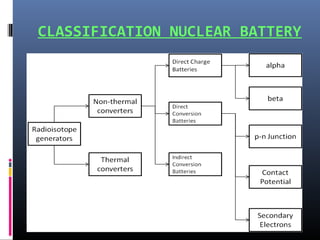
CLASSIFICATION NUCLEAR BATTERY
 Alternative energy technology.
 Provides extended battery life and power
density.
 Uses energy from beta particles.
 Beta particles from radioactive gas captured in
Si wafer coated with diode material.
 Absorbed radiation creates electron-hole pair.
 Results in the generation of electric current.
 Before the radioactive source is introduced , no
current flows as the electrical forces are in
equilibrium.
 As a beta emitter is introduced , electrons are
knocked out by its energy.
 Generates electron-hole pairs in the junction.
 When beta particle imparts more than ionization
potential the electron rises to a higher level.
Representation of basic beta
voltaic conversion
 Fermi voltage established between the electrodes.
 Potential difference drives electrons from electrode
A through the load where they give up the energy.
 Electron is then driven into electrode B to
recombine with a junction ion.
 Betavoltaics does not have solar-cell efficiency.
 Electrons shoot out in all directions; hence lost.
 Porous Si diodes with pits provide a 3-D surface
thereby increasing the efficiency.
 Energy from radioactive decay products.
 Circuit impedance has coil wound on a core
composed of radioactive elements.
 Decay by alpha emission; hence greater flux of
radioactive decay.
Schematic Diagram of an LC
resonant circuit
3 – capacitor
5 – inductor
9 – transformer T primary winding
11 – resistance
7 – core with radioactive elements
 Here energy is imparted to the alpha particles
during the decay of elements in the core.
 This energy is introduced to circuit when alpha
particles are absorbed by the inductor.
 Some of energy dissipated in ohmic resistance.
 This excess energy is delivered to the load
connected across transformerT secondary
winding.
1 – Capacitor
2 – Inductor
3 – Core with radioactive
elements
4 – Transformer T primary
winding
6 _ Secondary winding
7 _ Load
Load
EXTERIOR STRUCTURES
 In the center of cylinder have radioisotope
source.
 The outside is a thermionic converter
 Reflectors
 Metal tube casing
The major criterions considered in the selection of fuels are:
Avoidance of gamma in the decay chain
Half life( Should be more)
Cost should be less.
 Any radioisotope in the form of a solid that gives off alpha or
beta particles can be utilized in the nuclear battery.
 The most powerful source of energy known is radium-226.
 However Strontium-90 may also be used in this Battery.
 Space applications:
 Unaffected by long period of darkness and
radiation belts likeVan-Allen belt.
 Compact and lighter in weight.
 Can avoid heating equipments required for
storage batteries.
•High power for long time
independent of atmospheric
conditions.
.NASA is trying to harness this
technology in space applications.
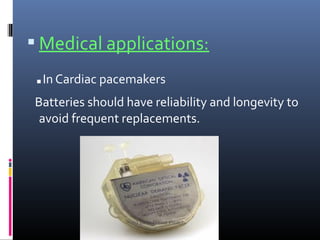
 Medical applications:
.In Cardiac pacemakers
Batteries should have reliability and longevity to
avoid frequent replacements.
•Nuclear powered laptop battery Xcell-N has 7000-
8000 times more life.
No need for charging, battery replacing.
Mobile devices:
Automobiles:
In initial stages.
No running short of fuel.
Possibility of replacing ionic fuels with its
advantages.
• Under-water sea probes and sea sensors:
In sensors working for long time.
At inaccessible and extreme conditions.
Use in coal mines and polar sensor
applications too.
• For powering MEMS devices : in optical
switches and smart dust sensors.
 Life span- minimum of 10 years.
 Reliable electricity.
 Amount of energy highest.
 Lighter with high energy density.
 Efficient, less waste generation.
 Reduces green house and associated effects.
 Fuel used is the nuclear waste from nuclear
fission.
 High initial cost of production as its in the
experimental stage.
 Energy conversion methodologies are not
much advanced.
 Regional and country-specific laws regarding
use and disposal of radioactive fuels.
 To gain social acceptance.
 Nuclear batteries will replace most of all the
chemical batteries.
 Long life span make it suitable space
applications.
 Need for compact, reliable, light weight and long
life power supplies.
 Can be used in easily inaccessible and extreme
conditions and reduce the rate of replacements.
 Small compact devices of future require small batteries.
 Nuclear batteries increase functionality, reliability and
longevity.
 Until final disposal all Radiation Protection Standards must
be met.
 Batteries of the near future.
Nuclearbattery
Nuclearbattery

Nuclearbattery

  • 2.
     Idea wasintroduced in 1950 and patented to Tracer Lab.  Radioisotope electric power system developed by Paul Brown.  He organized an approach to harness energy from the magnetic field of alpha and beta particles using Radium-226.  Low efficiency due to loss of electrons.
  • 4.
     Need forcompact reliable light weight and self- contained power supplies.  Chemical batteries require frequent replacements and are bulky.  Nuclear reactors offer economical and technical problems.  Fuel and Solar cells are expensive and requires sunlight respectively.
  • 5.
     Nuclear batterieshave lifespan up to decades and nearly 200 times more efficient.  Do not rely on nuclear reaction , so no radioactive wastes.  Uses emissions from radioactive isotope to generate electricity.  Can be used in inaccessible and extreme conditions.
  • 6.
    Radiations •Alpha - Theseare fast moving helium atoms. They have high energy, typically in the MeV range. They also are magnetic in nature •Beta - These are fast moving electrons. They typically have energies in the range of a few hundred keV to several MeV. •Gamma - These are photons, just like light, except of much higher energy. Radioisotopes Radioisotopes are artificially produced, unstable atoms of a chemical element, which have a different number of neutrons in the nucleus, but the same number of protons and the same chemical properties.
  • 7.
  • 9.
     Alternative energytechnology.  Provides extended battery life and power density.  Uses energy from beta particles.  Beta particles from radioactive gas captured in Si wafer coated with diode material.  Absorbed radiation creates electron-hole pair.  Results in the generation of electric current.
  • 10.
     Before theradioactive source is introduced , no current flows as the electrical forces are in equilibrium.  As a beta emitter is introduced , electrons are knocked out by its energy.  Generates electron-hole pairs in the junction.  When beta particle imparts more than ionization potential the electron rises to a higher level.
  • 11.
    Representation of basicbeta voltaic conversion
  • 12.
     Fermi voltageestablished between the electrodes.  Potential difference drives electrons from electrode A through the load where they give up the energy.  Electron is then driven into electrode B to recombine with a junction ion.  Betavoltaics does not have solar-cell efficiency.  Electrons shoot out in all directions; hence lost.  Porous Si diodes with pits provide a 3-D surface thereby increasing the efficiency.
  • 15.
     Energy fromradioactive decay products.  Circuit impedance has coil wound on a core composed of radioactive elements.  Decay by alpha emission; hence greater flux of radioactive decay.
  • 16.
    Schematic Diagram ofan LC resonant circuit 3 – capacitor 5 – inductor 9 – transformer T primary winding 11 – resistance 7 – core with radioactive elements
  • 17.
     Here energyis imparted to the alpha particles during the decay of elements in the core.  This energy is introduced to circuit when alpha particles are absorbed by the inductor.  Some of energy dissipated in ohmic resistance.  This excess energy is delivered to the load connected across transformerT secondary winding.
  • 19.
    1 – Capacitor 2– Inductor 3 – Core with radioactive elements 4 – Transformer T primary winding 6 _ Secondary winding 7 _ Load Load
  • 20.
    EXTERIOR STRUCTURES  Inthe center of cylinder have radioisotope source.  The outside is a thermionic converter  Reflectors  Metal tube casing
  • 21.
    The major criterionsconsidered in the selection of fuels are: Avoidance of gamma in the decay chain Half life( Should be more) Cost should be less.  Any radioisotope in the form of a solid that gives off alpha or beta particles can be utilized in the nuclear battery.  The most powerful source of energy known is radium-226.  However Strontium-90 may also be used in this Battery.
  • 23.
     Space applications: Unaffected by long period of darkness and radiation belts likeVan-Allen belt.  Compact and lighter in weight.  Can avoid heating equipments required for storage batteries.
  • 24.
    •High power forlong time independent of atmospheric conditions. .NASA is trying to harness this technology in space applications.
  • 25.
     Medical applications: .InCardiac pacemakers Batteries should have reliability and longevity to avoid frequent replacements.
  • 26.
    •Nuclear powered laptopbattery Xcell-N has 7000- 8000 times more life. No need for charging, battery replacing. Mobile devices:
  • 27.
    Automobiles: In initial stages. Norunning short of fuel. Possibility of replacing ionic fuels with its advantages.
  • 28.
    • Under-water seaprobes and sea sensors: In sensors working for long time. At inaccessible and extreme conditions. Use in coal mines and polar sensor applications too. • For powering MEMS devices : in optical switches and smart dust sensors.
  • 29.
     Life span-minimum of 10 years.  Reliable electricity.  Amount of energy highest.  Lighter with high energy density.  Efficient, less waste generation.  Reduces green house and associated effects.  Fuel used is the nuclear waste from nuclear fission.
  • 30.
     High initialcost of production as its in the experimental stage.  Energy conversion methodologies are not much advanced.  Regional and country-specific laws regarding use and disposal of radioactive fuels.  To gain social acceptance.
  • 31.
     Nuclear batterieswill replace most of all the chemical batteries.  Long life span make it suitable space applications.  Need for compact, reliable, light weight and long life power supplies.  Can be used in easily inaccessible and extreme conditions and reduce the rate of replacements.
  • 32.
     Small compactdevices of future require small batteries.  Nuclear batteries increase functionality, reliability and longevity.  Until final disposal all Radiation Protection Standards must be met.  Batteries of the near future.