NUCLEAR BATTERY
PAWAN KUMAR
EC-604
1505231030
GUIDE:
ER. POOJA GUPTA
CONTENT
▶ Introduction
▶ Historical Development
▶ Conversion techniques
▶ Types of nuclear batteries
▶ Radioisotope used
▶ Fuel Consideration
▶ Advantages
▶ Disadvantages
▶ Applications
▶ Conclusion
Introduction
▶ There is a great need of small, compact, light weighted and reliable
power supplies.
▶ Nuclear Battery: uses energy from the decay of radio isotopes.
▶ Unlike nuclear reactor there is no radioactive waste produced.
▶ It is used as power sources for equipment that must operate
unattended for long period of time.
Historical Development
▶ Nuclear battery technology began in 1913, when Henry
Moseley first demonstrated the beta cell.
▶ A radio isotope electric power system was developed by inventor
Paul Brown.
▶ The field received considerable in-depth research attention for
applications requiring long-life power sources for space needs during
the 1950s and 1960s.
▶ In 1954 RCA researched a small atomic battery for small radio
receivers.
Conversion techniques
▶ Thermal conversion:
The thermal converters (whose output power is a function of a
temperature differential) include thermoelectric and thermionic
generators.
▶ Non-thermal conversion:
The non-thermal converters (whose output power is not a function of
a temperature difference) extract a fraction of the incident energy as
it is being degraded into heat rather than using thermal energy to run
electrons in a cycle.
TYPES OF NUCLEAR BATTERIES
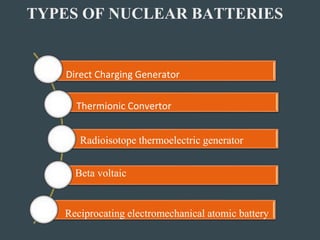
1. Direct Charging Generator
Reciprocating electromechanical atomic battery
Beta voltaic
● Radioisotope thermoelectric generator
1. Thermionic Convertor
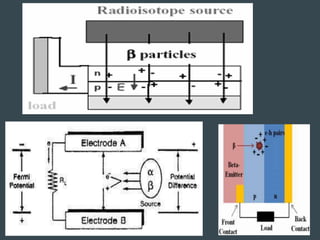
BETAVOLTAIC
▶ Use a non-thermal conversion process
▶. These are generators of electric current, using energy
from a radioactive source emitting beta particles electrons
▶ Converts the electron-hole pairs produced by the ionization trail of
beta particles traversing a p-n junction semiconductor
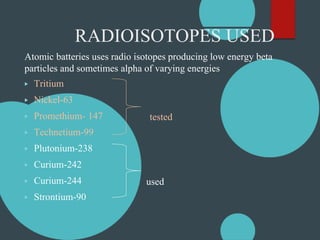
RADIOISOTOPES USED
Atomic batteries uses radio isotopes producing low energy beta
particles and sometimes alpha of varying energies
▶ Tritium
▶ Nickel-63
▶ Promethium- 147
▶ Technetium-99
▶ Plutonium-238
▶ Curium-242
▶ Curium-244
▶ Strontium-90
tested
used
Advantages…
▶ Reliable
▶ Lighter with high energy density
▶ Life span : minimum of decades
▶ Efficient use of end-product obtained post nuclear fission
and nuclear fusion process as fuel in nuclear batteries
▶ Energy obtained is high
▶ Reduces green house effect and related effects.
Disadvantages…
▶ High initial cost of production
▶ Energy conversion methodologies not much advanced
▶ To gain social acceptance
▶ Regional and country specific laws regarding the use and
disposal of radioactive materials
Applications..
▶ Space
▶ Automobiles
▶ Medical
▶ Underwater sea probes or sea sensors
▶ Military
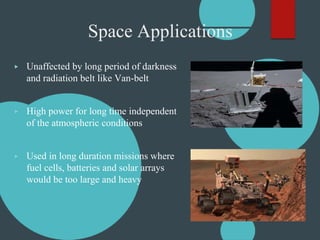
Space Applications
▶ Unaffected by long period of darkness
and radiation belt like Van-belt
▶ High power for long time independent
of the atmospheric conditions
▶ Used in long duration missions where
fuel cells, batteries and solar arrays
would be too large and heavy
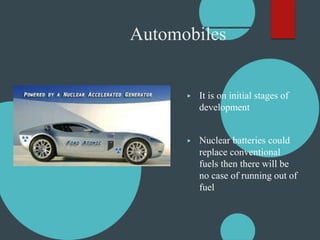
Automobiles
▶ It is on initial stages of
development
▶ Nuclear batteries could
replace conventional
fuels then there will be
no case of running out of
fuel
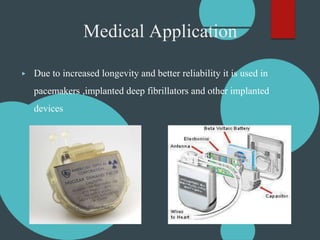
Medical Application
▶ Due to increased longevity and better reliability it is used in
pacemakers ,implanted deep fibrillators and other implanted
devices
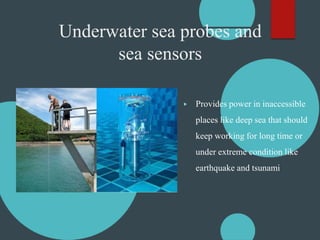
Underwater sea probes and
sea sensors
▶ Provides power in inaccessible
places like deep sea that should
keep working for long time or
under extreme condition like
earthquake and tsunami
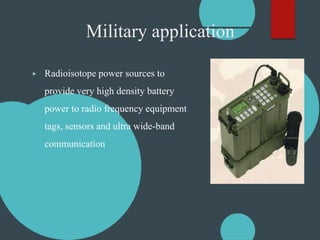
Military application
▶ Radioisotope power sources to
provide very high density battery
power to radio frequency equipment
tags, sensors and ultra wide-band
communication
Conclusion
▶ The current research of nuclear batteries shows
promise in future applications
▶ Implementation of this new technology, feasibility of
the device will be available for wide range of
application
▶ Nuclear cells are going to be the next best thing
ever invented in human history
THANK
YOU

Nuclear battery

  • 1.
  • 2.
    CONTENT ▶ Introduction ▶ HistoricalDevelopment ▶ Conversion techniques ▶ Types of nuclear batteries ▶ Radioisotope used ▶ Fuel Consideration ▶ Advantages ▶ Disadvantages ▶ Applications ▶ Conclusion
  • 3.
    Introduction ▶ There isa great need of small, compact, light weighted and reliable power supplies. ▶ Nuclear Battery: uses energy from the decay of radio isotopes. ▶ Unlike nuclear reactor there is no radioactive waste produced. ▶ It is used as power sources for equipment that must operate unattended for long period of time.
  • 4.
    Historical Development ▶ Nuclearbattery technology began in 1913, when Henry Moseley first demonstrated the beta cell. ▶ A radio isotope electric power system was developed by inventor Paul Brown. ▶ The field received considerable in-depth research attention for applications requiring long-life power sources for space needs during the 1950s and 1960s. ▶ In 1954 RCA researched a small atomic battery for small radio receivers.
  • 5.
    Conversion techniques ▶ Thermalconversion: The thermal converters (whose output power is a function of a temperature differential) include thermoelectric and thermionic generators. ▶ Non-thermal conversion: The non-thermal converters (whose output power is not a function of a temperature difference) extract a fraction of the incident energy as it is being degraded into heat rather than using thermal energy to run electrons in a cycle.
  • 6.
    TYPES OF NUCLEARBATTERIES 1. Direct Charging Generator Reciprocating electromechanical atomic battery Beta voltaic ● Radioisotope thermoelectric generator 1. Thermionic Convertor
  • 7.
    BETAVOLTAIC ▶ Use anon-thermal conversion process ▶. These are generators of electric current, using energy from a radioactive source emitting beta particles electrons ▶ Converts the electron-hole pairs produced by the ionization trail of beta particles traversing a p-n junction semiconductor
  • 9.
    RADIOISOTOPES USED Atomic batteriesuses radio isotopes producing low energy beta particles and sometimes alpha of varying energies ▶ Tritium ▶ Nickel-63 ▶ Promethium- 147 ▶ Technetium-99 ▶ Plutonium-238 ▶ Curium-242 ▶ Curium-244 ▶ Strontium-90 tested used
  • 10.
    Advantages… ▶ Reliable ▶ Lighterwith high energy density ▶ Life span : minimum of decades ▶ Efficient use of end-product obtained post nuclear fission and nuclear fusion process as fuel in nuclear batteries ▶ Energy obtained is high ▶ Reduces green house effect and related effects.
  • 11.
    Disadvantages… ▶ High initialcost of production ▶ Energy conversion methodologies not much advanced ▶ To gain social acceptance ▶ Regional and country specific laws regarding the use and disposal of radioactive materials
  • 12.
    Applications.. ▶ Space ▶ Automobiles ▶Medical ▶ Underwater sea probes or sea sensors ▶ Military
  • 13.
    Space Applications ▶ Unaffectedby long period of darkness and radiation belt like Van-belt ▶ High power for long time independent of the atmospheric conditions ▶ Used in long duration missions where fuel cells, batteries and solar arrays would be too large and heavy
  • 14.
    Automobiles ▶ It ison initial stages of development ▶ Nuclear batteries could replace conventional fuels then there will be no case of running out of fuel
  • 15.
    Medical Application ▶ Dueto increased longevity and better reliability it is used in pacemakers ,implanted deep fibrillators and other implanted devices
  • 16.
    Underwater sea probesand sea sensors ▶ Provides power in inaccessible places like deep sea that should keep working for long time or under extreme condition like earthquake and tsunami
  • 17.
    Military application ▶ Radioisotopepower sources to provide very high density battery power to radio frequency equipment tags, sensors and ultra wide-band communication
  • 18.
    Conclusion ▶ The currentresearch of nuclear batteries shows promise in future applications ▶ Implementation of this new technology, feasibility of the device will be available for wide range of application ▶ Nuclear cells are going to be the next best thing ever invented in human history
  • 19.