NSAIDs
in clinical orthopaedic practice

Vinod Naneria
Girish Yeotikar
Arjun Wadhwani
Choithram Hospital & Research
Centre, Indore, India
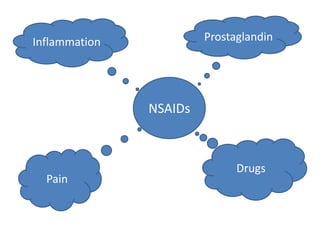
Prostaglandin

Inflammation

NSAIDs

Pain

Drugs
Inflammation
• Protective response as reaction of living tissue
to injury.
• Mediated by
– Amines – Histamine & 5HT,
– Lipids – Prostaglandins
– Small peptides – Bradykinin
– Large peptides – Interleukin 1

Hyper sensitization of free nerve endings – perceived as pain
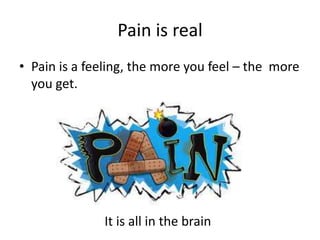
Pain is real
• Pain is a feeling, the more you feel – the more
you get.

It is all in the brain
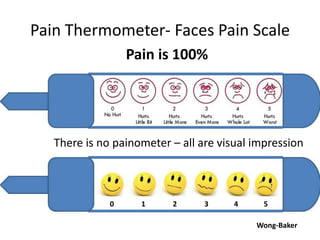
Pain Thermometer- Faces Pain Scale
Pain is 100%

There is no painometer – all are visual impression

0

1

2

3

4

5
Wong-Baker
Definition of Pain
• International Association for the
Study of Pain

Defined as an unpleasant
sensory or emotional
experience associated with
actual or potential tissue
damage.
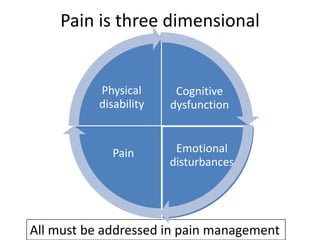
Pain is three dimensional

Physical
disability

Cognitive
dysfunction

Pain

Emotional
disturbances

All must be addressed in pain management
WHO on Pain
• Pain is one of the most underestimated
healthcare problems in the world…
• Adequate pain management is a fundamental
human right.
• Pain is part of the body's defence system.
Pain costs USA- $635 billion/year in medical treatment
and lost productivity.
Prostaglandins
• The word PG - as it was thought to be
secreted by prostrate.
• No preformed stores of Prostaglandins are
available in blood.
• Synthesized locally in presence of stimulus in
almost all tissues of the body.
Prostaglandins
• Lung & Spleen can synthesize all range of
Prostaglandins
• Platelets : Thromboxane A2
• Endothelium of Vessels : PG I2
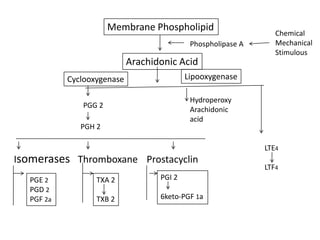
Membrane Phospholipid
Phospholipase A

Arachidonic Acid

Chemical
Mechanical
Stimulous

Lipooxygenase

Cyclooxygenase

Hydroperoxy
Arachidonic
acid

PGG 2
PGH 2

LTE4

Isomerases Thromboxane Prostacyclin
PGE 2
PGD 2
PGF 2a

TXA 2

PGI 2

TXB 2

6keto-PGF 1a

LTF4
COX in two forms
• COX-1, COX-2,
• COX-1 PGs are "housekeeping“ and
constitutively expressed in almost all tissues.
• Responsible for homeostatic functions:
– Integrity of the gastric mucosa,
– Platelet function, and
– Regulating renal blood flow.
COX in two forms
• COX-2 PGs inducible and tightly regulated.
• Under normal conditions, COX-2 expression is
highly restricted.
• COX-2 is dramatically unregulated during
inflammation.
• COX-2 play constitutive role only at
brain, bone & kidney.
NSAIDs
• Most extensively used medications in the
world.
• Fifth most utilized medication in all age
groups.
• The prevalence in aged above 65 is 70%.
• NSAID-related hospital admissions is from 7%
to 11%. (Preventable)
NSAIDs -- Benefit
•
•
•
•
•
•

Analgesia
Anti-pyraxia
Anti-inflammatory
Anti-thrombotic
Closure of Ductus arteriosus in new born
Anticancer – colonic cancer
NSAIDs annually account for 70 million prescriptions
and 30 billion OTC medications sold in the USA alone.
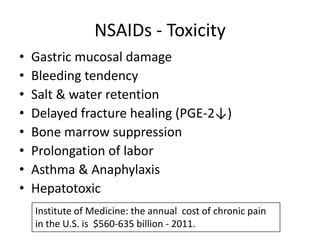
NSAIDs - Toxicity
•
•
•
•
•
•
•
•

Gastric mucosal damage
Bleeding tendency
Salt & water retention
Delayed fracture healing (PGE-2↓)
Bone marrow suppression
Prolongation of labor
Asthma & Anaphylaxis
Hepatotoxic
Institute of Medicine: the annual cost of chronic pain
in the U.S. is $560-635 billion - 2011.
Sitting is a busy OPD

Prescriptions of analgesic is a reflex
rather than a well thought of analytic process.
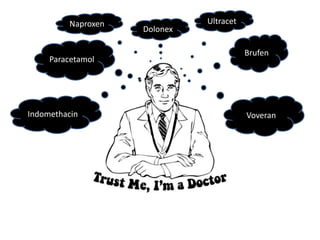
Naproxen

Paracetamol

Indomethacin

Dolonex

Ultracet

Brufen

Voveran
Clinical situation - 1
•
•
•
•
•
•
•

A 60 f was on analgesics for sometime,
Developed acute drop in blood pressure,
Had black color stool,
Had hematemesis,
Admitted with diagnosis of Acute GI bleed,
Peptic perforation?
Chronic anaemia?
Gastrointestinal Effects of NSAIDs
• ↓ production of prostaglandins in the
epithelial cells of gastric mucosa.
• ↓ epithelial mucus,
• ↓ secretion of bicarbonate,
• ↓ mucosal blood flow,

`
Gastrointestinal Effects of NSAIDs
• ↓ epithelial proliferation,
• ↓ mucosal resistance to injury.
• ↑ exposure of GI mucosa to as gastric
acid, pepsin, and bile salts.
• These effects are - systemic absorption of
NSAIDs
• NSAIDs given by any route can damage gastric
mucosa.
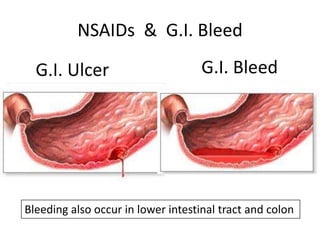
NSAIDs & G.I. Bleed
G.I. Ulcer

G.I. Bleed

Bleeding also occur in lower intestinal tract and colon
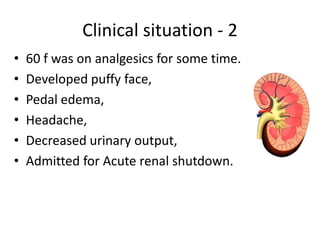
Clinical situation - 2
•
•
•
•
•
•

60 f was on analgesics for some time.
Developed puffy face,
Pedal edema,
Headache,
Decreased urinary output,
Admitted for Acute renal shutdown.
Renal prostaglandins
• Renal PGs are vasodilator & have
little influence on renal blood flow
and GFR in normal conditions.
Renal prostaglandins
• PGs are necessary to compensate for
angiotensin induced renal vasoconstriction in
volume-depleted states.
• NSAIDs block the production of PGs →
unopposed vasoconstriction → acute renal
failure.
Renal prostaglandins
• COX-2 NSAIDs →inhibition of juxtraglomerular PGs → Salt and water retention
• Idiopathic direct toxic - Acute interstitial
necrosis.
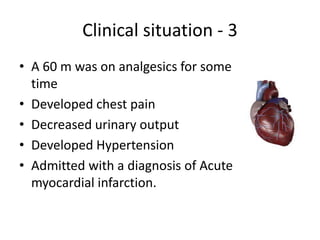
Clinical situation - 3
• A 60 m was on analgesics for some
time
• Developed chest pain
• Decreased urinary output
• Developed Hypertension
• Admitted with a diagnosis of Acute
myocardial infarction.
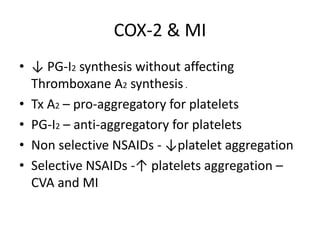
COX-2 & MI
• ↓ PG-I2 synthesis without affecting
Thromboxane A2 synthesis .
• Tx A2 – pro-aggregatory for platelets
• PG-I2 – anti-aggregatory for platelets
• Non selective NSAIDs - ↓platelet aggregation
• Selective NSAIDs -↑ platelets aggregation –
CVA and MI
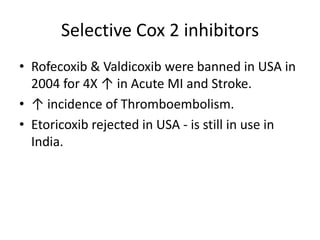
Selective Cox 2 inhibitors
• Rofecoxib & Valdicoxib were banned in USA in
2004 for 4X ↑ in Acute MI and Stroke.
• ↑ incidence of Thromboembolism.
• Etoricoxib rejected in USA - is still in use in
India.
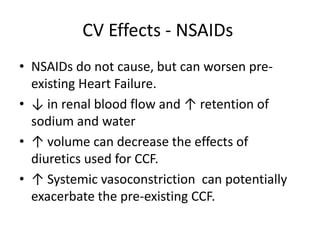
CV Effects - NSAIDs
• NSAIDs do not cause, but can worsen preexisting Heart Failure.
• ↓ in renal blood flow and ↑ retention of
sodium and water
• ↑ volume can decrease the effects of
diuretics used for CCF.
• ↑ Systemic vasoconstriction can potentially
exacerbate the pre-existing CCF.
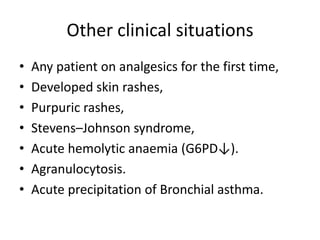
Other clinical situations
•
•
•
•
•
•
•

Any patient on analgesics for the first time,
Developed skin rashes,
Purpuric rashes,
Stevens–Johnson syndrome,
Acute hemolytic anaemia (G6PD↓).
Agranulocytosis.
Acute precipitation of Bronchial asthma.
Total & Differential WBC
• Neutropenia is another, albeit
rare, complication of NSAID therapy.
• ↑ risk of neutropenia with NSAID use.
• Analgin (Metamizole) banned in India in 2013
• Phenylbutazone banned –
agranulocytosis, and bone marrow
suppression, apastic anaemia, G.I.Bleed
Are these all real?
• All these clinical conditions are “REAL”.
• Rare.
• Events follow Murphy’s third law:
– If any thing is going to go wrong, they are going to
go wrong today with you!

• Remember “consumer forum is watching you”
Who are at risk
•
•
•
•

Elderly patients.
Diabetes & Hypertension.
CRF.
Cardiac on polypharmacy:
– Aspirin/Clopedogrel
– Anti-coagulants

•
•
•
•

Known asthmatics
Known H/o drug allergy.
Pregnancy and lactation.
Helicobacter pylori
Risk factors - G.I.Bleed
•
•
•
•
•
•
•
•

Age greater than 60 years,
Aspirin,
Prior history of GI event (ulcer, haemorrhage),
High dosage,
Duration of NSAID use,
Multiple NSAID use,
Concurrent use of corticosteroids/anticoagulants.
Helicobacter pylori status.
Renal Toxicity – Risk factors
– Elderly
– Diabetes
– Hypertension
– CRF
– CCF
– Dehydration
– Diuretics
– Cirrhosis
We are unique
• Continue/discontinue//substitute drugs on
our own.
• Few continue drugs for indefinite time.
• Do not seek another consultation regarding
drug continuation.
• Same prescription continue for years.
Drug dispensing system is very poorly monitored.
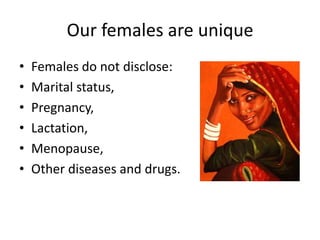
Our females are unique
•
•
•
•
•
•

Females do not disclose:
Marital status,
Pregnancy,
Lactation,
Menopause,
Other diseases and drugs.
Management
• Identification of
“Who are at risk”
• Investigate before
committing.
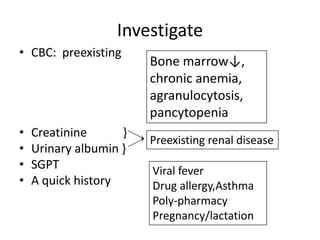
Investigate
• CBC: preexisting

•
•
•
•

Creatinine
}
Urinary albumin }
SGPT
A quick history

Bone
marrow↓, chronic
anemia, agranuloc
ytosis, pancytopeni
a

Preexisting renal disease
Viral fever
Drug allergy,Asthma
Poly-pharmacy
Pregnancy/lactation
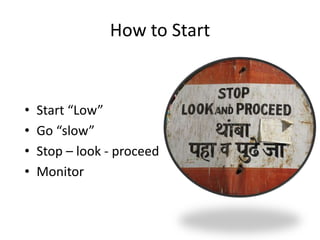
How to Start

•
•
•
•

Start “Low”
Go “slow”
Stop – look - proceed
Monitor
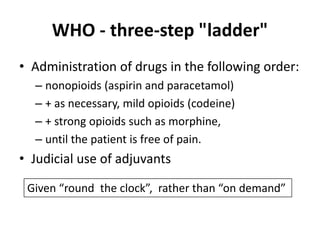
WHO - three-step "ladder"
• Administration of drugs in the following order:
– nonopioids (aspirin and paracetamol)
– + as necessary, mild opioids (codeine)
– + strong opioids such as morphine,
– until the patient is free of pain.

• Judicial use of adjuvants
Given “round the clock”, rather than “on demand”
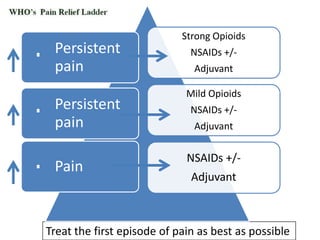
Persistent
pain
Persistent
pain
Pain

Strong Opioids

NSAIDs +/Adjuvant
Mild Opioids
NSAIDs +/Adjuvant

NSAIDs +/-

Adjuvant

Treat the first episode of pain as best as possible
Be careful
•
•
•
•

Pediatrics
Geriatrics
Pregnancy
Lactation
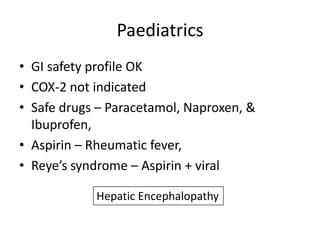
Paediatrics
• GI safety profile OK
• COX-2 not indicated
• Safe drugs – Paracetamol, Naproxen, &
Ibuprofen,
• Aspirin – Rheumatic fever,
• Reye’s syndrome – Aspirin + viral
Hepatic Encephalopathy
Nimesulide
• Nimesulide has never been approved for use
in USA, & other developed countries.
• In 2011, India put ban on Nimesulide in
children.
• Hepatotoxity.
• Relative COX – 2 inhibitor.
Safe in asthmatic patients where aspirin and NSAIDs
with cross sensitivity to aspirin can cause asthma.
Geriatric patients
• Rational prescribing of analgesics in elderly is
complex due to heterogeneity in
– drug disposition,
– co-morbid medical conditions,
– poly-pharmacy and
– variability in analgesic response.
“NSAIDs cause approximately 3500 hospitalisations
for and 400 deaths from ulcer bleeding per annum
in the UK in those aged 60 years and above”
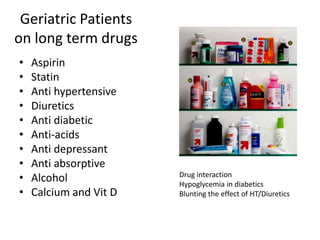
Geriatric Patients
on long term drugs
•
•
•
•
•
•
•
•
•
•

Aspirin
Statin
Anti hypertensive
Diuretics
Anti diabetic
Anti-acids
Anti depressant
Anti absorptive
Alcohol
Calcium and Vit D

Drug interaction
Hypoglycemia in diabetics
Blunting the effect of HT/Diuretics
Geriatric patients
• Mild opioids carry an unacceptable risk of falls
and fracture in older people which highlights
the need to limit their use.
• Patients must be worn for
– possible sedation
– Should be taken at home
– Preferably at bed time
– Minimum effective dose
Dextropropoxyphen (Proxyvon)
• Carried a black box warning in the U.S., stating:
Propoxyphene should be used with extreme caution, if
at all, in patients who have a history of
substance/drug/alcohol abuse, depression with
suicidal tendency, or who already take medications
that cause drowsiness (e.g., antidepressants, muscle
relaxants, pain relievers, sedatives, tranquilizers.
• In 2009 - banned in USA,
• In 2013 – banned in India due to ↑ in Cardiac arrhythmias.
Effects on Pregnancy
• The use of NSAIDs around the time
of conception may be associated
with a risk of miscarriage due to
Interfere in implantation, leading
to abnormal implantation.
• Paracetamol is safe in women who
are trying to conceive.
• Anti-acid are safest in 1st trimester
• Use H2 – blocker rather than PPI
Effects on Pregnancy
 During the third trimester of
pregnancy NSAIDs can cause:
– prolonged gestation and labour,
– increased bleeding,
– premature closure of the Ductus
arteriosus.
Analgesics during Lactation
• All drugs transfer into breast milk.
• Paracetamol, ibuprofen, naproxen and
codeine are considered to be 'safe', due to low
transfer into breast milk.
• Topical preparations - creams, sprays or
inhalers carry less risk.
• Feeding immediately prior to a dose
minimises infant exposure.
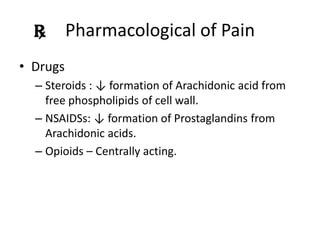
Pharmacological of Pain
• Drugs
– Steroids : ↓ formation of Arachidonic acid from
free phospholipids of cell wall.
– NSAIDSs: ↓ formation of Prostaglandins from
Arachidonic acids.
– Opioids – Centrally acting.
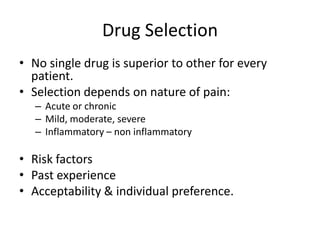
Drug Selection
• No single drug is superior to other for every
patient.
• Selection depends on nature of pain:
– Acute or chronic
– Mild, moderate, severe
– Inflammatory – non inflammatory

• Risk factors
• Past experience
• Acceptability & individual preference.
Adjuvant therapy
•
•
•
•

Depends on etiology of pain
Nociceptive
Neurogenic
Mix
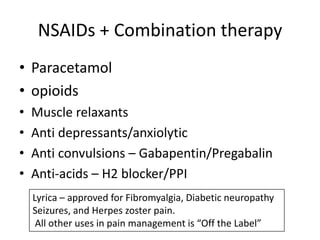
NSAIDs + Combination therapy
• Paracetamol
• opioids
•
•
•
•

Muscle relaxants
Anti depressants/anxiolytic
Anti convulsions – Gabapentin/Pregabalin
Anti-acids – H2 blocker/PPI
Lyrica – approved for Fibromyalgia, Diabetic neuropathy
Seizures, and Herpes zoster pain.
All other uses in pain management is “Off the Label”
Paracetamol
• Centrally acting analgesic COX -3 blocker
• Weak peripheral anti-inflammatory
• No effect on GI, renal, CVS, platelets and
respiration.
• Cause hepatic failure in chronic alcoholics.
• Not safe in premature infants – hepatotoxicity.
Paracetamol + NSAIDs combination is additive & rational
A combination of two NSAIDs is not additive
Opioids
• Centrally acting - ↓ µ,ĸ, and δ receptors
• Rational
• Concomitant use with NSAIDs is supraadditive
• Provide additional analgesia beyond “ceiling
effect”.
Associated therapy
• Locally acting drugs and patches
– Local high concentration in tissue
– Systemic toxicity are minimized
Safety / efficacy ?

• Local rubeficiant
• Physical therapy – heat, massage, and TNS
Gate theory
Fear of unknown
•
•
•
•

Treat the fear psychosis
Contribute 50% of pain perception
Brain is the culprit
Multiplication of pain perception occur in the
brain due to previous experience.

Talk
Talk
Talk
works better than drugs
Guidelines
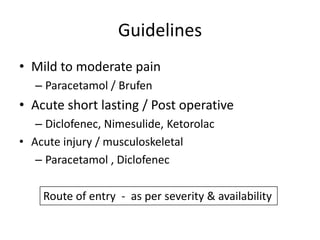
• Mild to moderate pain
– Paracetamol / Brufen

• Acute short lasting / Post operative
– Diclofenec, Nimesulide, Ketorolac
• Acute injury / musculoskeletal
– Paracetamol , Diclofenec

Route of entry - as per severity & availability
Guidelines
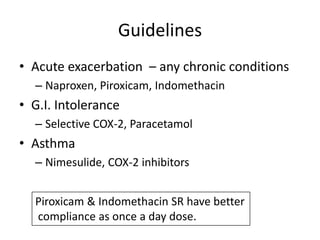
• Acute exacerbation – any chronic conditions
– Naproxen, Piroxicam, Indomethacin

• G.I. Intolerance
– Selective COX-2, Paracetamol

• Asthma
– Nimesulide, COX-2 inhibitors
Piroxicam & Indomethacin SR have better
compliance as once a day dose.
Complications of Long-term Proton Pump
Inhibitor Use
• Alteration of absorption of vitamins and minerals
– Calcium↓, Magnesium↓, Iron↓, Vitamin C↓, B12↓

• Metabolic effects on bone density,
– ↑ Hip fractures ? ↑ BMD (anti osteoclastic)

• Drug interactions: Clopidogrel - common pathway
• ↑ Methotrexate toxicity.
• Infection risk: ↑ Pneumonia, ↑Clostridium
Difficile, ↑Traveler's Diarrhoea, Small Intestinal
Bacterial Overgrowth, Spontaneous Bacterial
Peritonitis.
• Hypersensitivity response : Interstitial Nephritis.
Misoprostol
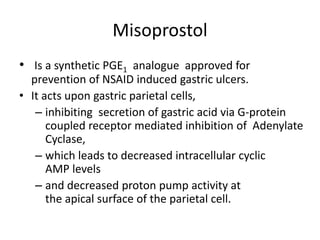
• Is a synthetic PGE1 analogue approved for

prevention of NSAID induced gastric ulcers.
• It acts upon gastric parietal cells,
– inhibiting secretion of gastric acid via G-protein
coupled receptor mediated inhibition of Adenylate
Cyclase,
– which leads to decreased intracellular cyclic
AMP levels
– and decreased proton pump activity at
the apical surface of the parietal cell.
Misoprostol
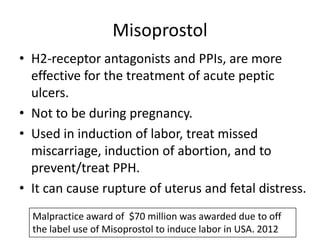
• H2-receptor antagonists and PPIs, are more
effective for the treatment of acute peptic
ulcers.
• Not to be given during pregnancy.
• Used in induction of labor, treat missed
miscarriage, induction of abortion, and to
prevent/treat PPH.
• It can cause rupture of uterus and fetal distress.
Malpractice award of $70 million was awarded due to off
the label use of Misoprostol to induce labor in USA. 2012
Recent advancement
• Nitroxyparacetamol: potent NO-releasing
version of paracetamol that has both analgesic
and also anti-inflammatory properties.
• Cannabinoids: as anti-nociceptive
• Cyclooxygenae inhibitors + NO donor
– Nitric oxide cause local vasodilatation which
negotiates the vasoconstriction by NSAIDs

• Ziconotide: snail venom as neurotrammiter
blocker.
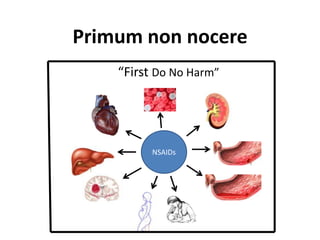
Primum non nocere
“First Do No Harm”

NSAIDs
Before
committing

Think

Thank You
DISCLAIMER
• This presentation is prepared for dissipation of general
knowledge about Non-steroidal anti-inflammatory drugs
amongst students of orthopaedic surgery.
• All graphics and jpeg files are taken from Google Image to
heighten the specific points in this presentation.
• If there is any objection/or copy write violation, please inform
naneria@yahoo.com for prompt deletion.
• It is intended for use only by the students of orthopaedic
surgery. Views expressed in this presentation are personal.
• For any confusion please contact the sole author for
clarification.
• Every body is allowed to copy or download and use the
material best suited to him. There is no financial involvement.
• For any correction or suggestion please contact
naneria@yahoo.com

NSAIDs in clinical orthopaedic practice

  • 1.
    NSAIDs in clinical orthopaedicpractice Vinod Naneria Girish Yeotikar Arjun Wadhwani Choithram Hospital & Research Centre, Indore, India
  • 2.
  • 3.
    Inflammation • Protective responseas reaction of living tissue to injury. • Mediated by – Amines – Histamine & 5HT, – Lipids – Prostaglandins – Small peptides – Bradykinin – Large peptides – Interleukin 1 Hyper sensitization of free nerve endings – perceived as pain
  • 4.
    Pain is real •Pain is a feeling, the more you feel – the more you get. It is all in the brain
  • 5.
    Pain Thermometer- FacesPain Scale Pain is 100% There is no painometer – all are visual impression 0 1 2 3 4 5 Wong-Baker
  • 6.
    Definition of Pain •International Association for the Study of Pain Defined as an unpleasant sensory or emotional experience associated with actual or potential tissue damage.
  • 7.
    Pain is threedimensional Physical disability Cognitive dysfunction Pain Emotional disturbances All must be addressed in pain management
  • 8.
    WHO on Pain •Pain is one of the most underestimated healthcare problems in the world… • Adequate pain management is a fundamental human right. • Pain is part of the body's defence system. Pain costs USA- $635 billion/year in medical treatment and lost productivity.
  • 9.
    Prostaglandins • The wordPG - as it was thought to be secreted by prostrate. • No preformed stores of Prostaglandins are available in blood. • Synthesized locally in presence of stimulus in almost all tissues of the body.
  • 10.
    Prostaglandins • Lung &Spleen can synthesize all range of Prostaglandins • Platelets : Thromboxane A2 • Endothelium of Vessels : PG I2
  • 11.
    Membrane Phospholipid Phospholipase A ArachidonicAcid Chemical Mechanical Stimulous Lipooxygenase Cyclooxygenase Hydroperoxy Arachidonic acid PGG 2 PGH 2 LTE4 Isomerases Thromboxane Prostacyclin PGE 2 PGD 2 PGF 2a TXA 2 PGI 2 TXB 2 6keto-PGF 1a LTF4
  • 12.
    COX in twoforms • COX-1, COX-2, • COX-1 PGs are "housekeeping“ and constitutively expressed in almost all tissues. • Responsible for homeostatic functions: – Integrity of the gastric mucosa, – Platelet function, and – Regulating renal blood flow.
  • 13.
    COX in twoforms • COX-2 PGs inducible and tightly regulated. • Under normal conditions, COX-2 expression is highly restricted. • COX-2 is dramatically unregulated during inflammation. • COX-2 play constitutive role only at brain, bone & kidney.
  • 14.
    NSAIDs • Most extensivelyused medications in the world. • Fifth most utilized medication in all age groups. • The prevalence in aged above 65 is 70%. • NSAID-related hospital admissions is from 7% to 11%. (Preventable)
  • 15.
    NSAIDs -- Benefit • • • • • • Analgesia Anti-pyraxia Anti-inflammatory Anti-thrombotic Closureof Ductus arteriosus in new born Anticancer – colonic cancer NSAIDs annually account for 70 million prescriptions and 30 billion OTC medications sold in the USA alone.
  • 16.
    NSAIDs - Toxicity • • • • • • • • Gastricmucosal damage Bleeding tendency Salt & water retention Delayed fracture healing (PGE-2↓) Bone marrow suppression Prolongation of labor Asthma & Anaphylaxis Hepatotoxic Institute of Medicine: the annual cost of chronic pain in the U.S. is $560-635 billion - 2011.
  • 17.
    Sitting is abusy OPD Prescriptions of analgesic is a reflex rather than a well thought of analytic process.
  • 18.
  • 19.
    Clinical situation -1 • • • • • • • A 60 f was on analgesics for sometime, Developed acute drop in blood pressure, Had black color stool, Had hematemesis, Admitted with diagnosis of Acute GI bleed, Peptic perforation? Chronic anaemia?
  • 20.
    Gastrointestinal Effects ofNSAIDs • ↓ production of prostaglandins in the epithelial cells of gastric mucosa. • ↓ epithelial mucus, • ↓ secretion of bicarbonate, • ↓ mucosal blood flow, `
  • 21.
    Gastrointestinal Effects ofNSAIDs • ↓ epithelial proliferation, • ↓ mucosal resistance to injury. • ↑ exposure of GI mucosa to as gastric acid, pepsin, and bile salts. • These effects are - systemic absorption of NSAIDs • NSAIDs given by any route can damage gastric mucosa.
  • 22.
    NSAIDs & G.I.Bleed G.I. Ulcer G.I. Bleed Bleeding also occur in lower intestinal tract and colon
  • 23.
    Clinical situation -2 • • • • • • 60 f was on analgesics for some time. Developed puffy face, Pedal edema, Headache, Decreased urinary output, Admitted for Acute renal shutdown.
  • 24.
    Renal prostaglandins • RenalPGs are vasodilator & have little influence on renal blood flow and GFR in normal conditions.
  • 25.
    Renal prostaglandins • PGsare necessary to compensate for angiotensin induced renal vasoconstriction in volume-depleted states. • NSAIDs block the production of PGs → unopposed vasoconstriction → acute renal failure.
  • 26.
    Renal prostaglandins • COX-2NSAIDs →inhibition of juxtraglomerular PGs → Salt and water retention • Idiopathic direct toxic - Acute interstitial necrosis.
  • 27.
    Clinical situation -3 • A 60 m was on analgesics for some time • Developed chest pain • Decreased urinary output • Developed Hypertension • Admitted with a diagnosis of Acute myocardial infarction.
  • 28.
    COX-2 & MI •↓ PG-I2 synthesis without affecting Thromboxane A2 synthesis . • Tx A2 – pro-aggregatory for platelets • PG-I2 – anti-aggregatory for platelets • Non selective NSAIDs - ↓platelet aggregation • Selective NSAIDs -↑ platelets aggregation – CVA and MI
  • 29.
    Selective Cox 2inhibitors • Rofecoxib & Valdicoxib were banned in USA in 2004 for 4X ↑ in Acute MI and Stroke. • ↑ incidence of Thromboembolism. • Etoricoxib rejected in USA - is still in use in India.
  • 30.
    CV Effects -NSAIDs • NSAIDs do not cause, but can worsen preexisting Heart Failure. • ↓ in renal blood flow and ↑ retention of sodium and water • ↑ volume can decrease the effects of diuretics used for CCF. • ↑ Systemic vasoconstriction can potentially exacerbate the pre-existing CCF.
  • 31.
    Other clinical situations • • • • • • • Anypatient on analgesics for the first time, Developed skin rashes, Purpuric rashes, Stevens–Johnson syndrome, Acute hemolytic anaemia (G6PD↓). Agranulocytosis. Acute precipitation of Bronchial asthma.
  • 32.
    Total & DifferentialWBC • Neutropenia is another, albeit rare, complication of NSAID therapy. • ↑ risk of neutropenia with NSAID use. • Analgin (Metamizole) banned in India in 2013 • Phenylbutazone banned – agranulocytosis, and bone marrow suppression, apastic anaemia, G.I.Bleed
  • 33.
    Are these allreal? • All these clinical conditions are “REAL”. • Rare. • Events follow Murphy’s third law: – If any thing is going to go wrong, they are going to go wrong today with you! • Remember “consumer forum is watching you”
  • 34.
    Who are atrisk • • • • Elderly patients. Diabetes & Hypertension. CRF. Cardiac on polypharmacy: – Aspirin/Clopedogrel – Anti-coagulants • • • • Known asthmatics Known H/o drug allergy. Pregnancy and lactation. Helicobacter pylori
  • 35.
    Risk factors -G.I.Bleed • • • • • • • • Age greater than 60 years, Aspirin, Prior history of GI event (ulcer, haemorrhage), High dosage, Duration of NSAID use, Multiple NSAID use, Concurrent use of corticosteroids/anticoagulants. Helicobacter pylori status.
  • 36.
    Renal Toxicity –Risk factors – Elderly – Diabetes – Hypertension – CRF – CCF – Dehydration – Diuretics – Cirrhosis
  • 37.
    We are unique •Continue/discontinue//substitute drugs on our own. • Few continue drugs for indefinite time. • Do not seek another consultation regarding drug continuation. • Same prescription continue for years. Drug dispensing system is very poorly monitored.
  • 38.
    Our females areunique • • • • • • Females do not disclose: Marital status, Pregnancy, Lactation, Menopause, Other diseases and drugs.
  • 39.
    Management • Identification of “Whoare at risk” • Investigate before committing.
  • 40.
    Investigate • CBC: preexisting • • • • Creatinine } Urinaryalbumin } SGPT A quick history Bone marrow↓, chronic anemia, agranuloc ytosis, pancytopeni a Preexisting renal disease Viral fever Drug allergy,Asthma Poly-pharmacy Pregnancy/lactation
  • 41.
    How to Start • • • • Start“Low” Go “slow” Stop – look - proceed Monitor
  • 42.
    WHO - three-step"ladder" • Administration of drugs in the following order: – nonopioids (aspirin and paracetamol) – + as necessary, mild opioids (codeine) – + strong opioids such as morphine, – until the patient is free of pain. • Judicial use of adjuvants Given “round the clock”, rather than “on demand”
  • 43.
    Persistent pain Persistent pain Pain Strong Opioids NSAIDs +/Adjuvant MildOpioids NSAIDs +/Adjuvant NSAIDs +/- Adjuvant Treat the first episode of pain as best as possible
  • 44.
  • 45.
    Paediatrics • GI safetyprofile OK • COX-2 not indicated • Safe drugs – Paracetamol, Naproxen, & Ibuprofen, • Aspirin – Rheumatic fever, • Reye’s syndrome – Aspirin + viral Hepatic Encephalopathy
  • 46.
    Nimesulide • Nimesulide hasnever been approved for use in USA, & other developed countries. • In 2011, India put ban on Nimesulide in children. • Hepatotoxity. • Relative COX – 2 inhibitor. Safe in asthmatic patients where aspirin and NSAIDs with cross sensitivity to aspirin can cause asthma.
  • 47.
    Geriatric patients • Rationalprescribing of analgesics in elderly is complex due to heterogeneity in – drug disposition, – co-morbid medical conditions, – poly-pharmacy and – variability in analgesic response. “NSAIDs cause approximately 3500 hospitalisations for and 400 deaths from ulcer bleeding per annum in the UK in those aged 60 years and above”
  • 48.
    Geriatric Patients on longterm drugs • • • • • • • • • • Aspirin Statin Anti hypertensive Diuretics Anti diabetic Anti-acids Anti depressant Anti absorptive Alcohol Calcium and Vit D Drug interaction Hypoglycemia in diabetics Blunting the effect of HT/Diuretics
  • 49.
    Geriatric patients • Mildopioids carry an unacceptable risk of falls and fracture in older people which highlights the need to limit their use. • Patients must be worn for – possible sedation – Should be taken at home – Preferably at bed time – Minimum effective dose
  • 50.
    Dextropropoxyphen (Proxyvon) • Carrieda black box warning in the U.S., stating: Propoxyphene should be used with extreme caution, if at all, in patients who have a history of substance/drug/alcohol abuse, depression with suicidal tendency, or who already take medications that cause drowsiness (e.g., antidepressants, muscle relaxants, pain relievers, sedatives, tranquilizers. • In 2009 - banned in USA, • In 2013 – banned in India due to ↑ in Cardiac arrhythmias.
  • 51.
    Effects on Pregnancy •The use of NSAIDs around the time of conception may be associated with a risk of miscarriage due to Interfere in implantation, leading to abnormal implantation. • Paracetamol is safe in women who are trying to conceive. • Anti-acid are safest in 1st trimester • Use H2 – blocker rather than PPI
  • 52.
    Effects on Pregnancy During the third trimester of pregnancy NSAIDs can cause: – prolonged gestation and labour, – increased bleeding, – premature closure of the Ductus arteriosus.
  • 53.
    Analgesics during Lactation •All drugs transfer into breast milk. • Paracetamol, ibuprofen, naproxen and codeine are considered to be 'safe', due to low transfer into breast milk. • Topical preparations - creams, sprays or inhalers carry less risk. • Feeding immediately prior to a dose minimises infant exposure.
  • 54.
    Pharmacological of Pain •Drugs – Steroids : ↓ formation of Arachidonic acid from free phospholipids of cell wall. – NSAIDSs: ↓ formation of Prostaglandins from Arachidonic acids. – Opioids – Centrally acting.
  • 55.
    Drug Selection • Nosingle drug is superior to other for every patient. • Selection depends on nature of pain: – Acute or chronic – Mild, moderate, severe – Inflammatory – non inflammatory • Risk factors • Past experience • Acceptability & individual preference.
  • 56.
    Adjuvant therapy • • • • Depends onetiology of pain Nociceptive Neurogenic Mix
  • 57.
    NSAIDs + Combinationtherapy • Paracetamol • opioids • • • • Muscle relaxants Anti depressants/anxiolytic Anti convulsions – Gabapentin/Pregabalin Anti-acids – H2 blocker/PPI Lyrica – approved for Fibromyalgia, Diabetic neuropathy Seizures, and Herpes zoster pain. All other uses in pain management is “Off the Label”
  • 58.
    Paracetamol • Centrally actinganalgesic COX -3 blocker • Weak peripheral anti-inflammatory • No effect on GI, renal, CVS, platelets and respiration. • Cause hepatic failure in chronic alcoholics. • Not safe in premature infants – hepatotoxicity. Paracetamol + NSAIDs combination is additive & rational A combination of two NSAIDs is not additive
  • 59.
    Opioids • Centrally acting- ↓ µ,ĸ, and δ receptors • Rational • Concomitant use with NSAIDs is supraadditive • Provide additional analgesia beyond “ceiling effect”.
  • 60.
    Associated therapy • Locallyacting drugs and patches – Local high concentration in tissue – Systemic toxicity are minimized Safety / efficacy ? • Local rubeficiant • Physical therapy – heat, massage, and TNS Gate theory
  • 61.
    Fear of unknown • • • • Treatthe fear psychosis Contribute 50% of pain perception Brain is the culprit Multiplication of pain perception occur in the brain due to previous experience. Talk Talk Talk works better than drugs
  • 62.
    Guidelines • Mild tomoderate pain – Paracetamol / Brufen • Acute short lasting / Post operative – Diclofenec, Nimesulide, Ketorolac • Acute injury / musculoskeletal – Paracetamol , Diclofenec Route of entry - as per severity & availability
  • 63.
    Guidelines • Acute exacerbation– any chronic conditions – Naproxen, Piroxicam, Indomethacin • G.I. Intolerance – Selective COX-2, Paracetamol • Asthma – Nimesulide, COX-2 inhibitors Piroxicam & Indomethacin SR have better compliance as once a day dose.
  • 64.
    Complications of Long-termProton Pump Inhibitor Use • Alteration of absorption of vitamins and minerals – Calcium↓, Magnesium↓, Iron↓, Vitamin C↓, B12↓ • Metabolic effects on bone density, – ↑ Hip fractures ? ↑ BMD (anti osteoclastic) • Drug interactions: Clopidogrel - common pathway • ↑ Methotrexate toxicity. • Infection risk: ↑ Pneumonia, ↑Clostridium Difficile, ↑Traveler's Diarrhoea, Small Intestinal Bacterial Overgrowth, Spontaneous Bacterial Peritonitis. • Hypersensitivity response : Interstitial Nephritis.
  • 65.
    Misoprostol • Is asynthetic PGE1 analogue approved for prevention of NSAID induced gastric ulcers. • It acts upon gastric parietal cells, – inhibiting secretion of gastric acid via G-protein coupled receptor mediated inhibition of Adenylate Cyclase, – which leads to decreased intracellular cyclic AMP levels – and decreased proton pump activity at the apical surface of the parietal cell.
  • 66.
    Misoprostol • H2-receptor antagonistsand PPIs, are more effective for the treatment of acute peptic ulcers. • Not to be given during pregnancy. • Used in induction of labor, treat missed miscarriage, induction of abortion, and to prevent/treat PPH. • It can cause rupture of uterus and fetal distress. Malpractice award of $70 million was awarded due to off the label use of Misoprostol to induce labor in USA. 2012
  • 67.
    Recent advancement • Nitroxyparacetamol:potent NO-releasing version of paracetamol that has both analgesic and also anti-inflammatory properties. • Cannabinoids: as anti-nociceptive • Cyclooxygenae inhibitors + NO donor – Nitric oxide cause local vasodilatation which negotiates the vasoconstriction by NSAIDs • Ziconotide: snail venom as neurotrammiter blocker.
  • 68.
    Primum non nocere “FirstDo No Harm” NSAIDs
  • 69.
  • 70.
    DISCLAIMER • This presentationis prepared for dissipation of general knowledge about Non-steroidal anti-inflammatory drugs amongst students of orthopaedic surgery. • All graphics and jpeg files are taken from Google Image to heighten the specific points in this presentation. • If there is any objection/or copy write violation, please inform naneria@yahoo.com for prompt deletion. • It is intended for use only by the students of orthopaedic surgery. Views expressed in this presentation are personal. • For any confusion please contact the sole author for clarification. • Every body is allowed to copy or download and use the material best suited to him. There is no financial involvement. • For any correction or suggestion please contact naneria@yahoo.com