A case of Knee buckling
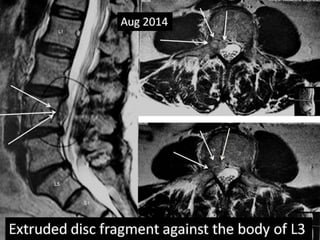
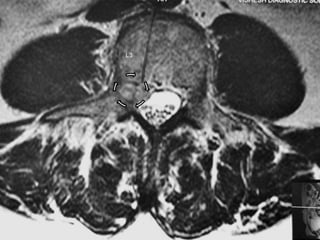
disc extrusion L3 – L4
Vinod Naneria
Girish Yeotikar
Arjun Wadhwani
Choithram Hospital & Research Centre,
Indore India
Case summary
• A 40 years old male C/o acute pain in the right
knee associated with frequent fall since last 7
days.
• No history of trauma.
• He was scared to walk with out support.
• Patient was limping and had insecurity while
walking.
• Now pain was gradually reducing.
Clinical examination
• Right knee was cold, (no inflammation)
• no deformity,
• no effusion,
• no tenderness,
• no laxity and had full range of movements.
• Patello-femoral joint was normal.
Clinical examination
• Examination of hip:
• full range free movements.
• Spine full flexion,
• SLRT - negative.
• Ankle normal with palpable DP, & PT vessels.
• EHL gr 5 power,
• ankle jerks are normal on both sides.
• Unable to walk on toes and heels.
Clinical examination
• There was no wasting of any muscle.
• The history was only 7 days.
• Active quadriceps was ok but not against
resistance (could be attributed due to pain).
• Quadriceps weakness gr 3 ?
• Left knee jerk was present.
• Right knee jerk was absent.
Clinical examination
• Testing of knee reflex and comparing with
deep reflexes of other limb, click the
possibility of neurological involvement.
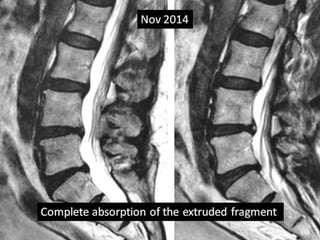
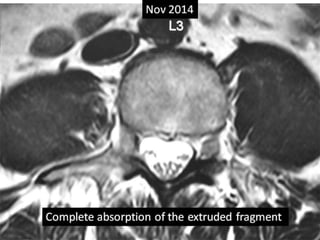
• Hence I asked for MRI. My patient had doubt
in mind. His pain/discomfort was in/around
knee and I am asking for MRI of spine!
Treatment
• Conservative
– Pain was getting less.
– Mono-radiculopathy.
– Minimal neurological deficit.
– Least possibility of progression/or deterioration
of neurology.
comments
• L3 –L4 extruded disc can be missed.
• Knee pain can come from spine and hip.
• High degree of suspicion.
• Through neurological examination.
• Comparison on two sides.
comments
• When Patient’s narration of symptoms does
not match with the clinical examination, it is
better to over investigate the patient.
• When differentiating between an L3
radiculopathy versus a femoral neuropathy,
weakness in the hip adductors in addition to
the quadriceps group would indicate an L3
radiculopathy.
DISCLAIMER
• Information contained and transmitted by this presentation is based
on personal experience and collection of cases at Choithram Hospital
& Research centre, Indore, India.
• It is intended for use only by the students of orthopaedic surgery.
• Views and opinion expressed in this presentation are personal.
• Depending upon the x-rays and clinical presentations viewers can
make their own opinion.
• For any confusion please contact the sole author for clarification.
• Every body is allowed to copy or download and use the material best
suited to him.
• We not responsible for any controversies arise out of this
presentation. For any correction or suggestion please contact
naneria@yahoo.com

L3 l4 disc extrusion

  • 1.
    A case ofKnee buckling disc extrusion L3 – L4 Vinod Naneria Girish Yeotikar Arjun Wadhwani Choithram Hospital & Research Centre, Indore India
  • 2.
    Case summary • A40 years old male C/o acute pain in the right knee associated with frequent fall since last 7 days. • No history of trauma. • He was scared to walk with out support. • Patient was limping and had insecurity while walking. • Now pain was gradually reducing.
  • 3.
    Clinical examination • Rightknee was cold, (no inflammation) • no deformity, • no effusion, • no tenderness, • no laxity and had full range of movements. • Patello-femoral joint was normal.
  • 4.
    Clinical examination • Examinationof hip: • full range free movements. • Spine full flexion, • SLRT - negative. • Ankle normal with palpable DP, & PT vessels. • EHL gr 5 power, • ankle jerks are normal on both sides. • Unable to walk on toes and heels.
  • 5.
    Clinical examination • Therewas no wasting of any muscle. • The history was only 7 days. • Active quadriceps was ok but not against resistance (could be attributed due to pain). • Quadriceps weakness gr 3 ? • Left knee jerk was present. • Right knee jerk was absent.
  • 6.
    Clinical examination • Testingof knee reflex and comparing with deep reflexes of other limb, click the possibility of neurological involvement. • Hence I asked for MRI. My patient had doubt in mind. His pain/discomfort was in/around knee and I am asking for MRI of spine!
  • 9.
    Treatment • Conservative – Painwas getting less. – Mono-radiculopathy. – Minimal neurological deficit. – Least possibility of progression/or deterioration of neurology.
  • 12.
    comments • L3 –L4extruded disc can be missed. • Knee pain can come from spine and hip. • High degree of suspicion. • Through neurological examination. • Comparison on two sides.
  • 13.
    comments • When Patient’snarration of symptoms does not match with the clinical examination, it is better to over investigate the patient. • When differentiating between an L3 radiculopathy versus a femoral neuropathy, weakness in the hip adductors in addition to the quadriceps group would indicate an L3 radiculopathy.
  • 14.
    DISCLAIMER • Information containedand transmitted by this presentation is based on personal experience and collection of cases at Choithram Hospital & Research centre, Indore, India. • It is intended for use only by the students of orthopaedic surgery. • Views and opinion expressed in this presentation are personal. • Depending upon the x-rays and clinical presentations viewers can make their own opinion. • For any confusion please contact the sole author for clarification. • Every body is allowed to copy or download and use the material best suited to him. • We not responsible for any controversies arise out of this presentation. For any correction or suggestion please contact naneria@yahoo.com