Broken AMP stem 
A case report 
Vinod Naneria 
Girish Yeotikar 
Arjun Wadhawani 
Choithram Hospital & Research centre, Indore, 
India
Case summary 
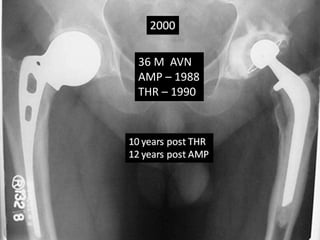
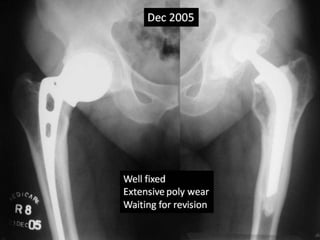
• 36 yrs Male had Bilateral AVN hips 
• AMP done in 1988 rt side at the age of 36 yrs 
• Triad - cemented THR was done on left side in 
1990 at the age of 38 yrs. 
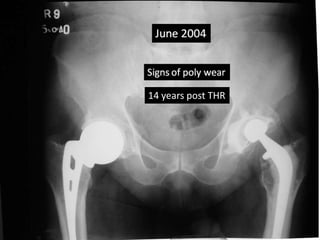
• Advised revision of cup due to poly wear 2005 
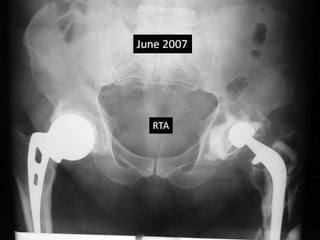
• Met with Road traffic accident in June 2007.
Case summary 
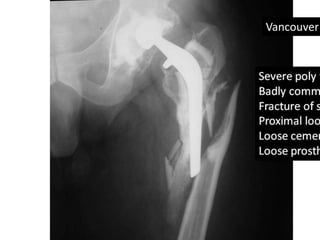
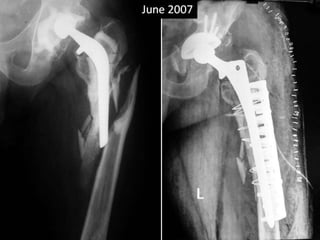
• Vancouver B3 type peri-prosthetic fracture 
• Revision THR for shattered femur by Mennen 
plate with non cemented Solution hip and 
bone grafting in acetabular wall defects. 
• Sciatic palsy 
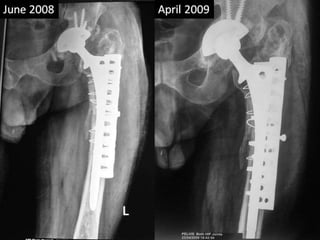
• Removal of Mennen plate and wires in April 
2009 after fracture union.
Case summary 
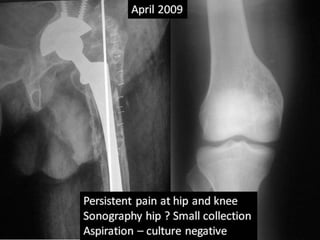
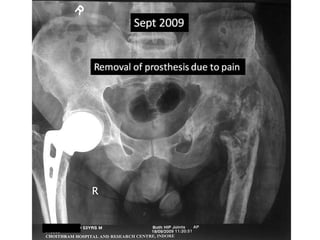
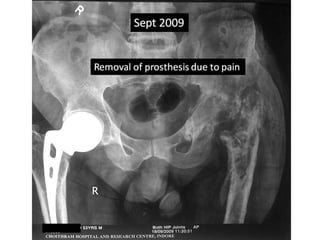
• Persistent pain in hip and knee since revision. 
• Hip ultra-sonography in April 2009 – small 
pocket – aspiration negative. 
• No relief with antibiotics. 
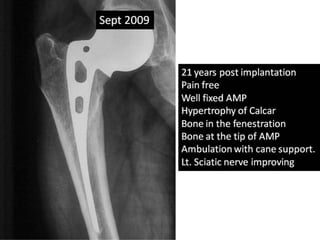
• Removal of Solution hip in Sept 2009.
Case summary 
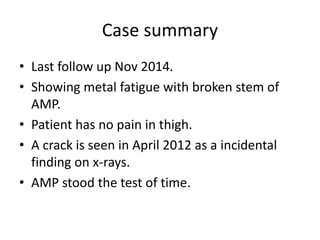
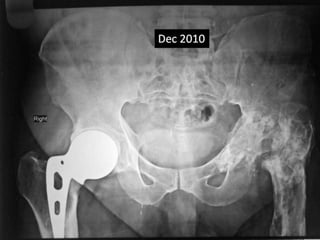
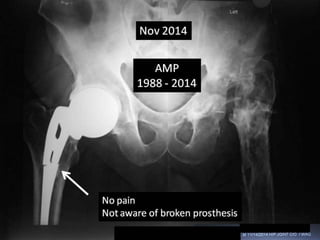
• Last follow up Nov 2014. 
• Showing metal fatigue with broken stem of 
AMP. 
• Patient has no pain in thigh. 
• A crack is seen in April 2012 as a incidental 
finding on x-rays. 
• AMP stood the test of time.
Case summary 
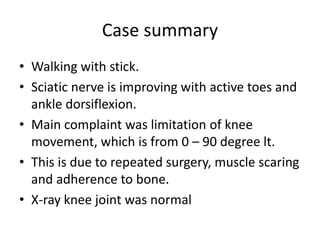
• Walking with stick. 
• Sciatic nerve is improving with active toes and 
ankle dorsiflexion. 
• Main complaint was limitation of knee 
movement, which is from 0 – 90 degree lt. 
• This is due to repeated surgery, muscle scaring 
and adherence to bone. 
• X-ray knee joint was normal
36 M AVN 
AMP – 1988 
THR – 1990
14 years post THR
Vancouver B3
Surgery 
• Removal of implant. 
• Removal of cement from femur 
• Severe bone loss from acetabular walls 
• Iliac bone grafts were packed 
• Revision of acetabular cup was done and was 
fixed with three screws
Surgery 
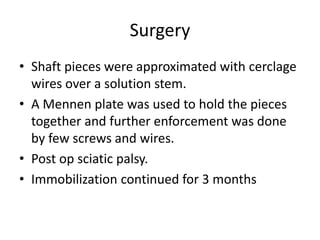
• Shaft pieces were approximated with cerclage 
wires over a solution stem. 
• A Mennen plate was used to hold the pieces 
together and further enforcement was done 
by few screws and wires. 
• Post op sciatic palsy. 
• Immobilization continued for 3 months
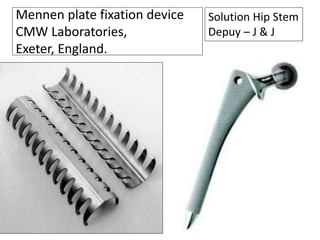
Mennen plate fixation device 
CMW Laboratories, 
Exeter, England. 
Solution Hip Stem 
Depuy – J & J
June 2012 
Incidental finding 
Signs of metal fatigue
Comments 
• Poly wear is a problem in THR in spite of being 
a well fixed implant. 
• Vancouver type three can be management 
with Mennen type plates and wire. 
• Non cemented stem needs good quality bone 
for incorporation. 
• Broken AMP stem is not a failure.
Non cemented AMP 
• In early AMP stem fracture is due to fixed 
distal stem and slight loose proximal head 
neck segment. 
• The bone has not grown in fenestrations. 
• In late AMP stem fracture, the proximal part is 
well fixed and the distal part seems loose. 
• The bone has grown in the fenestrations. 
Cyclic loading
References 
• Modes of failure' of cemented stem-type femoral components: a radiographic 
analysis of loosening. 
Gruen TA, McNeice GM, Amstutz HC. 
Clin Orthop Relat Res. 1979 Jun;(141):17-27. 
Prosthesis & nails are different ball games. 
Can galvanic corrosion play a role? 
Scratches occurred at screw holes during insertional attempts of interlocking 
screws with screw hole acting as a stress riser. Many a times the nail may have 
broken long before,Its perceived on the xrays only later. 
Prosthesis on the other hand is continuously subjected to cyclical loading.Distally 
well fixed prosthesis(typical Gruen's type IV) failure occurs ultimately when the 
fatigue limit of the metal exceeds the no. of cyclical loads it can bear.Laser etching 
marks(company marks etc)exactly at the high stress zones(i.e upper 1/3 rd & lower 
2/3rd area) , air bubbles in the metal alloy typically as occurs in stainless 
steel(316L) make the prosthesis more prone to it. 
Dr. Mohan M Desai 
Professor,Seth GSMC,KEMH,Mumbai
Segmental Fracture Of A Cemented Femoral Stem - A 
Case Report And Review Of Litrature 
R Sen, A Mootha, R Saini, V Kumar 
• incidence of 0.23% of femoral stem fracture in arthroplasty. 
• Various factors are excessive weight, high physical activity, long 
necked prosthesis, varus position of stem, metallurgical defects and 
scoring of the stem by a drill bit for wire fixation. 
• 316 L stainless steel stems were associated with high incidence of 
stem fractures, and expenimental studies on the fatigue strength of 
this alloy have indicated a direct relationship to grain size. 
• The most common cause of stem failure is considered to be loss of 
support by cement and bone in the proximal third, with the stem 
subject to cantilever forces that fatigue the metal. 
• These cantilever forces are considered to be increased in varus 
position of the stem. The antero-lateral side of the stem is 
considered to be site with maximum tensile stress and thus most of 
the times the fracture line initiates on the antero-lateral surface of 
the stem.
references 
• A 1995 survey study reported 172 stem 
fractures out of 64,483 cases (including both 
cemented and cementless prostheses), for an 
incidence of 0.27%. 
• Gruen et al. postulated that cantilever 
bending of a cemented stem that is well fixed 
distally but loose proximally could lead to a 
fatigue fracture.
DISCLAIMER 
Information contained and transmitted by this presentation is 
based on personal experience and collection of cases at 
Choithram Hospital & Research centre, Indore, India. It is 
intended for use only by the students of orthopaedic surgery. 
Views and opinion expressed in this presentation are 
personal. Depending upon the x-rays and clinical 
presentations viewers can make their own opinion. For any 
confusion please contact the sole author for clarification. 
Every body is allowed to copy or download and use the 
material best suited to him. I am not responsible for any 
controversies arise out of this presentation. For any 
correction or suggestion please contact naneria@yahoo.com

Broken AMP stem a case report

  • 1.
    Broken AMP stem A case report Vinod Naneria Girish Yeotikar Arjun Wadhawani Choithram Hospital & Research centre, Indore, India
  • 2.
    Case summary •36 yrs Male had Bilateral AVN hips • AMP done in 1988 rt side at the age of 36 yrs • Triad - cemented THR was done on left side in 1990 at the age of 38 yrs. • Advised revision of cup due to poly wear 2005 • Met with Road traffic accident in June 2007.
  • 3.
    Case summary •Vancouver B3 type peri-prosthetic fracture • Revision THR for shattered femur by Mennen plate with non cemented Solution hip and bone grafting in acetabular wall defects. • Sciatic palsy • Removal of Mennen plate and wires in April 2009 after fracture union.
  • 4.
    Case summary •Persistent pain in hip and knee since revision. • Hip ultra-sonography in April 2009 – small pocket – aspiration negative. • No relief with antibiotics. • Removal of Solution hip in Sept 2009.
  • 5.
    Case summary •Last follow up Nov 2014. • Showing metal fatigue with broken stem of AMP. • Patient has no pain in thigh. • A crack is seen in April 2012 as a incidental finding on x-rays. • AMP stood the test of time.
  • 6.
    Case summary •Walking with stick. • Sciatic nerve is improving with active toes and ankle dorsiflexion. • Main complaint was limitation of knee movement, which is from 0 – 90 degree lt. • This is due to repeated surgery, muscle scaring and adherence to bone. • X-ray knee joint was normal
  • 7.
    36 M AVN AMP – 1988 THR – 1990
  • 8.
  • 11.
  • 12.
    Surgery • Removalof implant. • Removal of cement from femur • Severe bone loss from acetabular walls • Iliac bone grafts were packed • Revision of acetabular cup was done and was fixed with three screws
  • 13.
    Surgery • Shaftpieces were approximated with cerclage wires over a solution stem. • A Mennen plate was used to hold the pieces together and further enforcement was done by few screws and wires. • Post op sciatic palsy. • Immobilization continued for 3 months
  • 14.
    Mennen plate fixationdevice CMW Laboratories, Exeter, England. Solution Hip Stem Depuy – J & J
  • 21.
    June 2012 Incidentalfinding Signs of metal fatigue
  • 23.
    Comments • Polywear is a problem in THR in spite of being a well fixed implant. • Vancouver type three can be management with Mennen type plates and wire. • Non cemented stem needs good quality bone for incorporation. • Broken AMP stem is not a failure.
  • 24.
    Non cemented AMP • In early AMP stem fracture is due to fixed distal stem and slight loose proximal head neck segment. • The bone has not grown in fenestrations. • In late AMP stem fracture, the proximal part is well fixed and the distal part seems loose. • The bone has grown in the fenestrations. Cyclic loading
  • 25.
    References • Modesof failure' of cemented stem-type femoral components: a radiographic analysis of loosening. Gruen TA, McNeice GM, Amstutz HC. Clin Orthop Relat Res. 1979 Jun;(141):17-27. Prosthesis & nails are different ball games. Can galvanic corrosion play a role? Scratches occurred at screw holes during insertional attempts of interlocking screws with screw hole acting as a stress riser. Many a times the nail may have broken long before,Its perceived on the xrays only later. Prosthesis on the other hand is continuously subjected to cyclical loading.Distally well fixed prosthesis(typical Gruen's type IV) failure occurs ultimately when the fatigue limit of the metal exceeds the no. of cyclical loads it can bear.Laser etching marks(company marks etc)exactly at the high stress zones(i.e upper 1/3 rd & lower 2/3rd area) , air bubbles in the metal alloy typically as occurs in stainless steel(316L) make the prosthesis more prone to it. Dr. Mohan M Desai Professor,Seth GSMC,KEMH,Mumbai
  • 26.
    Segmental Fracture OfA Cemented Femoral Stem - A Case Report And Review Of Litrature R Sen, A Mootha, R Saini, V Kumar • incidence of 0.23% of femoral stem fracture in arthroplasty. • Various factors are excessive weight, high physical activity, long necked prosthesis, varus position of stem, metallurgical defects and scoring of the stem by a drill bit for wire fixation. • 316 L stainless steel stems were associated with high incidence of stem fractures, and expenimental studies on the fatigue strength of this alloy have indicated a direct relationship to grain size. • The most common cause of stem failure is considered to be loss of support by cement and bone in the proximal third, with the stem subject to cantilever forces that fatigue the metal. • These cantilever forces are considered to be increased in varus position of the stem. The antero-lateral side of the stem is considered to be site with maximum tensile stress and thus most of the times the fracture line initiates on the antero-lateral surface of the stem.
  • 27.
    references • A1995 survey study reported 172 stem fractures out of 64,483 cases (including both cemented and cementless prostheses), for an incidence of 0.27%. • Gruen et al. postulated that cantilever bending of a cemented stem that is well fixed distally but loose proximally could lead to a fatigue fracture.
  • 28.
    DISCLAIMER Information containedand transmitted by this presentation is based on personal experience and collection of cases at Choithram Hospital & Research centre, Indore, India. It is intended for use only by the students of orthopaedic surgery. Views and opinion expressed in this presentation are personal. Depending upon the x-rays and clinical presentations viewers can make their own opinion. For any confusion please contact the sole author for clarification. Every body is allowed to copy or download and use the material best suited to him. I am not responsible for any controversies arise out of this presentation. For any correction or suggestion please contact naneria@yahoo.com