Financial Management
BA4401
CHAPTER 1
MBA
INTRODUCTION
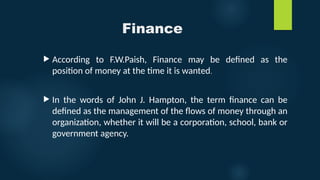
Finance
 According to F.W.Paish, Finance may be defined as the
position of money at the time it is wanted.
 In the words of John J. Hampton, the term finance can be
defined as the management of the flows of money through an
organization, whether it will be a corporation, school, bank or
government agency.
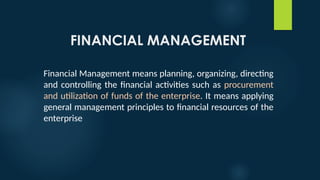
FINANCIAL MANAGEMENT
Financial Management means planning, organizing, directing
and controlling the financial activities such as procurement
and utilization of funds of the enterprise. It means applying
general management principles to financial resources of the
enterprise
Financial Management – Definition
 According to Weston and Brigham,
financial management is an area of
financial decision making, harmonizing
individual motives and enterprise goals.
 In the words of Phillippatus,
financial management is concerned with the managerial
decisions that result in the acquisition and financing of long-
term and short-term credits for the firm.
As such it deals with the situations that require selection of
specific assets / combination of assets, the selection of specific
liability / combination of liabilities as well as the problem of
size and growth of an enterprise.
The analysis of these decisions is based on the expected
inflows and outflows of funds and their effects upon
managerial objectives.
OBJECTIVES OF FINANCIAL
MANAGEMENT
 Its objectives must be consistent with the overall objectives of
business.
 The overall objective of financial management is to provide
maximum return to the owners on their investment in the long-
term. This is known as wealth maximization.
 Wealth maximization means maximizing the market value of
investment in shares of the company.
In order to maximize wealth, financial management must
achieve the following specific objectives
(a) To ensure availability of sufficient funds at reasonable cost
(liquidity).
(b) To ensure effective utilization of funds (financial control).
(c) To ensure safety of funds by creating reserves, re-investing
profits, etc. (minimization of risk).
(d) To ensure adequate return on investment (profitability).
Contd..
(e) To generate and build-up surplus for expansion and growth
(growth).
(f) To minimize cost of capital by developing a sound and
economical combination of corporate securities (economy).
(g) To coordinate the activities of the finance department with
the activities of other departments of the firm (cooperation).
Profit Maximization
Very often maximization of profits is considered to be the main
objective of financial management.
Profitability is an operational concept that signifies economic
efficiency.
Some writers on finance believe that it leads to efficient allocation of
resources and optimum use of capital.
It is said that profit maximization is a simple and straightforward
objective. It also ensures the survival and growth of a business firm.
But modern authors on financial management have criticized the
goal of profit maximization.
FUNCTIONS OF FINANCIAL
MANAGEMENT
 Estimating the Amount of Capital Required
 Determining Capital Structure
 Choice of Sources of Funds
 Procurement of Funds
 Utilizations of Fund
 Disposal of Profits or Surplus
 Management of Cash
 Financial Control
1. Estimating the Amount of Capital Required:
 This is the foremost function of the financial manager.
 Business firms require capital for:
i) purchase of fixed assets,
ii) meeting working capital requirements, and
iii) modernization and expansion of business.
The financial manager makes estimates of funds required for
both short-term and long-term.
2. Determining Capital Structure:
 Once the requirement of capital funds has been determined,
a decision regarding the kind and proportion of various
sources of funds has to be taken.
 For this, financial manager has to determine the proper mix
of equity and debt and short-term and long-term debt ratio.
 This is done to achieve minimum cost of capital and maximize
shareholders wealth
3. Choice of Sources of Funds
 Before the actual procurement of funds, the finance
manager has to decide the sources from which the funds
are to be raised.
 The management can raise finance from various sources
like equity shareholders, preference shareholders,
debenture- holders, banks and other financial institutions,
public deposits, etc.
4. Procurement of Funds:
 The financial manager takes steps to procure the funds required
for the business.
 It might require negotiation with creditors and financial
institutions, issue of prospectus, etc.
 The procurement of funds is dependent not only upon cost of
raising funds but also on other factors like general market
conditions, choice of investors, government policy, etc.
5. Utilizations of Funds:
 The funds procured by the financial manager are to be
prudently invested in various assets so as to maximize the
return on investment.
 While taking investment decisions, management should be
guided by three important principles, viz.,
 safety,
 profitability, and
 liquidity.
6. Disposal of Profits or Surplus:
 The financial manager has to decide how much to retain for
plugging back and how much to distribute as dividend to
shareholders out of the profits of the company.
 The factors which influence these decisions include the trend of
earnings of the company, the trend of the market price of its
shares, the requirements of funds for self- financing the future
programmers’ and so on.
7. Management of Cash:
 Management of cash and other current assets is an important
task of financial manager.
 It involves forecasting the cash inflows and outflows to ensure
that there is neither shortage nor surplus of cash with the
firm.
 Sufficient funds must be available for purchase of materials,
payment of wages and meeting day-to-day expenses.
8. Financial Control
 Evaluation of financial performance is also an important function
of financial manager.
 The overall measure of evaluation is Return on Investment (ROI).
 The other techniques of financial control and evaluation include
budgetary control, cost control, internal audit, break-even
analysis and ratio analysis.
 The financial manager must lay emphasis on financial planning as
well.
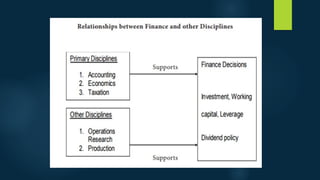
Basic Financial Decisions
 Investing Decision
 Financing Decision
 Dividend Decision
Investing Decision
 Related to investment
 Both long-term and short-term
Long Term
Capital Budgeting
Investment in Long-term
Fixed Asset
Short-term
W/c mgt
Cash, bank, deposits, receivables.
Financing Decision
 Related to collection of fund (Source)
 Debt – equity mix
 Rising of fund both
 Long-term fund
 Capital Structure
 Short-term fund
 Working capital
 Mainly two type
 Financial Planning (Estimating the requirement)
 Capital structure Decision (Identifying the sources)
Dividend Decision
 Decision related to profit
 Distributing profit as dividend
 Retained Earnings – Surplus – Reserve – Plugging back
ROLE OF FINANCE MANAGER
ROLE OF FINANCIAL MANAGER
 Fund rising
 Fund allocation
 Profit planning
(it refers to operating decision in areas in
pricing
costs volume of output and
the firms selection of product lines. it is a bonus for
optimizing investment and financing decisions )
 Understanding the capital market
Contd…
 Prepare financial statements, business activity reports, and
forecasts
 Monitor financial details to ensure that legal requirements
are met
 Supervise employees who do financial reporting and
budgeting
 Review company financial reports and seek ways to reduce
costs
 Analyze market trends to find opportunities for expansion or
for acquiring other companies
 Help management to make financial decisions.
Broadly speaking, financial managers have to have
decisions regarding 4 main topics within a company
 Investment decisions / Capital Budgeting Decision - (long and short
term investment decisions). For example: the most appropriate level
and mix of assets a company should hold.
 Financing decisions / Capital Structure - The optimal levels of each
financing source - E.g. Debt - Equity ratio.
 Liquidity decisions - Involves the current assets and liabilities of the
company - one function is to maintain cash reserves.
 Dividend decisions - Disbursement of dividend to shareholders and
retained earnings
Functions of Finance Manager
1. Forecasting Of Cash Flow.
2. Raising Funds
3. Managing The Flow Of Internal Funds
4. To Facilitate Cost Control
5. To Facilitate Pricing Of Product, Product Lines And
Services
6. Forecasting Profits
7. Measuring Required Return
8. Managing Assets
9. Managing Funds
10. Make Arrangements For The Purchase Of Assets
1. Forecasting of Cash Flow. This is necessary for the
successful day to day operations of the business so
that it can discharge its obligations as and when they
rise. In fact, it involves matching of cash inflows against
outflows and the manager must forecast the sources
and timing of inflows from customers and use them to
pay the liability
2. Raising Funds: the Financial Manager has to plan for
mobilising funds from different sources so that the
requisite amount of funds are made available to the
business enterprise to meet its requirements for short
3. Managing the Flow of Internal Funds: Here the
Manager has to keep a track of the surplus in various
bank accounts of the organisation and ensure that
they are properly utilised to meet the requirements of
the business. This will ensure that liquidity position of
the company is maintained intact with the minimum
amount of external borrowings.
4. To Facilitate Cost Control: The Financial Manager is
generally the first person to recognise when the costs
for the supplies or production processes are exceeding
the standard costs/budgeted figures. Consequently, he
can make recommendations to the top management
for controlling the costs.
5. To Facilitate Pricing of Product, Product Lines and
Services: The Financial Manager can supply important
information about cost changes and cost at varying
levels of production and the profit margins needed to
carry on the business successfully. In fact, financial
manager provides tools of analysis of information in
pricing decisions and contribute to the formulation of
pricing policies jointly with the marketing manager.
6. Forecasting Profits: The Financial manager is
usually responsible for collecting the relevant data to
make forecasts of profit levels in future.
7. Measuring Required Return: The acceptance or
rejection of an investment proposal depends on
whether the expected return from the proposed
investment is equal to or more than the required
return. An investment project is accepted if the
expected return is equal or more than the required
return. Determination of required rate of return is
the responsibility of the financial manager and is a
part of the financing decision.
8. Managing Assets: The function of asset management
focuses on the decision-making role of the financial
manager. Finance personnel meet with other officers of
the firm and participate in making decisions affecting
the current and future utilization of the firm’s resources.
As an example, managers may discuss the total amount
of assets needed by the firm to carry out its operations.
They will determine the composition or a mix of assets
that will help the firm best achieve its goals. They will
identify ways to use existing assets more effectively and
reduce waste and unwarranted expenses.
The decision-making role crosses liquidity and
profitability lines. Converting the idle equipment into
cash improves liquidity. Reducing costs improves
9. Managing Funds: In the management of funds, the
financial manager acts as a specialised staff officer to the
Chief Executive of the company. The manager is
responsible for having sufficient funds for the firm to
conduct its business and to pay its bills. Money must be
located to finance receivables and inventories,
10. make arrangements for the purchase of assets, and to
identify the sources of long-term financing. Cash must be
available to pay dividends declared by the board of
directors. The management of funds has therefore, both
liquidity and profitability aspects.
Functions of Finance
 According to Paul G. Hasings, “finance” is the management of the
monetary affairs of a company. It includes determining what has
to be paid for and when, raising the money on the best terms
available, and devoting the available funds to the best uses.
 Kenneth Midgley and Ronald Burns state: “Financing is the
process of organising the flow of funds so that a business can
carry out its objectives in the most efficient manner and meet its
obligations as they fall due.”
Functions of Finance
 It is the process of acquiring and utilizing funds of a business.
 These are related to overall management of an organization.
 It is concerned with the policy decisions such as like of
business, size of firm, type of equipment used, use of debt,
liquidity position.
 These policy decisions determine the size of the profitability
and riskiness of the business of the firm
 Finance functions can be grouped as outlined
below:
 Financial planning
 Financial control
 Financing decisions
 Investment decision
 Management of income and dividend decision
 Incidental functions
Finance Function – Objectives
1. Assessing the Financial Requirements
2. Proper Utilisation of Funds
3. Increasing Profitability
4. Maximising Value of Firm
Strategic Financial Management
The term "strategic" refers to financial management
practices that are focused on long-term success, as
opposed to "tactical" management decisions, which
relate to short-term positioning.
Strategic Financial Management
It refers to specific planning of the usage and
management of a company's financial resources to
attain its objectives as a business concern and
return maximum value to shareholders over the
long run.
Breaking down the definition
 It’s a planning
 Related to finance of a company
 How to use or manage the finance of company
 For a long-term
 For attain maximum value to shareholders
Wealth maximisation
 Strategic financial management involves
precisely defining
A company's business objectives or goals,
Identifying and quantifying its available or potential
resources, and
Prepare a plan for utilizing finances and other capital
resources to achieve its goals
 After the initial planning phase, strategic
management requires
Establishing ongoing procedures for collecting and
analyzing data,
Making consistent financial decisions,
Tracking and analysing differences, between
budgeted and actual results
To identify problems and,
Take appropriate corrective actions as A dynamic
process of adjustment and fine-tuning.
Key Elements Of Strategic
Financial Management
 Budgeting
 Risk management
 Ongoing review and evaluation.
Strategic financial management
 It is the study of finance with a long term view considering
the strategic goals of the enterprise.
 Financial management is nowadays increasingly referred to
as "Strategic Financial Management" so as to give it an
increased frame of reference.
 To understand what strategic financial management is
about, we must first understand what is meant by the term
"Strategic".
 Which is something that is done as part of a plan that is
meant to achieve a particular purpose.
 Therefore, Strategic Financial Management are those
aspect of the overall plan of the organisation that
concerns financial managers.
 This includes different parts of the business plan, for
example marketing and sales plan, production plan,
personnel plan, capital expenditure, etc.
 These all have financial implications for the financial
managers of an organisation.
 The objective of the Financial Management is the
maximisation of shareholders wealth.
 To satisfy this objective a company requires a "long term
course of action" and this is where strategy fits in.
STRATEGIC FINANCIAL PLANNING
 It involving financial policy has direct interact with
scope and resources deployment .financial
policies –investment and financial choices- should
there for be considered at the corporate level ,and
should not be treated as functional area policy
decisions to be decided at lower level
STEPS IN FINANCIAL PLANNING
 Analyzing the past performance
 Analyzing the operating characteristics
 Determine the corporate strategic and investment
needs
 Forecasting the cash flow from operations
 Analyzing financing alternatives
 Analyzing the consequences of financial plan
 Evaluating consistency of financial policies
ECONOMIC VALUE ADDED (EVA)
 It is a residual measure of financial performance.
 it is defined as the operating profit after tax less the
charge for the capital, both equity and debt ,used in a
business.
 it represents the value added to the share holders by
generating operating profits in excess of the cost of
capital employed in the business .
 EVA increases if operating profits can be made to grow
without enquiry more capital, greater efficiency it is a
management tool that disclose the impact of both strategic
and both operational decision of the management.
 It can prove as an effective tool for increasing share holders
wealth by integrating EVA in for key areas such as
 1 measuring business performance
 2 guiding managerial decision making
 3 aligning managerial incentives with share holders interest
 4 improving financial and business literacy
 EVA = net operating after tax – cost of capital employed
TIME VALUE OF MONEY
 The discounted cash flow criteria of investment
evaluation are based on the concept of time value of
money.
 The time value of money have its logic in the fact that
investors have ample investment opportunity available
to them.
 Therefore the one rupee received today is not of the
same in the value as one rupee received after a period
of time ,since one rupee received can be invested at a
rate of interest there are basically to ways of counting
Thank You

Chapter 1.pptxChapter 1.pptxChapter 1.pptx

  • 1.
  • 2.
  • 5.
    Finance  According toF.W.Paish, Finance may be defined as the position of money at the time it is wanted.  In the words of John J. Hampton, the term finance can be defined as the management of the flows of money through an organization, whether it will be a corporation, school, bank or government agency.
  • 6.
    FINANCIAL MANAGEMENT Financial Managementmeans planning, organizing, directing and controlling the financial activities such as procurement and utilization of funds of the enterprise. It means applying general management principles to financial resources of the enterprise
  • 7.
    Financial Management –Definition  According to Weston and Brigham, financial management is an area of financial decision making, harmonizing individual motives and enterprise goals.
  • 8.
     In thewords of Phillippatus, financial management is concerned with the managerial decisions that result in the acquisition and financing of long- term and short-term credits for the firm. As such it deals with the situations that require selection of specific assets / combination of assets, the selection of specific liability / combination of liabilities as well as the problem of size and growth of an enterprise. The analysis of these decisions is based on the expected inflows and outflows of funds and their effects upon managerial objectives.
  • 9.
    OBJECTIVES OF FINANCIAL MANAGEMENT Its objectives must be consistent with the overall objectives of business.  The overall objective of financial management is to provide maximum return to the owners on their investment in the long- term. This is known as wealth maximization.  Wealth maximization means maximizing the market value of investment in shares of the company.
  • 10.
    In order tomaximize wealth, financial management must achieve the following specific objectives (a) To ensure availability of sufficient funds at reasonable cost (liquidity). (b) To ensure effective utilization of funds (financial control). (c) To ensure safety of funds by creating reserves, re-investing profits, etc. (minimization of risk). (d) To ensure adequate return on investment (profitability).
  • 11.
    Contd.. (e) To generateand build-up surplus for expansion and growth (growth). (f) To minimize cost of capital by developing a sound and economical combination of corporate securities (economy). (g) To coordinate the activities of the finance department with the activities of other departments of the firm (cooperation).
  • 12.
    Profit Maximization Very oftenmaximization of profits is considered to be the main objective of financial management. Profitability is an operational concept that signifies economic efficiency. Some writers on finance believe that it leads to efficient allocation of resources and optimum use of capital. It is said that profit maximization is a simple and straightforward objective. It also ensures the survival and growth of a business firm. But modern authors on financial management have criticized the goal of profit maximization.
  • 13.
    FUNCTIONS OF FINANCIAL MANAGEMENT Estimating the Amount of Capital Required  Determining Capital Structure  Choice of Sources of Funds  Procurement of Funds  Utilizations of Fund  Disposal of Profits or Surplus  Management of Cash  Financial Control
  • 14.
    1. Estimating theAmount of Capital Required:  This is the foremost function of the financial manager.  Business firms require capital for: i) purchase of fixed assets, ii) meeting working capital requirements, and iii) modernization and expansion of business. The financial manager makes estimates of funds required for both short-term and long-term.
  • 15.
    2. Determining CapitalStructure:  Once the requirement of capital funds has been determined, a decision regarding the kind and proportion of various sources of funds has to be taken.  For this, financial manager has to determine the proper mix of equity and debt and short-term and long-term debt ratio.  This is done to achieve minimum cost of capital and maximize shareholders wealth
  • 16.
    3. Choice ofSources of Funds  Before the actual procurement of funds, the finance manager has to decide the sources from which the funds are to be raised.  The management can raise finance from various sources like equity shareholders, preference shareholders, debenture- holders, banks and other financial institutions, public deposits, etc.
  • 17.
    4. Procurement ofFunds:  The financial manager takes steps to procure the funds required for the business.  It might require negotiation with creditors and financial institutions, issue of prospectus, etc.  The procurement of funds is dependent not only upon cost of raising funds but also on other factors like general market conditions, choice of investors, government policy, etc.
  • 18.
    5. Utilizations ofFunds:  The funds procured by the financial manager are to be prudently invested in various assets so as to maximize the return on investment.  While taking investment decisions, management should be guided by three important principles, viz.,  safety,  profitability, and  liquidity.
  • 19.
    6. Disposal ofProfits or Surplus:  The financial manager has to decide how much to retain for plugging back and how much to distribute as dividend to shareholders out of the profits of the company.  The factors which influence these decisions include the trend of earnings of the company, the trend of the market price of its shares, the requirements of funds for self- financing the future programmers’ and so on.
  • 20.
    7. Management ofCash:  Management of cash and other current assets is an important task of financial manager.  It involves forecasting the cash inflows and outflows to ensure that there is neither shortage nor surplus of cash with the firm.  Sufficient funds must be available for purchase of materials, payment of wages and meeting day-to-day expenses.
  • 21.
    8. Financial Control Evaluation of financial performance is also an important function of financial manager.  The overall measure of evaluation is Return on Investment (ROI).  The other techniques of financial control and evaluation include budgetary control, cost control, internal audit, break-even analysis and ratio analysis.  The financial manager must lay emphasis on financial planning as well.
  • 22.
    Basic Financial Decisions Investing Decision  Financing Decision  Dividend Decision
  • 23.
    Investing Decision  Relatedto investment  Both long-term and short-term Long Term Capital Budgeting Investment in Long-term Fixed Asset Short-term W/c mgt Cash, bank, deposits, receivables.
  • 24.
    Financing Decision  Relatedto collection of fund (Source)  Debt – equity mix  Rising of fund both  Long-term fund  Capital Structure  Short-term fund  Working capital  Mainly two type  Financial Planning (Estimating the requirement)  Capital structure Decision (Identifying the sources)
  • 25.
    Dividend Decision  Decisionrelated to profit  Distributing profit as dividend  Retained Earnings – Surplus – Reserve – Plugging back
  • 26.
  • 27.
    ROLE OF FINANCIALMANAGER  Fund rising  Fund allocation  Profit planning (it refers to operating decision in areas in pricing costs volume of output and the firms selection of product lines. it is a bonus for optimizing investment and financing decisions )  Understanding the capital market
  • 28.
    Contd…  Prepare financialstatements, business activity reports, and forecasts  Monitor financial details to ensure that legal requirements are met  Supervise employees who do financial reporting and budgeting  Review company financial reports and seek ways to reduce costs  Analyze market trends to find opportunities for expansion or for acquiring other companies  Help management to make financial decisions.
  • 29.
    Broadly speaking, financialmanagers have to have decisions regarding 4 main topics within a company  Investment decisions / Capital Budgeting Decision - (long and short term investment decisions). For example: the most appropriate level and mix of assets a company should hold.  Financing decisions / Capital Structure - The optimal levels of each financing source - E.g. Debt - Equity ratio.  Liquidity decisions - Involves the current assets and liabilities of the company - one function is to maintain cash reserves.  Dividend decisions - Disbursement of dividend to shareholders and retained earnings
  • 30.
    Functions of FinanceManager 1. Forecasting Of Cash Flow. 2. Raising Funds 3. Managing The Flow Of Internal Funds 4. To Facilitate Cost Control 5. To Facilitate Pricing Of Product, Product Lines And Services 6. Forecasting Profits 7. Measuring Required Return 8. Managing Assets 9. Managing Funds 10. Make Arrangements For The Purchase Of Assets
  • 31.
    1. Forecasting ofCash Flow. This is necessary for the successful day to day operations of the business so that it can discharge its obligations as and when they rise. In fact, it involves matching of cash inflows against outflows and the manager must forecast the sources and timing of inflows from customers and use them to pay the liability 2. Raising Funds: the Financial Manager has to plan for mobilising funds from different sources so that the requisite amount of funds are made available to the business enterprise to meet its requirements for short
  • 32.
    3. Managing theFlow of Internal Funds: Here the Manager has to keep a track of the surplus in various bank accounts of the organisation and ensure that they are properly utilised to meet the requirements of the business. This will ensure that liquidity position of the company is maintained intact with the minimum amount of external borrowings. 4. To Facilitate Cost Control: The Financial Manager is generally the first person to recognise when the costs for the supplies or production processes are exceeding the standard costs/budgeted figures. Consequently, he can make recommendations to the top management for controlling the costs.
  • 33.
    5. To FacilitatePricing of Product, Product Lines and Services: The Financial Manager can supply important information about cost changes and cost at varying levels of production and the profit margins needed to carry on the business successfully. In fact, financial manager provides tools of analysis of information in pricing decisions and contribute to the formulation of pricing policies jointly with the marketing manager. 6. Forecasting Profits: The Financial manager is usually responsible for collecting the relevant data to make forecasts of profit levels in future.
  • 34.
    7. Measuring RequiredReturn: The acceptance or rejection of an investment proposal depends on whether the expected return from the proposed investment is equal to or more than the required return. An investment project is accepted if the expected return is equal or more than the required return. Determination of required rate of return is the responsibility of the financial manager and is a part of the financing decision.
  • 35.
    8. Managing Assets:The function of asset management focuses on the decision-making role of the financial manager. Finance personnel meet with other officers of the firm and participate in making decisions affecting the current and future utilization of the firm’s resources. As an example, managers may discuss the total amount of assets needed by the firm to carry out its operations. They will determine the composition or a mix of assets that will help the firm best achieve its goals. They will identify ways to use existing assets more effectively and reduce waste and unwarranted expenses. The decision-making role crosses liquidity and profitability lines. Converting the idle equipment into cash improves liquidity. Reducing costs improves
  • 36.
    9. Managing Funds:In the management of funds, the financial manager acts as a specialised staff officer to the Chief Executive of the company. The manager is responsible for having sufficient funds for the firm to conduct its business and to pay its bills. Money must be located to finance receivables and inventories, 10. make arrangements for the purchase of assets, and to identify the sources of long-term financing. Cash must be available to pay dividends declared by the board of directors. The management of funds has therefore, both liquidity and profitability aspects.
  • 37.
    Functions of Finance According to Paul G. Hasings, “finance” is the management of the monetary affairs of a company. It includes determining what has to be paid for and when, raising the money on the best terms available, and devoting the available funds to the best uses.  Kenneth Midgley and Ronald Burns state: “Financing is the process of organising the flow of funds so that a business can carry out its objectives in the most efficient manner and meet its obligations as they fall due.”
  • 38.
    Functions of Finance It is the process of acquiring and utilizing funds of a business.  These are related to overall management of an organization.  It is concerned with the policy decisions such as like of business, size of firm, type of equipment used, use of debt, liquidity position.  These policy decisions determine the size of the profitability and riskiness of the business of the firm
  • 39.
     Finance functionscan be grouped as outlined below:  Financial planning  Financial control  Financing decisions  Investment decision  Management of income and dividend decision  Incidental functions
  • 40.
    Finance Function –Objectives 1. Assessing the Financial Requirements 2. Proper Utilisation of Funds 3. Increasing Profitability 4. Maximising Value of Firm
  • 41.
    Strategic Financial Management Theterm "strategic" refers to financial management practices that are focused on long-term success, as opposed to "tactical" management decisions, which relate to short-term positioning.
  • 42.
    Strategic Financial Management Itrefers to specific planning of the usage and management of a company's financial resources to attain its objectives as a business concern and return maximum value to shareholders over the long run.
  • 43.
    Breaking down thedefinition  It’s a planning  Related to finance of a company  How to use or manage the finance of company  For a long-term  For attain maximum value to shareholders Wealth maximisation
  • 44.
     Strategic financialmanagement involves precisely defining A company's business objectives or goals, Identifying and quantifying its available or potential resources, and Prepare a plan for utilizing finances and other capital resources to achieve its goals
  • 45.
     After theinitial planning phase, strategic management requires Establishing ongoing procedures for collecting and analyzing data, Making consistent financial decisions, Tracking and analysing differences, between budgeted and actual results To identify problems and, Take appropriate corrective actions as A dynamic process of adjustment and fine-tuning.
  • 46.
    Key Elements OfStrategic Financial Management  Budgeting  Risk management  Ongoing review and evaluation.
  • 47.
    Strategic financial management It is the study of finance with a long term view considering the strategic goals of the enterprise.  Financial management is nowadays increasingly referred to as "Strategic Financial Management" so as to give it an increased frame of reference.  To understand what strategic financial management is about, we must first understand what is meant by the term "Strategic".  Which is something that is done as part of a plan that is meant to achieve a particular purpose.
  • 48.
     Therefore, StrategicFinancial Management are those aspect of the overall plan of the organisation that concerns financial managers.  This includes different parts of the business plan, for example marketing and sales plan, production plan, personnel plan, capital expenditure, etc.  These all have financial implications for the financial managers of an organisation.  The objective of the Financial Management is the maximisation of shareholders wealth.  To satisfy this objective a company requires a "long term course of action" and this is where strategy fits in.
  • 49.
    STRATEGIC FINANCIAL PLANNING It involving financial policy has direct interact with scope and resources deployment .financial policies –investment and financial choices- should there for be considered at the corporate level ,and should not be treated as functional area policy decisions to be decided at lower level
  • 50.
    STEPS IN FINANCIALPLANNING  Analyzing the past performance  Analyzing the operating characteristics  Determine the corporate strategic and investment needs  Forecasting the cash flow from operations  Analyzing financing alternatives  Analyzing the consequences of financial plan  Evaluating consistency of financial policies
  • 51.
    ECONOMIC VALUE ADDED(EVA)  It is a residual measure of financial performance.  it is defined as the operating profit after tax less the charge for the capital, both equity and debt ,used in a business.  it represents the value added to the share holders by generating operating profits in excess of the cost of capital employed in the business .
  • 52.
     EVA increasesif operating profits can be made to grow without enquiry more capital, greater efficiency it is a management tool that disclose the impact of both strategic and both operational decision of the management.  It can prove as an effective tool for increasing share holders wealth by integrating EVA in for key areas such as  1 measuring business performance  2 guiding managerial decision making  3 aligning managerial incentives with share holders interest  4 improving financial and business literacy  EVA = net operating after tax – cost of capital employed
  • 53.
    TIME VALUE OFMONEY  The discounted cash flow criteria of investment evaluation are based on the concept of time value of money.  The time value of money have its logic in the fact that investors have ample investment opportunity available to them.  Therefore the one rupee received today is not of the same in the value as one rupee received after a period of time ,since one rupee received can be invested at a rate of interest there are basically to ways of counting
  • 54.