INVESTMENT
BANKING
Presented By:
Sejal Shrimali……….115
Lisha Joy…………….53
Akshita Prajapati…...89
Richa Parmar……….71
Tejal Damor…………24
Introduction:
What Does Investment Bank -Mean?
A financial intermediary that performs a
variety of services. This includes
underwriting, acting as an intermediary
between an issuer of securities and the
investing public, facilitating mergers and
other corporate reorganizations, and also
acting as a broker for institutional clients.
The role of the investment bank begins
with pre-underwriting counseling and
continues after the distribution of securities
in the form of advice.
An investment bank is a financial
institution that assists corporations and
governments in raising capital by
underwriting and acting as the agent in the
issuance of securities.
An investment bank also assists
companies involved in mergers and
acquisitions, divestitures, etc.
Use case of investment:
Investment banking activities:
Underwriting
Acting as an intermediary between an
issuer of securities and the investing
public
Facilitating mergers and other corporate
reorganizations
Broker for institutional clients.
Role of an Investment Bank:
The major work of investment banks
includes a lot of consulting.
For instance, they offer advices on
mergers and acquisitions to companies
The other arena where they give advice
are tracking the market and determining
when should a company come out with a
public offering and what is the best
possible way to manage the public assets
of businesses
The role that an investment bank plays
sometimes gets overlapped with that of a
Private brokerage house.
The usual advice of buying and selling is
also given by investment banks.
Purpose of Investment Banking:-
An intermediary between the capital
markets (investors) and corporations
(borrowers)
Offers strategic advice and financial
analysis on Mergers & Acquisitions,
Divestitures, and Capital Structure
Offers Equity and Fixed Income
Underwriting (e.g.. IPO’s, High Yield
Offerings)
Provides asset management advice to
high net worth individuals and institutions.
Provides Sales and Trading of Equity
(Stocks), Fixed Income Securities (Bonds),
Derivatives (Options).
Offers research and advice on publicly
listed stocks and bonds to institutional and
individual investors.
Structure of Investment Banks:-
Major investment banking divisions
include:
Investment Banking:-
Intermediary between the capital
markets
Advice and analysis on M&A and
Capital Structure
Equity and Fixed Income
Underwriting
 Asset Management:
Provide asset management services
to investors and institutions
 Sales and Trading:
Sales and Trading of Equity (Stocks),
Fixed Income Securities (Bonds),
Derivatives (Options).
 Research:
Provide research on public stocks
and bonds
TYPES OF INVESTMENT
BANKING:
FD (Fixed Deposit)
MUTUAL FUND
INSURANCE
GOLD
FD:
IF you are making investment in FD then
there will be a customer and a worker.
There are two types of FD:
Saving account
Current account
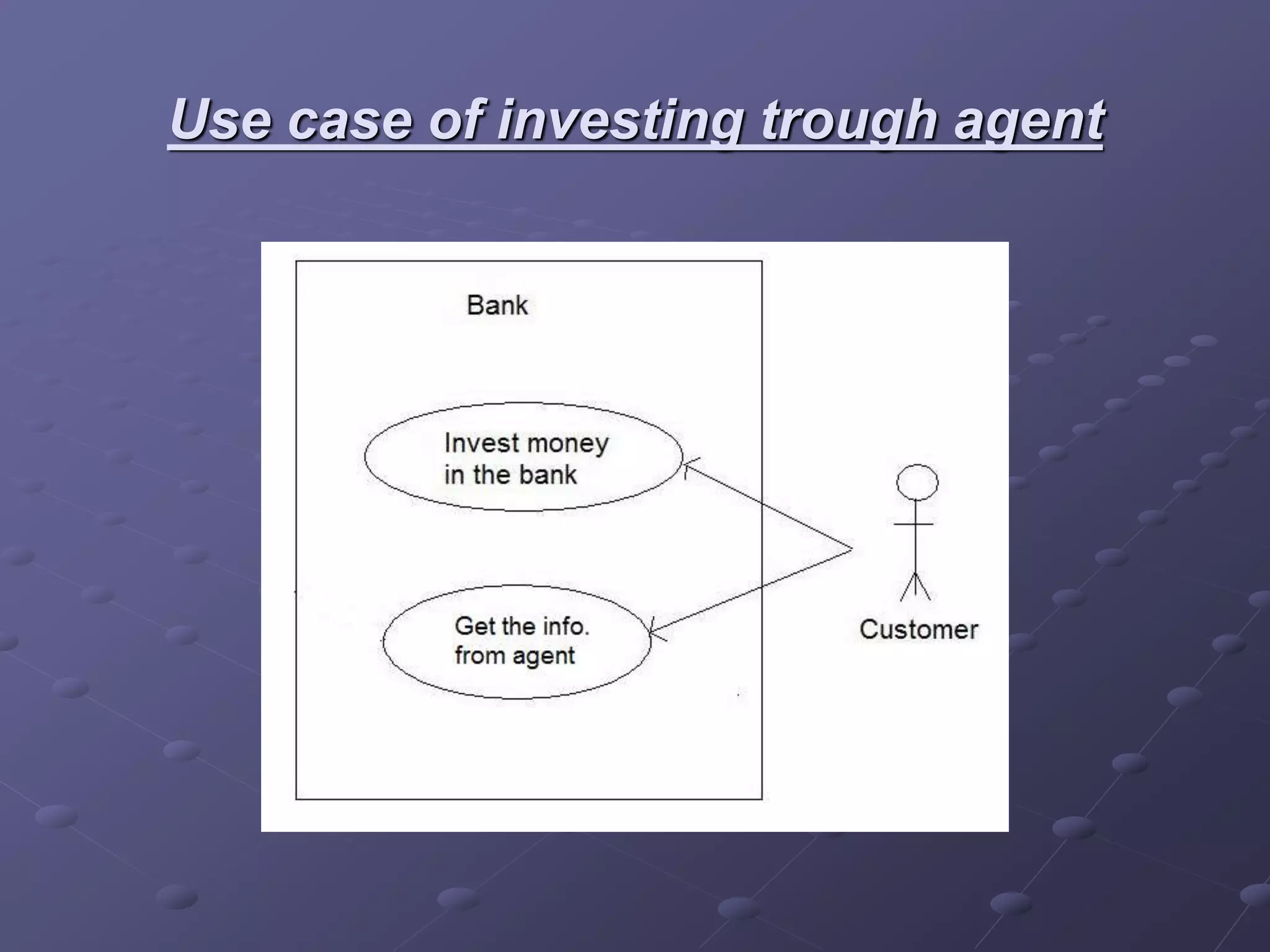
Use case of investing trough agent
Activity diagram:
Activity diagram of invest trough agent
Topics to cover in mutual fund:-
Concept
Organization of a Mutual Fund
Advantages of Mutual Funds
Frequently Used Terms
Equity based investment:
In equity based investment all the money
is invested in pure stock share market
Debt based investment:
And in debt based investment all money
will be invested government based
security and bonds
The return that we get is non-taxable
The NAV (the net asset value) is the unit
of mutual fund. For e.g. the HDFC bank
returns 98%.
If a customer wants to invest in mutual
fund pan card is necessary.
The worker in mutual fund is AMC (asset
management company) and the actor is
the customer.
Flow of a Mutual Fund
Advantages of mutual fund:-
Professional Management
Diversification
Convenient Administration
Return Potential
Low Costs
Liquidity
Transparency
Flexibility
Choice of schemes
Tax benefits
Well regulated
Use case diagram:
Activity diagram:
Insurance:
Insurance, in law and economics, is a form of risk
management primarily used to hedge against the risk of
a contingent, uncertain loss. Insurance is defined as the
equitable transfer of the risk of a loss, from one entity to
another, in exchange for payment. An insurer is a
company selling the insurance; an insured or
policyholder is the person or entity buying the
insurance policy. The insurance rate is a factor used to
determine the amount to be charged for a certain
amount of insurance coverage, called the premium.
Risk management, the practice of appraising and
controlling risk, has evolved as a discrete field of study
and practice.
The transaction involves the insured
assuming a guaranteed and known
relatively small loss in the form of payment
to the insurer in exchange for the insurer's
promise to compensate (indemnify) the
insured in the case of a large, possibly
devastating loss. The insured receives a
contract called the insurance policy which
details the conditions and circumstances
under which the insured will be.
Use case of insurance:
Gold:
Gold is a wonderful investment idea and so
say the returns on the investment.
Gold has come to be a good investment
option that helps to maximize returns and
minimize the risks.
With stocks and shares recording a dip with
the slightest of excuses, gold now has come
to be a good addition to the portfolio that
helps stabilize the returns and ensures
some level of certainty in returns.
Resources
Visit to the bank (yes bank)
Internet
www.google.co.in
www.yesbank.in
Bank manager (vishal raval)
Work of group members
All the members has done visit to the
bank.
The collection of the information is done
by Akshita and Sejal.
Searching the information from the net is
done by Lisha and Tejal.
Reporting is done by Richa.
Thank you……

investment banking.ppt

  • 1.
  • 2.
    Presented By: Sejal Shrimali……….115 LishaJoy…………….53 Akshita Prajapati…...89 Richa Parmar……….71 Tejal Damor…………24
  • 3.
    Introduction: What Does InvestmentBank -Mean? A financial intermediary that performs a variety of services. This includes underwriting, acting as an intermediary between an issuer of securities and the investing public, facilitating mergers and other corporate reorganizations, and also acting as a broker for institutional clients.
  • 4.
    The role ofthe investment bank begins with pre-underwriting counseling and continues after the distribution of securities in the form of advice. An investment bank is a financial institution that assists corporations and governments in raising capital by underwriting and acting as the agent in the issuance of securities. An investment bank also assists companies involved in mergers and acquisitions, divestitures, etc.
  • 5.
    Use case ofinvestment:
  • 6.
    Investment banking activities: Underwriting Actingas an intermediary between an issuer of securities and the investing public Facilitating mergers and other corporate reorganizations Broker for institutional clients.
  • 7.
    Role of anInvestment Bank: The major work of investment banks includes a lot of consulting. For instance, they offer advices on mergers and acquisitions to companies The other arena where they give advice are tracking the market and determining when should a company come out with a public offering and what is the best possible way to manage the public assets of businesses
  • 8.
    The role thatan investment bank plays sometimes gets overlapped with that of a Private brokerage house. The usual advice of buying and selling is also given by investment banks.
  • 9.
    Purpose of InvestmentBanking:- An intermediary between the capital markets (investors) and corporations (borrowers) Offers strategic advice and financial analysis on Mergers & Acquisitions, Divestitures, and Capital Structure Offers Equity and Fixed Income Underwriting (e.g.. IPO’s, High Yield Offerings)
  • 10.
    Provides asset managementadvice to high net worth individuals and institutions. Provides Sales and Trading of Equity (Stocks), Fixed Income Securities (Bonds), Derivatives (Options). Offers research and advice on publicly listed stocks and bonds to institutional and individual investors.
  • 11.
    Structure of InvestmentBanks:- Major investment banking divisions include: Investment Banking:- Intermediary between the capital markets Advice and analysis on M&A and Capital Structure Equity and Fixed Income Underwriting
  • 12.
     Asset Management: Provideasset management services to investors and institutions  Sales and Trading: Sales and Trading of Equity (Stocks), Fixed Income Securities (Bonds), Derivatives (Options).  Research: Provide research on public stocks and bonds
  • 13.
    TYPES OF INVESTMENT BANKING: FD(Fixed Deposit) MUTUAL FUND INSURANCE GOLD
  • 14.
    FD: IF you aremaking investment in FD then there will be a customer and a worker. There are two types of FD: Saving account Current account
  • 15.
    Use case ofinvesting trough agent
  • 16.
  • 17.
    Activity diagram ofinvest trough agent
  • 18.
    Topics to coverin mutual fund:- Concept Organization of a Mutual Fund Advantages of Mutual Funds Frequently Used Terms
  • 19.
    Equity based investment: Inequity based investment all the money is invested in pure stock share market Debt based investment: And in debt based investment all money will be invested government based security and bonds The return that we get is non-taxable
  • 20.
    The NAV (thenet asset value) is the unit of mutual fund. For e.g. the HDFC bank returns 98%. If a customer wants to invest in mutual fund pan card is necessary. The worker in mutual fund is AMC (asset management company) and the actor is the customer.
  • 21.
    Flow of aMutual Fund
  • 22.
    Advantages of mutualfund:- Professional Management Diversification Convenient Administration Return Potential Low Costs Liquidity Transparency Flexibility Choice of schemes Tax benefits Well regulated
  • 23.
  • 24.
  • 25.
    Insurance: Insurance, in lawand economics, is a form of risk management primarily used to hedge against the risk of a contingent, uncertain loss. Insurance is defined as the equitable transfer of the risk of a loss, from one entity to another, in exchange for payment. An insurer is a company selling the insurance; an insured or policyholder is the person or entity buying the insurance policy. The insurance rate is a factor used to determine the amount to be charged for a certain amount of insurance coverage, called the premium. Risk management, the practice of appraising and controlling risk, has evolved as a discrete field of study and practice.
  • 26.
    The transaction involvesthe insured assuming a guaranteed and known relatively small loss in the form of payment to the insurer in exchange for the insurer's promise to compensate (indemnify) the insured in the case of a large, possibly devastating loss. The insured receives a contract called the insurance policy which details the conditions and circumstances under which the insured will be.
  • 27.
    Use case ofinsurance:
  • 28.
    Gold: Gold is awonderful investment idea and so say the returns on the investment. Gold has come to be a good investment option that helps to maximize returns and minimize the risks. With stocks and shares recording a dip with the slightest of excuses, gold now has come to be a good addition to the portfolio that helps stabilize the returns and ensures some level of certainty in returns.
  • 29.
    Resources Visit to thebank (yes bank) Internet www.google.co.in www.yesbank.in Bank manager (vishal raval)
  • 30.
    Work of groupmembers All the members has done visit to the bank. The collection of the information is done by Akshita and Sejal. Searching the information from the net is done by Lisha and Tejal. Reporting is done by Richa.
  • 31.