byby
MOHAMEDMOHAMED
NISHAD .TNISHAD .T
FINANCEFINANCE
Finance is the life-blood of business.Finance is the life-blood of business.
 Without finance neither any business canWithout finance neither any business can
be started nor successfully run .be started nor successfully run .
 Finance is needed to promote or establishFinance is needed to promote or establish
business, acquire fixed assets, makebusiness, acquire fixed assets, make
necessary investigations, develop productnecessary investigations, develop product
keep man and machines at workkeep man and machines at work
,encourage management to make,encourage management to make
progress and create values.progress and create values.
FINANCEFINANCE
Finance is defined as the provision ofFinance is defined as the provision of
money at the time when it is required. It ismoney at the time when it is required. It is
the life-blood of the an enterprise. Withoutthe life-blood of the an enterprise. Without
adequate finance, no enterprise canadequate finance, no enterprise can
possibly accomplish its objectivespossibly accomplish its objectives
FINANCEFINANCE
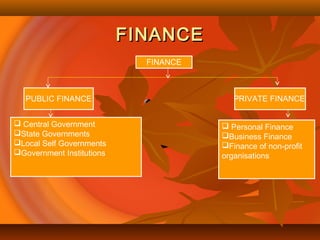
FINANCE
PUBLIC FINANCE
 Central Government
State Governments
Local Self Governments
Government Institutions
PRIVATE FINANCE
 Personal Finance
Business Finance
Finance of non-profit
organisations
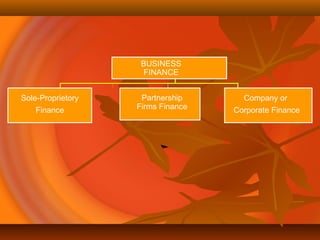
BUSINESS
FINANCE
Sole-Proprietory
Finance
Partnership
Firms Finance
Company or
Corporate Finance
FINANCIAL MANAGEMENTFINANCIAL MANAGEMENT
 Traditionally known as ‘Business Finance’Traditionally known as ‘Business Finance’
and ‘Corporation Finance’and ‘Corporation Finance’
 According to Guthmann & Dougall “BusinessAccording to Guthmann & Dougall “Business
finance can be broadly defined as the activityfinance can be broadly defined as the activity
concerned with planning, raising, controllingconcerned with planning, raising, controlling
and administering the funds used in theand administering the funds used in the
business.”business.”
FINANCIAL MANAGEMENTFINANCIAL MANAGEMENT
Financial management is one theFinancial management is one the
functional area of management. It refer tofunctional area of management. It refer to
that part of the management activity whichthat part of the management activity which
is concerned with the planning andis concerned with the planning and
controlling of firms financial resources.controlling of firms financial resources.
DEFINITIONDEFINITION
““Financial management is the applicationFinancial management is the application
of planning and control function of theof planning and control function of the
finance function”finance function”
Howard and UptonHoward and Upton
Importance of FMImportance of FM
 No business, whether big, medium, orNo business, whether big, medium, or
small can be started without an adequatesmall can be started without an adequate
amount of finance. Right from the veryamount of finance. Right from the very
beginning, i.e., conceiving an idea tobeginning, i.e., conceiving an idea to
business, finance is needed to promote orbusiness, finance is needed to promote or
establish the business, acquire fixedestablish the business, acquire fixed
assets, make investigation such as marketassets, make investigation such as market
survey etc, develop product, keep men &survey etc, develop product, keep men &
machine at work, encourage managementmachine at work, encourage management
to make progress and create valuesto make progress and create values
Importance of FMImportance of FM
 The importance of corporation finance hasThe importance of corporation finance has
arisen because of the fact that presentarisen because of the fact that present
day business activities are predominantlyday business activities are predominantly
carried on company or corporate from ofcarried on company or corporate from of
the organisation. Following factors furtherthe organisation. Following factors further
increased the importance of FMincreased the importance of FM
1.1. The increase in size and influence of theThe increase in size and influence of the
business enterprisebusiness enterprise
2.2. Wide distribution of corporate ownershipWide distribution of corporate ownership
3.3. Separation of ownership & managementSeparation of ownership & management
Importance of FMImportance of FM
 FM is indispensible to any orgn as it helpsFM is indispensible to any orgn as it helps
1.1. Financial planning & successful promotion of anFinancial planning & successful promotion of an
enterpriseenterprise
2.2. Acquisition of funds as & when required at minimumAcquisition of funds as & when required at minimum
possible costpossible cost
3.3. Proper use & allocation of fundsProper use & allocation of funds
4.4. Taking sound financial decisionTaking sound financial decision
5.5. Improving the profitability through financial controlsImproving the profitability through financial controls
6.6. Increasing the wealth of investors and nations, &Increasing the wealth of investors and nations, &
7.7. Promoting & mobilising individual & corporatePromoting & mobilising individual & corporate
savingssavings
Finance functionFinance function
 Finance function is the most important ofFinance function is the most important of
all functions. It remains a focus of allall functions. It remains a focus of all
activities. It is not possible to substitute oractivities. It is not possible to substitute or
eliminate this function bcoz the businesseliminate this function bcoz the business
will close down in the absence of finance.will close down in the absence of finance.
The need for money is continuous. It startThe need for money is continuous. It start
with setting up of an enterprise & remainswith setting up of an enterprise & remains
at all times. The development &at all times. The development &
expansion of business rather needs moreexpansion of business rather needs more
commitment of funds.commitment of funds.
Finance functionFinance function
 The fund will have to be raised from variousThe fund will have to be raised from various
sources. The receiving money is notsources. The receiving money is not
enough, its utilisation is more important. Theenough, its utilisation is more important. The
money once received will have be returnedmoney once received will have be returned
also. If its use is proper then its return will bealso. If its use is proper then its return will be
easy otherwise it will create difficulties foreasy otherwise it will create difficulties for
repayment. The management should haverepayment. The management should have
an idea of using the money profitably. It mayan idea of using the money profitably. It may
be easy to raise funds but it may be difficultbe easy to raise funds but it may be difficult
to repay them.to repay them.
Approaches to financeApproaches to finance
functionfunction The Traditional approachThe Traditional approach
It relates to the initial stage of its evolution duringIt relates to the initial stage of its evolution during
1920s & 1930s when the term ‘corporate finance’1920s & 1930s when the term ‘corporate finance’
was used to describe what is known as financialwas used to describe what is known as financial
management today. According to this approach,management today. According to this approach,
the scope of finance function was confined tothe scope of finance function was confined to
only procurement of funds needed by a firm ononly procurement of funds needed by a firm on
most suitable terms. The utilisation of funds wasmost suitable terms. The utilisation of funds was
considered beyond the purview of financeconsidered beyond the purview of finance
function. It was felt that decisions regarding thefunction. It was felt that decisions regarding the
application of funds are taken somewhere else inapplication of funds are taken somewhere else in
the organisationthe organisation
The Modern approachThe Modern approach
 It includes both raising of funds as well asIt includes both raising of funds as well as
their effective utilisation.their effective utilisation.
 The cost of raising funds and the returnsThe cost of raising funds and the returns
from their use should be compared.from their use should be compared.
 The funds raised should be able to giveThe funds raised should be able to give
more returns than the cost involved inmore returns than the cost involved in
procuring them.procuring them.
 This approach considers the three decisionsThis approach considers the three decisions
Investment decision, Financing decisions &Investment decision, Financing decisions &
Dividend decisionDividend decision
Aims of Finance functionAims of Finance function
 Acquiring Sufficient FundsAcquiring Sufficient Funds
 Proper Utilisation FundsProper Utilisation Funds
 Increasing profitabilityIncreasing profitability
 Maximising firm’s ValueMaximising firm’s Value
Scope / Content of FMScope / Content of FM
 Estimating Financial RequirementEstimating Financial Requirement
 Deciding Capital StructureDeciding Capital Structure
 Selecting a Source of FinanceSelecting a Source of Finance
 Selecting a Patten of InvestmentSelecting a Patten of Investment
 Proper Cash ManagementProper Cash Management
 Implementing Financial ControlImplementing Financial Control
 Proper use of surplusProper use of surplus
Objective of FMObjective of FM
FM is concerned with procurement &useFM is concerned with procurement &use
of funds. Its main aim is to use businessof funds. Its main aim is to use business
fund in such a way that the firm’s value orfund in such a way that the firm’s value or
earnings are maximised. This objectiveearnings are maximised. This objective
can be achieved bycan be achieved by
 Profit maximisationProfit maximisation
 Wealth maximisationWealth maximisation
PROFIT MAXIMISATIONPROFIT MAXIMISATION
 Arguments are in favour of profit maximisation:Arguments are in favour of profit maximisation:
1.1. When profit earning is the aim of business then profitWhen profit earning is the aim of business then profit
maximisation should be the obvious objective.maximisation should be the obvious objective.
2.2. Profitability is the barometer for measuring efficiency.Profitability is the barometer for measuring efficiency.
3.3. A business will be able to survive under unfavourableA business will be able to survive under unfavourable
situation, only if it has some past earningssituation, only if it has some past earnings
4.4. Profit are the main sources of finance for growth of aProfit are the main sources of finance for growth of a
business.business.
5.5. Profitability is essential for fulfilling social goals alsoProfitability is essential for fulfilling social goals also
PROFIT MAXIMISATIONPROFIT MAXIMISATION
 Arguments against profit maximisationArguments against profit maximisation
1.1. AmbiguityAmbiguity
2.2. Ignores Time Value of MoneyIgnores Time Value of Money
3.3. Ignores Risk FactorIgnores Risk Factor
4.4. Dividend PolicyDividend Policy
WEALTH MAXIMISATIONWEALTH MAXIMISATION
 Arguments in favour of wealth maximisationArguments in favour of wealth maximisation
1.1. It serves the interest of owners & other stake holdersIt serves the interest of owners & other stake holders
2.2. It is consistent with the objective of owners welfareIt is consistent with the objective of owners welfare
3.3. It implies long-run survival & growth of the firmIt implies long-run survival & growth of the firm
4.4. It takes into consideration the risk factor & time valueIt takes into consideration the risk factor & time value
of moneyof money
5.5. The effect of dividend policy on market price ofThe effect of dividend policy on market price of
shares also consideredshares also considered
6.6. This leads towards maximising shareholders utility orThis leads towards maximising shareholders utility or
value maxmisation of equity share holdersvalue maxmisation of equity share holders
WEALTH MAXIMISATIONWEALTH MAXIMISATION
 Arguments against wealth maximisationArguments against wealth maximisation
1.1. It is a prescriptive ideaIt is a prescriptive idea
2.2. This objective not necessarily sociallyThis objective not necessarily socially
desirable.desirable.
3.3. There is some controversy as to whetherThere is some controversy as to whether
objective is to maximise the shareholder’sobjective is to maximise the shareholder’s
wealth or wealth of the firmwealth or wealth of the firm
4.4. This objective may also face difficultiesThis objective may also face difficulties
when ownership & management arewhen ownership & management are
separatedseparated
FINANCIAL DECISIONFINANCIAL DECISION
 Investment DecisionInvestment Decision
 Long-term investment decisionLong-term investment decision
 Short-term investment decisionShort-term investment decision
 Financing DecisionFinancing Decision
 Dividend DecisionDividend Decision
Functional areas of FMFunctional areas of FM
 Determining Financial NeedsDetermining Financial Needs
 Selecting the Source of FundsSelecting the Source of Funds
 Financial Analysis & interpretationFinancial Analysis & interpretation
 Cost-Volume –Profit AnalysisCost-Volume –Profit Analysis
 Capital BudgetingCapital Budgeting
 Working capital ManagementWorking capital Management
 Profit planning & controlProfit planning & control
 Dividend policyDividend policy
Functions of FinancialFunctions of Financial
ManagerManager
 Financial Forecasting & PlanningFinancial Forecasting & Planning
 Acquisition of FundsAcquisition of Funds
 Investment of FundsInvestment of Funds
 Helping in valuation decisionHelping in valuation decision
 Maintain proper liquidityMaintain proper liquidity
The financial decision involvesThe financial decision involves
 Investment, Financial & DividendInvestment, Financial & Dividend
decisiondecision
 Investment, Capital budgeting&Investment, Capital budgeting&
Dividend decisionDividend decision
 Investment, financing &DividendInvestment, financing &Dividend
decisiondecision
Value or wealth maximisationValue or wealth maximisation
objectives stands forobjectives stands for
 Maximisation of earnings per shareMaximisation of earnings per share
 Maximisation of value of debtMaximisation of value of debt
instumentinstument
 Maximising the value of equityMaximising the value of equity
 None of theseNone of these
F M is concerned with theF M is concerned with the
 Raising of fund from the marketRaising of fund from the market
 Investing the funds in most appropriateInvesting the funds in most appropriate
asstsassts
 Procurement of funds & their effectiveProcurement of funds & their effective
utlisationutlisation
 Management of working fund onlyManagement of working fund only
Objective of the firm in FMObjective of the firm in FM
isis
 Profit MaximisationProfit Maximisation
 Profitability maximisationProfitability maximisation
 Wealth maximisationWealth maximisation
 Cash maximisationCash maximisation
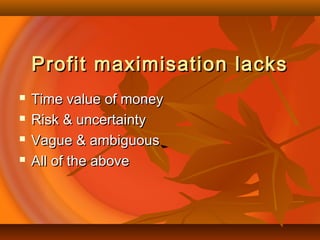
Profit maximisation lacksProfit maximisation lacks
 Time value of moneyTime value of money
 Risk & uncertaintyRisk & uncertainty
 Vague & ambiguousVague & ambiguous
 All of the aboveAll of the above
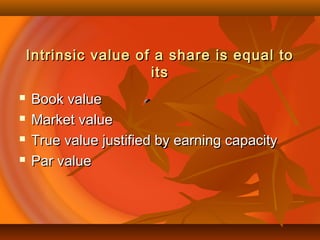
Intrinsic value of a share is equal toIntrinsic value of a share is equal to
itsits
 Book valueBook value
 Market valueMarket value
 True value justified by earning capacityTrue value justified by earning capacity
 Par valuePar value
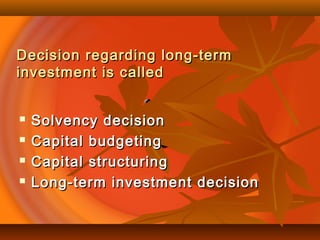
Decision regarding long-termDecision regarding long-term
investment is calledinvestment is called
 Solvency decisionSolvency decision
 Capital budgetingCapital budgeting
 Capital structuringCapital structuring
 Long-term investment decisionLong-term investment decision

Financial mangement intro nsd

  • 1.
  • 2.
    FINANCEFINANCE Finance is thelife-blood of business.Finance is the life-blood of business.  Without finance neither any business canWithout finance neither any business can be started nor successfully run .be started nor successfully run .  Finance is needed to promote or establishFinance is needed to promote or establish business, acquire fixed assets, makebusiness, acquire fixed assets, make necessary investigations, develop productnecessary investigations, develop product keep man and machines at workkeep man and machines at work ,encourage management to make,encourage management to make progress and create values.progress and create values.
  • 3.
    FINANCEFINANCE Finance is definedas the provision ofFinance is defined as the provision of money at the time when it is required. It ismoney at the time when it is required. It is the life-blood of the an enterprise. Withoutthe life-blood of the an enterprise. Without adequate finance, no enterprise canadequate finance, no enterprise can possibly accomplish its objectivespossibly accomplish its objectives
  • 4.
    FINANCEFINANCE FINANCE PUBLIC FINANCE  CentralGovernment State Governments Local Self Governments Government Institutions PRIVATE FINANCE  Personal Finance Business Finance Finance of non-profit organisations
  • 5.
  • 6.
    FINANCIAL MANAGEMENTFINANCIAL MANAGEMENT Traditionally known as ‘Business Finance’Traditionally known as ‘Business Finance’ and ‘Corporation Finance’and ‘Corporation Finance’  According to Guthmann & Dougall “BusinessAccording to Guthmann & Dougall “Business finance can be broadly defined as the activityfinance can be broadly defined as the activity concerned with planning, raising, controllingconcerned with planning, raising, controlling and administering the funds used in theand administering the funds used in the business.”business.”
  • 7.
    FINANCIAL MANAGEMENTFINANCIAL MANAGEMENT Financialmanagement is one theFinancial management is one the functional area of management. It refer tofunctional area of management. It refer to that part of the management activity whichthat part of the management activity which is concerned with the planning andis concerned with the planning and controlling of firms financial resources.controlling of firms financial resources.
  • 8.
    DEFINITIONDEFINITION ““Financial management isthe applicationFinancial management is the application of planning and control function of theof planning and control function of the finance function”finance function” Howard and UptonHoward and Upton
  • 9.
    Importance of FMImportanceof FM  No business, whether big, medium, orNo business, whether big, medium, or small can be started without an adequatesmall can be started without an adequate amount of finance. Right from the veryamount of finance. Right from the very beginning, i.e., conceiving an idea tobeginning, i.e., conceiving an idea to business, finance is needed to promote orbusiness, finance is needed to promote or establish the business, acquire fixedestablish the business, acquire fixed assets, make investigation such as marketassets, make investigation such as market survey etc, develop product, keep men &survey etc, develop product, keep men & machine at work, encourage managementmachine at work, encourage management to make progress and create valuesto make progress and create values
  • 10.
    Importance of FMImportanceof FM  The importance of corporation finance hasThe importance of corporation finance has arisen because of the fact that presentarisen because of the fact that present day business activities are predominantlyday business activities are predominantly carried on company or corporate from ofcarried on company or corporate from of the organisation. Following factors furtherthe organisation. Following factors further increased the importance of FMincreased the importance of FM 1.1. The increase in size and influence of theThe increase in size and influence of the business enterprisebusiness enterprise 2.2. Wide distribution of corporate ownershipWide distribution of corporate ownership 3.3. Separation of ownership & managementSeparation of ownership & management
  • 11.
    Importance of FMImportanceof FM  FM is indispensible to any orgn as it helpsFM is indispensible to any orgn as it helps 1.1. Financial planning & successful promotion of anFinancial planning & successful promotion of an enterpriseenterprise 2.2. Acquisition of funds as & when required at minimumAcquisition of funds as & when required at minimum possible costpossible cost 3.3. Proper use & allocation of fundsProper use & allocation of funds 4.4. Taking sound financial decisionTaking sound financial decision 5.5. Improving the profitability through financial controlsImproving the profitability through financial controls 6.6. Increasing the wealth of investors and nations, &Increasing the wealth of investors and nations, & 7.7. Promoting & mobilising individual & corporatePromoting & mobilising individual & corporate savingssavings
  • 12.
    Finance functionFinance function Finance function is the most important ofFinance function is the most important of all functions. It remains a focus of allall functions. It remains a focus of all activities. It is not possible to substitute oractivities. It is not possible to substitute or eliminate this function bcoz the businesseliminate this function bcoz the business will close down in the absence of finance.will close down in the absence of finance. The need for money is continuous. It startThe need for money is continuous. It start with setting up of an enterprise & remainswith setting up of an enterprise & remains at all times. The development &at all times. The development & expansion of business rather needs moreexpansion of business rather needs more commitment of funds.commitment of funds.
  • 13.
    Finance functionFinance function The fund will have to be raised from variousThe fund will have to be raised from various sources. The receiving money is notsources. The receiving money is not enough, its utilisation is more important. Theenough, its utilisation is more important. The money once received will have be returnedmoney once received will have be returned also. If its use is proper then its return will bealso. If its use is proper then its return will be easy otherwise it will create difficulties foreasy otherwise it will create difficulties for repayment. The management should haverepayment. The management should have an idea of using the money profitably. It mayan idea of using the money profitably. It may be easy to raise funds but it may be difficultbe easy to raise funds but it may be difficult to repay them.to repay them.
  • 14.
    Approaches to financeApproachesto finance functionfunction The Traditional approachThe Traditional approach It relates to the initial stage of its evolution duringIt relates to the initial stage of its evolution during 1920s & 1930s when the term ‘corporate finance’1920s & 1930s when the term ‘corporate finance’ was used to describe what is known as financialwas used to describe what is known as financial management today. According to this approach,management today. According to this approach, the scope of finance function was confined tothe scope of finance function was confined to only procurement of funds needed by a firm ononly procurement of funds needed by a firm on most suitable terms. The utilisation of funds wasmost suitable terms. The utilisation of funds was considered beyond the purview of financeconsidered beyond the purview of finance function. It was felt that decisions regarding thefunction. It was felt that decisions regarding the application of funds are taken somewhere else inapplication of funds are taken somewhere else in the organisationthe organisation
  • 15.
    The Modern approachTheModern approach  It includes both raising of funds as well asIt includes both raising of funds as well as their effective utilisation.their effective utilisation.  The cost of raising funds and the returnsThe cost of raising funds and the returns from their use should be compared.from their use should be compared.  The funds raised should be able to giveThe funds raised should be able to give more returns than the cost involved inmore returns than the cost involved in procuring them.procuring them.  This approach considers the three decisionsThis approach considers the three decisions Investment decision, Financing decisions &Investment decision, Financing decisions & Dividend decisionDividend decision
  • 16.
    Aims of FinancefunctionAims of Finance function  Acquiring Sufficient FundsAcquiring Sufficient Funds  Proper Utilisation FundsProper Utilisation Funds  Increasing profitabilityIncreasing profitability  Maximising firm’s ValueMaximising firm’s Value
  • 17.
    Scope / Contentof FMScope / Content of FM  Estimating Financial RequirementEstimating Financial Requirement  Deciding Capital StructureDeciding Capital Structure  Selecting a Source of FinanceSelecting a Source of Finance  Selecting a Patten of InvestmentSelecting a Patten of Investment  Proper Cash ManagementProper Cash Management  Implementing Financial ControlImplementing Financial Control  Proper use of surplusProper use of surplus
  • 18.
    Objective of FMObjectiveof FM FM is concerned with procurement &useFM is concerned with procurement &use of funds. Its main aim is to use businessof funds. Its main aim is to use business fund in such a way that the firm’s value orfund in such a way that the firm’s value or earnings are maximised. This objectiveearnings are maximised. This objective can be achieved bycan be achieved by  Profit maximisationProfit maximisation  Wealth maximisationWealth maximisation
  • 19.
    PROFIT MAXIMISATIONPROFIT MAXIMISATION Arguments are in favour of profit maximisation:Arguments are in favour of profit maximisation: 1.1. When profit earning is the aim of business then profitWhen profit earning is the aim of business then profit maximisation should be the obvious objective.maximisation should be the obvious objective. 2.2. Profitability is the barometer for measuring efficiency.Profitability is the barometer for measuring efficiency. 3.3. A business will be able to survive under unfavourableA business will be able to survive under unfavourable situation, only if it has some past earningssituation, only if it has some past earnings 4.4. Profit are the main sources of finance for growth of aProfit are the main sources of finance for growth of a business.business. 5.5. Profitability is essential for fulfilling social goals alsoProfitability is essential for fulfilling social goals also
  • 20.
    PROFIT MAXIMISATIONPROFIT MAXIMISATION Arguments against profit maximisationArguments against profit maximisation 1.1. AmbiguityAmbiguity 2.2. Ignores Time Value of MoneyIgnores Time Value of Money 3.3. Ignores Risk FactorIgnores Risk Factor 4.4. Dividend PolicyDividend Policy
  • 21.
    WEALTH MAXIMISATIONWEALTH MAXIMISATION Arguments in favour of wealth maximisationArguments in favour of wealth maximisation 1.1. It serves the interest of owners & other stake holdersIt serves the interest of owners & other stake holders 2.2. It is consistent with the objective of owners welfareIt is consistent with the objective of owners welfare 3.3. It implies long-run survival & growth of the firmIt implies long-run survival & growth of the firm 4.4. It takes into consideration the risk factor & time valueIt takes into consideration the risk factor & time value of moneyof money 5.5. The effect of dividend policy on market price ofThe effect of dividend policy on market price of shares also consideredshares also considered 6.6. This leads towards maximising shareholders utility orThis leads towards maximising shareholders utility or value maxmisation of equity share holdersvalue maxmisation of equity share holders
  • 22.
    WEALTH MAXIMISATIONWEALTH MAXIMISATION Arguments against wealth maximisationArguments against wealth maximisation 1.1. It is a prescriptive ideaIt is a prescriptive idea 2.2. This objective not necessarily sociallyThis objective not necessarily socially desirable.desirable. 3.3. There is some controversy as to whetherThere is some controversy as to whether objective is to maximise the shareholder’sobjective is to maximise the shareholder’s wealth or wealth of the firmwealth or wealth of the firm 4.4. This objective may also face difficultiesThis objective may also face difficulties when ownership & management arewhen ownership & management are separatedseparated
  • 23.
    FINANCIAL DECISIONFINANCIAL DECISION Investment DecisionInvestment Decision  Long-term investment decisionLong-term investment decision  Short-term investment decisionShort-term investment decision  Financing DecisionFinancing Decision  Dividend DecisionDividend Decision
  • 24.
    Functional areas ofFMFunctional areas of FM  Determining Financial NeedsDetermining Financial Needs  Selecting the Source of FundsSelecting the Source of Funds  Financial Analysis & interpretationFinancial Analysis & interpretation  Cost-Volume –Profit AnalysisCost-Volume –Profit Analysis  Capital BudgetingCapital Budgeting  Working capital ManagementWorking capital Management  Profit planning & controlProfit planning & control  Dividend policyDividend policy
  • 25.
    Functions of FinancialFunctionsof Financial ManagerManager  Financial Forecasting & PlanningFinancial Forecasting & Planning  Acquisition of FundsAcquisition of Funds  Investment of FundsInvestment of Funds  Helping in valuation decisionHelping in valuation decision  Maintain proper liquidityMaintain proper liquidity
  • 27.
    The financial decisioninvolvesThe financial decision involves  Investment, Financial & DividendInvestment, Financial & Dividend decisiondecision  Investment, Capital budgeting&Investment, Capital budgeting& Dividend decisionDividend decision  Investment, financing &DividendInvestment, financing &Dividend decisiondecision
  • 28.
    Value or wealthmaximisationValue or wealth maximisation objectives stands forobjectives stands for  Maximisation of earnings per shareMaximisation of earnings per share  Maximisation of value of debtMaximisation of value of debt instumentinstument  Maximising the value of equityMaximising the value of equity  None of theseNone of these
  • 29.
    F M isconcerned with theF M is concerned with the  Raising of fund from the marketRaising of fund from the market  Investing the funds in most appropriateInvesting the funds in most appropriate asstsassts  Procurement of funds & their effectiveProcurement of funds & their effective utlisationutlisation  Management of working fund onlyManagement of working fund only
  • 30.
    Objective of thefirm in FMObjective of the firm in FM isis  Profit MaximisationProfit Maximisation  Profitability maximisationProfitability maximisation  Wealth maximisationWealth maximisation  Cash maximisationCash maximisation
  • 31.
    Profit maximisation lacksProfitmaximisation lacks  Time value of moneyTime value of money  Risk & uncertaintyRisk & uncertainty  Vague & ambiguousVague & ambiguous  All of the aboveAll of the above
  • 32.
    Intrinsic value ofa share is equal toIntrinsic value of a share is equal to itsits  Book valueBook value  Market valueMarket value  True value justified by earning capacityTrue value justified by earning capacity  Par valuePar value
  • 33.
    Decision regarding long-termDecisionregarding long-term investment is calledinvestment is called  Solvency decisionSolvency decision  Capital budgetingCapital budgeting  Capital structuringCapital structuring  Long-term investment decisionLong-term investment decision