1Chapte
Khursheed Ahmad Bhat, HOD. Department of Hospital Administration TMU
2
Chapter 1 – The Investment Setting.
 Chapter outlines
 What is Finance?
 Scope of Corporate Finance?
 Importance of corporate finance.
 Profit maximisation V/S wealth maximisation objectives.
 Role of finance manager.
 Sources of Finance.
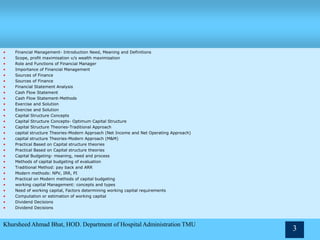
• Financial Management- Introduction Need, Meaning and Definitions
• Scope, profit maximisation v/s wealth maximisation
• Role and Functions of Financial Manager
• Importance of Financial Management
• Sources of Finance
• Financial Statement Analysis
• Cash Flow Statement
• Cash Flow Statement-Methods
• Exercise and Solution
• Capital Structure Concepts
• Capital Structure Concepts- Optimum Capital Structure
• Capital Structure Theories-Traditional Approach
• capital structure Theories-Modern Approach (Net Income and Net Operating Approach)
• capital structure Theories-Modern Approach (M&M)
• Practical Based on Capital structure theories
• Capital Budgeting- meaning, need and process
• Methods of capital budgeting of evaluation
• Traditional Method: pay back and ARR
• Modern methods: NPV, IRR, PI
• Practical on Modern methods of capital budgeting
• working capital Management: concepts and types
• Need of working capital, Factors determining working capital requirements
• Computation or estimation of working capital
• Dividend Decisions
Khursheed Ahmad Bhat, HOD. Department of Hospital Administration TMU
3
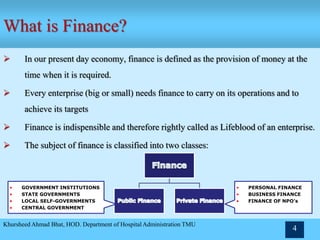
What is Finance?
 In our present day economy, finance is defined as the provision of money at the
time when it is required.
 Every enterprise (big or small) needs finance to carry on its operations and to
achieve its targets
 Finance is indispensible and therefore rightly called as Lifeblood of an enterprise.
 The subject of finance is classified into two classes:
Khursheed Ahmad Bhat, HOD. Department of Hospital Administration TMU
4
• GOVERNMENT INSTITUTIONS
• STATE GOVERNMENTS
• LOCAL SELF-GOVERNMENTS
• CENTRAL GOVERNMENT
• PERSONAL FINANCE
• BUSINESS FINANCE
• FINANCE OF NPO’s
Meaning Of Finance
 Literally speaking, business finance connotes finance of business activities. It is
composed of two words (i) Business and (ii) Finance.
• The word business literally means “a state of being busy”
• All creative human activities relating to the production and distribution of goods &
services for satisfying human wants are known as business.
• Finance refers to the management of flows of money through an organisation.
• It concerns with the manipulation, use and control of money,
 There are three approaches to finance
1. Provision of funds to the business on most suitable basis. It confines finance to the
raising of funds and to the study of institutions and instruments from where funds
are raised.
2. Provision and management of cash.
3. Raising of funds and their effective utilisation.
Khursheed Ahmad Bhat, HOD. Department of Hospital Administration TMU
5
Business Finance
 Business finance can further be subdivided into three categories, viz
I. Sole-propritory finance
II. Partnership firm finance
III. Corporate or company finance
Khursheed Ahmad Bhat, HOD. Department of Hospital Administration TMU
6
Definition of Business Finance
• “That business activity which is concerned with the acquisition and conservation of
capital funds in meeting the financial needs and overall objectives of a business
enterprise.” Wheeler
• Business finance can be broadly defined as the activity concerned with the planning,
raising, controlling and administering the funds used in the business.” Guthmannn
• Business finance deals primarily with raising, administering and disbursing funds by
privately owned business units operating in non-financial fields of industry” Prather
Khursheed Ahmad Bhat, HOD. Department of Hospital Administration TMU
7
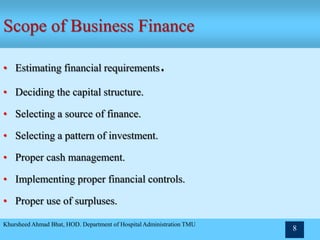
Scope of Business Finance
• Estimating financial requirements.
• Deciding the capital structure.
• Selecting a source of finance.
• Selecting a pattern of investment.
• Proper cash management.
• Implementing proper financial controls.
• Proper use of surpluses.
Khursheed Ahmad Bhat, HOD. Department of Hospital Administration TMU
8
Importance of Business Finance
• Finance is the lifeblood and nerve centre of a business.
• Universal lubricant which keeps the enterprise dynamic.
• The importance of corporate finance (a constituent of business
finance) has arisen because of the fact that present day business
activities are predominantly carried on company or corporate form of
organisation.
• The advent of corporate enterprises has resulted into:
1. The increase in size and influence of business enterprises.
2. Wide distribution of corporate ownership and
3. Separation of ownership and management.
Khursheed Ahmad Bhat, HOD. Department of Hospital Administration TMU
9
Financial management is indispensable to
any organisation as it helps in:
• Financial planning & successful promotion of an enterprise.
• Acquisition of funds at minimum possible cost.
• Proper use and allocation of funds.
• Taking sound financial decisions.
• Improving profitability through financial controls
• Increasing wealth of investors and the nation.
• Promoting and mobilising individual and corporate savings.
Khursheed Ahmad Bhat, HOD. Department of Hospital Administration TMU
10
Relationship of finance with other business
functions.
Business Functions of a Manufacturing Concern
Purchase
Function
Production
Function
Distribution
Function
Accounting
Function
Personnel
Function
R & D
Function
Khursheed Ahmad Bhat, HOD. Department of Hospital Administration TMU
11
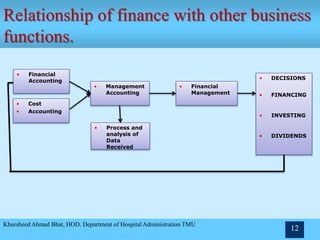
Relationship of finance with other business
functions.
Khursheed Ahmad Bhat, HOD. Department of Hospital Administration TMU
12
• Financial
Accounting
• Financial
Accounting
• Cost
• Accounting
• Management
Accounting
• Process and
analysis of
Data
Received
• Financial
Management
• DECISIONS
• FINANCING
• INVESTING
• DIVIDENDS
Objective of Financial Management
Profit Maximisation:
• Profit earning is the main aim of every economic activity.
• A business as an economic institution must earn profit to cover its cost a d provide
funds for growth.
• No business can survive without profit earning. So profit is a measure of efficiency
and serves as a protection against risk which cant be ensured, as the accumulated
profit enables a business to face risk, competition and adverse government policies.
Wealth Maximisation:
• wealth maximisation is the appropriate objective of an enterprise.
• Financial theory asserts that wealth maximisation is the single substitute for a
stockholder’s utility.
• When the firm maximises stockholder’s wealth, the individual stockholder can use
this wealth to maximise his individual utility.
Khursheed Ahmad Bhat, HOD. Department of Hospital Administration TMU
13
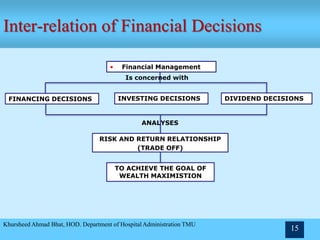
Inter-relation of Financial Decisions
Khursheed Ahmad Bhat, HOD. Department of Hospital Administration TMU
14
INVESTMENT
DECISION
DIVIDEND
DECISION
FINANCING
DECISION
•INTER-RELATION OF FINANCIAL DECISION
Inter-relation of Financial Decisions
Khursheed Ahmad Bhat, HOD. Department of Hospital Administration TMU
15
• Financial Management
FINANCING DECISIONS INVESTING DECISIONS DIVIDEND DECISIONS
RISK AND RETURN RELATIONSHIP
(TRADE OFF)
TO ACHIEVE THE GOAL OF
WEALTH MAXIMISTION
Is concerned with
ANALYSES
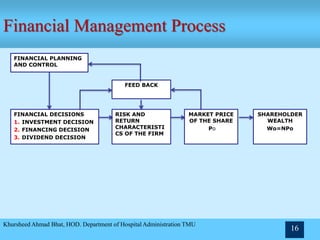
Financial Management Process
Khursheed Ahmad Bhat, HOD. Department of Hospital Administration TMU
16
FINANCIAL PLANNING
AND CONTROL
FINANCIAL DECISIONS
1. INVESTMENT DECISION
2. FINANCING DECISION
3. DIVIDEND DECISION
RISK AND
RETURN
CHARACTERISTI
CS OF THE FIRM
MARKET PRICE
OF THE SHARE
Po
SHAREHOLDER
WEALTH
Wo=NPo
FEED BACK
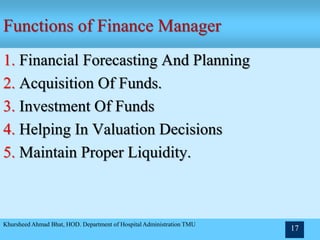
Functions of Finance Manager
1. Financial Forecasting And Planning
2. Acquisition Of Funds.
3. Investment Of Funds
4. Helping In Valuation Decisions
5. Maintain Proper Liquidity.
Khursheed Ahmad Bhat, HOD. Department of Hospital Administration TMU
17
Organisation of The Finance Function
Khursheed Ahmad Bhat, HOD. Department of Hospital Administration TMU
18
Board Of Directors
Managing Director
Vice President Finance Vice President SalesVice President Production
Financial Controller Treasurers
Accounting
And Payroll
Profit
AnalysisBudgeting
Annual
Reports
Planning &
Control
Relation with
Banks &
Financial
Institutions
Protect Funds
& Securities
AuditCash
Management
Additional
Funds
Khursheed Ahmad Bhat, HOD. Department of Hospital Administration TMU
19

Chapter 1 – financial management

  • 1.
  • 2.
    Khursheed Ahmad Bhat,HOD. Department of Hospital Administration TMU 2 Chapter 1 – The Investment Setting.  Chapter outlines  What is Finance?  Scope of Corporate Finance?  Importance of corporate finance.  Profit maximisation V/S wealth maximisation objectives.  Role of finance manager.  Sources of Finance.
  • 3.
    • Financial Management-Introduction Need, Meaning and Definitions • Scope, profit maximisation v/s wealth maximisation • Role and Functions of Financial Manager • Importance of Financial Management • Sources of Finance • Sources of Finance • Financial Statement Analysis • Cash Flow Statement • Cash Flow Statement-Methods • Exercise and Solution • Exercise and Solution • Capital Structure Concepts • Capital Structure Concepts- Optimum Capital Structure • Capital Structure Theories-Traditional Approach • capital structure Theories-Modern Approach (Net Income and Net Operating Approach) • capital structure Theories-Modern Approach (M&M) • Practical Based on Capital structure theories • Practical Based on Capital structure theories • Capital Budgeting- meaning, need and process • Methods of capital budgeting of evaluation • Traditional Method: pay back and ARR • Modern methods: NPV, IRR, PI • Practical on Modern methods of capital budgeting • working capital Management: concepts and types • Need of working capital, Factors determining working capital requirements • Computation or estimation of working capital • Dividend Decisions • Dividend Decisions Khursheed Ahmad Bhat, HOD. Department of Hospital Administration TMU 3
  • 4.
    What is Finance? In our present day economy, finance is defined as the provision of money at the time when it is required.  Every enterprise (big or small) needs finance to carry on its operations and to achieve its targets  Finance is indispensible and therefore rightly called as Lifeblood of an enterprise.  The subject of finance is classified into two classes: Khursheed Ahmad Bhat, HOD. Department of Hospital Administration TMU 4 • GOVERNMENT INSTITUTIONS • STATE GOVERNMENTS • LOCAL SELF-GOVERNMENTS • CENTRAL GOVERNMENT • PERSONAL FINANCE • BUSINESS FINANCE • FINANCE OF NPO’s
  • 5.
    Meaning Of Finance Literally speaking, business finance connotes finance of business activities. It is composed of two words (i) Business and (ii) Finance. • The word business literally means “a state of being busy” • All creative human activities relating to the production and distribution of goods & services for satisfying human wants are known as business. • Finance refers to the management of flows of money through an organisation. • It concerns with the manipulation, use and control of money,  There are three approaches to finance 1. Provision of funds to the business on most suitable basis. It confines finance to the raising of funds and to the study of institutions and instruments from where funds are raised. 2. Provision and management of cash. 3. Raising of funds and their effective utilisation. Khursheed Ahmad Bhat, HOD. Department of Hospital Administration TMU 5
  • 6.
    Business Finance  Businessfinance can further be subdivided into three categories, viz I. Sole-propritory finance II. Partnership firm finance III. Corporate or company finance Khursheed Ahmad Bhat, HOD. Department of Hospital Administration TMU 6
  • 7.
    Definition of BusinessFinance • “That business activity which is concerned with the acquisition and conservation of capital funds in meeting the financial needs and overall objectives of a business enterprise.” Wheeler • Business finance can be broadly defined as the activity concerned with the planning, raising, controlling and administering the funds used in the business.” Guthmannn • Business finance deals primarily with raising, administering and disbursing funds by privately owned business units operating in non-financial fields of industry” Prather Khursheed Ahmad Bhat, HOD. Department of Hospital Administration TMU 7
  • 8.
    Scope of BusinessFinance • Estimating financial requirements. • Deciding the capital structure. • Selecting a source of finance. • Selecting a pattern of investment. • Proper cash management. • Implementing proper financial controls. • Proper use of surpluses. Khursheed Ahmad Bhat, HOD. Department of Hospital Administration TMU 8
  • 9.
    Importance of BusinessFinance • Finance is the lifeblood and nerve centre of a business. • Universal lubricant which keeps the enterprise dynamic. • The importance of corporate finance (a constituent of business finance) has arisen because of the fact that present day business activities are predominantly carried on company or corporate form of organisation. • The advent of corporate enterprises has resulted into: 1. The increase in size and influence of business enterprises. 2. Wide distribution of corporate ownership and 3. Separation of ownership and management. Khursheed Ahmad Bhat, HOD. Department of Hospital Administration TMU 9
  • 10.
    Financial management isindispensable to any organisation as it helps in: • Financial planning & successful promotion of an enterprise. • Acquisition of funds at minimum possible cost. • Proper use and allocation of funds. • Taking sound financial decisions. • Improving profitability through financial controls • Increasing wealth of investors and the nation. • Promoting and mobilising individual and corporate savings. Khursheed Ahmad Bhat, HOD. Department of Hospital Administration TMU 10
  • 11.
    Relationship of financewith other business functions. Business Functions of a Manufacturing Concern Purchase Function Production Function Distribution Function Accounting Function Personnel Function R & D Function Khursheed Ahmad Bhat, HOD. Department of Hospital Administration TMU 11
  • 12.
    Relationship of financewith other business functions. Khursheed Ahmad Bhat, HOD. Department of Hospital Administration TMU 12 • Financial Accounting • Financial Accounting • Cost • Accounting • Management Accounting • Process and analysis of Data Received • Financial Management • DECISIONS • FINANCING • INVESTING • DIVIDENDS
  • 13.
    Objective of FinancialManagement Profit Maximisation: • Profit earning is the main aim of every economic activity. • A business as an economic institution must earn profit to cover its cost a d provide funds for growth. • No business can survive without profit earning. So profit is a measure of efficiency and serves as a protection against risk which cant be ensured, as the accumulated profit enables a business to face risk, competition and adverse government policies. Wealth Maximisation: • wealth maximisation is the appropriate objective of an enterprise. • Financial theory asserts that wealth maximisation is the single substitute for a stockholder’s utility. • When the firm maximises stockholder’s wealth, the individual stockholder can use this wealth to maximise his individual utility. Khursheed Ahmad Bhat, HOD. Department of Hospital Administration TMU 13
  • 14.
    Inter-relation of FinancialDecisions Khursheed Ahmad Bhat, HOD. Department of Hospital Administration TMU 14 INVESTMENT DECISION DIVIDEND DECISION FINANCING DECISION •INTER-RELATION OF FINANCIAL DECISION
  • 15.
    Inter-relation of FinancialDecisions Khursheed Ahmad Bhat, HOD. Department of Hospital Administration TMU 15 • Financial Management FINANCING DECISIONS INVESTING DECISIONS DIVIDEND DECISIONS RISK AND RETURN RELATIONSHIP (TRADE OFF) TO ACHIEVE THE GOAL OF WEALTH MAXIMISTION Is concerned with ANALYSES
  • 16.
    Financial Management Process KhursheedAhmad Bhat, HOD. Department of Hospital Administration TMU 16 FINANCIAL PLANNING AND CONTROL FINANCIAL DECISIONS 1. INVESTMENT DECISION 2. FINANCING DECISION 3. DIVIDEND DECISION RISK AND RETURN CHARACTERISTI CS OF THE FIRM MARKET PRICE OF THE SHARE Po SHAREHOLDER WEALTH Wo=NPo FEED BACK
  • 17.
    Functions of FinanceManager 1. Financial Forecasting And Planning 2. Acquisition Of Funds. 3. Investment Of Funds 4. Helping In Valuation Decisions 5. Maintain Proper Liquidity. Khursheed Ahmad Bhat, HOD. Department of Hospital Administration TMU 17
  • 18.
    Organisation of TheFinance Function Khursheed Ahmad Bhat, HOD. Department of Hospital Administration TMU 18 Board Of Directors Managing Director Vice President Finance Vice President SalesVice President Production Financial Controller Treasurers Accounting And Payroll Profit AnalysisBudgeting Annual Reports Planning & Control Relation with Banks & Financial Institutions Protect Funds & Securities AuditCash Management Additional Funds
  • 19.
    Khursheed Ahmad Bhat,HOD. Department of Hospital Administration TMU 19