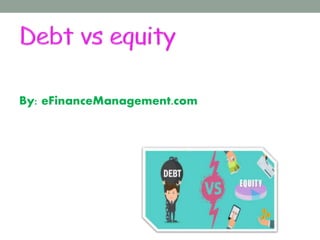
By: eFinanceManagement.com
1. Introduction
2. Sources of Equity
3. Sources of Debt
4. Advantages of Debt
compared to Equity
5. Disadvantages of Debt
Compared to Equity
6. Comparison between
Debt and Equity
Companies can raise capital via debt or
equity. Equity refers to stocks, or an ownership stake, in a
company. Buyers of a company's equity become
shareholders in that company. The shareholders recoup
their investment when the company's value increases
(their shares rise in value), or when the company pays
a dividend. Buyers of a company's debt are lenders; they
recoup their investment in the form of interest paid by the
company on the debt.
Debt market and equity market are broad terms for two
categories of investment that are bought and sold.
Debt instruments are essentially loans that yield
payments of interest to their owners.
Equities are inherently riskier than debt and have a
greater potential for big gains or big losses.
1. Retained Earning:-
Firms can obtain equity financing by retaining earnings rather than
by distributing the earnings to their owners. For permanently
retaining the earnings the company may issue bonus shares to its
shareholders.
2. Corporate Investors:-
Many established companies purchase equity in younger, private
companies. The investing companies are known as strategic
partners, strategic investors, corporate investors, or corporate
partners. Such investors create a network of companies.
3. Crowd funding:-
People invest in the companies because they believe in their ideas
and expect higher returns in future. Crowd funding involves a
number of people investing in the company in small amounts. The
money collected from the people is summed up to determine
whether the targeted funds have been received or not.

1.Insurance Agencies:
Insurance agencies or companies are another major sources of debt
financing to small business or startup companies. They normally offer 2
types of loans i.e. Policy Loan or Mortgage Loan. A policy loan
depends on the measure of cash that is paid as a premium on the
protection policy.
2.Purchasing on Installments:
Buying goods on installments is one of another sources of debt
financing. Buying on installments involves buying assets benefit as well
as making installment in pre-decided installments. The purchaser needs
to mortgage his assets until the point when full settlements of
payments are made.
3.Finance Companies:
Hundreds of alternative finance companies provide short-term cash
loans to small businesses. However, these loans often carry high fees
and interest rates. In addition, they are loosely regulated, and
standards tend to be low. Small-business owners are advised to be
extremely careful before signing a contract with one of these groups.
A lender is entitled only to repayment of the agreed-
upon principal of the loan plus interest, and has no direct
claim on future profits of the business.
Interest on the debt can be deducted on the company's
tax return lowering the actual cost of the loan to the
company.
Raising debt capital is less complicated because the
company is not required to comply with state and federal
securities laws and regulations.
Debt financing is widely available in one form or another
for most small business owners. It is a popular avenue for
many businesses because the terms are often clear and
finite, and owners retain full control of their operations
unlike an equity financing arrangement.
Interest is a fixed cost which raises the
company's break-even point. High interest costs during
difficult financial periods can increase the risk of
insolvency.
The company is usually required to pledge assets of the
company to the lender as collateral, and owners of the
company are in some cases required to personally
guarantee repayment of the loan.
Debt instruments often contain restrictions on the
company's activities, preventing management from
pursuing alternative financing options and non-core
business opportunities.
debt financing is the potential for personal financial
losses if it becomes impossible to repay the loan.
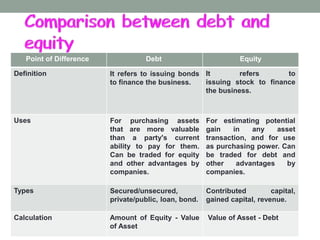
Point of Difference Debt Equity
Definition It refers to issuing bonds
to finance the business.
It refers to
issuing stock to finance
the business.
Uses For purchasing assets
that are more valuable
than a party's current
ability to pay for them.
Can be traded for equity
and other advantages by
companies.
For estimating potential
gain in any asset
transaction, and for use
as purchasing power. Can
be traded for debt and
other advantages by
companies.
Types Secured/unsecured,
private/public, loan, bond.
Contributed capital,
gained capital, revenue.
Calculation Amount of Equity - Value
of Asset
Value of Asset - Debt
Whether business takes debt or equity financing,
depends upon the need and requirement of the
business. Debt and equity both are solutions that can
solve the fund related problems of the business. Both
debt and equity have their advantages and
disadvantages. It is up to the owner to select which
suits the business needs.
To know more about it Please click on the link given
below….
https://efinancemanagement.com/financial-leverage/debt-
vs-equity

Debt vs equity

  • 1.
  • 2.
    1. Introduction 2. Sourcesof Equity 3. Sources of Debt 4. Advantages of Debt compared to Equity 5. Disadvantages of Debt Compared to Equity 6. Comparison between Debt and Equity
  • 3.
    Companies can raisecapital via debt or equity. Equity refers to stocks, or an ownership stake, in a company. Buyers of a company's equity become shareholders in that company. The shareholders recoup their investment when the company's value increases (their shares rise in value), or when the company pays a dividend. Buyers of a company's debt are lenders; they recoup their investment in the form of interest paid by the company on the debt. Debt market and equity market are broad terms for two categories of investment that are bought and sold. Debt instruments are essentially loans that yield payments of interest to their owners. Equities are inherently riskier than debt and have a greater potential for big gains or big losses.
  • 4.
    1. Retained Earning:- Firmscan obtain equity financing by retaining earnings rather than by distributing the earnings to their owners. For permanently retaining the earnings the company may issue bonus shares to its shareholders. 2. Corporate Investors:- Many established companies purchase equity in younger, private companies. The investing companies are known as strategic partners, strategic investors, corporate investors, or corporate partners. Such investors create a network of companies. 3. Crowd funding:- People invest in the companies because they believe in their ideas and expect higher returns in future. Crowd funding involves a number of people investing in the company in small amounts. The money collected from the people is summed up to determine whether the targeted funds have been received or not. 
  • 5.
    1.Insurance Agencies: Insurance agenciesor companies are another major sources of debt financing to small business or startup companies. They normally offer 2 types of loans i.e. Policy Loan or Mortgage Loan. A policy loan depends on the measure of cash that is paid as a premium on the protection policy. 2.Purchasing on Installments: Buying goods on installments is one of another sources of debt financing. Buying on installments involves buying assets benefit as well as making installment in pre-decided installments. The purchaser needs to mortgage his assets until the point when full settlements of payments are made. 3.Finance Companies: Hundreds of alternative finance companies provide short-term cash loans to small businesses. However, these loans often carry high fees and interest rates. In addition, they are loosely regulated, and standards tend to be low. Small-business owners are advised to be extremely careful before signing a contract with one of these groups.
  • 6.
    A lender isentitled only to repayment of the agreed- upon principal of the loan plus interest, and has no direct claim on future profits of the business. Interest on the debt can be deducted on the company's tax return lowering the actual cost of the loan to the company. Raising debt capital is less complicated because the company is not required to comply with state and federal securities laws and regulations. Debt financing is widely available in one form or another for most small business owners. It is a popular avenue for many businesses because the terms are often clear and finite, and owners retain full control of their operations unlike an equity financing arrangement.
  • 7.
    Interest is afixed cost which raises the company's break-even point. High interest costs during difficult financial periods can increase the risk of insolvency. The company is usually required to pledge assets of the company to the lender as collateral, and owners of the company are in some cases required to personally guarantee repayment of the loan. Debt instruments often contain restrictions on the company's activities, preventing management from pursuing alternative financing options and non-core business opportunities. debt financing is the potential for personal financial losses if it becomes impossible to repay the loan.
  • 8.
    Point of DifferenceDebt Equity Definition It refers to issuing bonds to finance the business. It refers to issuing stock to finance the business. Uses For purchasing assets that are more valuable than a party's current ability to pay for them. Can be traded for equity and other advantages by companies. For estimating potential gain in any asset transaction, and for use as purchasing power. Can be traded for debt and other advantages by companies. Types Secured/unsecured, private/public, loan, bond. Contributed capital, gained capital, revenue. Calculation Amount of Equity - Value of Asset Value of Asset - Debt
  • 9.
    Whether business takesdebt or equity financing, depends upon the need and requirement of the business. Debt and equity both are solutions that can solve the fund related problems of the business. Both debt and equity have their advantages and disadvantages. It is up to the owner to select which suits the business needs. To know more about it Please click on the link given below…. https://efinancemanagement.com/financial-leverage/debt- vs-equity