Periodicity
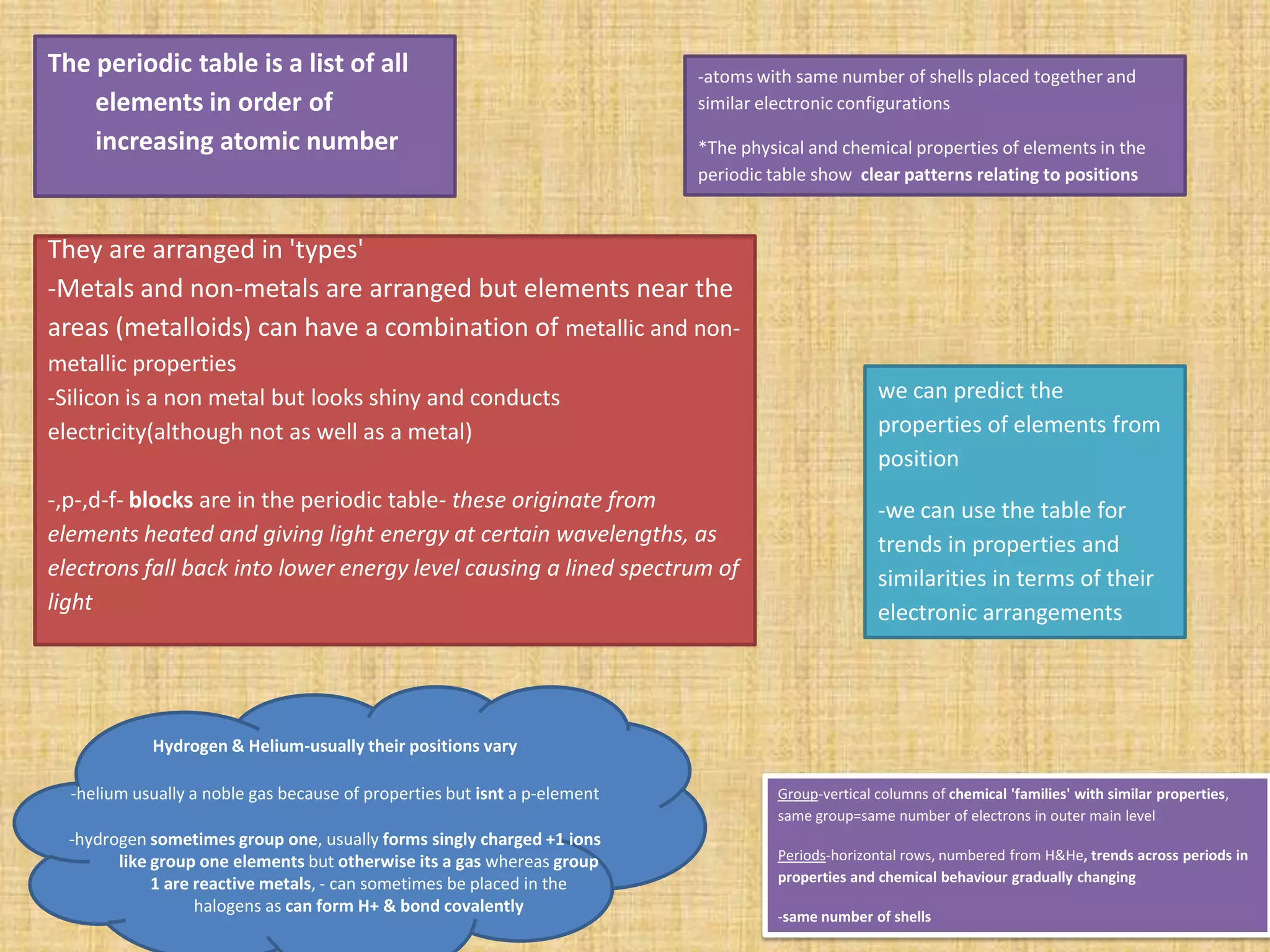
The periodic table is a list of all
elements in order of
increasing atomic number

-atoms with same number of shells placed together and
similar electronic configurations
*The physical and chemical properties of elements in the
periodic table show clear patterns relating to positions

They are arranged in 'types'
-Metals and non-metals are arranged but elements near the
areas (metalloids) can have a combination of metallic and nonmetallic properties
-Silicon is a non metal but looks shiny and conducts
electricity(although not as well as a metal)
-,p-,d-f- blocks are in the periodic table- these originate from
elements heated and giving light energy at certain wavelengths, as
electrons fall back into lower energy level causing a lined spectrum of
light

we can predict the
properties of elements from
position
-we can use the table for
trends in properties and
similarities in terms of their
electronic arrangements

Hydrogen & Helium-usually their positions vary
-helium usually a noble gas because of properties but isnt a p-element
-hydrogen sometimes group one, usually forms singly charged +1 ions
like group one elements but otherwise its a gas whereas group
1 are reactive metals, - can sometimes be placed in the
halogens as can form H+ & bond covalently

Group-vertical columns of chemical 'families' with similar properties,
same group=same number of electrons in outer main level
Periods-horizontal rows, numbered from H&He, trends across periods in
properties and chemical behaviour gradually changing
-same number of shells
s-block~groups 1,2- alkali
metals,alkaline earth metals
-elements which have their highest
energy electrons in s-orbitals
- The s-block elements are all those
with only s electrons in the outer
shell.
Reactivityp-block~groups 3-8,
The p-block elements are all
those with at least one pelectron in the outer shell.

d-block~transition metals+ scandium, zinc
-elements which have their highest energy
electrons in d-orbitals
-The d-block elements are all those with at least
one d-electron and at least one s-electron but no f
or p electrons in the outer shell.

*s-block elements (metals) get more reactive as you go
down
*right elements (non-metals) get more reactive as you
go up
*Transition elements are rather unreactive;useful
metals
*Lanthanides arent often found, tend to form 3+ ions in
compounds and have similar reactivity

f-block~omitted lanthanides,actinides
The f-block elements are all those with
at least one f-electron and at least one
s-electron but no d or p electrons in the
outer shell

*Actinides are radioactive metals-only thorium,
uranium occur naturally enough (Earth’s crust)
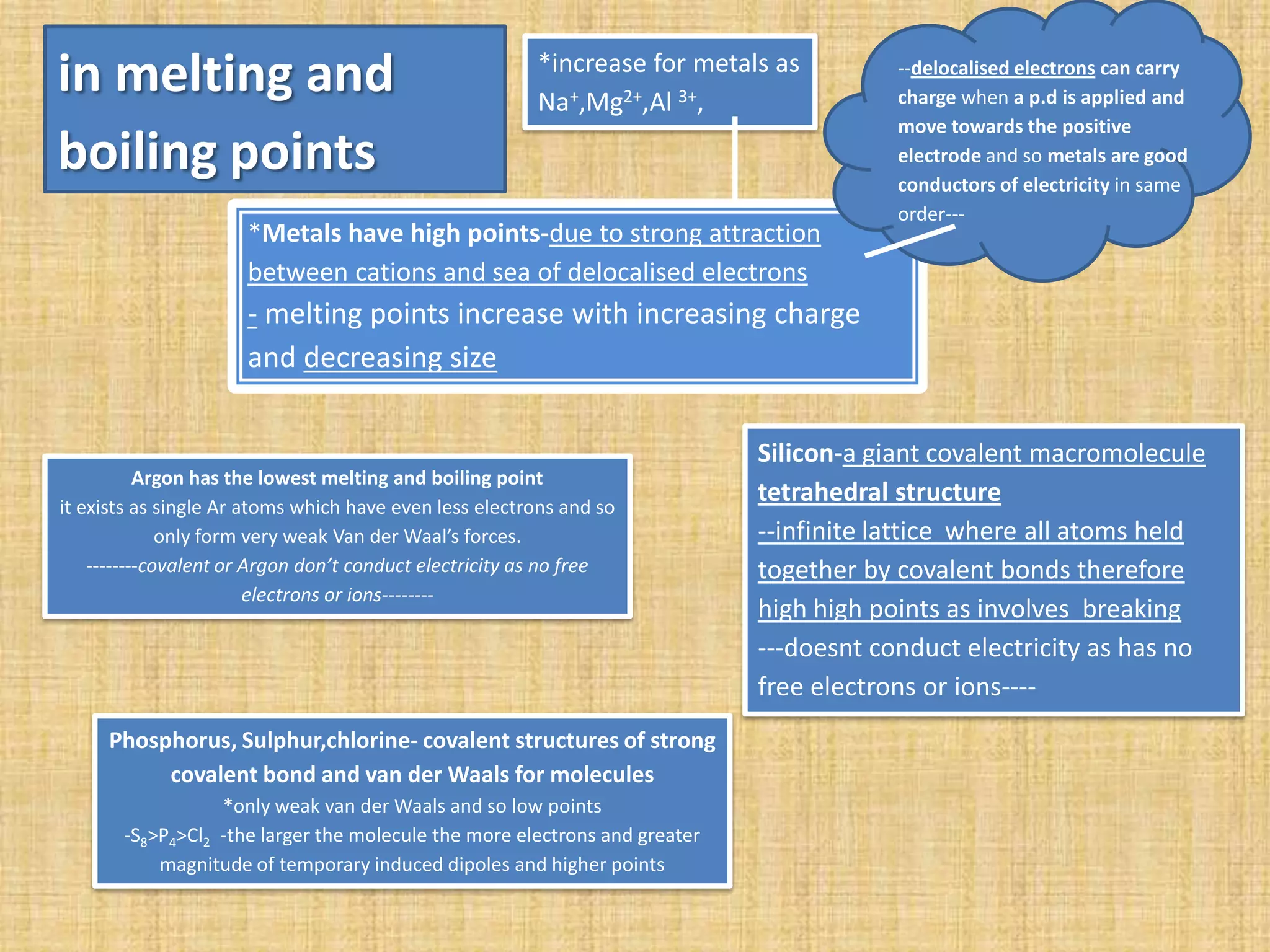
in melting and
boiling points

*increase for metals as
Na+,Mg2+,Al 3+,

*Metals have high points-due to strong attraction
between cations and sea of delocalised electrons

--delocalised electrons can carry
charge when a p.d is applied and
move towards the positive
electrode and so metals are good
conductors of electricity in same
order---

- melting points increase with increasing charge
and decreasing size

Argon has the lowest melting and boiling point
it exists as single Ar atoms which have even less electrons and so
only form very weak Van der Waal’s forces.
--------covalent or Argon don’t conduct electricity as no free
electrons or ions--------

Phosphorus, Sulphur,chlorine- covalent structures of strong
covalent bond and van der Waals for molecules
*only weak van der Waals and so low points
-S8>P4>Cl2 -the larger the molecule the more electrons and greater
magnitude of temporary induced dipoles and higher points

Silicon-a giant covalent macromolecule
tetrahedral structure
--infinite lattice where all atoms held
together by covalent bonds therefore
high high points as involves breaking
---doesnt conduct electricity as has no
free electrons or ions----
Increases across as nuclear charge increases but
shielding remains the same
electrons are attracted more strongly to the atom and so that
atom will have a larger share of electrons in a covalent bond
Trend in atomic radius
general decrease
-As nuclear charge increases but shielding stays the same

cant measure individual atom
but half the distance between
centres of a pair of atoms

-attraction of outer
electrons increases and
electrons are pulled in
closer
Except Mg-Al-decrease

Trends in ionisation energies
general increase

*Al-outer electron in 3p orbital . Mg- in 3s orbital
--3p is better shielded from its nucleus making it
easier to remove--

Except P-S-slight decrease
*P- outer electron in 3p is unpaired, S- in 3p is
paired
--P experiences less repulsion than S so harder to
remove electron from P than S--

-as nuclear charge increases but shielding stays the same
-attraction of outer electron increases and harder to
remove
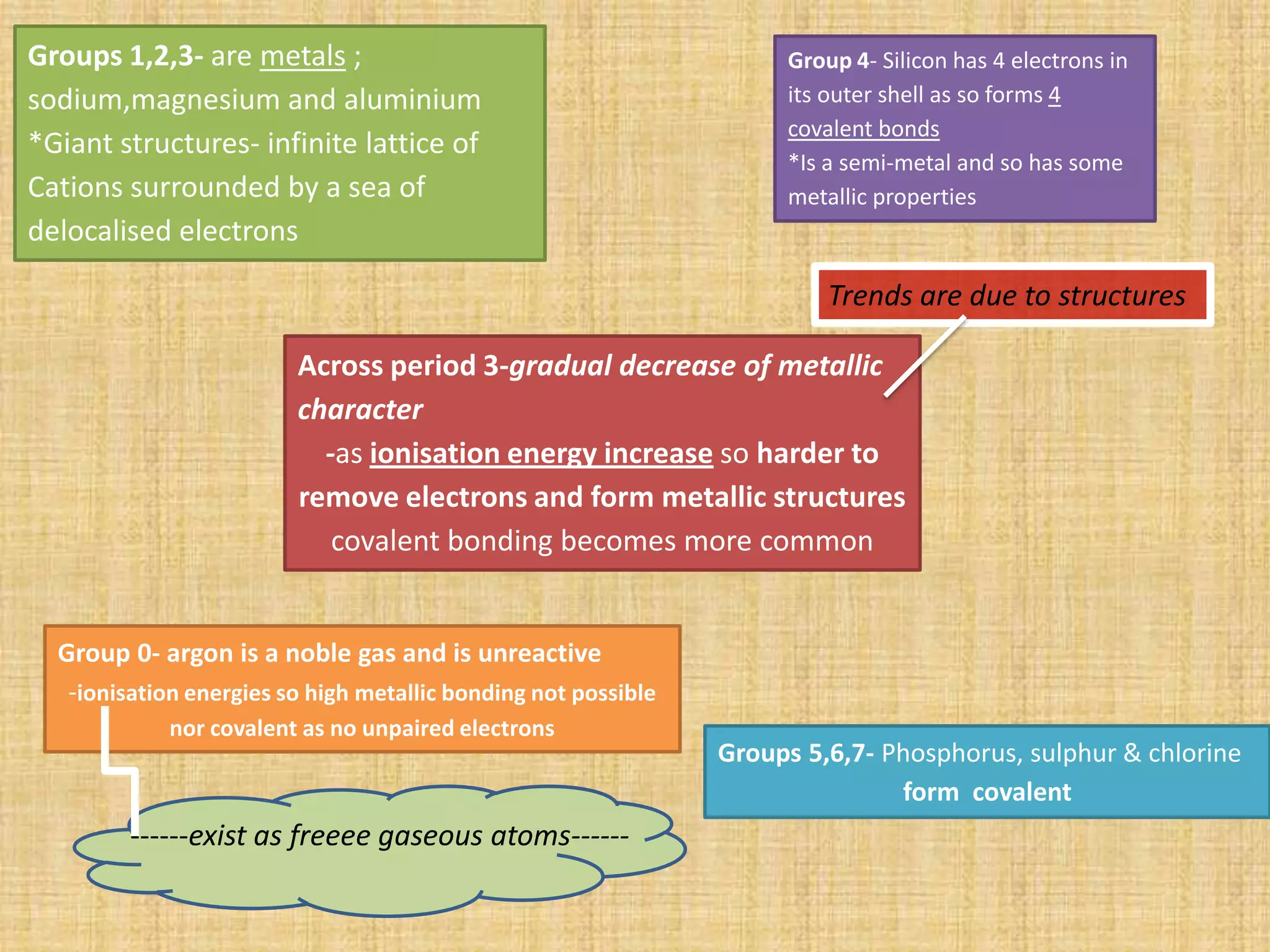
Groups 1,2,3- are metals ;
sodium,magnesium and aluminium
*Giant structures- infinite lattice of
Cations surrounded by a sea of
delocalised electrons

Group 4- Silicon has 4 electrons in
its outer shell as so forms 4
covalent bonds
*Is a semi-metal and so has some
metallic properties

Trends are due to structures
Across period 3-gradual decrease of metallic
character
-as ionisation energy increase so harder to
remove electrons and form metallic structures
covalent bonding becomes more common

Group 0- argon is a noble gas and is unreactive
-ionisation energies so high metallic bonding not possible
nor covalent as no unpaired electrons

------exist as freeee gaseous atoms------

Groups 5,6,7- Phosphorus, sulphur & chlorine
form covalent

1.4 -Periodicity AS chemistry aqa

  • 1.
  • 2.
    The periodic tableis a list of all elements in order of increasing atomic number -atoms with same number of shells placed together and similar electronic configurations *The physical and chemical properties of elements in the periodic table show clear patterns relating to positions They are arranged in 'types' -Metals and non-metals are arranged but elements near the areas (metalloids) can have a combination of metallic and nonmetallic properties -Silicon is a non metal but looks shiny and conducts electricity(although not as well as a metal) -,p-,d-f- blocks are in the periodic table- these originate from elements heated and giving light energy at certain wavelengths, as electrons fall back into lower energy level causing a lined spectrum of light we can predict the properties of elements from position -we can use the table for trends in properties and similarities in terms of their electronic arrangements Hydrogen & Helium-usually their positions vary -helium usually a noble gas because of properties but isnt a p-element -hydrogen sometimes group one, usually forms singly charged +1 ions like group one elements but otherwise its a gas whereas group 1 are reactive metals, - can sometimes be placed in the halogens as can form H+ & bond covalently Group-vertical columns of chemical 'families' with similar properties, same group=same number of electrons in outer main level Periods-horizontal rows, numbered from H&He, trends across periods in properties and chemical behaviour gradually changing -same number of shells
  • 3.
    s-block~groups 1,2- alkali metals,alkalineearth metals -elements which have their highest energy electrons in s-orbitals - The s-block elements are all those with only s electrons in the outer shell. Reactivityp-block~groups 3-8, The p-block elements are all those with at least one pelectron in the outer shell. d-block~transition metals+ scandium, zinc -elements which have their highest energy electrons in d-orbitals -The d-block elements are all those with at least one d-electron and at least one s-electron but no f or p electrons in the outer shell. *s-block elements (metals) get more reactive as you go down *right elements (non-metals) get more reactive as you go up *Transition elements are rather unreactive;useful metals *Lanthanides arent often found, tend to form 3+ ions in compounds and have similar reactivity f-block~omitted lanthanides,actinides The f-block elements are all those with at least one f-electron and at least one s-electron but no d or p electrons in the outer shell *Actinides are radioactive metals-only thorium, uranium occur naturally enough (Earth’s crust)
  • 4.
    in melting and boilingpoints *increase for metals as Na+,Mg2+,Al 3+, *Metals have high points-due to strong attraction between cations and sea of delocalised electrons --delocalised electrons can carry charge when a p.d is applied and move towards the positive electrode and so metals are good conductors of electricity in same order--- - melting points increase with increasing charge and decreasing size Argon has the lowest melting and boiling point it exists as single Ar atoms which have even less electrons and so only form very weak Van der Waal’s forces. --------covalent or Argon don’t conduct electricity as no free electrons or ions-------- Phosphorus, Sulphur,chlorine- covalent structures of strong covalent bond and van der Waals for molecules *only weak van der Waals and so low points -S8>P4>Cl2 -the larger the molecule the more electrons and greater magnitude of temporary induced dipoles and higher points Silicon-a giant covalent macromolecule tetrahedral structure --infinite lattice where all atoms held together by covalent bonds therefore high high points as involves breaking ---doesnt conduct electricity as has no free electrons or ions----
  • 5.
    Increases across asnuclear charge increases but shielding remains the same electrons are attracted more strongly to the atom and so that atom will have a larger share of electrons in a covalent bond
  • 6.
    Trend in atomicradius general decrease -As nuclear charge increases but shielding stays the same cant measure individual atom but half the distance between centres of a pair of atoms -attraction of outer electrons increases and electrons are pulled in closer
  • 7.
    Except Mg-Al-decrease Trends inionisation energies general increase *Al-outer electron in 3p orbital . Mg- in 3s orbital --3p is better shielded from its nucleus making it easier to remove-- Except P-S-slight decrease *P- outer electron in 3p is unpaired, S- in 3p is paired --P experiences less repulsion than S so harder to remove electron from P than S-- -as nuclear charge increases but shielding stays the same -attraction of outer electron increases and harder to remove
  • 8.
    Groups 1,2,3- aremetals ; sodium,magnesium and aluminium *Giant structures- infinite lattice of Cations surrounded by a sea of delocalised electrons Group 4- Silicon has 4 electrons in its outer shell as so forms 4 covalent bonds *Is a semi-metal and so has some metallic properties Trends are due to structures Across period 3-gradual decrease of metallic character -as ionisation energy increase so harder to remove electrons and form metallic structures covalent bonding becomes more common Group 0- argon is a noble gas and is unreactive -ionisation energies so high metallic bonding not possible nor covalent as no unpaired electrons ------exist as freeee gaseous atoms------ Groups 5,6,7- Phosphorus, sulphur & chlorine form covalent