
Dr. Naglaa Youssef (Ph.D.)
Lecture-2
Outline
 Definitions of hospital acquired infection (HAI)
(Nosocomial infection)
 Risk factors influencing the development of
HAI
 Common sites of HAI
 Urinary tract infection
 Lower respiratory tract infection
 Gastrointestinal tact infection
 Surgical wound
 IV sites
 Complications of HAI
ILOs.
3
• Illustrate the meaning of hospital acquired infection (HAI).
• Mention the common types/sites of HAI.
• Give examples of risk factors contributing to developing HAI.
• Recognize the highly risk group of patients who can acquire HAI.
• Clarify the role of health care providers in preventing HAI.
Definition
“Hospital acquired infection” also is called
“nosocomial infection” It is defined as:
“An infection acquired in hospital by a patient
who was admitted for a reason other than that
infection’’.
4
Risk factors influencing the development
of HAI
 The microbial agent
 Patient susceptibility
 Environmental factors
 Bacterial resistance
5
Causes of HAI
 Decreased patients’ immunity,
 Demonstrate variety of medical procedures,
 Use invasive techniques,
 Crowded hospital with populations,
Common devices used in medical procedures:
 Catheters
 Ventilators,
 IV set,
 Endoscopy, …etc.
6
The most common nosocomial pathogens
 Bacteria
 Virus
 Parasites
 Fungi
7
HAI due to Bacteria
Commensal bacteria Pathogenic bacteria
 Normal flora of healthy
humans have a significant
protective role by preventing
colonization by pathogenic
microorganisms. Some
commensal bacteria may
cause infection if the natural
host is compromised.
 For example, cutaneous
coagulase negative
staphylococci cause
intravascular line infection and
 Intestinal Escherichia coli are
the most common cause of
urinary infection.
 Anaerobic Gram-positive rods: (e.g. Clostridium)
cause gangrene.
 Gram-positive bacteria: Staphylococcus aureus
(cutaneous bacteria that colonize the skin and nose of
both hospital staff and patients) cause a wide variety of
lung, bone, heart and bloodstream infections and are
frequently resistant to antibiotics.
 Gram-negative bacteria: (e.g. Escherichia coli,
Proteus, Klebsiella, Enterobacter, Serratia marcescens),
may colonize sites when the host defences are
compromised (catheter insertion, bladder catheter,
cannula insertion) and cause serious infections (surgical
site, lung, bacteraemia, peritoneum infection).
 Gram-negative bacteria such as Pseudomonas spp.
are often isolated in water and damp areas. They may
colonize the digestive tract of hospitalized patients.
8
HAI due to Virus
 Hepatitis B and C viruses, HIV
 transfusions,
 dialysis,
 injections,
 endoscopy,
 Rotavirus,
 Ebola, influenza viruses,
 Herpes simplex virus,
 Varicella-zoster virus,
9
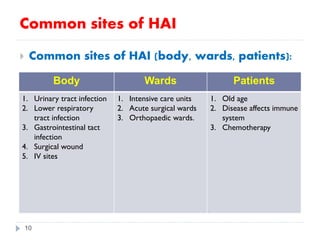
Common sites of HAI
 Common sites of HAI (body, wards, patients):
10
PatientsWardsBody
1. Old age
2. Disease affects immune
system
3. Chemotherapy
1. Intensive care units
2. Acute surgical wards
3. Orthopaedic wards.
1. Urinary tract infection
2. Lower respiratory
tract infection
3. Gastrointestinal tact
infection
4. Surgical wound
5. IV sites
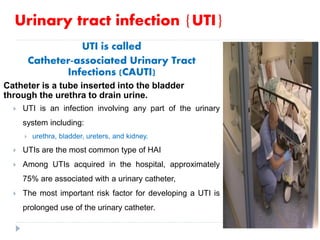
Urinary tract infection {UTI}
UTI is called
Catheter-associated Urinary Tract
Infections (CAUTI)
Catheter is a tube inserted into the bladder
through the urethra to drain urine.
 UTI is an infection involving any part of the urinary
system including:
 urethra, bladder, ureters, and kidney.
 UTIs are the most common type of HAI
 Among UTIs acquired in the hospital, approximately
75% are associated with a urinary catheter,
 The most important risk factor for developing a UTI is
prolonged use of the urinary catheter.
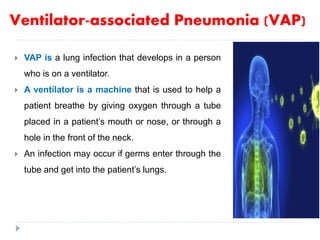
 VAP is a lung infection that develops in a person
who is on a ventilator.
 A ventilator is a machine that is used to help a
patient breathe by giving oxygen through a tube
placed in a patient’s mouth or nose, or through a
hole in the front of the neck.
 An infection may occur if germs enter through the
tube and get into the patient’s lungs.
Ventilator-associated Pneumonia (VAP)
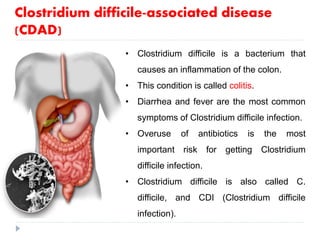
• Clostridium difficile is a bacterium that
causes an inflammation of the colon.
• This condition is called colitis.
• Diarrhea and fever are the most common
symptoms of Clostridium difficile infection.
• Overuse of antibiotics is the most
important risk for getting Clostridium
difficile infection.
• Clostridium difficile is also called C.
difficile, and CDI (Clostridium difficile
infection).
Clostridium difficile-associated disease
(CDAD)
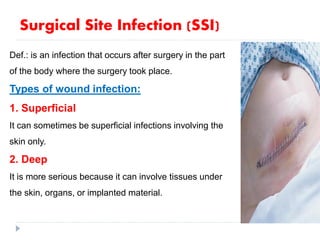
Def.: is an infection that occurs after surgery in the part
of the body where the surgery took place.
Types of wound infection:
1. Superficial
It can sometimes be superficial infections involving the
skin only.
2. Deep
It is more serious because it can involve tissues under
the skin, organs, or implanted material.
Surgical Site Infection (SSI)
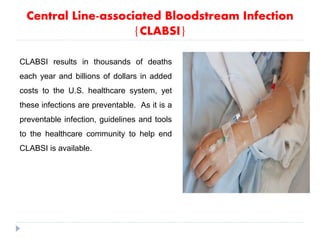
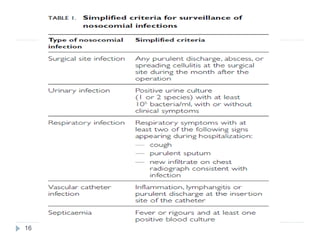
Central Line-associated Bloodstream Infection
{CLABSI}
CLABSI results in thousands of deaths
each year and billions of dollars in added
costs to the U.S. healthcare system, yet
these infections are preventable. As it is a
preventable infection, guidelines and tools
to the healthcare community to help end
CLABSI is available.
16
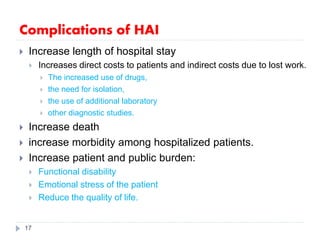
Complications of HAI
 Increase length of hospital stay
 Increases direct costs to patients and indirect costs due to lost work.
 The increased use of drugs,
 the need for isolation,
 the use of additional laboratory
 other diagnostic studies.
 Increase death
 increase morbidity among hospitalized patients.
 Increase patient and public burden:
 Functional disability
 Emotional stress of the patient
 Reduce the quality of life.
17
Thank you18

Nosocomial infection

  • 1.
    Dr. Naglaa Youssef(Ph.D.) Lecture-2
  • 2.
    Outline  Definitions ofhospital acquired infection (HAI) (Nosocomial infection)  Risk factors influencing the development of HAI  Common sites of HAI  Urinary tract infection  Lower respiratory tract infection  Gastrointestinal tact infection  Surgical wound  IV sites  Complications of HAI
  • 3.
    ILOs. 3 • Illustrate themeaning of hospital acquired infection (HAI). • Mention the common types/sites of HAI. • Give examples of risk factors contributing to developing HAI. • Recognize the highly risk group of patients who can acquire HAI. • Clarify the role of health care providers in preventing HAI.
  • 4.
    Definition “Hospital acquired infection”also is called “nosocomial infection” It is defined as: “An infection acquired in hospital by a patient who was admitted for a reason other than that infection’’. 4
  • 5.
    Risk factors influencingthe development of HAI  The microbial agent  Patient susceptibility  Environmental factors  Bacterial resistance 5
  • 6.
    Causes of HAI Decreased patients’ immunity,  Demonstrate variety of medical procedures,  Use invasive techniques,  Crowded hospital with populations, Common devices used in medical procedures:  Catheters  Ventilators,  IV set,  Endoscopy, …etc. 6
  • 7.
    The most commonnosocomial pathogens  Bacteria  Virus  Parasites  Fungi 7
  • 8.
    HAI due toBacteria Commensal bacteria Pathogenic bacteria  Normal flora of healthy humans have a significant protective role by preventing colonization by pathogenic microorganisms. Some commensal bacteria may cause infection if the natural host is compromised.  For example, cutaneous coagulase negative staphylococci cause intravascular line infection and  Intestinal Escherichia coli are the most common cause of urinary infection.  Anaerobic Gram-positive rods: (e.g. Clostridium) cause gangrene.  Gram-positive bacteria: Staphylococcus aureus (cutaneous bacteria that colonize the skin and nose of both hospital staff and patients) cause a wide variety of lung, bone, heart and bloodstream infections and are frequently resistant to antibiotics.  Gram-negative bacteria: (e.g. Escherichia coli, Proteus, Klebsiella, Enterobacter, Serratia marcescens), may colonize sites when the host defences are compromised (catheter insertion, bladder catheter, cannula insertion) and cause serious infections (surgical site, lung, bacteraemia, peritoneum infection).  Gram-negative bacteria such as Pseudomonas spp. are often isolated in water and damp areas. They may colonize the digestive tract of hospitalized patients. 8
  • 9.
    HAI due toVirus  Hepatitis B and C viruses, HIV  transfusions,  dialysis,  injections,  endoscopy,  Rotavirus,  Ebola, influenza viruses,  Herpes simplex virus,  Varicella-zoster virus, 9
  • 10.
    Common sites ofHAI  Common sites of HAI (body, wards, patients): 10 PatientsWardsBody 1. Old age 2. Disease affects immune system 3. Chemotherapy 1. Intensive care units 2. Acute surgical wards 3. Orthopaedic wards. 1. Urinary tract infection 2. Lower respiratory tract infection 3. Gastrointestinal tact infection 4. Surgical wound 5. IV sites
  • 11.
    Urinary tract infection{UTI} UTI is called Catheter-associated Urinary Tract Infections (CAUTI) Catheter is a tube inserted into the bladder through the urethra to drain urine.  UTI is an infection involving any part of the urinary system including:  urethra, bladder, ureters, and kidney.  UTIs are the most common type of HAI  Among UTIs acquired in the hospital, approximately 75% are associated with a urinary catheter,  The most important risk factor for developing a UTI is prolonged use of the urinary catheter.
  • 12.
     VAP isa lung infection that develops in a person who is on a ventilator.  A ventilator is a machine that is used to help a patient breathe by giving oxygen through a tube placed in a patient’s mouth or nose, or through a hole in the front of the neck.  An infection may occur if germs enter through the tube and get into the patient’s lungs. Ventilator-associated Pneumonia (VAP)
  • 13.
    • Clostridium difficileis a bacterium that causes an inflammation of the colon. • This condition is called colitis. • Diarrhea and fever are the most common symptoms of Clostridium difficile infection. • Overuse of antibiotics is the most important risk for getting Clostridium difficile infection. • Clostridium difficile is also called C. difficile, and CDI (Clostridium difficile infection). Clostridium difficile-associated disease (CDAD)
  • 14.
    Def.: is aninfection that occurs after surgery in the part of the body where the surgery took place. Types of wound infection: 1. Superficial It can sometimes be superficial infections involving the skin only. 2. Deep It is more serious because it can involve tissues under the skin, organs, or implanted material. Surgical Site Infection (SSI)
  • 15.
    Central Line-associated BloodstreamInfection {CLABSI} CLABSI results in thousands of deaths each year and billions of dollars in added costs to the U.S. healthcare system, yet these infections are preventable. As it is a preventable infection, guidelines and tools to the healthcare community to help end CLABSI is available.
  • 16.
  • 17.
    Complications of HAI Increase length of hospital stay  Increases direct costs to patients and indirect costs due to lost work.  The increased use of drugs,  the need for isolation,  the use of additional laboratory  other diagnostic studies.  Increase death  increase morbidity among hospitalized patients.  Increase patient and public burden:  Functional disability  Emotional stress of the patient  Reduce the quality of life. 17
  • 18.