Dr. Naglaa Youssef
Medical-Surgical Nursing Dep.
Faculty of Nursing
Cairo University
Content outlines
 Definition of pain
 Components of pain
 Types of pain
 Physiology of pain
 Management of pain
 Assessment of pain
 Nursing diagnosis of patient with pain
 Nursing care for patient with pain
Pain definition
 Pain has been defined as an „‟unpleasant sensation
usually associated with disease or injury‟‟ (Timby
2009).
 It causes physical discomfort that is a companied by
suffering, which is the emotional component of pain.
 the American Pain Society coined the phrase “Pain:
The 5th Vital Sign”
 Pain is „‟whatever the person says it is, and existing
whenever the person says it does‟‟ (Margo
McCaffery 1998).
 “It is not the responsibility of clients to prove that
they are in pain; it is the nurses‟ responsibility to
believe them.” (Crisp & Taylor, 2005).
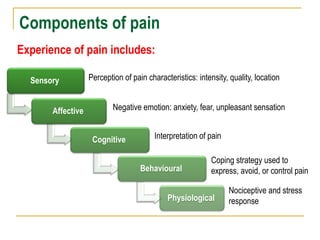
Components of pain
Experience of pain includes:
Sensory
Affective
Cognitive
Behavioural
Physiological
Perception of pain characteristics: intensity, quality, location
Negative emotion: anxiety, fear, unpleasant sensation
Interpretation of pain
Coping strategy used to
express, avoid, or control pain
Nociceptive and stress
response
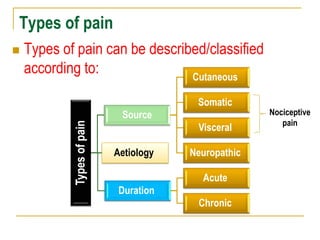
Types of pain
 Types of pain can be described/classified
according to:
Typesofpain
Source
Cutaneous
Somatic
Visceral
NeuropathicAetiology
Duration
Acute
Chronic
Nociceptive
pain
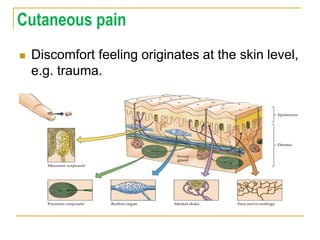
Cutaneous pain
 Discomfort feeling originates at the skin level,
e.g. trauma.
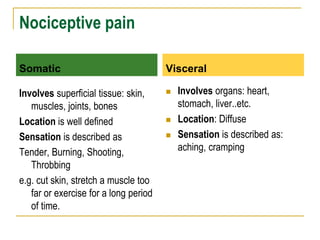
Nociceptive pain
Somatic
Involves superficial tissue: skin,
muscles, joints, bones
Location is well defined
Sensation is described as
Tender, Burning, Shooting,
Throbbing
e.g. cut skin, stretch a muscle too
far or exercise for a long period
of time.
Visceral
 Involves organs: heart,
stomach, liver..etc.
 Location: Diffuse
 Sensation is described as:
aching, cramping
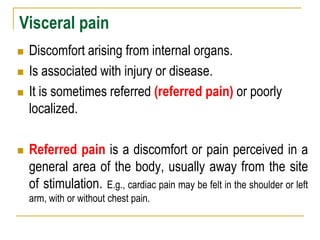
Visceral pain
 Discomfort arising from internal organs.
 Is associated with injury or disease.
 It is sometimes referred (referred pain) or poorly
localized.
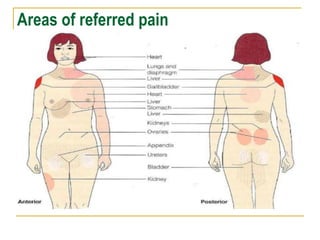
 Referred pain is a discomfort or pain perceived in a
general area of the body, usually away from the site
of stimulation. E.g., cardiac pain may be felt in the shoulder or left
arm, with or without chest pain.
Areas of referred pain
 Radiating pain
 Perceived in the source of pain and extended to
nearby tissue.
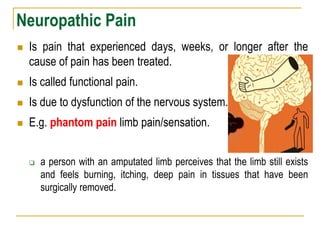
Neuropathic Pain
 Is pain that experienced days, weeks, or longer after the
cause of pain has been treated.
 Is called functional pain.
 Is due to dysfunction of the nervous system.
 E.g. phantom pain limb pain/sensation.
 a person with an amputated limb perceives that the limb still exists
and feels burning, itching, deep pain in tissues that have been
surgically removed.
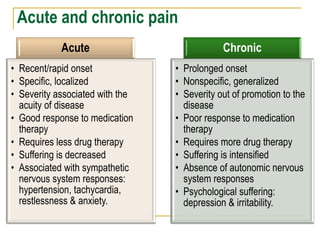
Acute and chronic pain
Acute
• Recent/rapid onset
• Specific, localized
• Severity associated with the
acuity of disease
• Good response to medication
therapy
• Requires less drug therapy
• Suffering is decreased
• Associated with sympathetic
nervous system responses:
hypertension, tachycardia,
restlessness & anxiety.
Chronic
• Prolonged onset
• Nonspecific, generalized
• Severity out of promotion to the
disease
• Poor response to medication
therapy
• Requires more drug therapy
• Suffering is intensified
• Absence of autonomic nervous
system responses
• Psychological suffering:
depression & irritability.
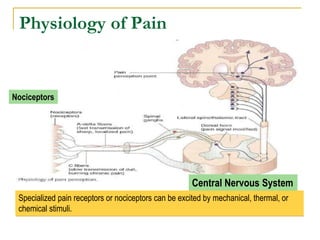
Physiology of Pain
Specialized pain receptors or nociceptors can be excited by mechanical, thermal, or
chemical stimuli.
Nociceptors
Central Nervous System
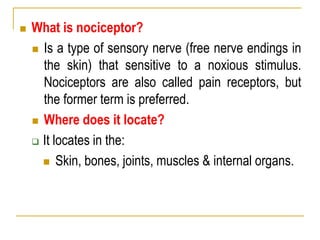
 What is nociceptor?
 Is a type of sensory nerve (free nerve endings in
the skin) that sensitive to a noxious stimulus.
Nociceptors are also called pain receptors, but
the former term is preferred.
 Where does it locate?
 It locates in the:
 Skin, bones, joints, muscles & internal organs.
Physiology of pain
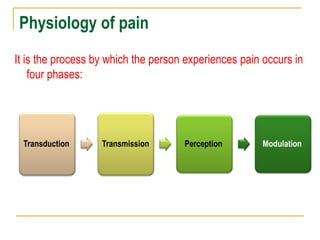
It is the process by which the person experiences pain occurs in
four phases:
Transduction Transmission Perception Modulation
First phase: Transduction
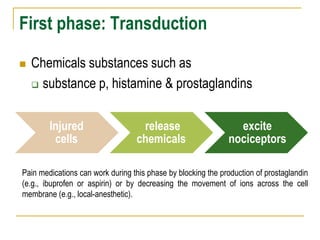
 Chemicals substances such as
 substance p, histamine & prostaglandins
Injured
cells
release
chemicals
excite
nociceptors
Pain medications can work during this phase by blocking the production of prostaglandin
(e.g., ibuprofen or aspirin) or by decreasing the movement of ions across the cell
membrane (e.g., local-anesthetic).
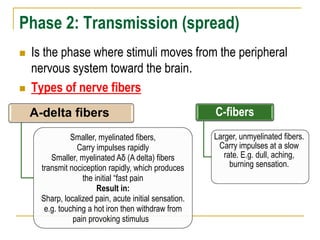
Phase 2: Transmission (spread)
 Is the phase where stimuli moves from the peripheral
nervous system toward the brain.
 Types of nerve fibers
A-delta fibers
Smaller, myelinated fibers,
Carry impulses rapidly
Smaller, myelinated Aδ (A delta) fibers
transmit nociception rapidly, which produces
the initial “fast pain
Result in:
Sharp, localized pain, acute initial sensation.
e.g. touching a hot iron then withdraw from
pain provoking stimulus
C-fibers
Larger, unmyelinated fibers.
Carry impulses at a slow
rate. E.g. dull, aching,
burning sensation.
 Pain impulses move to higher level in the brain such
as: thalamus, cerebral cortex and limbic system by
assistance of substance P.
 Prostaglandin is a chemical that released from
injured cells speeds the pain transmission.
Opioids (narcotic analgesics) block the release of neurotransmitters,
particularly substance P, which stops the pain at the spinal level.
Phase 3: Perception
 What does perception mean?
 Is the person‟s „‟conscious experience of discomfort
„‟(Timby 2009).
 When does perception occur?
 It occurs when the pain threshold (‫األلم‬ ‫)عتبة‬ is
reached.
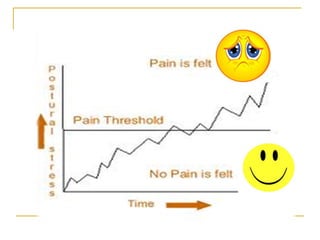
What is pain threshold?
 „‟Point at which sufficient pain-transmitting stimuli
reach the brain‟‟ (Timby 2009).
 The point at which a stimulus is perceived as
painful.
 What is pain tolerance?
 Is the maximum amount (intensity) or duration of
pain that person can endure or tolerate.
Phase 4: Modulation or descending ( ‫تعديل‬‫المسار‬ )
 Is the last phase of pain impulse transmission
where the brain interacts with the spinal nerves in a
downward way to alter the pain experience.
 Release of pain inhibiting neurochemicals that can
reduce the pain, such as:
 Endogenous opioids
 Gamma-aminobutyric acid
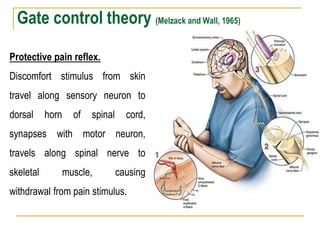
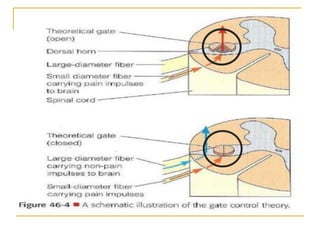
Gate control theory (Melzack and Wall, 1965)
Protective pain reflex.
Discomfort stimulus from skin
travel along sensory neuron to
dorsal horn of spinal cord,
synapses with motor neuron,
travels along spinal nerve to
skeletal muscle, causing
withdrawal from pain stimulus.
Physiological response to pain
 Pain produces a physiological stress response that includes
increased heart and breathing rates to facilitate the increasing
demands of oxygen and other nutrients to vital organs. Failure to
relieve pain produces a prolonged stress state, which can result in
harmful multisystem effects (Middleton, 2003).
 Incase of sever traumatic pain may place client into shock.
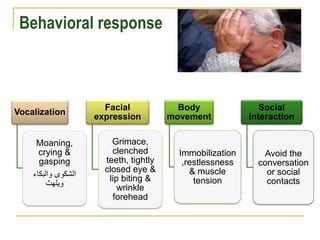
Vocalization
Moaning,
crying &
gasping
‫والبكاء‬ ‫الشكوى‬
‫ويلهث‬
Facial
expression
Grimace,
clenched
teeth, tightly
closed eye &
lip biting &
wrinkle
forehead
Body
movement
Immobilization
,restlessness
& muscle
tension
Social
interaction
Avoid the
conversation
or social
contacts
Behavioral response
Impact of pain on patient daily life
 Fatigue
 Sleeping disturbance
 Loss of appetite
 Social withdraw
 Disturb family life
 Tense muscles
 Impair immune system….poor healing, infection, ulcers.
 Stop activity…..complications of immobility such as
muscle atrophy, cardiovascular complications
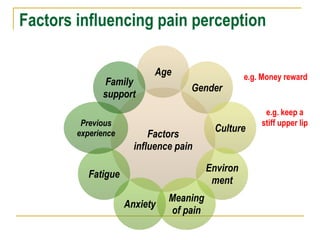
Factors influencing pain perception
Factors
influence pain
Age
Gender
Culture
Environ
ment
Meaning
of pain
Anxiety
Fatigue
Previous
experience
Family
support
e.g. keep a
stiff upper lip
e.g. Money reward
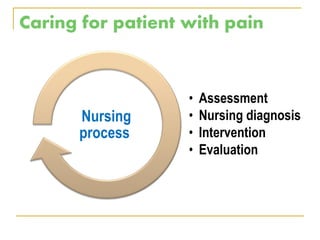
• Assessment
• Nursing diagnosis
• Intervention
• Evaluation
Nursing
process
Caring for patient with pain
 Pain is the fifth vital signs that should be
assessed during assessment stage (the
American Pain Association).
Pain assessment
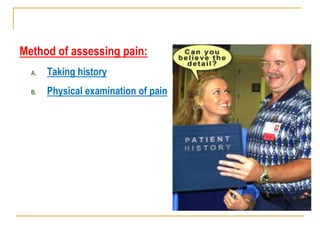
Method of assessing pain:
A. Taking history
B. Physical examination of pain
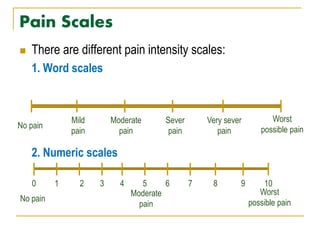
Pain Scales
 There are different pain intensity scales:
1. Word scales
2. Numeric scales
0
Mild
pain
Moderate
pain
Sever
pain
Very sever
pain
Worst
possible painNo pain
7 85 6 92 3 41
No pain
10
Worst
possible pain
Moderate
pain
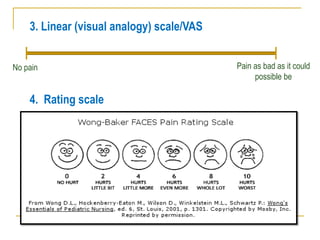
3. Linear (visual analogy) scale/VAS
4. Rating scale
No pain Pain as bad as it could
possible be
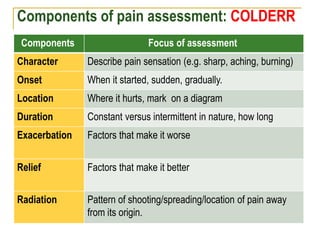
Components of pain assessment: COLDERR
Focus of assessmentComponents
Describe pain sensation (e.g. sharp, aching, burning)Character
When it started, sudden, gradually.Onset
Where it hurts, mark on a diagramLocation
Constant versus intermittent in nature, how longDuration
Factors that make it worseExacerbation
Factors that make it betterRelief
Pattern of shooting/spreading/location of pain away
from its origin.
Radiation
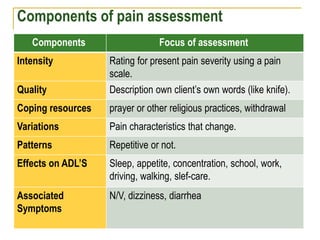
Components of pain assessment
Focus of assessmentComponents
Rating for present pain severity using a pain
scale.
Intensity
Description own client‟s own words (like knife).Quality
prayer or other religious practices, withdrawalCoping resources
Pain characteristics that change.Variations
Repetitive or not.Patterns
Sleep, appetite, concentration, school, work,
driving, walking, slef-care.
Effects on ADL’S
N/V, dizziness, diarrheaAssociated
Symptoms
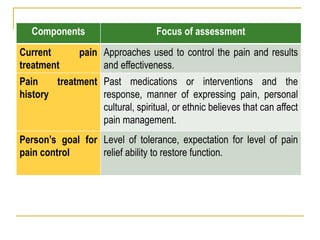
Focus of assessmentComponents
Approaches used to control the pain and results
and effectiveness.
Current pain
treatment
Past medications or interventions and the
response, manner of expressing pain, personal
cultural, spiritual, or ethnic believes that can affect
pain management.
Pain treatment
history
Level of tolerance, expectation for level of pain
relief ability to restore function.
Person’s goal for
pain control
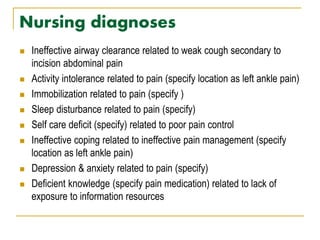
Nursing diagnoses
 Ineffective airway clearance related to weak cough secondary to
incision abdominal pain
 Activity intolerance related to pain (specify location as left ankle pain)
 Immobilization related to pain (specify )
 Sleep disturbance related to pain (specify)
 Self care deficit (specify) related to poor pain control
 Ineffective coping related to ineffective pain management (specify
location as left ankle pain)
 Depression & anxiety related to pain (specify)
 Deficient knowledge (specify pain medication) related to lack of
exposure to information resources
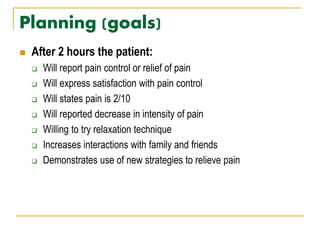
Planning (goals)
 After 2 hours the patient:
 Will report pain control or relief of pain
 Will express satisfaction with pain control
 Will states pain is 2/10
 Will reported decrease in intensity of pain
 Willing to try relaxation technique
 Increases interactions with family and friends
 Demonstrates use of new strategies to relieve pain
Interventions
1. Monitoring
2. Actions / interventions
3. Teaching
Monitoring
 Use pain assessment scale to identify intensity of pain.
 Assess and record pain and its characteristics:
location, quality, frequency, and duration.
 Assess vital signs every 30 minutes
Actions / interventions
 Aim of pain management to preventing, reducing,
relieving pain, such as:
Non-pharmacologic interventions
Pharmacologic management
Health teaching
Non-pharmacologic interventions
 Relaxation techniques = releasing
tension
 Education = support & coping
methods
 Imagery = using mind to visualize
an experience=daydreaming
 Distraction=switch from unpleasant
sensory experience to one more
pleasant
 Acupuncture= thin needles
are inserted into the skin
 Acupressure = tissue
compression
 Meditation = concentrating
on a spiritual word or idea
 Heat & cold = thermal
therapy = swelling &
vasodilatation
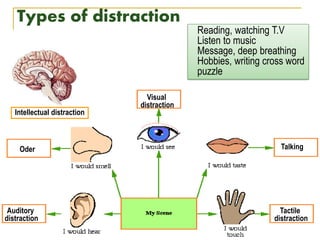
Types of distraction
Visual
distraction
Tactile
distraction
Auditory
distraction
TalkingOder
Intellectual distraction
Reading, watching T.V
Listen to music
Message, deep breathing
Hobbies, writing cross word
puzzle
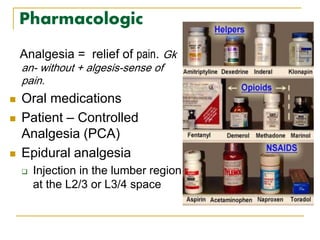
Pharmacologic
Analgesia = relief of pain. Gk
an- without + algesis-sense of
pain.
 Oral medications
 Patient – Controlled
Analgesia (PCA)
 Epidural analgesia
 Injection in the lumber region
at the L2/3 or L3/4 space
Health teaching
 Teach patient additional strategies to
relieve pain and discomfort: distraction,
relaxation, cutaneous stimulation, etc.
 Instruct patient and family about potential
side effects of analgesics and their
prevention and management.
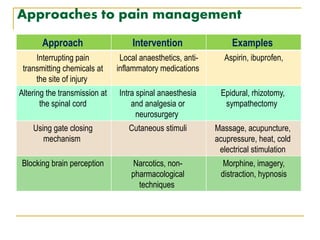
Approaches to pain management
ExamplesInterventionApproach
Aspirin, ibuprofen,Local anaesthetics, anti-
inflammatory medications
Interrupting pain
transmitting chemicals at
the site of injury
Epidural, rhizotomy,
sympathectomy
Intra spinal anaesthesia
and analgesia or
neurosurgery
Altering the transmission at
the spinal cord
Massage, acupuncture,
acupressure, heat, cold
electrical stimulation
Cutaneous stimuliUsing gate closing
mechanism
Morphine, imagery,
distraction, hypnosis
Narcotics, non-
pharmacological
techniques
Blocking brain perception
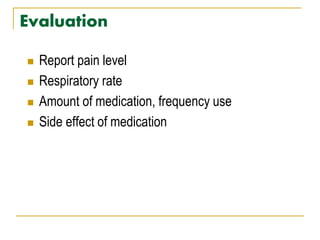
Evaluation
 Report pain level
 Respiratory rate
 Amount of medication, frequency use
 Side effect of medication
Pain managment

Pain managment

  • 1.
    Dr. Naglaa Youssef Medical-SurgicalNursing Dep. Faculty of Nursing Cairo University
  • 2.
    Content outlines  Definitionof pain  Components of pain  Types of pain  Physiology of pain  Management of pain  Assessment of pain  Nursing diagnosis of patient with pain  Nursing care for patient with pain
  • 3.
    Pain definition  Painhas been defined as an „‟unpleasant sensation usually associated with disease or injury‟‟ (Timby 2009).  It causes physical discomfort that is a companied by suffering, which is the emotional component of pain.  the American Pain Society coined the phrase “Pain: The 5th Vital Sign”
  • 4.
     Pain is„‟whatever the person says it is, and existing whenever the person says it does‟‟ (Margo McCaffery 1998).  “It is not the responsibility of clients to prove that they are in pain; it is the nurses‟ responsibility to believe them.” (Crisp & Taylor, 2005).
  • 5.
    Components of pain Experienceof pain includes: Sensory Affective Cognitive Behavioural Physiological Perception of pain characteristics: intensity, quality, location Negative emotion: anxiety, fear, unpleasant sensation Interpretation of pain Coping strategy used to express, avoid, or control pain Nociceptive and stress response
  • 6.
    Types of pain Types of pain can be described/classified according to: Typesofpain Source Cutaneous Somatic Visceral NeuropathicAetiology Duration Acute Chronic Nociceptive pain
  • 7.
    Cutaneous pain  Discomfortfeeling originates at the skin level, e.g. trauma.
  • 8.
    Nociceptive pain Somatic Involves superficialtissue: skin, muscles, joints, bones Location is well defined Sensation is described as Tender, Burning, Shooting, Throbbing e.g. cut skin, stretch a muscle too far or exercise for a long period of time. Visceral  Involves organs: heart, stomach, liver..etc.  Location: Diffuse  Sensation is described as: aching, cramping
  • 9.
    Visceral pain  Discomfortarising from internal organs.  Is associated with injury or disease.  It is sometimes referred (referred pain) or poorly localized.  Referred pain is a discomfort or pain perceived in a general area of the body, usually away from the site of stimulation. E.g., cardiac pain may be felt in the shoulder or left arm, with or without chest pain.
  • 10.
  • 11.
     Radiating pain Perceived in the source of pain and extended to nearby tissue.
  • 12.
    Neuropathic Pain  Ispain that experienced days, weeks, or longer after the cause of pain has been treated.  Is called functional pain.  Is due to dysfunction of the nervous system.  E.g. phantom pain limb pain/sensation.  a person with an amputated limb perceives that the limb still exists and feels burning, itching, deep pain in tissues that have been surgically removed.
  • 13.
    Acute and chronicpain Acute • Recent/rapid onset • Specific, localized • Severity associated with the acuity of disease • Good response to medication therapy • Requires less drug therapy • Suffering is decreased • Associated with sympathetic nervous system responses: hypertension, tachycardia, restlessness & anxiety. Chronic • Prolonged onset • Nonspecific, generalized • Severity out of promotion to the disease • Poor response to medication therapy • Requires more drug therapy • Suffering is intensified • Absence of autonomic nervous system responses • Psychological suffering: depression & irritability.
  • 14.
    Physiology of Pain Specializedpain receptors or nociceptors can be excited by mechanical, thermal, or chemical stimuli. Nociceptors Central Nervous System
  • 15.
     What isnociceptor?  Is a type of sensory nerve (free nerve endings in the skin) that sensitive to a noxious stimulus. Nociceptors are also called pain receptors, but the former term is preferred.  Where does it locate?  It locates in the:  Skin, bones, joints, muscles & internal organs.
  • 16.
    Physiology of pain Itis the process by which the person experiences pain occurs in four phases: Transduction Transmission Perception Modulation
  • 17.
    First phase: Transduction Chemicals substances such as  substance p, histamine & prostaglandins Injured cells release chemicals excite nociceptors Pain medications can work during this phase by blocking the production of prostaglandin (e.g., ibuprofen or aspirin) or by decreasing the movement of ions across the cell membrane (e.g., local-anesthetic).
  • 18.
    Phase 2: Transmission(spread)  Is the phase where stimuli moves from the peripheral nervous system toward the brain.  Types of nerve fibers A-delta fibers Smaller, myelinated fibers, Carry impulses rapidly Smaller, myelinated Aδ (A delta) fibers transmit nociception rapidly, which produces the initial “fast pain Result in: Sharp, localized pain, acute initial sensation. e.g. touching a hot iron then withdraw from pain provoking stimulus C-fibers Larger, unmyelinated fibers. Carry impulses at a slow rate. E.g. dull, aching, burning sensation.
  • 19.
     Pain impulsesmove to higher level in the brain such as: thalamus, cerebral cortex and limbic system by assistance of substance P.  Prostaglandin is a chemical that released from injured cells speeds the pain transmission. Opioids (narcotic analgesics) block the release of neurotransmitters, particularly substance P, which stops the pain at the spinal level.
  • 20.
    Phase 3: Perception What does perception mean?  Is the person‟s „‟conscious experience of discomfort „‟(Timby 2009).  When does perception occur?  It occurs when the pain threshold (‫األلم‬ ‫)عتبة‬ is reached.
  • 21.
    What is painthreshold?  „‟Point at which sufficient pain-transmitting stimuli reach the brain‟‟ (Timby 2009).  The point at which a stimulus is perceived as painful.  What is pain tolerance?  Is the maximum amount (intensity) or duration of pain that person can endure or tolerate.
  • 23.
    Phase 4: Modulationor descending ( ‫تعديل‬‫المسار‬ )  Is the last phase of pain impulse transmission where the brain interacts with the spinal nerves in a downward way to alter the pain experience.  Release of pain inhibiting neurochemicals that can reduce the pain, such as:  Endogenous opioids  Gamma-aminobutyric acid
  • 24.
    Gate control theory(Melzack and Wall, 1965) Protective pain reflex. Discomfort stimulus from skin travel along sensory neuron to dorsal horn of spinal cord, synapses with motor neuron, travels along spinal nerve to skeletal muscle, causing withdrawal from pain stimulus.
  • 26.
    Physiological response topain  Pain produces a physiological stress response that includes increased heart and breathing rates to facilitate the increasing demands of oxygen and other nutrients to vital organs. Failure to relieve pain produces a prolonged stress state, which can result in harmful multisystem effects (Middleton, 2003).  Incase of sever traumatic pain may place client into shock.
  • 27.
    Vocalization Moaning, crying & gasping ‫والبكاء‬ ‫الشكوى‬ ‫ويلهث‬ Facial expression Grimace, clenched teeth,tightly closed eye & lip biting & wrinkle forehead Body movement Immobilization ,restlessness & muscle tension Social interaction Avoid the conversation or social contacts Behavioral response
  • 28.
    Impact of painon patient daily life  Fatigue  Sleeping disturbance  Loss of appetite  Social withdraw  Disturb family life  Tense muscles  Impair immune system….poor healing, infection, ulcers.  Stop activity…..complications of immobility such as muscle atrophy, cardiovascular complications
  • 29.
    Factors influencing painperception Factors influence pain Age Gender Culture Environ ment Meaning of pain Anxiety Fatigue Previous experience Family support e.g. keep a stiff upper lip e.g. Money reward
  • 30.
    • Assessment • Nursingdiagnosis • Intervention • Evaluation Nursing process Caring for patient with pain
  • 31.
     Pain isthe fifth vital signs that should be assessed during assessment stage (the American Pain Association). Pain assessment
  • 32.
    Method of assessingpain: A. Taking history B. Physical examination of pain
  • 33.
    Pain Scales  Thereare different pain intensity scales: 1. Word scales 2. Numeric scales 0 Mild pain Moderate pain Sever pain Very sever pain Worst possible painNo pain 7 85 6 92 3 41 No pain 10 Worst possible pain Moderate pain
  • 34.
    3. Linear (visualanalogy) scale/VAS 4. Rating scale No pain Pain as bad as it could possible be
  • 35.
    Components of painassessment: COLDERR Focus of assessmentComponents Describe pain sensation (e.g. sharp, aching, burning)Character When it started, sudden, gradually.Onset Where it hurts, mark on a diagramLocation Constant versus intermittent in nature, how longDuration Factors that make it worseExacerbation Factors that make it betterRelief Pattern of shooting/spreading/location of pain away from its origin. Radiation
  • 36.
    Components of painassessment Focus of assessmentComponents Rating for present pain severity using a pain scale. Intensity Description own client‟s own words (like knife).Quality prayer or other religious practices, withdrawalCoping resources Pain characteristics that change.Variations Repetitive or not.Patterns Sleep, appetite, concentration, school, work, driving, walking, slef-care. Effects on ADL’S N/V, dizziness, diarrheaAssociated Symptoms
  • 37.
    Focus of assessmentComponents Approachesused to control the pain and results and effectiveness. Current pain treatment Past medications or interventions and the response, manner of expressing pain, personal cultural, spiritual, or ethnic believes that can affect pain management. Pain treatment history Level of tolerance, expectation for level of pain relief ability to restore function. Person’s goal for pain control
  • 38.
    Nursing diagnoses  Ineffectiveairway clearance related to weak cough secondary to incision abdominal pain  Activity intolerance related to pain (specify location as left ankle pain)  Immobilization related to pain (specify )  Sleep disturbance related to pain (specify)  Self care deficit (specify) related to poor pain control  Ineffective coping related to ineffective pain management (specify location as left ankle pain)  Depression & anxiety related to pain (specify)  Deficient knowledge (specify pain medication) related to lack of exposure to information resources
  • 39.
    Planning (goals)  After2 hours the patient:  Will report pain control or relief of pain  Will express satisfaction with pain control  Will states pain is 2/10  Will reported decrease in intensity of pain  Willing to try relaxation technique  Increases interactions with family and friends  Demonstrates use of new strategies to relieve pain
  • 40.
    Interventions 1. Monitoring 2. Actions/ interventions 3. Teaching
  • 41.
    Monitoring  Use painassessment scale to identify intensity of pain.  Assess and record pain and its characteristics: location, quality, frequency, and duration.  Assess vital signs every 30 minutes
  • 42.
    Actions / interventions Aim of pain management to preventing, reducing, relieving pain, such as: Non-pharmacologic interventions Pharmacologic management Health teaching
  • 43.
    Non-pharmacologic interventions  Relaxationtechniques = releasing tension  Education = support & coping methods  Imagery = using mind to visualize an experience=daydreaming  Distraction=switch from unpleasant sensory experience to one more pleasant  Acupuncture= thin needles are inserted into the skin  Acupressure = tissue compression  Meditation = concentrating on a spiritual word or idea  Heat & cold = thermal therapy = swelling & vasodilatation
  • 44.
    Types of distraction Visual distraction Tactile distraction Auditory distraction TalkingOder Intellectualdistraction Reading, watching T.V Listen to music Message, deep breathing Hobbies, writing cross word puzzle
  • 45.
    Pharmacologic Analgesia = reliefof pain. Gk an- without + algesis-sense of pain.  Oral medications  Patient – Controlled Analgesia (PCA)  Epidural analgesia  Injection in the lumber region at the L2/3 or L3/4 space
  • 46.
    Health teaching  Teachpatient additional strategies to relieve pain and discomfort: distraction, relaxation, cutaneous stimulation, etc.  Instruct patient and family about potential side effects of analgesics and their prevention and management.
  • 47.
    Approaches to painmanagement ExamplesInterventionApproach Aspirin, ibuprofen,Local anaesthetics, anti- inflammatory medications Interrupting pain transmitting chemicals at the site of injury Epidural, rhizotomy, sympathectomy Intra spinal anaesthesia and analgesia or neurosurgery Altering the transmission at the spinal cord Massage, acupuncture, acupressure, heat, cold electrical stimulation Cutaneous stimuliUsing gate closing mechanism Morphine, imagery, distraction, hypnosis Narcotics, non- pharmacological techniques Blocking brain perception
  • 48.
    Evaluation  Report painlevel  Respiratory rate  Amount of medication, frequency use  Side effect of medication