
Naglaa F.A. Youssef (PhD)
Lecturer
Faculty of Nursing
Cairo University
Introduction to search the databases to
find relevant literature
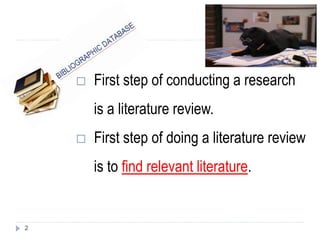
 First step of conducting a research
is a literature review.
 First step of doing a literature review
is to find relevant literature.
2
3
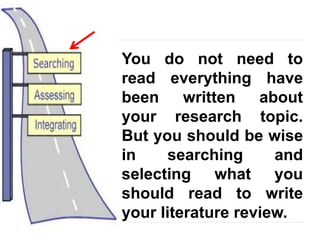
You do not need to
read everything have
been written about
your research topic.
But you should be wise
in searching and
selecting what you
should read to write
your literature review.
4
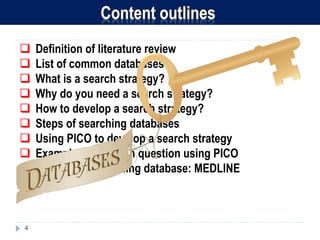
 Definition of literature review
 List of common databases
 What is a search strategy?
 Why do you need a search strategy?
 How to develop a search strategy?
 Steps of searching databases
 Using PICO to develop a search strategy
 Example of research question using PICO
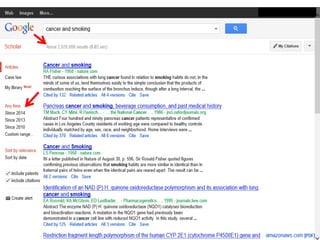
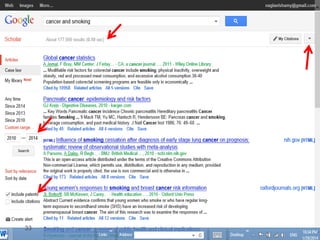
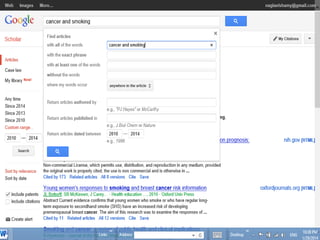
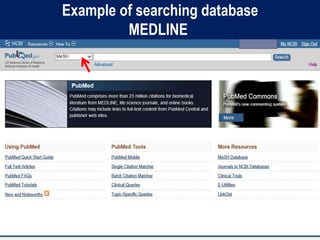
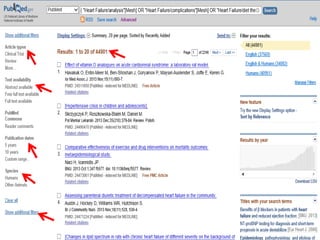
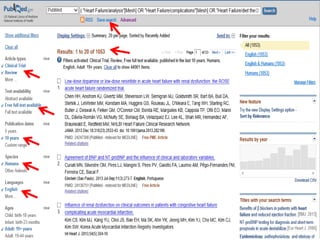
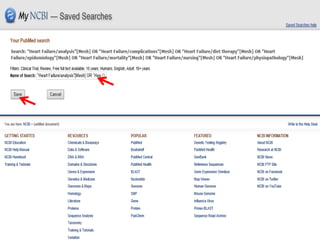
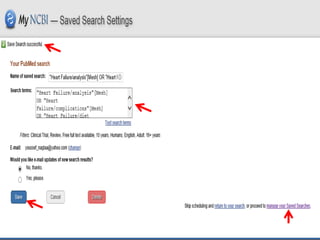
 Example of searching database: MEDLINE
Definition of literature review
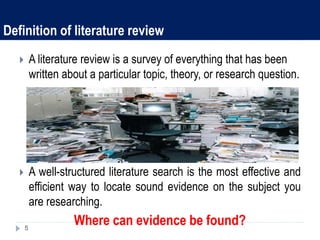
 A literature review is a survey of everything that has been
written about a particular topic, theory, or research question.
 A well-structured literature search is the most effective and
efficient way to locate sound evidence on the subject you
are researching.
Where can evidence be found?5
6
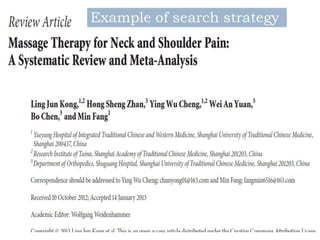
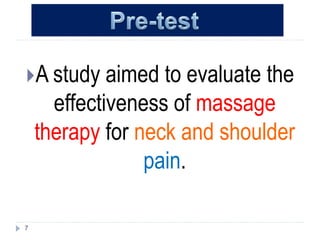
A study aimed to evaluate the
effectiveness of massage
therapy for neck and shoulder
pain.
7
8
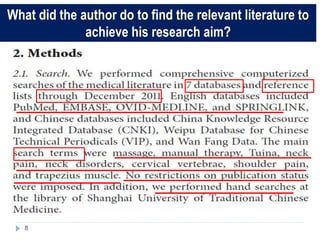
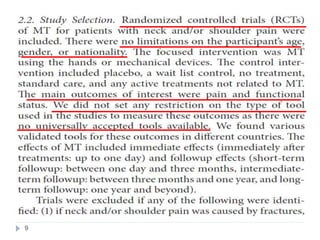
What did the author do to find the relevant literature to
achieve his research aim?
9
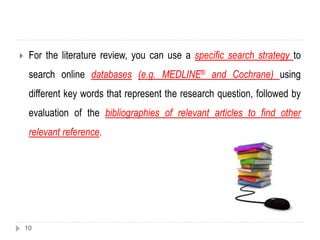
 For the literature review, you can use a specific search strategy to
search online databases (e.g. MEDLINE® and Cochrane) using
different key words that represent the research question, followed by
evaluation of the bibliographies of relevant articles to find other
relevant reference.
10
List of common databases
 Medical Literature Analysis and Retrieval
System Online (MEDLINE),
 Cumulative Index to Nursing and Allied
Health Literature (CINAHL),
 Cochran library,
 Psychological Information (PsychInfo)
 OvidSP
11
A database is a
system intended
to organize,
store, and
retrieve large
amounts of data
easily.
What is a search strategy?
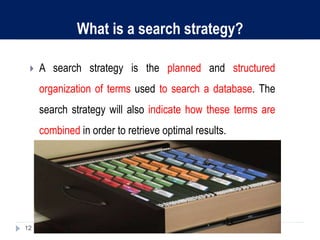
 A search strategy is the planned and structured
organization of terms used to search a database. The
search strategy will also indicate how these terms are
combined in order to retrieve optimal results.
12
13
Why do you need a search strategy?
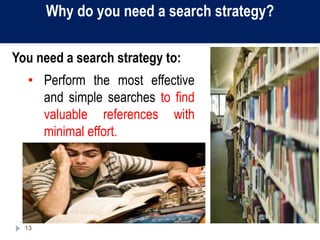
You need a search strategy to:
• Perform the most effective
and simple searches to find
valuable references with
minimal effort.
14
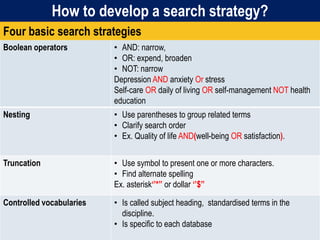
How to develop a search strategy?
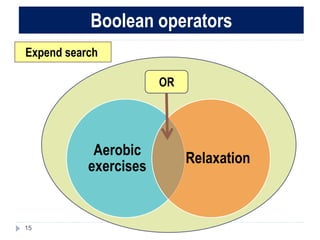
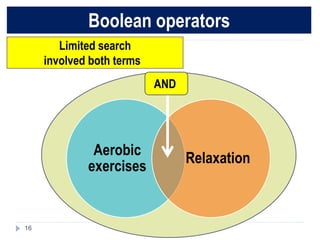
• AND: narrow,
• OR: expend, broaden
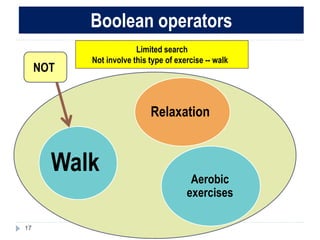
• NOT: narrow
Depression AND anxiety Or stress
Self-care OR daily of living OR self-management NOT health
education
Boolean operators
• Use parentheses to group related terms
• Clarify search order
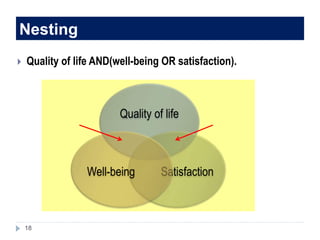
• Ex. Quality of life AND(well-being OR satisfaction).
Nesting
• Use symbol to present one or more characters.
• Find alternate spelling
Ex. asterisk‘’*’’ or dollar ‘’$’’
Truncation
• Is called subject heading, standardised terms in the
discipline.
• Is specific to each database
Controlled vocabularies
Four basic search strategies
15
Boolean operators
Aerobic
exercises
Relaxation
OR
Expend search
16
Boolean operators
Aerobic
exercises
Relaxation
AND
Limited search
involved both terms
17
Boolean operators
Walk
NOT
Limited search
Not involve this type of exercise -- walk
Relaxation
Aerobic
exercises
Nesting
 Quality of life AND(well-being OR satisfaction).
18
Quality of life
SatisfactionWell-being
Truncation
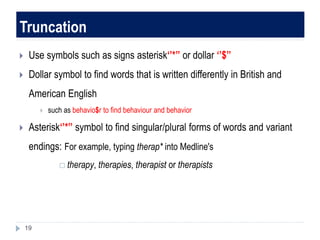
 Use symbols such as signs asterisk‘’*’’ or dollar ‘’$’’
 Dollar symbol to find words that is written differently in British and
American English
 such as behavio$r to find behaviour and behavior
 Asterisk‘’*’’ symbol to find singular/plural forms of words and variant
endings: For example, typing therap* into Medline's
 therapy, therapies, therapist or therapists
19
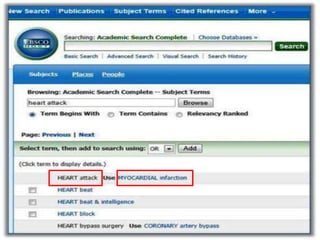
Controlled vocabularies
 Is called subject heading,
 Are standardised terms in the discipline.
 Is specific to each database. Each databases
has a local lingo
Some things go by different names depending
on where you are. Then know the local lingo or
idiom or phrase.
20
21
Steps of doing a literature search
1. Asking an answerable review question:
1. Select a topic area of review (cardiac disease)
2. Narrowing the topic area (myocardia infarction)
3. Use PICO/PICOT/PEOT format
4. Relating the review question to the research design (type of design that can answer
your question) (RCT, longitudinal study…..)
5. Know type of question [treatment, prevention, diagnosis, prognosis, causation, experience]
2. Develop and write your search strategy plan
1. State the main concepts, keywords (concept map)
2. Time and length of review (from 2005-2010)
3. Specify the inclusion and exclusion criteria for selecting paper [subjects/population ,
intervention or exposure, comparative group, outcomes and type of study
design]……PICO/PICOT/PEOT format
4. Databases/resources searching
22
23
Research topic
Ex. Alcohol intake
• What is the impact of alcohol intake on foetus outcome?
• What are the economic and psychological implications
of alcohol intake?
• Is the use of dressing A better than dressing B in the
treatment of venous leg ulcer?
State your topic as question
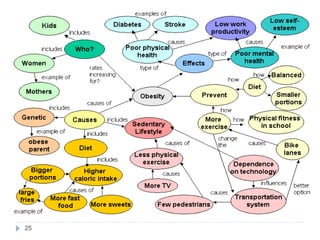
 Developing map of keywords and subject headings
 Sources of keywords and subject headings
 Other related terms---------Dictionary
 Abstracts…key words list
 Books or other references
 Databases (this is what we will do today using PubMed)
24
Brainstorm keywords
25
 MeSH Database
MeSH (Medical Subject Headings) is the U.S. National
Library of Medicine's controlled vocabulary for indexing
articles for MEDLINE/PubMed. MeSH terminology provides
a consistent way to retrieve information that may use
different terminology for the same concepts.
26
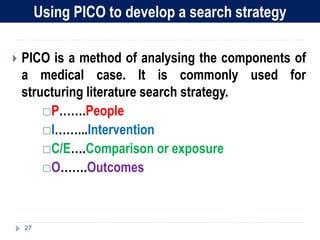
 PICO is a method of analysing the components of
a medical case. It is commonly used for
structuring literature search strategy.
P…….People
I……...Intervention
C/E….Comparison or exposure
O…….Outcomes
27
Using PICO to develop a search strategy
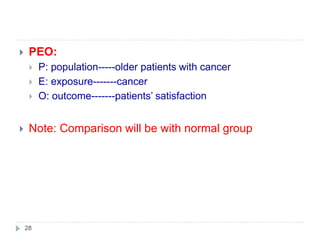
 PEO:
 P: population-----older patients with cancer
 E: exposure-------cancer
 O: outcome-------patients’ satisfaction
 Note: Comparison will be with normal group
28
29
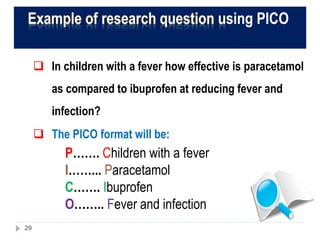
 In children with a fever how effective is paracetamol
as compared to ibuprofen at reducing fever and
infection?
 The PICO format will be:
P……. Children with a fever
I……... Paracetamol
C……. Ibuprofen
O…….. Fever and infection
sing PICO
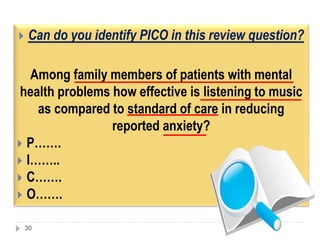
 Can do you identify PICO in this review question?
Among family members of patients with mental
health problems how effective is listening to music
as compared to standard of care in reducing
reported anxiety?
 P…….
 I……..
 C…….
 O…….
30
31
32
33
34
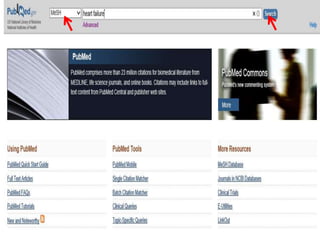
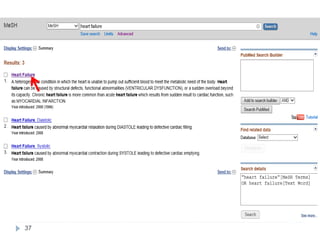
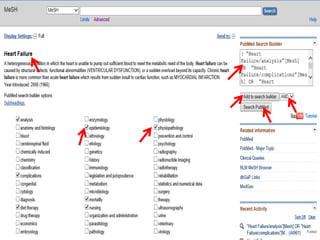
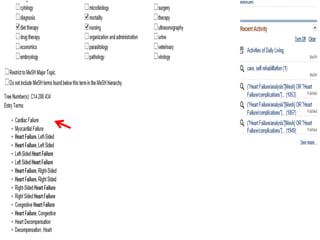
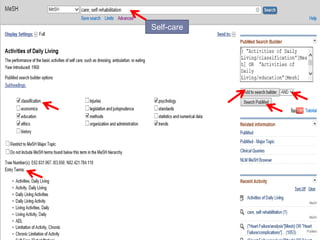
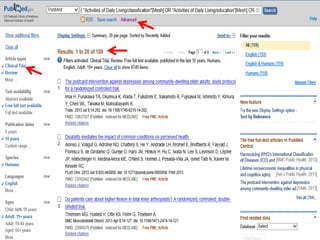
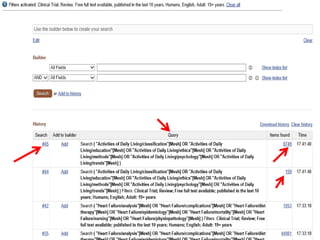
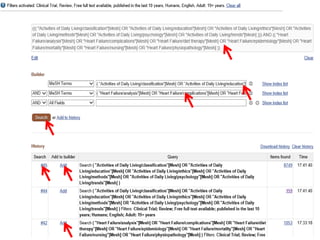
Example of searching database
MEDLINE
35
36
37
38
39
40
41
42
43
44
Self-care
45
46
49
50
51
52
53
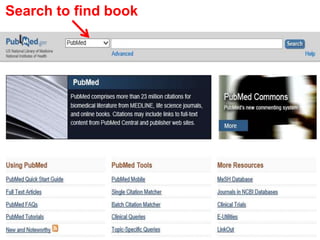
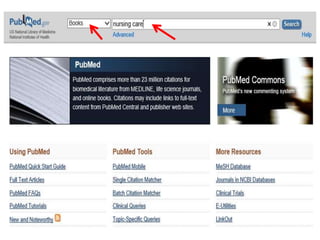
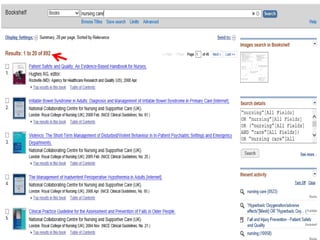
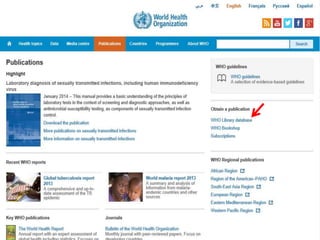
Search to find book
54
55
Post-test
56
Systematic searching of electronic databases [MEDLINE,
CINAHL and PsychInfo] was conducted. Google scholar was
also accessed as a public site for research. The search was
not limited to publishing time or study design in order to find all
the relevant papers up to April 2012. The following Medical
Subject Headings (MeSH) and appropriate keywords were
used separately and in combination based on ‘‘AND’’ and
‘‘OR’’ terms: health-related quality of life’, ‘quality of life’, ‘well-
being’, ‘functional status’, ‘health status’,‘social support', 'social
network', 'psychosocial support', 'support system', 'perceived
social support', 'liver disease', 'liver cirrhosis', and 'hepatitis'.
57
58
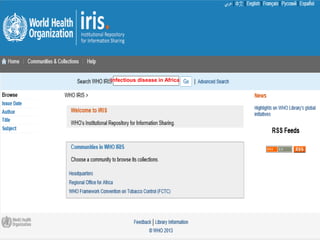
infectious disease in Africa
59
60
61
62
63
64
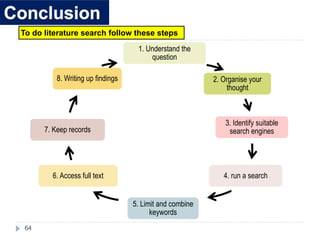
1. Understand the
question
2. Organise your
thought
3. Identify suitable
search engines
4. run a search
5. Limit and combine
keywords
6. Access full text
7. Keep records
8. Writing up findings
To do literature search follow these steps
65

Introduction of search databases

  • 1.
    Naglaa F.A. Youssef(PhD) Lecturer Faculty of Nursing Cairo University Introduction to search the databases to find relevant literature
  • 2.
     First stepof conducting a research is a literature review.  First step of doing a literature review is to find relevant literature. 2
  • 3.
    3 You do notneed to read everything have been written about your research topic. But you should be wise in searching and selecting what you should read to write your literature review.
  • 4.
    4  Definition ofliterature review  List of common databases  What is a search strategy?  Why do you need a search strategy?  How to develop a search strategy?  Steps of searching databases  Using PICO to develop a search strategy  Example of research question using PICO  Example of searching database: MEDLINE
  • 5.
    Definition of literaturereview  A literature review is a survey of everything that has been written about a particular topic, theory, or research question.  A well-structured literature search is the most effective and efficient way to locate sound evidence on the subject you are researching. Where can evidence be found?5
  • 6.
  • 7.
    A study aimedto evaluate the effectiveness of massage therapy for neck and shoulder pain. 7
  • 8.
    8 What did theauthor do to find the relevant literature to achieve his research aim?
  • 9.
  • 10.
     For theliterature review, you can use a specific search strategy to search online databases (e.g. MEDLINE® and Cochrane) using different key words that represent the research question, followed by evaluation of the bibliographies of relevant articles to find other relevant reference. 10
  • 11.
    List of commondatabases  Medical Literature Analysis and Retrieval System Online (MEDLINE),  Cumulative Index to Nursing and Allied Health Literature (CINAHL),  Cochran library,  Psychological Information (PsychInfo)  OvidSP 11 A database is a system intended to organize, store, and retrieve large amounts of data easily.
  • 12.
    What is asearch strategy?  A search strategy is the planned and structured organization of terms used to search a database. The search strategy will also indicate how these terms are combined in order to retrieve optimal results. 12
  • 13.
    13 Why do youneed a search strategy? You need a search strategy to: • Perform the most effective and simple searches to find valuable references with minimal effort.
  • 14.
    14 How to developa search strategy? • AND: narrow, • OR: expend, broaden • NOT: narrow Depression AND anxiety Or stress Self-care OR daily of living OR self-management NOT health education Boolean operators • Use parentheses to group related terms • Clarify search order • Ex. Quality of life AND(well-being OR satisfaction). Nesting • Use symbol to present one or more characters. • Find alternate spelling Ex. asterisk‘’*’’ or dollar ‘’$’’ Truncation • Is called subject heading, standardised terms in the discipline. • Is specific to each database Controlled vocabularies Four basic search strategies
  • 15.
  • 16.
  • 17.
    17 Boolean operators Walk NOT Limited search Notinvolve this type of exercise -- walk Relaxation Aerobic exercises
  • 18.
    Nesting  Quality oflife AND(well-being OR satisfaction). 18 Quality of life SatisfactionWell-being
  • 19.
    Truncation  Use symbolssuch as signs asterisk‘’*’’ or dollar ‘’$’’  Dollar symbol to find words that is written differently in British and American English  such as behavio$r to find behaviour and behavior  Asterisk‘’*’’ symbol to find singular/plural forms of words and variant endings: For example, typing therap* into Medline's  therapy, therapies, therapist or therapists 19
  • 20.
    Controlled vocabularies  Iscalled subject heading,  Are standardised terms in the discipline.  Is specific to each database. Each databases has a local lingo Some things go by different names depending on where you are. Then know the local lingo or idiom or phrase. 20
  • 21.
  • 22.
    Steps of doinga literature search 1. Asking an answerable review question: 1. Select a topic area of review (cardiac disease) 2. Narrowing the topic area (myocardia infarction) 3. Use PICO/PICOT/PEOT format 4. Relating the review question to the research design (type of design that can answer your question) (RCT, longitudinal study…..) 5. Know type of question [treatment, prevention, diagnosis, prognosis, causation, experience] 2. Develop and write your search strategy plan 1. State the main concepts, keywords (concept map) 2. Time and length of review (from 2005-2010) 3. Specify the inclusion and exclusion criteria for selecting paper [subjects/population , intervention or exposure, comparative group, outcomes and type of study design]……PICO/PICOT/PEOT format 4. Databases/resources searching 22
  • 23.
    23 Research topic Ex. Alcoholintake • What is the impact of alcohol intake on foetus outcome? • What are the economic and psychological implications of alcohol intake? • Is the use of dressing A better than dressing B in the treatment of venous leg ulcer? State your topic as question
  • 24.
     Developing mapof keywords and subject headings  Sources of keywords and subject headings  Other related terms---------Dictionary  Abstracts…key words list  Books or other references  Databases (this is what we will do today using PubMed) 24 Brainstorm keywords
  • 25.
  • 26.
     MeSH Database MeSH(Medical Subject Headings) is the U.S. National Library of Medicine's controlled vocabulary for indexing articles for MEDLINE/PubMed. MeSH terminology provides a consistent way to retrieve information that may use different terminology for the same concepts. 26
  • 27.
     PICO isa method of analysing the components of a medical case. It is commonly used for structuring literature search strategy. P…….People I……...Intervention C/E….Comparison or exposure O…….Outcomes 27 Using PICO to develop a search strategy
  • 28.
     PEO:  P:population-----older patients with cancer  E: exposure-------cancer  O: outcome-------patients’ satisfaction  Note: Comparison will be with normal group 28
  • 29.
    29  In childrenwith a fever how effective is paracetamol as compared to ibuprofen at reducing fever and infection?  The PICO format will be: P……. Children with a fever I……... Paracetamol C……. Ibuprofen O…….. Fever and infection sing PICO
  • 30.
     Can doyou identify PICO in this review question? Among family members of patients with mental health problems how effective is listening to music as compared to standard of care in reducing reported anxiety?  P…….  I……..  C…….  O……. 30
  • 31.
  • 32.
  • 33.
  • 34.
  • 35.
    Example of searchingdatabase MEDLINE 35
  • 36.
  • 37.
  • 38.
  • 39.
  • 40.
  • 41.
  • 42.
  • 43.
  • 44.
  • 45.
  • 46.
  • 49.
  • 50.
  • 51.
  • 52.
  • 53.
  • 54.
  • 55.
  • 56.
    Post-test 56 Systematic searching ofelectronic databases [MEDLINE, CINAHL and PsychInfo] was conducted. Google scholar was also accessed as a public site for research. The search was not limited to publishing time or study design in order to find all the relevant papers up to April 2012. The following Medical Subject Headings (MeSH) and appropriate keywords were used separately and in combination based on ‘‘AND’’ and ‘‘OR’’ terms: health-related quality of life’, ‘quality of life’, ‘well- being’, ‘functional status’, ‘health status’,‘social support', 'social network', 'psychosocial support', 'support system', 'perceived social support', 'liver disease', 'liver cirrhosis', and 'hepatitis'.
  • 57.
  • 58.
  • 59.
  • 60.
  • 61.
  • 62.
  • 63.
  • 64.
    64 1. Understand the question 2.Organise your thought 3. Identify suitable search engines 4. run a search 5. Limit and combine keywords 6. Access full text 7. Keep records 8. Writing up findings To do literature search follow these steps
  • 65.

Editor's Notes

  • #2  Good afternoon everybody, My name is Naglaa Fathy Afifi Youssef, I am a lecturer in faculty of nursing, Cairo university, Before I will you what I am going to talk about I want everyone introduce hisself briefly please Before I tell you what I am going to talk about today, I want to express my thanks to the National Research Centre Medical Research Division for giving me this chance to present my study.
  • #6 Evidence may be found in: books, journals, government documents and the internet. Gray literatures like theses or conferences
  • #15 Boolean operators define the relationships between words or groups of words.
  • #57 This study aimed to find the association between social support and quality of life among patients with liver cirrhosis
  • #65 Example Search 1: What is the quality of life of cardiac patients Search 2: What is the association between quality of life and mental health of cardiac patients Search 3: What is the non-medical interventions that have been developed to improve these patients quality of life or mental health status. Other example I need to develop a research that aims to assess the impact of an intervention program to improve their mental health status. Search 1: non medical intervention programs that are using to treat depression and improve physical health Search 2: Depression and its association with physical health in cardiac diseased patients