The North-South Divide
The Realities of a Complex Problem
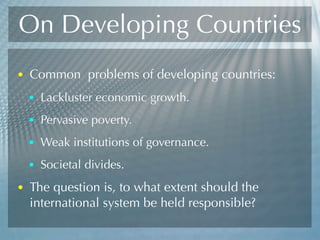
On Developing Countries
• Common problems of developing countries:
• Lackluster economic growth.
• Pervasive poverty.
• Weak institutions of governance.
• Societal divides.
• The question is, to what extent should the
international system be held responsible?
The Burning Questions
• Are developing countries disadvantaged by the
structure of the current international system?
• Is the system “biased” in favor of the developing
world?
• Are the problems experienced by developing
countries of their own doing?
• To what extent should the developed world view
this as their problem also?
• Have international institutions made the problem
better or worse?
Facts
• According to the 1999 UNDP Report (Patterns of
Global Inequality), the fifth of the world’s
population living in the highest-income countries
have:
• 86 percent of world GDP
• 82 percent of world export markets
• 68 percent of foreign direct investments
• In contrast, the bottom half have just 1 percent of
each.
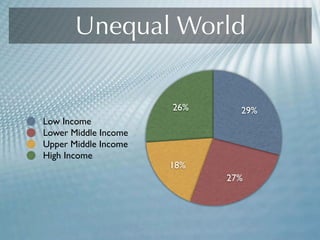
Unequal World
26%
18%
27%
29%
Low Income
Lower Middle Income
Upper Middle Income
High Income
Unequal World
26%
18%
27%
29%
Low Income
Lower Middle Income
Upper Middle Income
High Income
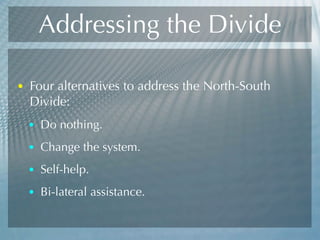
Addressing the Divide
• Four alternatives to address the North-South
Divide:
• Do nothing.
• Change the system.
• Self-help.
• Bi-lateral assistance.

North-South Divide (Analysis)

  • 1.
    The North-South Divide TheRealities of a Complex Problem
  • 2.
    On Developing Countries •Common problems of developing countries: • Lackluster economic growth. • Pervasive poverty. • Weak institutions of governance. • Societal divides. • The question is, to what extent should the international system be held responsible?
  • 3.
    The Burning Questions •Are developing countries disadvantaged by the structure of the current international system? • Is the system “biased” in favor of the developing world? • Are the problems experienced by developing countries of their own doing? • To what extent should the developed world view this as their problem also? • Have international institutions made the problem better or worse?
  • 4.
    Facts • According tothe 1999 UNDP Report (Patterns of Global Inequality), the fifth of the world’s population living in the highest-income countries have: • 86 percent of world GDP • 82 percent of world export markets • 68 percent of foreign direct investments • In contrast, the bottom half have just 1 percent of each.
  • 5.
    Unequal World 26% 18% 27% 29% Low Income LowerMiddle Income Upper Middle Income High Income
  • 6.
    Unequal World 26% 18% 27% 29% Low Income LowerMiddle Income Upper Middle Income High Income
  • 7.
    Addressing the Divide •Four alternatives to address the North-South Divide: • Do nothing. • Change the system. • Self-help. • Bi-lateral assistance.