20ME508 NON DESTRUCTIVE
TESTING-NDT
By
Dr.K.P.Dhanabalakrishnan
Prof & HoD
Department of Aeronautical Engineering
Hindusthan Institute of Technology
Course Objectives
• To introduce the concept of NDT among the students
• To understand various types of non-traditional
practices available for manufacturing industry
• To provide the concept of evaluation methods of
testing
• To provide knowledge to find the internal flaws in the
material by NDT and take measures to eliminate them
• To provide knowledge of modern tools and software(s)
for analyzing and solving real life problems
• Lecture hours-3 per week
• Credit-3
After completion of this course
…..Course Outcomes
• CO1-Apply the various NDT principles and testing
methods
• CO2-Relate the applications of surface NDT
methods
• CO3-Appraise the concepts of thermography and
eddy current testing
• CO4-Exhibit knowledge about ultrasonic testing
and acoustic emission testing
• CO5-Illustrate the basic knowledge of radiography
Text Books
• “Practical non-destructive testing” by Baldev
Raj, T.Jayakumar and M.Thavasimuthu, Narosa
Publishing House
• “Non-destructive testing techniques” by Ravi
Prakash, New Age International Publishers
Reference Books
• “Non-destructive evaluation and quality
control”, ASM Metals Handbook,Vol:17
• “Introduction to non-destructive testing: a
training guide “ by Paul E Mix, Wiley
• “Handbook of non-destructive evaluation” by
Charles, J.Hellier, Mc Graw Hill
• ASNT, American Society for Non-Destructives
Testing, NDT Handbook –Volumes : 1, 2, 3, 4,
5, 6 and 7
NDT ----This syllabus is about
• Unit 1-Overview of NDT----------9 Hours
• Unit 2-Surface NDE Methods------9 Hours
• Unit 3-Thermography and Eddy current testing
(ET)----------9 Hours
• Unit 4- Ultrasonic Testing (UT) and acoustic
emission (AE)----------9 Hours
• Unit 5- Radiography (RT)----------9 Hours
• Total-45 Hours
Unit 1-Overview of NDT
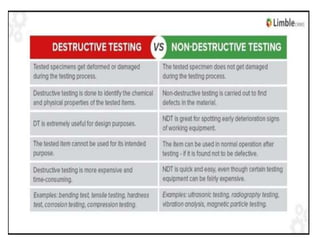
• NDT versus mechanical testing
• Overview of the NDT methods for the
detection of manufacturing defects as well as
material characterization
• Relative merits and limitations
• Various physical characteristics of materials
and their applications in NDT
• Visual inspection-unaided and aided
Introduction
• Any product is designed to perform certain functions
• A customer prefers that product to perform well
trouble free for a stipulated time period
• Trouble free performance is termed “reliability”
• Today a machine, vehicle etc comprises of various
components
• All these components put together should be reliable
to give a trouble free service
• These components should be free of defects
• A need to have methods by which defects in products
can be examined without affecting their performance
• NDT-Non-destructive Testing
• NDE-Non-destructive Evaluation
• NDI-Non-destructive Inspection
• Detecting and assessing the inhomogeneities and
harmful defects without impairing the usefulness
of materials, components or systems
• NDT plays an important role in quality control of
the finished product
• Saving in time, cost and improvement in precision
and reliability are the end result after using NDT
• Non-Destructive Testing (NDT) is a discipline
grouping together processes and techniques
to identify characteristic differences, welding
defects, and discontinuities, all while avoiding
any harm to the original part.
• The use of non-destructive testing
measurement techniques is essential for the
industry.
• Many methods are available
• Visual inspection is the simplest
Principal NDT methods
• 1.Visual or optical inspection
• 2. Dye penetrant testing
• 3.Magneticle particle testing
• 4.Eddy current testing
• 5.Radiographic testing and
• 6.Ultrasonic testing
• Nuclear
• Defence and
• Aerospace
• Require use of high technology
• Emphasis has now shifted from detection of
defects to sizing and characterization of
defects
New NDT Methods
• Radiography
• Acoustic emission
• Thermography
• Strain sensing
• Microwave technique
• Holography etc

NON DESTRUCTIVE TESTING INTRODUCTION SYLLABUS

  • 1.
    20ME508 NON DESTRUCTIVE TESTING-NDT By Dr.K.P.Dhanabalakrishnan Prof& HoD Department of Aeronautical Engineering Hindusthan Institute of Technology
  • 2.
    Course Objectives • Tointroduce the concept of NDT among the students • To understand various types of non-traditional practices available for manufacturing industry • To provide the concept of evaluation methods of testing • To provide knowledge to find the internal flaws in the material by NDT and take measures to eliminate them • To provide knowledge of modern tools and software(s) for analyzing and solving real life problems
  • 3.
    • Lecture hours-3per week • Credit-3
  • 4.
    After completion ofthis course …..Course Outcomes • CO1-Apply the various NDT principles and testing methods • CO2-Relate the applications of surface NDT methods • CO3-Appraise the concepts of thermography and eddy current testing • CO4-Exhibit knowledge about ultrasonic testing and acoustic emission testing • CO5-Illustrate the basic knowledge of radiography
  • 5.
    Text Books • “Practicalnon-destructive testing” by Baldev Raj, T.Jayakumar and M.Thavasimuthu, Narosa Publishing House • “Non-destructive testing techniques” by Ravi Prakash, New Age International Publishers
  • 6.
    Reference Books • “Non-destructiveevaluation and quality control”, ASM Metals Handbook,Vol:17 • “Introduction to non-destructive testing: a training guide “ by Paul E Mix, Wiley • “Handbook of non-destructive evaluation” by Charles, J.Hellier, Mc Graw Hill • ASNT, American Society for Non-Destructives Testing, NDT Handbook –Volumes : 1, 2, 3, 4, 5, 6 and 7
  • 7.
    NDT ----This syllabusis about • Unit 1-Overview of NDT----------9 Hours • Unit 2-Surface NDE Methods------9 Hours • Unit 3-Thermography and Eddy current testing (ET)----------9 Hours • Unit 4- Ultrasonic Testing (UT) and acoustic emission (AE)----------9 Hours • Unit 5- Radiography (RT)----------9 Hours • Total-45 Hours
  • 8.
    Unit 1-Overview ofNDT • NDT versus mechanical testing • Overview of the NDT methods for the detection of manufacturing defects as well as material characterization • Relative merits and limitations • Various physical characteristics of materials and their applications in NDT • Visual inspection-unaided and aided
  • 9.
    Introduction • Any productis designed to perform certain functions • A customer prefers that product to perform well trouble free for a stipulated time period • Trouble free performance is termed “reliability” • Today a machine, vehicle etc comprises of various components • All these components put together should be reliable to give a trouble free service • These components should be free of defects • A need to have methods by which defects in products can be examined without affecting their performance
  • 10.
    • NDT-Non-destructive Testing •NDE-Non-destructive Evaluation • NDI-Non-destructive Inspection • Detecting and assessing the inhomogeneities and harmful defects without impairing the usefulness of materials, components or systems • NDT plays an important role in quality control of the finished product • Saving in time, cost and improvement in precision and reliability are the end result after using NDT
  • 11.
    • Non-Destructive Testing(NDT) is a discipline grouping together processes and techniques to identify characteristic differences, welding defects, and discontinuities, all while avoiding any harm to the original part. • The use of non-destructive testing measurement techniques is essential for the industry.
  • 13.
    • Many methodsare available • Visual inspection is the simplest
  • 14.
    Principal NDT methods •1.Visual or optical inspection • 2. Dye penetrant testing • 3.Magneticle particle testing • 4.Eddy current testing • 5.Radiographic testing and • 6.Ultrasonic testing
  • 15.
    • Nuclear • Defenceand • Aerospace • Require use of high technology • Emphasis has now shifted from detection of defects to sizing and characterization of defects
  • 16.
    New NDT Methods •Radiography • Acoustic emission • Thermography • Strain sensing • Microwave technique • Holography etc