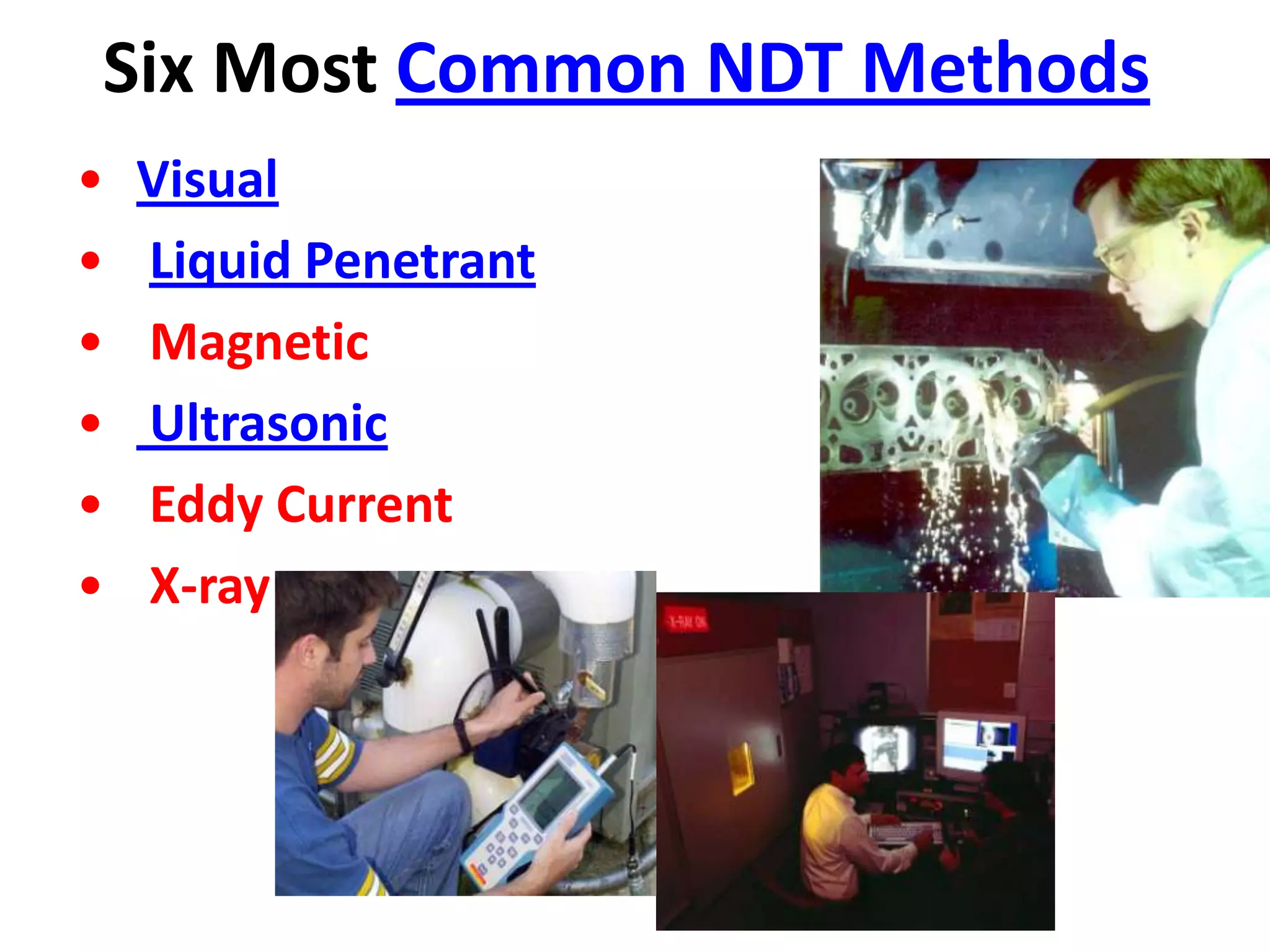
Six Most Common NDT Methods
• Visual
• Liquid Penetrant
• Magnetic
• Ultrasonic
• Eddy Current
• X-ray
Visual Inspection
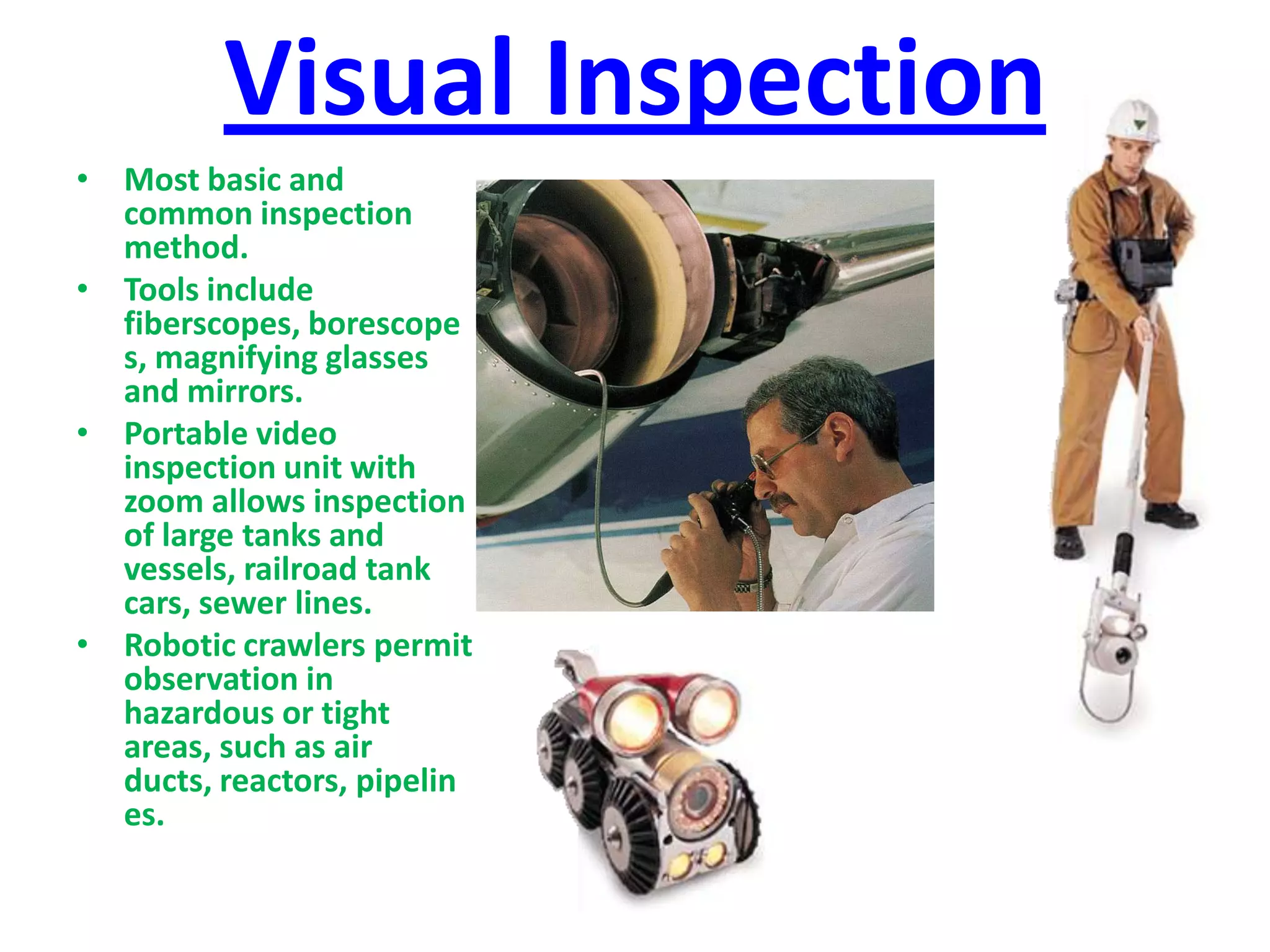
• Most basic and
common inspection
method.
• Tools include
fiberscopes, borescope
s, magnifying glasses
and mirrors.
• Portable video
inspection unit with
zoom allows inspection
of large tanks and
vessels, railroad tank
cars, sewer lines.
• Robotic crawlers permit
observation in
hazardous or tight
areas, such as air
ducts, reactors, pipelin
es.
Liquid Penetrant Inspection
• A liquid with high surface wetting characteristics is
applied to the surface of the part and allowed time to
seep into surface breaking defects.
• The excess liquid is removed from the surface of the
part.
• A developer (powder) is applied to pull the trapped
penetrant out the defect and spread it on the surface
where it can be seen.
• Visual inspection is the final step in the process. The
penetrant used is often loaded with a fluorescent dye
and the inspection is done under UV light to increase test
sensitivity.
Magnetic Particle Inspection
The part is magnetized. Finely milled iron particles
coated with a dye pigment are then applied to the
specimen. These particles are attracted to magnetic flux
leakage fields and will cluster to form an indication
directly over the discontinuity. This indication can be
visually detected under proper lighting conditions.
Magnetic Particle Crack Indications
Ultrasonic Imaging
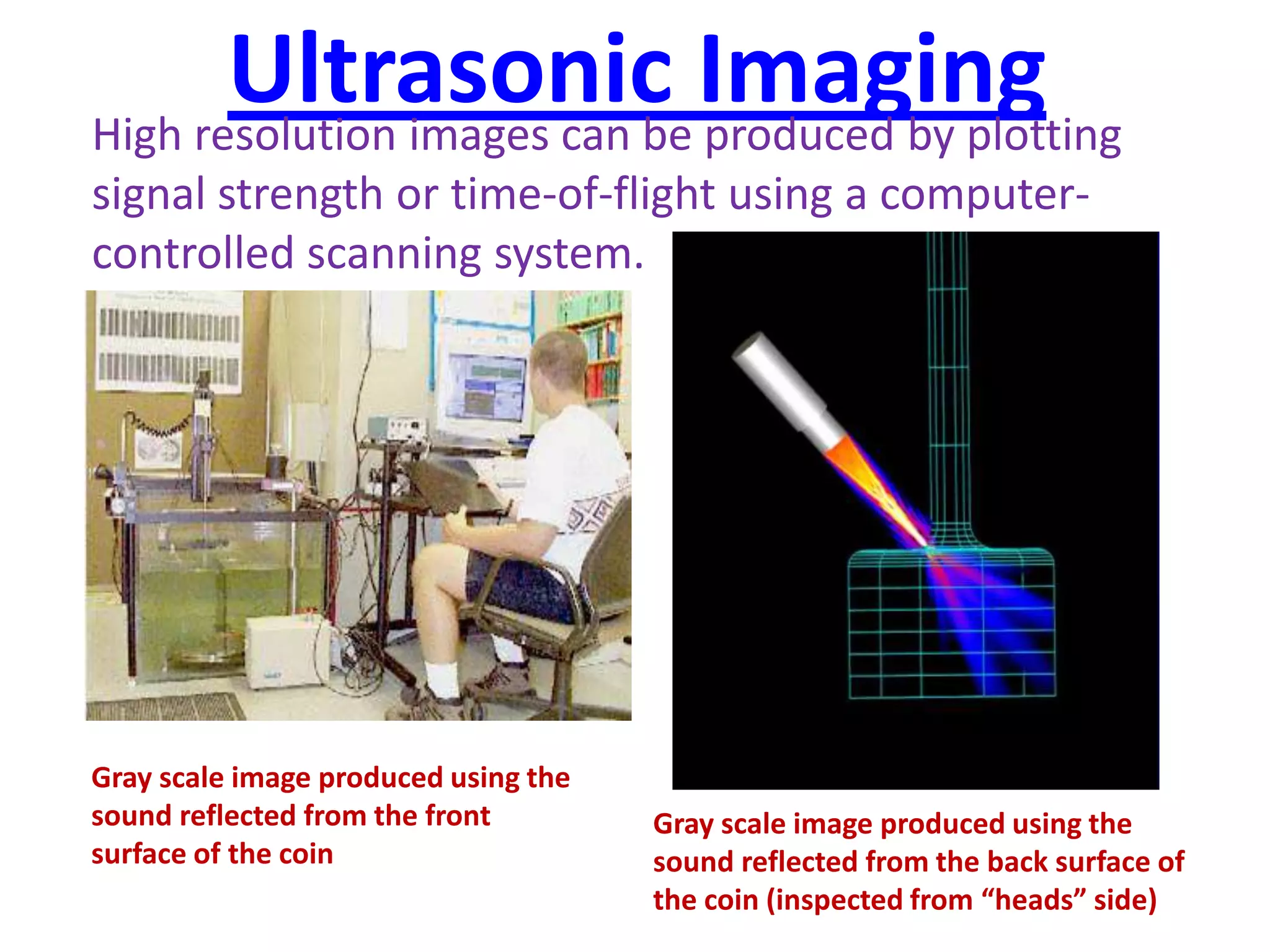
Gray scale image produced using the
sound reflected from the front
surface of the coin
Gray scale image produced using the
sound reflected from the back surface of
the coin (inspected from “heads” side)
High resolution images can be produced by plotting
signal strength or time-of-flight using a computer-
controlled scanning system.
High frequency sound waves are introduced into a material and
they are reflected back from surfaces or flaws.
Reflected sound energy is displayed versus time, and inspector can
visualize a cross section of the specimen showing the depth of
features that reflect sound. f
plate
crack
0 2 4 6 8 10
initial
pulse
crack
echo
back surface
echo
Oscilloscope, or flaw
detector screen
Ultrasonic Inspection (Pulse-Echo)
Conductive
material
Coil
Coil's
magnetic field
Eddy
currents
Eddy current's
magnetic field
Eddy Current Testing
Eddy Current TestingEddy current testing is particularly well suited for detecting surface cracks
but can also be used to make electrical conductivity and coating thickness
measurements. Here a small surface probe is scanned over the part
surface in an attempt to detect a crack.
For More Information on NDT
Ndt India
http://www.ndtindia.org
BA-15, Mangolpuri Industrial Area, Phase-2,
New Delhi, India-110034
Phone : 09560222333
Fax : + 91-11-43852040
Email : info@sigmatest.org

Six ndt methods

  • 1.
    Six Most CommonNDT Methods • Visual • Liquid Penetrant • Magnetic • Ultrasonic • Eddy Current • X-ray
  • 2.
    Visual Inspection • Mostbasic and common inspection method. • Tools include fiberscopes, borescope s, magnifying glasses and mirrors. • Portable video inspection unit with zoom allows inspection of large tanks and vessels, railroad tank cars, sewer lines. • Robotic crawlers permit observation in hazardous or tight areas, such as air ducts, reactors, pipelin es.
  • 3.
    Liquid Penetrant Inspection •A liquid with high surface wetting characteristics is applied to the surface of the part and allowed time to seep into surface breaking defects. • The excess liquid is removed from the surface of the part. • A developer (powder) is applied to pull the trapped penetrant out the defect and spread it on the surface where it can be seen. • Visual inspection is the final step in the process. The penetrant used is often loaded with a fluorescent dye and the inspection is done under UV light to increase test sensitivity.
  • 4.
    Magnetic Particle Inspection Thepart is magnetized. Finely milled iron particles coated with a dye pigment are then applied to the specimen. These particles are attracted to magnetic flux leakage fields and will cluster to form an indication directly over the discontinuity. This indication can be visually detected under proper lighting conditions.
  • 5.
  • 6.
    Ultrasonic Imaging Gray scaleimage produced using the sound reflected from the front surface of the coin Gray scale image produced using the sound reflected from the back surface of the coin (inspected from “heads” side) High resolution images can be produced by plotting signal strength or time-of-flight using a computer- controlled scanning system.
  • 7.
    High frequency soundwaves are introduced into a material and they are reflected back from surfaces or flaws. Reflected sound energy is displayed versus time, and inspector can visualize a cross section of the specimen showing the depth of features that reflect sound. f plate crack 0 2 4 6 8 10 initial pulse crack echo back surface echo Oscilloscope, or flaw detector screen Ultrasonic Inspection (Pulse-Echo)
  • 8.
  • 9.
    Eddy Current TestingEddycurrent testing is particularly well suited for detecting surface cracks but can also be used to make electrical conductivity and coating thickness measurements. Here a small surface probe is scanned over the part surface in an attempt to detect a crack.
  • 10.
    For More Informationon NDT Ndt India http://www.ndtindia.org BA-15, Mangolpuri Industrial Area, Phase-2, New Delhi, India-110034 Phone : 09560222333 Fax : + 91-11-43852040 Email : info@sigmatest.org