DESTRUCTIVE TESTING
AND NON-DESTRUCTIVE
TESTING
DESTRUCTIVE
TESTING
❖ Destructive testing is undertaken in order to understand a
specimen’s performance or material behaviour ,these procedures
are carried out to the test specimen’s failure.Destructive testing
procedures can either follow specific standards or can be tailored
to reproduce set service condition.
❖ Destructive testing methods are commonly used for material
characterisation ,fabrication validation,failure investigation,and
can form a key part of engineering critical assessments ,which
also involves
non-destructive testing (NDT) techniques such as digital
radiography.
TYPES OF DESTRUCTIVE
TESTING
1) Aggressive Environment
Testing
2) Corrosion Testing
3) Fracture and Mechanical
Testing
4) Fatigue Testing
5) Hydrogen Testing
6) Residual Stress
Measurement
7) Services
8) Poldi hardness test
9) Rockwell hardness test
POLDI HARDNESS
TEST
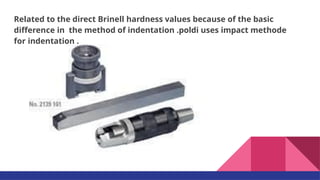
● The poldi hardness tester is one of the portable hardness tester.
● The indentation is obtained on the test surface by striking a blow
the ball which also produces indentation on the standard bar.
● The diameter of the indentation on the test surface and the
standard are correlated in the manufacturer’s table and the
hardness measured in BHN.
● Thus the method is not commonly used due to the availability
of other accurate portable hardness testers in the industry.
● Ideally ,the Brinell hardness number obtained by this method
cannot be
Related to the direct Brinell hardness values because of the basic
difference in the method of indentation .poldi uses impact methode
for indentation .
ROCKWELL HARDNESS
TEST
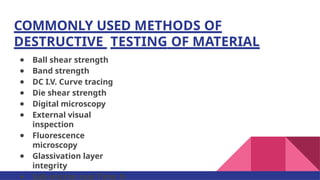
● In the rockwell hardness test ,a differential -depth method ,the
depth of the indent made by the indenter is measured.
● In constant ,the indentation size is measured in the brinell,and
knoop optical test methods.
● The deeper a define indenter penetrates at a define test into the
surface of a work piece (specimen), the softer material.
● In the rockwell method,the test force is applied in two stages .
● This allows the impact of specimen surface roughness .
(e.g-grooves in the specimen ) and measuring errors caused by
indentation depth measurement to be eliminated .
COMMONLY USED METHODS OF
DESTRUCTIVE TESTING OF MATERIAL
● Ball shear strength
● Band strength
● DC I.V. Curve tracing
● Die shear strength
● Digital microscopy
● External visual
inspection
● Fluorescence
microscopy
● Glassivation layer
integrity
● Sub-micron real Time X-
● Cross -sectioning
● Particle impact
● Scanning electron microscopy (SEM)
inspection
● SEM metallization inspection
● Solder reflow /Moisture sensitivity testing
● Metallization thickness
● Hermeticity testing
● SEM,XRF,and FTIR Elemental Analysis
● Scanning Acoustic microscopy
● Ion milling
● Aod De-encapsulation
ADVANTAGES OF DESTRUCTIVE
TESTING
● Allows a roughly identify the mechanical properties of the
adhesive joint (fracture strength, elongation, modulus of
elasticity ....)
● The mechanical properties of the adhesive or adhesive bonding
can be defined according to the different types of stresses
that undergo, efforts such as tension, compression, shear,
peel, dynamic forces of impact ...
● There are many standards on destructive testing
● The costs of equipment for destructive testing are cheaper
compare with the equipment used in nondestructive testing.
● Ability to compare adhesives with this type of testing
● Verification of surface preparation, curing conditions, working
conditions and adhesives system products (primers, activators,
adhesives ...)
● Predict and identify the approximate nature of the failure or
breakdown that may occur during the lifetime of the bonded
joint in use, when the specimen is previously submitted to an
accelerated ageing.
● Tests on a relatively cheaper cost.
DISADVANTAGES OF DESTRUCTIVE
TESTING
● You cannot identifies internal defectology (bubbles,
delaminating, pores, wrong thickness ...) of the real bonded
joint, preventing repairs before being put in use or during their
lifetime.
● Need to make specimens simulating the same process (surface
preparation, environmental conditions, and adhesives system
products) which cannot be reused once have been tested again.
● Not directly identifies the status of the adhesion area in the
bonded joint.
NON-DESTRUCTIVE TESTING
(NDT)
● Non -destructive testing (NDT) is a testing and analysis technique
used by industry to evaluate the properties of a
material ,component ,structure or system for characteristic
differences or welding defects and discontinuities without causing
damage to the original part .NDT also known as non
-destructive examination (NDE),non-destructive inspection
(NDI),and non-destructive evaluation(NDE).
COMMONLY USED METHODS OF
NON-DESTRUCTIVETESTING OF
MATERIAL:
● Eddy-current
● Magnetic -
particle
● Liquid
penetrant
● Radiographic
● Ultrasonic
● Visual testing
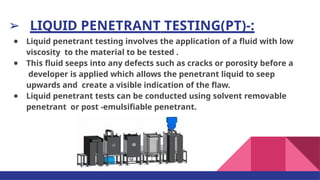
➢ LIQUID PENETRANT TESTING(PT)-:
● Liquid penetrant testing involves the application of a fluid with low
viscosity to the material to be tested .
● This fluid seeps into any defects such as cracks or porosity before a
developer is applied which allows the penetrant liquid to seep
upwards and create a visible indication of the flaw.
● Liquid penetrant tests can be conducted using solvent removable
penetrant or post -emulsifiable penetrant.
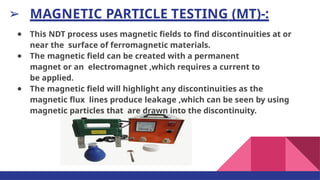
➢ MAGNETIC PARTICLE TESTING (MT)-:
● This NDT process uses magnetic fields to find discontinuities at or
near the surface of ferromagnetic materials.
● The magnetic field can be created with a permanent
magnet or an electromagnet ,which requires a current to
be applied.
● The magnetic field will highlight any discontinuities as the
magnetic flux lines produce leakage ,which can be seen by using
magnetic particles that are drawn into the discontinuity.
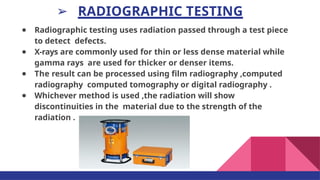
➢ RADIOGRAPHIC TESTING
● Radiographic testing uses radiation passed through a test piece
to detect defects.
● X-rays are commonly used for thin or less dense material while
gamma rays are used for thicker or denser items.
● The result can be processed using film radiography ,computed
radiography computed tomography or digital radiography .
● Whichever method is used ,the radiation will show
discontinuities in the material due to the strength of the
radiation .
ADVANTAGES OF NON-
DESTRUCTIVE TESTING(NDT)-:
● There are a number of distinct advantages ,the most obvious of
which is that the pieces being tested are left undamaged by the
process,allowing for an item to be repaired rather than replaced
should any problems be found.
● Ti is very safe testing method for operators ,with most
techniques being harmless to humans ,although some types of
test -such as radiographic testing -still need to be conducted
under strict conditions .
● This testing technique can also help prevent injury or fatalities by
ensuring structures,components and machinery is safe.
● Non -destructive testing is also a very accurate way of inspection
since the tests are repeatable and a number of tests can be used
together to correlate results.
● Unlike destructive testing ,NDT is cost effective as it can prevent the
need to replace an item before malfunction occurs without
destroying the piece itself.
● It is also useful for testing of welds and verification of welding
process has been completed to the correct specification within the
bounds of quality control,for example to make sure that the base
metal has reached the correct temperature,cooled at the specific
rate and tat compatible material have been used to prevent
welding defects.
DISADVANTAGES OF NON-
DESTRUCTIVE TESTING(NDT)-:
● Components needing to be cleaned before and after inspection.
● Sensitivity of inspection can sometimes be affected by the
finish of a component.
● Sometimes there might be a lack of depth sizing .
● On some non-destructive test methods,only relatively non-porous
surface can be inspected .
● Some test methods require electricity.
● Some can also be affected by variations in magnetic permeability.
● Somes tests are only effective on materials that are conductive.
THANK
YOU

DESTRUCTIVE TESTING ,NON-DESTRUCTIVE TESTING AND PARTIALLY TESTING-2.pptx

  • 1.
  • 2.
    DESTRUCTIVE TESTING ❖ Destructive testingis undertaken in order to understand a specimen’s performance or material behaviour ,these procedures are carried out to the test specimen’s failure.Destructive testing procedures can either follow specific standards or can be tailored to reproduce set service condition. ❖ Destructive testing methods are commonly used for material characterisation ,fabrication validation,failure investigation,and can form a key part of engineering critical assessments ,which also involves non-destructive testing (NDT) techniques such as digital radiography.
  • 3.
    TYPES OF DESTRUCTIVE TESTING 1)Aggressive Environment Testing 2) Corrosion Testing 3) Fracture and Mechanical Testing 4) Fatigue Testing 5) Hydrogen Testing 6) Residual Stress Measurement 7) Services 8) Poldi hardness test 9) Rockwell hardness test
  • 4.
    POLDI HARDNESS TEST ● Thepoldi hardness tester is one of the portable hardness tester. ● The indentation is obtained on the test surface by striking a blow the ball which also produces indentation on the standard bar. ● The diameter of the indentation on the test surface and the standard are correlated in the manufacturer’s table and the hardness measured in BHN. ● Thus the method is not commonly used due to the availability of other accurate portable hardness testers in the industry. ● Ideally ,the Brinell hardness number obtained by this method cannot be
  • 5.
    Related to thedirect Brinell hardness values because of the basic difference in the method of indentation .poldi uses impact methode for indentation .
  • 6.
    ROCKWELL HARDNESS TEST ● Inthe rockwell hardness test ,a differential -depth method ,the depth of the indent made by the indenter is measured. ● In constant ,the indentation size is measured in the brinell,and knoop optical test methods. ● The deeper a define indenter penetrates at a define test into the surface of a work piece (specimen), the softer material. ● In the rockwell method,the test force is applied in two stages . ● This allows the impact of specimen surface roughness .
  • 7.
    (e.g-grooves in thespecimen ) and measuring errors caused by indentation depth measurement to be eliminated .
  • 8.
    COMMONLY USED METHODSOF DESTRUCTIVE TESTING OF MATERIAL ● Ball shear strength ● Band strength ● DC I.V. Curve tracing ● Die shear strength ● Digital microscopy ● External visual inspection ● Fluorescence microscopy ● Glassivation layer integrity ● Sub-micron real Time X-
  • 9.
    ● Cross -sectioning ●Particle impact ● Scanning electron microscopy (SEM) inspection ● SEM metallization inspection ● Solder reflow /Moisture sensitivity testing ● Metallization thickness ● Hermeticity testing ● SEM,XRF,and FTIR Elemental Analysis ● Scanning Acoustic microscopy ● Ion milling ● Aod De-encapsulation
  • 10.
    ADVANTAGES OF DESTRUCTIVE TESTING ●Allows a roughly identify the mechanical properties of the adhesive joint (fracture strength, elongation, modulus of elasticity ....) ● The mechanical properties of the adhesive or adhesive bonding can be defined according to the different types of stresses that undergo, efforts such as tension, compression, shear, peel, dynamic forces of impact ... ● There are many standards on destructive testing ● The costs of equipment for destructive testing are cheaper compare with the equipment used in nondestructive testing.
  • 11.
    ● Ability tocompare adhesives with this type of testing ● Verification of surface preparation, curing conditions, working conditions and adhesives system products (primers, activators, adhesives ...) ● Predict and identify the approximate nature of the failure or breakdown that may occur during the lifetime of the bonded joint in use, when the specimen is previously submitted to an accelerated ageing. ● Tests on a relatively cheaper cost.
  • 12.
    DISADVANTAGES OF DESTRUCTIVE TESTING ●You cannot identifies internal defectology (bubbles, delaminating, pores, wrong thickness ...) of the real bonded joint, preventing repairs before being put in use or during their lifetime. ● Need to make specimens simulating the same process (surface preparation, environmental conditions, and adhesives system products) which cannot be reused once have been tested again. ● Not directly identifies the status of the adhesion area in the bonded joint.
  • 13.
    NON-DESTRUCTIVE TESTING (NDT) ● Non-destructive testing (NDT) is a testing and analysis technique used by industry to evaluate the properties of a material ,component ,structure or system for characteristic differences or welding defects and discontinuities without causing damage to the original part .NDT also known as non -destructive examination (NDE),non-destructive inspection (NDI),and non-destructive evaluation(NDE).
  • 14.
    COMMONLY USED METHODSOF NON-DESTRUCTIVETESTING OF MATERIAL: ● Eddy-current ● Magnetic - particle ● Liquid penetrant ● Radiographic ● Ultrasonic ● Visual testing
  • 15.
    ➢ LIQUID PENETRANTTESTING(PT)-: ● Liquid penetrant testing involves the application of a fluid with low viscosity to the material to be tested . ● This fluid seeps into any defects such as cracks or porosity before a developer is applied which allows the penetrant liquid to seep upwards and create a visible indication of the flaw. ● Liquid penetrant tests can be conducted using solvent removable penetrant or post -emulsifiable penetrant.
  • 16.
    ➢ MAGNETIC PARTICLETESTING (MT)-: ● This NDT process uses magnetic fields to find discontinuities at or near the surface of ferromagnetic materials. ● The magnetic field can be created with a permanent magnet or an electromagnet ,which requires a current to be applied. ● The magnetic field will highlight any discontinuities as the magnetic flux lines produce leakage ,which can be seen by using magnetic particles that are drawn into the discontinuity.
  • 17.
    ➢ RADIOGRAPHIC TESTING ●Radiographic testing uses radiation passed through a test piece to detect defects. ● X-rays are commonly used for thin or less dense material while gamma rays are used for thicker or denser items. ● The result can be processed using film radiography ,computed radiography computed tomography or digital radiography . ● Whichever method is used ,the radiation will show discontinuities in the material due to the strength of the radiation .
  • 18.
    ADVANTAGES OF NON- DESTRUCTIVETESTING(NDT)-: ● There are a number of distinct advantages ,the most obvious of which is that the pieces being tested are left undamaged by the process,allowing for an item to be repaired rather than replaced should any problems be found. ● Ti is very safe testing method for operators ,with most techniques being harmless to humans ,although some types of test -such as radiographic testing -still need to be conducted under strict conditions . ● This testing technique can also help prevent injury or fatalities by ensuring structures,components and machinery is safe.
  • 19.
    ● Non -destructivetesting is also a very accurate way of inspection since the tests are repeatable and a number of tests can be used together to correlate results. ● Unlike destructive testing ,NDT is cost effective as it can prevent the need to replace an item before malfunction occurs without destroying the piece itself. ● It is also useful for testing of welds and verification of welding process has been completed to the correct specification within the bounds of quality control,for example to make sure that the base metal has reached the correct temperature,cooled at the specific rate and tat compatible material have been used to prevent welding defects.
  • 20.
    DISADVANTAGES OF NON- DESTRUCTIVETESTING(NDT)-: ● Components needing to be cleaned before and after inspection. ● Sensitivity of inspection can sometimes be affected by the finish of a component. ● Sometimes there might be a lack of depth sizing . ● On some non-destructive test methods,only relatively non-porous surface can be inspected . ● Some test methods require electricity. ● Some can also be affected by variations in magnetic permeability. ● Somes tests are only effective on materials that are conductive.
  • 21.