

NON- VERBAL COMMUNICATION PRATISHTHA SHIRA RAM E.C. DEPT. 1 ST  YEAR
Communication is the articulation of sending a message through different media, whether it be verbal or nonverbal, so long as a being transmits a thought provoking idea, gesture, action, etc.   Communication
Non-Verbal Communication 'Nonverbal communication (NVC) is usually understood as the process of communication through  sending and receiving wordless messages.
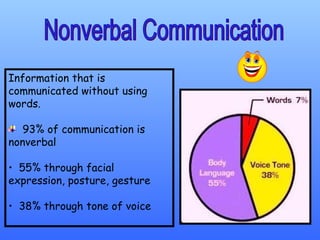
Information that is communicated without using words. 93% of communication is nonverbal 55% through facial expression, posture, gesture 38% through tone of voice Nonverbal Communication
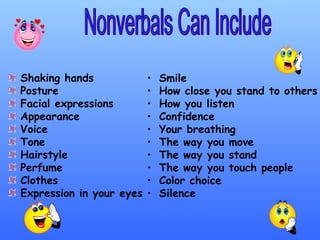
Shaking hands  Posture Facial expressions  Appearance  Voice  Tone  Hairstyle Perfume Clothes  Expression in your eyes  Nonverbals Can Include Smile  How close you stand to others  How you listen  Confidence  Your breathing  The way you move  The way you stand  The way you touch people  Color choice  Silence
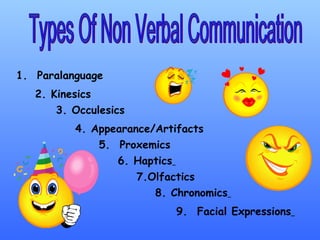
1.  Paralanguage 2. Kinesics 3. Occulesics     4. Appearance/Artifacts  5.  Proxemics 6. Haptics   7.Olfactics 8. Chronomics   9.  Facial Expressions   Types Of Non Verbal Communication
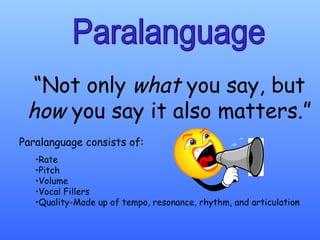
Paralanguage “ Not only  what  you say, but  how  you say it also matters.” Paralanguage consists of: Rate  Pitch  Volume  Vocal Fillers  Quality-Made up of tempo, resonance, rhythm, and articulatio n
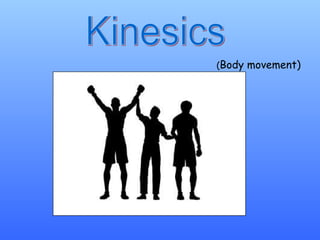
Kinesics ( Body movement)
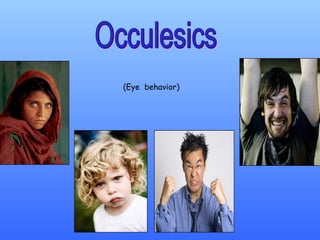
Occulesics (Eye  behavior)
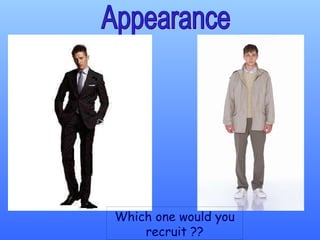
Appearance Which one would you recruit ??
Olfactics What would you prefer smelling   ?
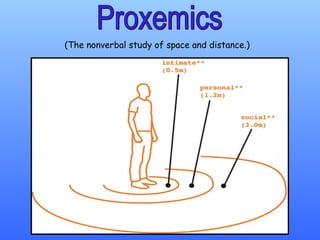
(The nonverbal study of space and distance.) Proxemics
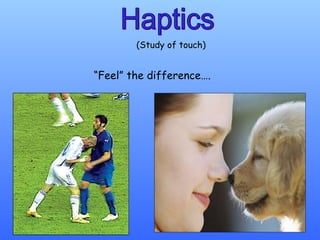
Haptics (Study of touch) “ Feel” the difference….
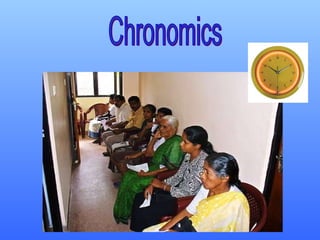
Chronomics
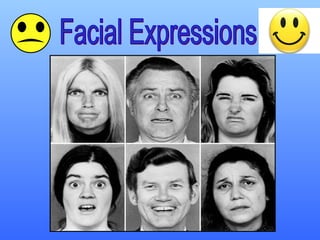
Facial Expressions
Thank You

Non Verbal Communication

  • 1.
    NON- VERBAL COMMUNICATIONPRATISHTHA SHIRA RAM E.C. DEPT. 1 ST YEAR
  • 2.
    Communication is thearticulation of sending a message through different media, whether it be verbal or nonverbal, so long as a being transmits a thought provoking idea, gesture, action, etc. Communication
  • 3.
    Non-Verbal Communication 'Nonverbalcommunication (NVC) is usually understood as the process of communication through sending and receiving wordless messages.
  • 4.
    Information that iscommunicated without using words. 93% of communication is nonverbal 55% through facial expression, posture, gesture 38% through tone of voice Nonverbal Communication
  • 5.
    Shaking hands Posture Facial expressions Appearance Voice Tone Hairstyle Perfume Clothes Expression in your eyes Nonverbals Can Include Smile How close you stand to others How you listen Confidence Your breathing The way you move The way you stand The way you touch people Color choice Silence
  • 6.
    1.  Paralanguage 2.Kinesics 3. Occulesics    4. Appearance/Artifacts 5.  Proxemics 6. Haptics 7.Olfactics 8. Chronomics 9.  Facial Expressions Types Of Non Verbal Communication
  • 7.
    Paralanguage “ Notonly what you say, but how you say it also matters.” Paralanguage consists of: Rate Pitch Volume Vocal Fillers Quality-Made up of tempo, resonance, rhythm, and articulatio n
  • 8.
    Kinesics ( Bodymovement)
  • 9.
  • 10.
    Appearance Which onewould you recruit ??
  • 11.
    Olfactics What wouldyou prefer smelling ?
  • 12.
    (The nonverbal studyof space and distance.) Proxemics
  • 13.
    Haptics (Study oftouch) “ Feel” the difference….
  • 14.
  • 15.
  • 16.

Editor's Notes

  • #4 Such messages can be communicated through gesture; body language or posture; facial expressions and eye contact; object communication such as clothing, hairstyle or even architectural ; symbols and infographics. Speech may also contain nonverbal elements known as paralanguage including voice quality, emotion and speaking style, as well as prosodic features such as rhythm, intonation and stress. Likewise, written texts have nonverbal elements such as handwriting style, spatial arrangement of words, or the use of emoticons.
  • #7 The vocal cues that accompany spoken language: The way we say words Rate-speed Pitch- Volume Vocal Fillers Quality-Made up of tempo, resonance, rhythm, and articulatio n 2. Kinesics -Body Movements 3. Occulesics -Eye behavior      Proxemics -The nonverbal study of space and distance 6. Haptics-   The nonverbal communication study of touch 7.  Olfactics-   The nonverbal communication study of smell
  • #12 Olfactics