Body Language Lecture Notes WTUC Dec. 2006
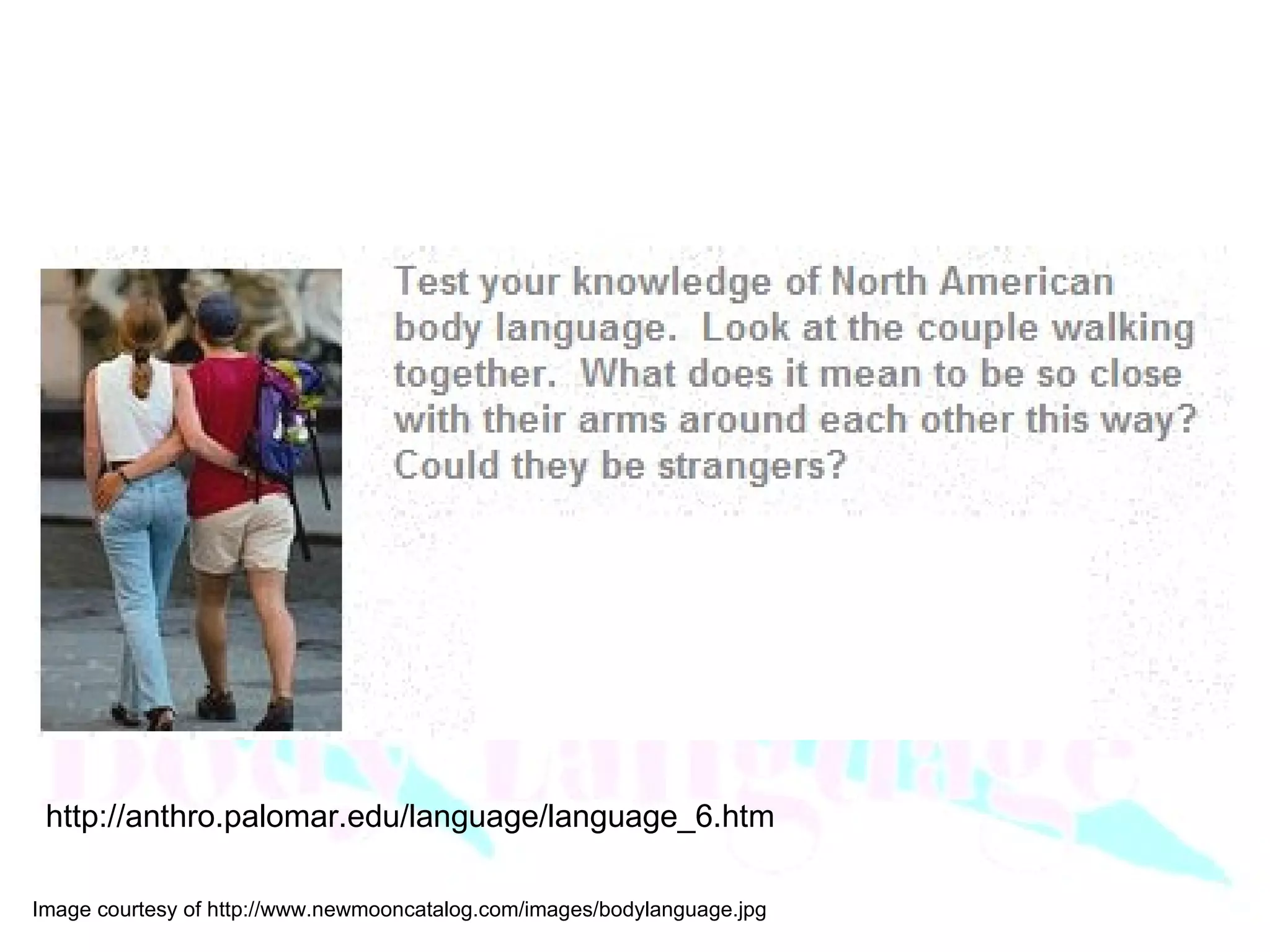
Work in Groups http://anthro.palomar.edu/language/language_6.htm
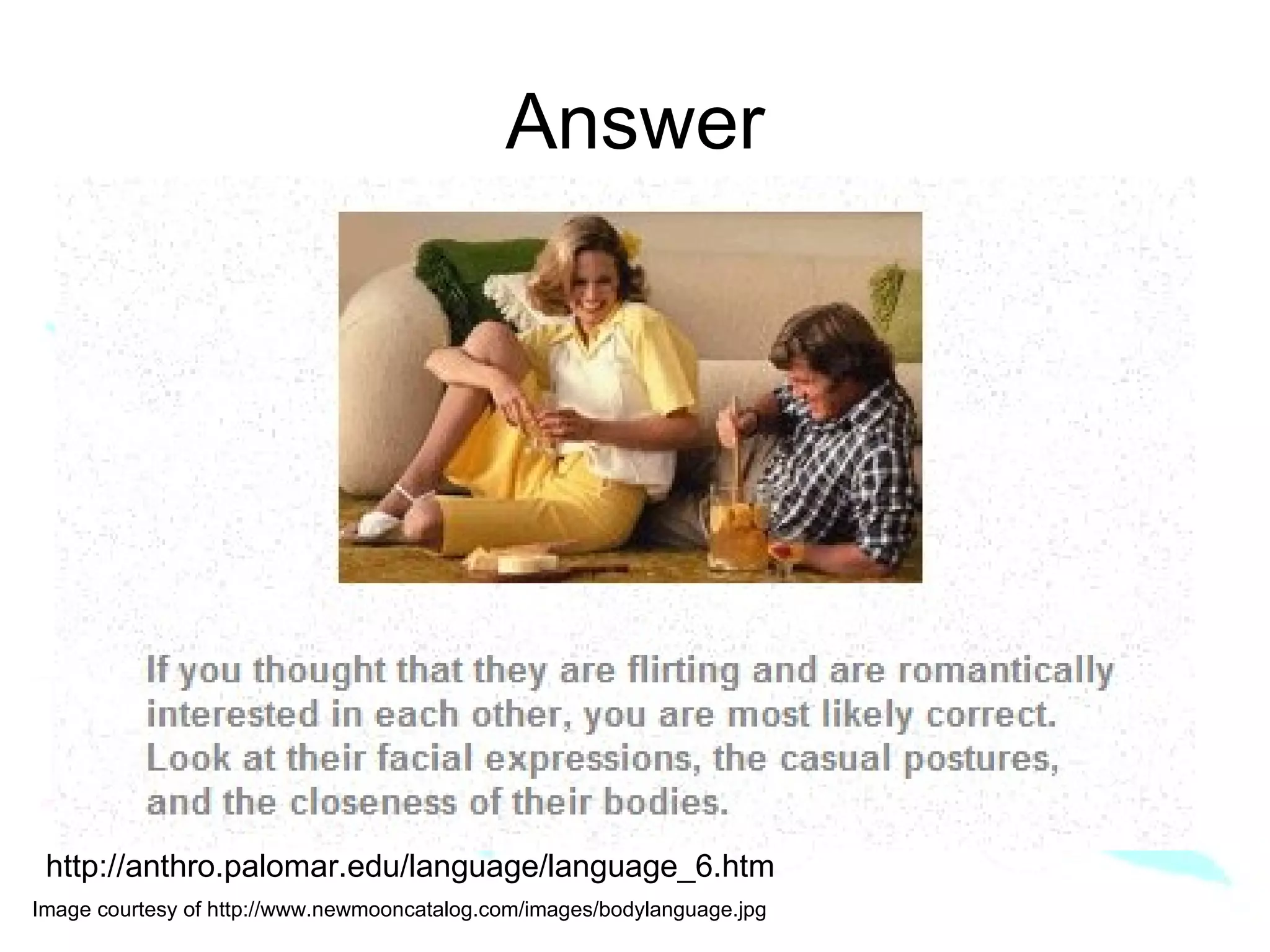
Answer http://anthro.palomar.edu/language/language_6.htm
Non-verbal communication Communication is far more than speech and writing.    non-verbal human communication is very important for effective interaction with others.   Growing up in a society, we learn how to use gestures, glances, slight changes in tone of voice, and other auxiliary communication devices to alter or emphasize what we say and do.   We learn these highly culture bound techniques over years largely by observing others and imitating them.  http://anthro.palomar.edu/language/language_6.htm
http://anthro.palomar.edu/language/language_6.htm
Answer
Paralanguage Linguists refer to all of these auxiliary communication devices as  paralanguage .  It is part of the redundancy in communication that helps prevent ineffective communication.  The paralanguage messages that can be observed through face to face contact also makes it more difficult to lie or to hide emotions.  Paralanguage is often more important in communication than what is actually being said orally.   It has been suggested that as much as 70% of what we communicate when talking directly with others is through paralanguage.
Kinesics The most obvious form of paralanguage is  body language  or  kinesics.    This is the language of gestures, expressions, and postures.   In North America, for instance, we commonly use our arms and hands to say good-bye, point, count, express excitement, beckon, warn away, threaten, etc.  We use our head to say yes or no, to smile, frown, and wink acknowledgement or flirtation.  Our head and shoulder in combination may shrug to indicate that we do not know something. http://anthro.palomar.edu/language/language_6.htm
http://anthro.palomar.edu/language/language_6.htm
Communication Process http://anthro.palomar.edu/language/language_6.htm
Body Language Body language  is a broad term for forms of  communication  using  body  movements or  gestures  instead of, or in addition to, sounds, verbal language, or other forms of communication.  http://en.wikipedia.org/wiki/Body_language
Reading Body Language Although people are generally not aware of it, they send and receive non-verbal signals all the time.  These signals can indicate what they are truly feeling. The technique of 'reading' people is used frequently.  http://en.wikipedia.org/wiki/Body_language
Hand-Gestures Warm-Up #1: Hand Gestures : Ask students to demonstrate and describe the meaning of various hand gestures. You'll be amazed at how many there are. Discuss how facial expressions and other body movements influence the meaning of a hand gesture. What do hand gestures mean in different cultures?  http://www.rider.edu/~suler/bodylang.html
Using Body Language: Flirting A simple example involves using use  body language  to discover when someone is attracted to you, or create sexual and romantic interest in someone you desire. 
Warm-Up #2: Bar Body Behavior :  Discuss body language in a bar or club. What personality types can you detect just by how people use their bodies? What are the obvious and subtle behaviors of the braggart, the flirt, the wallflower, the drunk, etc.? Consider such factors as personal space, posture, eye contact, speed and angle of movement.  http://www.rider.edu/~suler/bodylang.html
READING YOUR EMOTIONS  Posture while you are sitting, standing and walking. Are you erect or slouching? Are your muscles in your legs, back and buttocks tense or relaxed?  Gait while you are walking. Is it long, strong, grounded, steady and even, or is it short, weak, uneven, unsteady, and ungrounded? Facial muscles with your third eye when you are talking to others and when you are quiet and alone. Is your brow furrowed? Are your eyebrows being drawn together? Are your lips relaxed or tense? Are you smiling? Why?  Are your jaws relaxed, or are you clenching them? http://www.shambhalablackbelts.com/Communications/readingbodylanguage.htm
http://www.happynews.com/news/6132006/reading-body-language-like-an-expert.htm
Replacing speech Communication can be done without speaking. For example: Pointing with feet, legs, hands, head or whole body  Gestures with fingers, hands and arms.  Tilting of head  Movement of any combination of the 90 muscles in the face.  Replacement for speech can be direct one-for-one gestures with clear meaning or may be less obvious or conscious movements that signal requests, attitudes and intent. http://changingminds.org/explanations/behaviors/body_language/using_non-verbal.htm
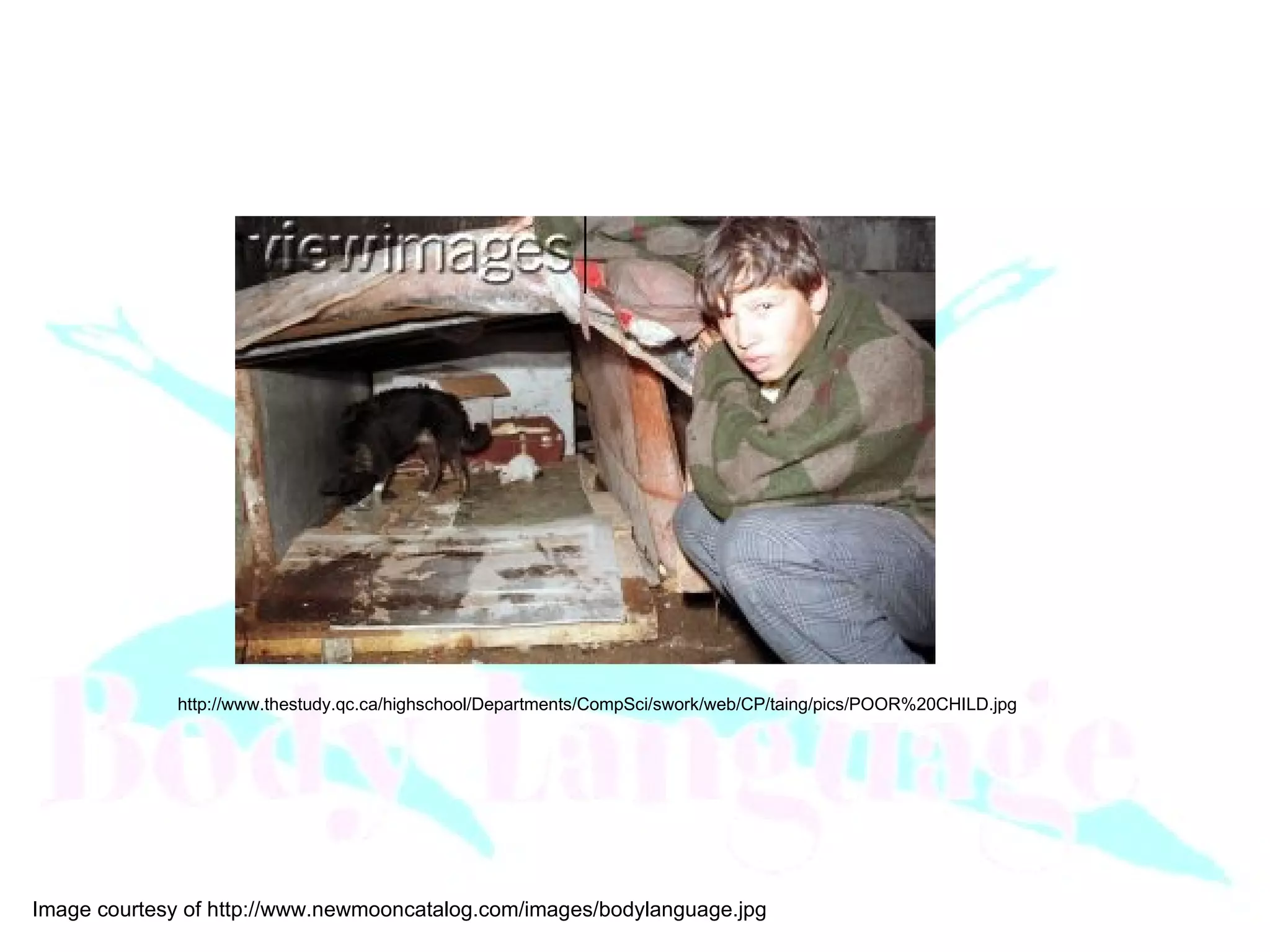
Conveying personality and status  Non-verbal communication extends beyond bodily actions to anything that sends messages. This includes much about who you are, and in particular where you fit into the social hierarchy. Such items include: Dress, including style, tidiness, coordination.  Personal adornments, from jewelry to watches and badges.  Office and desk space at work, including size and type of computer, chair, etc.  Items owned, from cameras to cars to houses.  http://changingminds.org/explanations/behaviors/body_language/using_non-verbal.htm
http://irishcar.com/ICOimages/fkbmw5.jpg Prada.com
http://www.thestudy.qc.ca/highschool/Departments/CompSci/swork/web/CP/taing/pics/POOR%20CHILD.jpg
http://www.trinidadexpress.com/shared/images/2004/09/04/suit.jpg http://www.laserline.uk.net/largeimages/loser.jpg
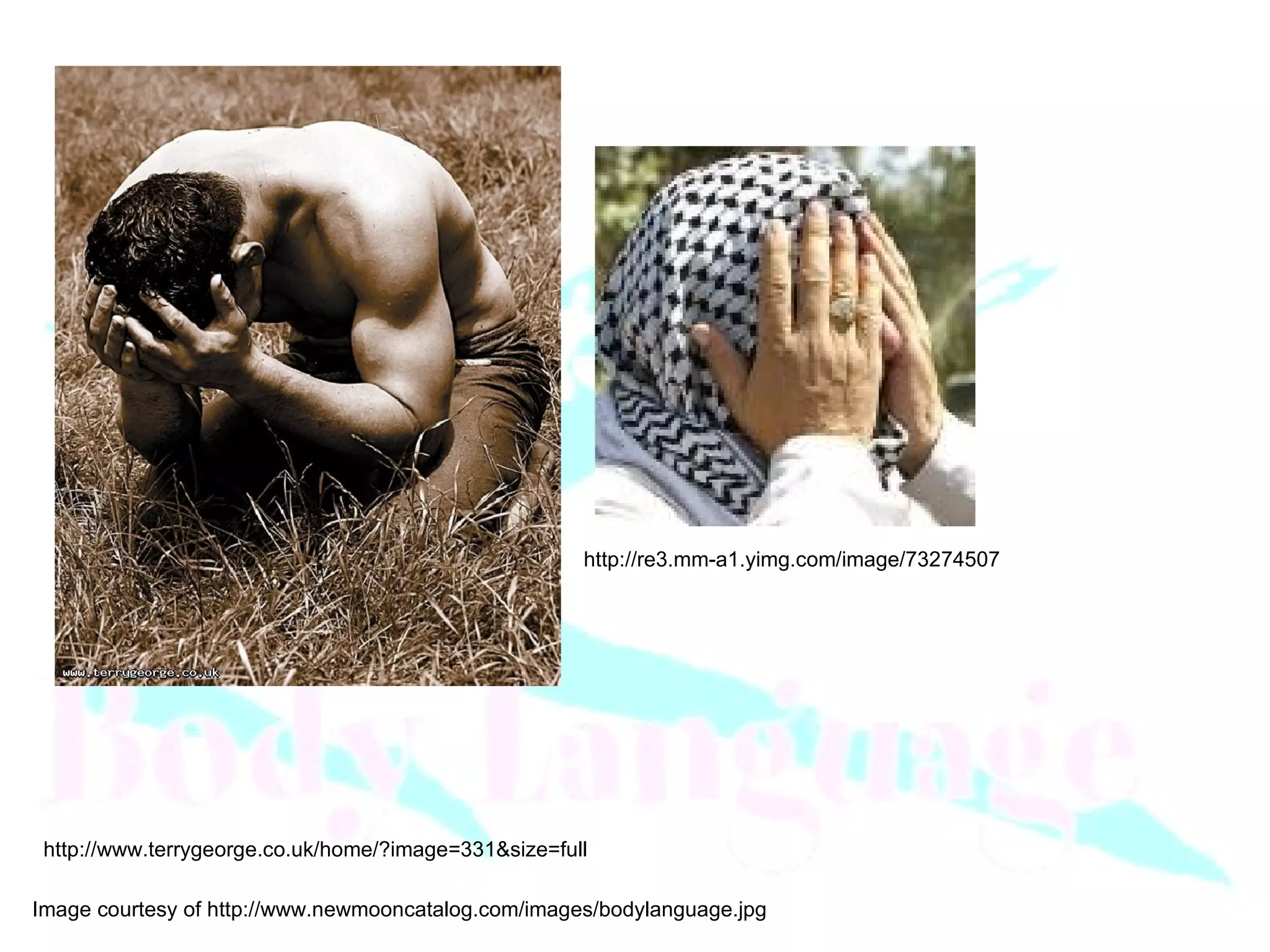
Expressing emotion  Emotions are particularly expressed through non-verbal communication, where the voice and body can tell a lot more about how you feel than your words. In particular, if you feel unable to express emotions verbally, your words and body language can easily conflict, sending messages that may be interpreted as stress or deceit. 
http://www.terrygeorge.co.uk/home/?image=331&size=full http://re3.mm-a1.yimg.com/image/73274507
In our daily lives we encounter many forms of body language gestures, those are a few examples: Self-confidence : hands behind the back, hands clasped in front  Superiority : hands clasped behind the head  Stress : shaking of legs  Defensive : Crossing of arms is often considered to be a defensive, closed posture.  http://en.wikipedia.org/wiki/Body_language
Signs of Deception Body Language of Lies: •  Physical expression will be limited and stiff, with few arm and hand movements. Hand, arm and leg movement are toward their own body the liar takes up less space. •  A person who is lying to you will avoid making eye contact. •  Hands touching their face, throat & mouth. Touching or scratching the nose or behind their ear.  Not likely  to touch his chest/heart with an open hand.
Emotional Gestures & Contradiction  •  Timing and duration of emotional gestures and emotions are off a normal pace. The display of emotion is delayed, stays longer it would naturally, then stops suddenly. •  Timing is off between emotions gestures/expressions and words. Example: Someone says "I love it!" when receiving a gift, and then smile after making that statement, rather then at the same time the statement is made. •  Gestures/expressions don’t match the verbal statement, such as frowning when saying “I love you.” •  Expressions are limited to mouth movements when someone is faking emotions (like happy, surprised, sad, awe, )instead of the whole face. For example; when someone smiles naturally their whole face is involved: jaw/cheek movement, eyes and forehead push down, etc.
Interactions and Reactions  A guilty person gets defensive. An innocent person will often go on the offensive. •  A liar is uncomfortable facing his questioner/accuser and may turn his head or body away.  •  A liar might unconsciously place objects (book, coffee cup, etc.) between themselves and you.
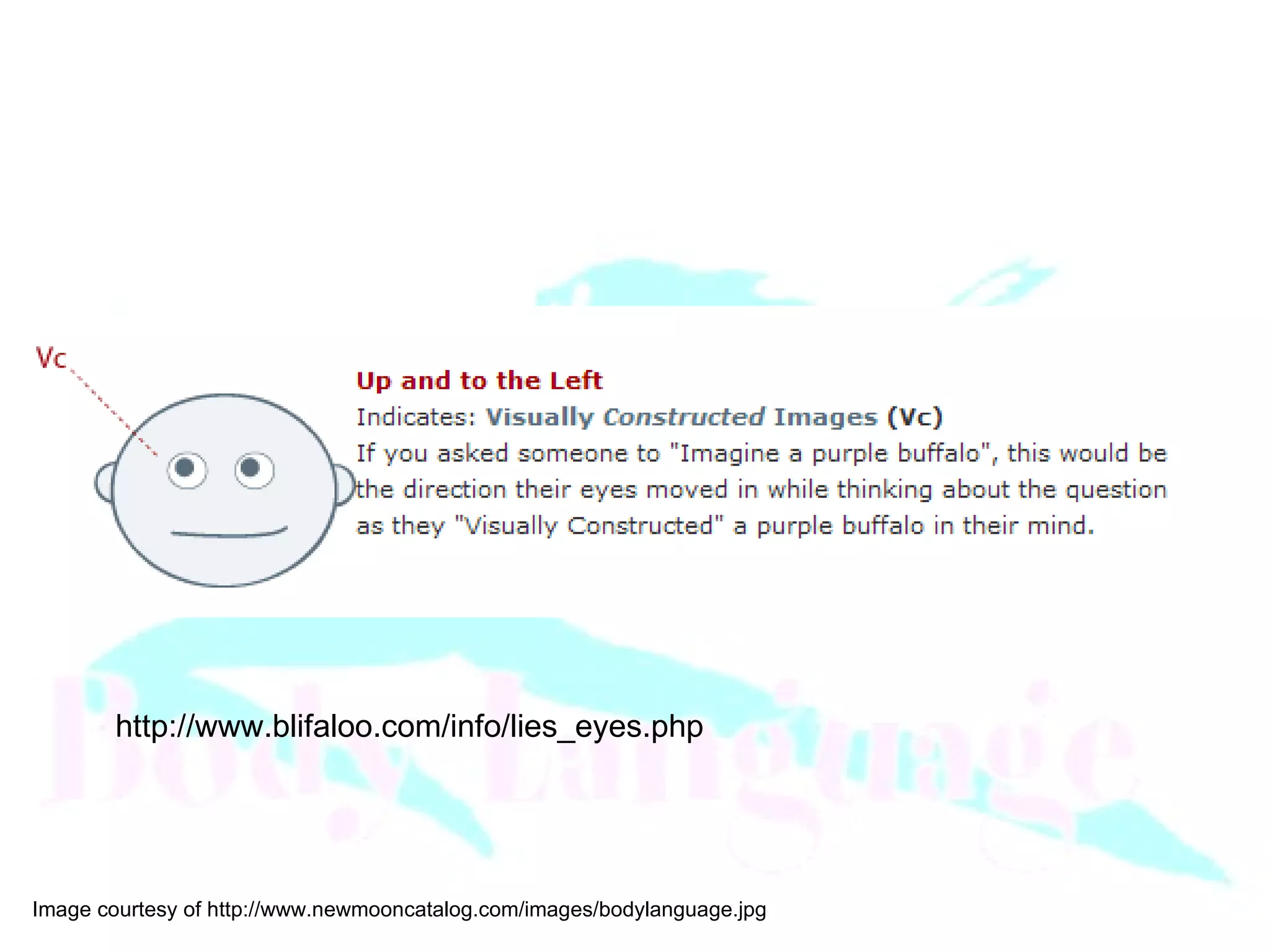
"Imagine a purple buffalo“
http://www.blifaloo.com/info/lies_eyes.php
Improvised Role Plays   Divide the class into small groups. Ask the groups to create a role play that involves ONLY body language and NO talking. The group can pick any scene and characters it wants. Encourage the group NOT to over-plan the role play.
After each role play, discuss what they believe was happening in the scene based on what they saw in the body language. What are the personalities of the people, their relationships with each other, the issues affecting the group, etc.?

Nonverbal Communication

  • 1.
    Body Language LectureNotes WTUC Dec. 2006
  • 2.
    Work in Groupshttp://anthro.palomar.edu/language/language_6.htm
  • 3.
  • 4.
    Non-verbal communication Communicationis far more than speech and writing.   non-verbal human communication is very important for effective interaction with others.  Growing up in a society, we learn how to use gestures, glances, slight changes in tone of voice, and other auxiliary communication devices to alter or emphasize what we say and do.  We learn these highly culture bound techniques over years largely by observing others and imitating them. http://anthro.palomar.edu/language/language_6.htm
  • 5.
  • 6.
  • 7.
    Paralanguage Linguists referto all of these auxiliary communication devices as paralanguage .  It is part of the redundancy in communication that helps prevent ineffective communication.  The paralanguage messages that can be observed through face to face contact also makes it more difficult to lie or to hide emotions.  Paralanguage is often more important in communication than what is actually being said orally.  It has been suggested that as much as 70% of what we communicate when talking directly with others is through paralanguage.
  • 8.
    Kinesics The mostobvious form of paralanguage is body language or kinesics.   This is the language of gestures, expressions, and postures.   In North America, for instance, we commonly use our arms and hands to say good-bye, point, count, express excitement, beckon, warn away, threaten, etc.  We use our head to say yes or no, to smile, frown, and wink acknowledgement or flirtation.  Our head and shoulder in combination may shrug to indicate that we do not know something. http://anthro.palomar.edu/language/language_6.htm
  • 9.
  • 10.
  • 11.
    Body Language Bodylanguage is a broad term for forms of communication using body movements or gestures instead of, or in addition to, sounds, verbal language, or other forms of communication. http://en.wikipedia.org/wiki/Body_language
  • 12.
    Reading Body LanguageAlthough people are generally not aware of it, they send and receive non-verbal signals all the time. These signals can indicate what they are truly feeling. The technique of 'reading' people is used frequently. http://en.wikipedia.org/wiki/Body_language
  • 13.
    Hand-Gestures Warm-Up #1:Hand Gestures : Ask students to demonstrate and describe the meaning of various hand gestures. You'll be amazed at how many there are. Discuss how facial expressions and other body movements influence the meaning of a hand gesture. What do hand gestures mean in different cultures? http://www.rider.edu/~suler/bodylang.html
  • 14.
    Using Body Language:Flirting A simple example involves using use body language to discover when someone is attracted to you, or create sexual and romantic interest in someone you desire. 
  • 15.
    Warm-Up #2: BarBody Behavior : Discuss body language in a bar or club. What personality types can you detect just by how people use their bodies? What are the obvious and subtle behaviors of the braggart, the flirt, the wallflower, the drunk, etc.? Consider such factors as personal space, posture, eye contact, speed and angle of movement. http://www.rider.edu/~suler/bodylang.html
  • 16.
    READING YOUR EMOTIONS Posture while you are sitting, standing and walking. Are you erect or slouching? Are your muscles in your legs, back and buttocks tense or relaxed? Gait while you are walking. Is it long, strong, grounded, steady and even, or is it short, weak, uneven, unsteady, and ungrounded? Facial muscles with your third eye when you are talking to others and when you are quiet and alone. Is your brow furrowed? Are your eyebrows being drawn together? Are your lips relaxed or tense? Are you smiling? Why? Are your jaws relaxed, or are you clenching them? http://www.shambhalablackbelts.com/Communications/readingbodylanguage.htm
  • 17.
  • 18.
    Replacing speech Communicationcan be done without speaking. For example: Pointing with feet, legs, hands, head or whole body Gestures with fingers, hands and arms. Tilting of head Movement of any combination of the 90 muscles in the face. Replacement for speech can be direct one-for-one gestures with clear meaning or may be less obvious or conscious movements that signal requests, attitudes and intent. http://changingminds.org/explanations/behaviors/body_language/using_non-verbal.htm
  • 19.
    Conveying personality andstatus Non-verbal communication extends beyond bodily actions to anything that sends messages. This includes much about who you are, and in particular where you fit into the social hierarchy. Such items include: Dress, including style, tidiness, coordination. Personal adornments, from jewelry to watches and badges. Office and desk space at work, including size and type of computer, chair, etc. Items owned, from cameras to cars to houses. http://changingminds.org/explanations/behaviors/body_language/using_non-verbal.htm
  • 20.
  • 21.
  • 22.
  • 23.
    Expressing emotion Emotions are particularly expressed through non-verbal communication, where the voice and body can tell a lot more about how you feel than your words. In particular, if you feel unable to express emotions verbally, your words and body language can easily conflict, sending messages that may be interpreted as stress or deceit. 
  • 24.
  • 25.
    In our dailylives we encounter many forms of body language gestures, those are a few examples: Self-confidence : hands behind the back, hands clasped in front Superiority : hands clasped behind the head Stress : shaking of legs Defensive : Crossing of arms is often considered to be a defensive, closed posture. http://en.wikipedia.org/wiki/Body_language
  • 26.
    Signs of DeceptionBody Language of Lies: • Physical expression will be limited and stiff, with few arm and hand movements. Hand, arm and leg movement are toward their own body the liar takes up less space. • A person who is lying to you will avoid making eye contact. • Hands touching their face, throat & mouth. Touching or scratching the nose or behind their ear. Not likely to touch his chest/heart with an open hand.
  • 27.
    Emotional Gestures &Contradiction • Timing and duration of emotional gestures and emotions are off a normal pace. The display of emotion is delayed, stays longer it would naturally, then stops suddenly. • Timing is off between emotions gestures/expressions and words. Example: Someone says "I love it!" when receiving a gift, and then smile after making that statement, rather then at the same time the statement is made. • Gestures/expressions don’t match the verbal statement, such as frowning when saying “I love you.” • Expressions are limited to mouth movements when someone is faking emotions (like happy, surprised, sad, awe, )instead of the whole face. For example; when someone smiles naturally their whole face is involved: jaw/cheek movement, eyes and forehead push down, etc.
  • 28.
    Interactions and Reactions A guilty person gets defensive. An innocent person will often go on the offensive. • A liar is uncomfortable facing his questioner/accuser and may turn his head or body away. • A liar might unconsciously place objects (book, coffee cup, etc.) between themselves and you.
  • 29.
  • 30.
  • 31.
    Improvised Role Plays Divide the class into small groups. Ask the groups to create a role play that involves ONLY body language and NO talking. The group can pick any scene and characters it wants. Encourage the group NOT to over-plan the role play.
  • 32.
    After each roleplay, discuss what they believe was happening in the scene based on what they saw in the body language. What are the personalities of the people, their relationships with each other, the issues affecting the group, etc.?