



Non Verbal Communication
Submitted to: Nisha Mishra Ma’am
Introduction to communication
• Communication is simply the act of
transferring information from one place,
person or group to another.
• Every communication involves at least:
1) One sender
2) A message
3) A recipient
Non verbal communication
• Nonverbal communication is the transfer of information
through the use of body language including eye contact,
facial expressions, gestures and more.
• Importance on non verbal communication:
1. Supports your message
2. Communicates messages.
3. Communicates intention.
4. Conveys feelings.
5. Offers support.
6. Showcases your personality
7. Indicates a desired action.
8. Deescalates tension.
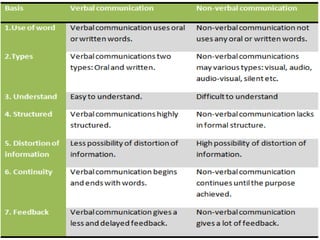
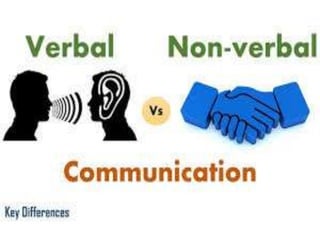
V/S
Characteristics of Non Verbal
Communication
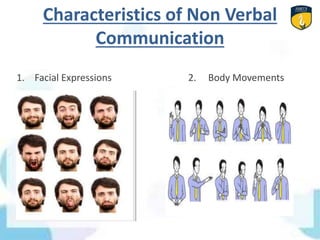
1. Facial Expressions 2. Body Movements
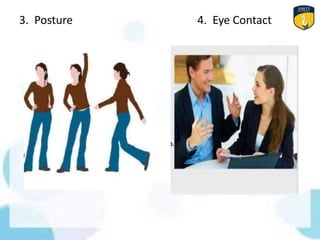
3. Posture 4. Eye Contact
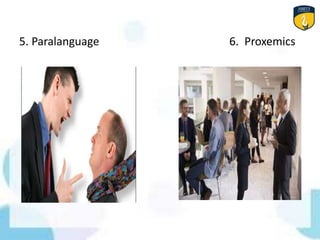
5. Paralanguage 6. Proxemics
Classification of Non Verbal
Communication
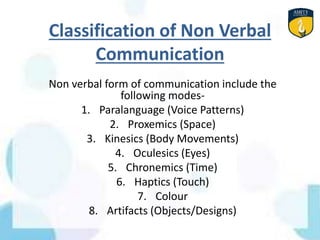
Non verbal form of communication include the
following modes-
1. Paralanguage (Voice Patterns)
2. Proxemics (Space)
3. Kinesics (Body Movements)
4. Oculesics (Eyes)
5. Chronemics (Time)
6. Haptics (Touch)
7. Colour
8. Artifacts (Objects/Designs)
Paralanguage
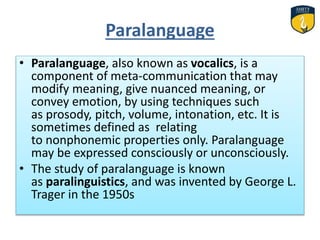
• Paralanguage, also known as vocalics, is a
component of meta-communication that may
modify meaning, give nuanced meaning, or
convey emotion, by using techniques such
as prosody, pitch, volume, intonation, etc. It is
sometimes defined as relating
to nonphonemic properties only. Paralanguage
may be expressed consciously or unconsciously.
• The study of paralanguage is known
as paralinguistics, and was invented by George L.
Trager in the 1950s
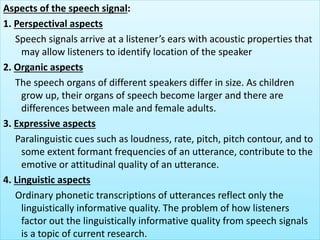
Aspects of the speech signal:
1. Perspectival aspects
Speech signals arrive at a listener’s ears with acoustic properties that
may allow listeners to identify location of the speaker
2. Organic aspects
The speech organs of different speakers differ in size. As children
grow up, their organs of speech become larger and there are
differences between male and female adults.
3. Expressive aspects
Paralinguistic cues such as loudness, rate, pitch, pitch contour, and to
some extent formant frequencies of an utterance, contribute to the
emotive or attitudinal quality of an utterance.
4. Linguistic aspects
Ordinary phonetic transcriptions of utterances reflect only the
linguistically informative quality. The problem of how listeners
factor out the linguistically informative quality from speech signals
is a topic of current research.
Proxemics
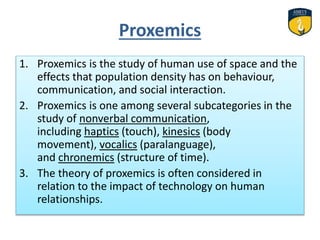
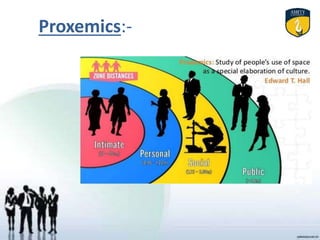
1. Proxemics is the study of human use of space and the
effects that population density has on behaviour,
communication, and social interaction.
2. Proxemics is one among several subcategories in the
study of nonverbal communication,
including haptics (touch), kinesics (body
movement), vocalics (paralanguage),
and chronemics (structure of time).
3. The theory of proxemics is often considered in
relation to the impact of technology on human
relationships.
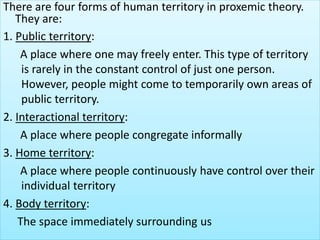
There are four forms of human territory in proxemic theory.
They are:
1. Public territory:
A place where one may freely enter. This type of territory
is rarely in the constant control of just one person.
However, people might come to temporarily own areas of
public territory.
2. Interactional territory:
A place where people congregate informally
3. Home territory:
A place where people continuously have control over their
individual territory
4. Body territory:
The space immediately surrounding us
Proxemics:-
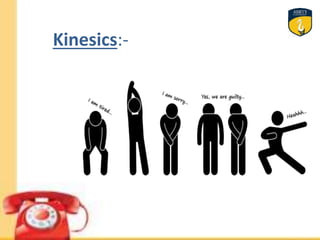
Kinesics
1. Kinesics is the study of how we use
body movement.
2. It includes body movements such as
gestures, winkling, smiling, or style of
dressing and grooming.
Relevant concepts of Kinesics
1. Emblems - Body movements or gestures
that are directly translatable into a word or
phrase.
2. Illustrators - Accompany or reinforce verbal
messages.
3. Affect Displays - Show emotion.
4. Regulators - Control the flow and pace of
communication.
5. Manipulators - Release physical or
emotional tension.
Kinesics:-
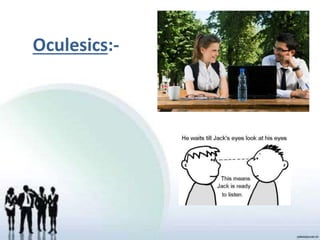
Oculesics
1. Oculesics is a technical term for
communicating through eye contact.
2. It can express different emotions such
as you are paying attention with the
person you are talking with when you
have an eye contact.
3. It conveys different meaning in different
places as in China too much of direct
eye contact is considered bad manners.
Oculesics:-
Chronemics
1. Chronemics is the study of the use of
time in nonverbal communication.
2. The use of time can affect lifestyles,
daily agendas, speed of speech,
movements and how long people are
willing to listen.
3. Time can also be used as an indicator of
status and attitude.
Haptics
1. Haptic communication is communicating by touch.
For example: We use handshakes to gain trust and introduce
ourselves.
2. Touch can mean both positive and negative meaning.
3. It can be used for:
 Task-orientation
 Ritual interaction
 Friendship
 Emotional attachment
 Sexual intent
Haptic:-
Colour
1. Colour is important communication tool.
2. It is tied to religious, cultural, political and social
influences.
3. Different colours represent different qualities:
 Yellow – warm, exciting, happy
 Blue – deep, peaceful, supernatural
 Green – peace, stillness, nature
 White – harmony, silence, cleanliness
 Black – grief, dark, unknown
 Red – glowing, confidence, alive
 Orange – radiant, healthy, serious
Artifacts
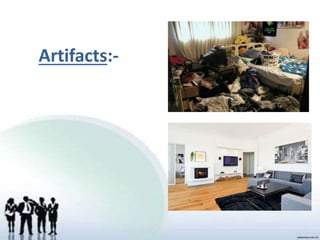
1. Artifacts are used as objects to convey
different messages.
2. It reflects taste of choice of the person.
3. It is used for creating impression.
Artifacts:-
Advantages Of Non Verbal
Communication
1. Non-verbal cues complement a verbal
message by adding to its meaning.
2. Non-verbal message may substitute for
the verbal message if it is long distance.
3. Help to illiterate people
4. Help to handicapped people
5. Attractive presentation
6. Reducing wastage of time
7. Quick expression of message
Disadvantages Of Non Verbal
Communication
1. Cultural Difference
2. Imprecise and inaccurate
3. Not everyone prefers
4. Absence of Permanent Record
5. Problem in Feedback
Ways To Develop Non Verbal
Communication
1. Establish eye contact when speaking
with others.
2. Monitor facial expression.
3. Pay attention to proximity.
4. Stand and sit up straight.
5. Watch your tone.
Thank You!

Non verbal communication

  • 1.
    Non Verbal Communication Submittedto: Nisha Mishra Ma’am
  • 2.
    Introduction to communication •Communication is simply the act of transferring information from one place, person or group to another. • Every communication involves at least: 1) One sender 2) A message 3) A recipient
  • 4.
    Non verbal communication •Nonverbal communication is the transfer of information through the use of body language including eye contact, facial expressions, gestures and more. • Importance on non verbal communication: 1. Supports your message 2. Communicates messages. 3. Communicates intention. 4. Conveys feelings. 5. Offers support. 6. Showcases your personality 7. Indicates a desired action. 8. Deescalates tension.
  • 5.
  • 8.
    Characteristics of NonVerbal Communication 1. Facial Expressions 2. Body Movements
  • 9.
    3. Posture 4.Eye Contact
  • 10.
  • 11.
    Classification of NonVerbal Communication Non verbal form of communication include the following modes- 1. Paralanguage (Voice Patterns) 2. Proxemics (Space) 3. Kinesics (Body Movements) 4. Oculesics (Eyes) 5. Chronemics (Time) 6. Haptics (Touch) 7. Colour 8. Artifacts (Objects/Designs)
  • 12.
    Paralanguage • Paralanguage, alsoknown as vocalics, is a component of meta-communication that may modify meaning, give nuanced meaning, or convey emotion, by using techniques such as prosody, pitch, volume, intonation, etc. It is sometimes defined as relating to nonphonemic properties only. Paralanguage may be expressed consciously or unconsciously. • The study of paralanguage is known as paralinguistics, and was invented by George L. Trager in the 1950s
  • 13.
    Aspects of thespeech signal: 1. Perspectival aspects Speech signals arrive at a listener’s ears with acoustic properties that may allow listeners to identify location of the speaker 2. Organic aspects The speech organs of different speakers differ in size. As children grow up, their organs of speech become larger and there are differences between male and female adults. 3. Expressive aspects Paralinguistic cues such as loudness, rate, pitch, pitch contour, and to some extent formant frequencies of an utterance, contribute to the emotive or attitudinal quality of an utterance. 4. Linguistic aspects Ordinary phonetic transcriptions of utterances reflect only the linguistically informative quality. The problem of how listeners factor out the linguistically informative quality from speech signals is a topic of current research.
  • 14.
    Proxemics 1. Proxemics isthe study of human use of space and the effects that population density has on behaviour, communication, and social interaction. 2. Proxemics is one among several subcategories in the study of nonverbal communication, including haptics (touch), kinesics (body movement), vocalics (paralanguage), and chronemics (structure of time). 3. The theory of proxemics is often considered in relation to the impact of technology on human relationships.
  • 15.
    There are fourforms of human territory in proxemic theory. They are: 1. Public territory: A place where one may freely enter. This type of territory is rarely in the constant control of just one person. However, people might come to temporarily own areas of public territory. 2. Interactional territory: A place where people congregate informally 3. Home territory: A place where people continuously have control over their individual territory 4. Body territory: The space immediately surrounding us
  • 16.
  • 17.
    Kinesics 1. Kinesics isthe study of how we use body movement. 2. It includes body movements such as gestures, winkling, smiling, or style of dressing and grooming.
  • 18.
    Relevant concepts ofKinesics 1. Emblems - Body movements or gestures that are directly translatable into a word or phrase. 2. Illustrators - Accompany or reinforce verbal messages. 3. Affect Displays - Show emotion. 4. Regulators - Control the flow and pace of communication. 5. Manipulators - Release physical or emotional tension.
  • 19.
  • 20.
    Oculesics 1. Oculesics isa technical term for communicating through eye contact. 2. It can express different emotions such as you are paying attention with the person you are talking with when you have an eye contact. 3. It conveys different meaning in different places as in China too much of direct eye contact is considered bad manners.
  • 21.
  • 22.
    Chronemics 1. Chronemics isthe study of the use of time in nonverbal communication. 2. The use of time can affect lifestyles, daily agendas, speed of speech, movements and how long people are willing to listen. 3. Time can also be used as an indicator of status and attitude.
  • 23.
    Haptics 1. Haptic communicationis communicating by touch. For example: We use handshakes to gain trust and introduce ourselves. 2. Touch can mean both positive and negative meaning. 3. It can be used for:  Task-orientation  Ritual interaction  Friendship  Emotional attachment  Sexual intent
  • 24.
  • 25.
    Colour 1. Colour isimportant communication tool. 2. It is tied to religious, cultural, political and social influences. 3. Different colours represent different qualities:  Yellow – warm, exciting, happy  Blue – deep, peaceful, supernatural  Green – peace, stillness, nature  White – harmony, silence, cleanliness  Black – grief, dark, unknown  Red – glowing, confidence, alive  Orange – radiant, healthy, serious
  • 26.
    Artifacts 1. Artifacts areused as objects to convey different messages. 2. It reflects taste of choice of the person. 3. It is used for creating impression.
  • 27.
  • 28.
    Advantages Of NonVerbal Communication 1. Non-verbal cues complement a verbal message by adding to its meaning. 2. Non-verbal message may substitute for the verbal message if it is long distance. 3. Help to illiterate people 4. Help to handicapped people 5. Attractive presentation 6. Reducing wastage of time 7. Quick expression of message
  • 29.
    Disadvantages Of NonVerbal Communication 1. Cultural Difference 2. Imprecise and inaccurate 3. Not everyone prefers 4. Absence of Permanent Record 5. Problem in Feedback
  • 30.
    Ways To DevelopNon Verbal Communication 1. Establish eye contact when speaking with others. 2. Monitor facial expression. 3. Pay attention to proximity. 4. Stand and sit up straight. 5. Watch your tone.
  • 31.