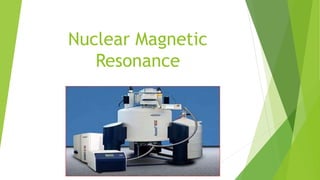
Nuclear Magnetic
Resonance
Definition
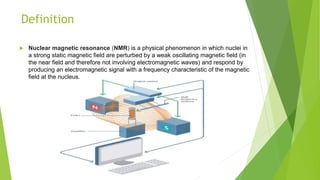
 Nuclear magnetic resonance (NMR) is a physical phenomenon in which nuclei in
a strong static magnetic field are perturbed by a weak oscillating magnetic field (in
the near field and therefore not involving electromagnetic waves) and respond by
producing an electromagnetic signal with a frequency characteristic of the magnetic
field at the nucleus.
Principles of nuclear magnetic
resonance (NMR)
 The principle behind NMR is that many nuclei have spin and all nuclei are
electrically charged.
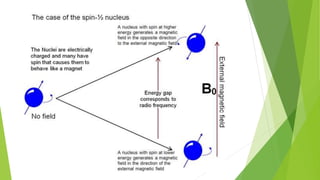
 If an external magnetic field is applied, an energy transfer is possible between
the base energy to a higher energy level (generally a single energy gap).
 The energy transfer takes place at a wavelength that corresponds to radio
frequencies and when the spin returns to its base level, energy is emitted at the
same frequency.
 The signal that matches this transfer is measured in many ways and processed
in order to yield an NMR spectrum for the nucleus concerned
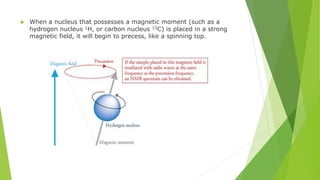
 When a nucleus that possesses a magnetic moment (such as a
hydrogen nucleus 1H, or carbon nucleus 13C) is placed in a strong
magnetic field, it will begin to precess, like a spinning top.
 The principle of NMR usually involves three sequential steps:
 The alignment (polarization) of the magnetic nuclear spins in an applied,
constant magnetic fieldB0.
 The perturbation of this alignment of the nuclear spins by a weak oscillating
magnetic field, usually referred to as a radio-frequency (RF) pulse. The
oscillation frequency required for significant perturbation is dependent upon the
static magnetic field (B0) and the nuclei of observation.
 The detection of the NMR signal during or after the RF pulse, due to the voltage
induced in a detection coil by precession of the nuclear spins around B0. After
an RF pulse, precession usually occurs with the nuclei's intrinsic Larmor
frequency and, in itself, does not involve transitions between spin states or
energy levels.
Nuclear magnetic resonance
spectroscopy
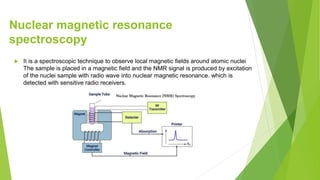
 It is a spectroscopic technique to observe local magnetic fields around atomic nuclei
The sample is placed in a magnetic field and the NMR signal is produced by excitation
of the nuclei sample with radio wave into nuclear magnetic resonance. which is
detected with sensitive radio receivers.
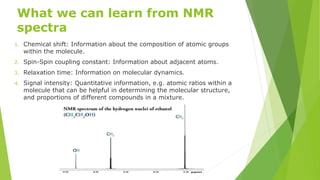
What we can learn from NMR
spectra
1. Chemical shift: Information about the composition of atomic groups
within the molecule.
2. Spin-Spin coupling constant: Information about adjacent atoms.
3. Relaxation time: Information on molecular dynamics.
4. Signal intensity: Quantitative information, e.g. atomic ratios within a
molecule that can be helpful in determining the molecular structure,
and proportions of different compounds in a mixture.
Uses of NMR
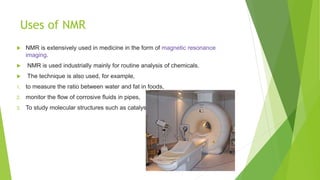
 NMR is extensively used in medicine in the form of magnetic resonance
imaging.
 NMR is used industrially mainly for routine analysis of chemicals.
 The technique is also used, for example,
1. to measure the ratio between water and fat in foods,
2. monitor the flow of corrosive fluids in pipes,
3. To study molecular structures such as catalysts
Thank you!

NMR

  • 1.
  • 2.
    Definition  Nuclear magneticresonance (NMR) is a physical phenomenon in which nuclei in a strong static magnetic field are perturbed by a weak oscillating magnetic field (in the near field and therefore not involving electromagnetic waves) and respond by producing an electromagnetic signal with a frequency characteristic of the magnetic field at the nucleus.
  • 3.
    Principles of nuclearmagnetic resonance (NMR)  The principle behind NMR is that many nuclei have spin and all nuclei are electrically charged.  If an external magnetic field is applied, an energy transfer is possible between the base energy to a higher energy level (generally a single energy gap).  The energy transfer takes place at a wavelength that corresponds to radio frequencies and when the spin returns to its base level, energy is emitted at the same frequency.  The signal that matches this transfer is measured in many ways and processed in order to yield an NMR spectrum for the nucleus concerned
  • 5.
     When anucleus that possesses a magnetic moment (such as a hydrogen nucleus 1H, or carbon nucleus 13C) is placed in a strong magnetic field, it will begin to precess, like a spinning top.
  • 6.
     The principleof NMR usually involves three sequential steps:  The alignment (polarization) of the magnetic nuclear spins in an applied, constant magnetic fieldB0.  The perturbation of this alignment of the nuclear spins by a weak oscillating magnetic field, usually referred to as a radio-frequency (RF) pulse. The oscillation frequency required for significant perturbation is dependent upon the static magnetic field (B0) and the nuclei of observation.  The detection of the NMR signal during or after the RF pulse, due to the voltage induced in a detection coil by precession of the nuclear spins around B0. After an RF pulse, precession usually occurs with the nuclei's intrinsic Larmor frequency and, in itself, does not involve transitions between spin states or energy levels.
  • 7.
    Nuclear magnetic resonance spectroscopy It is a spectroscopic technique to observe local magnetic fields around atomic nuclei The sample is placed in a magnetic field and the NMR signal is produced by excitation of the nuclei sample with radio wave into nuclear magnetic resonance. which is detected with sensitive radio receivers.
  • 8.
    What we canlearn from NMR spectra 1. Chemical shift: Information about the composition of atomic groups within the molecule. 2. Spin-Spin coupling constant: Information about adjacent atoms. 3. Relaxation time: Information on molecular dynamics. 4. Signal intensity: Quantitative information, e.g. atomic ratios within a molecule that can be helpful in determining the molecular structure, and proportions of different compounds in a mixture.
  • 10.
    Uses of NMR NMR is extensively used in medicine in the form of magnetic resonance imaging.  NMR is used industrially mainly for routine analysis of chemicals.  The technique is also used, for example, 1. to measure the ratio between water and fat in foods, 2. monitor the flow of corrosive fluids in pipes, 3. To study molecular structures such as catalysts
  • 11.