BY
ABRARAHMAD Ro-1
AKASH CHAUHAN Ro-2
RNTCP(REVISED NATIONAL
TUBERCULOSIS CONTROL
PROGRAM)
contents
■ Tuberculosis
■ Burden
■ RNTCP
■ Goal & Objectives
■ Organization
■ Strategies
■ Diagnosis
■ Treatment
■ Monitoring and evaluation
■ References
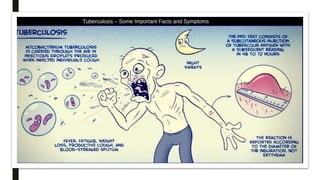
 Pathogenesis-bacteria attacks first in hilar areas in lung because air flow is maximum & forms
ghon’s focus. At this stage the person becomesTB infected but non-infectious k/a primaryTB
PrimaryTB -95% case- healedTB
- 2-4% case- latentTB
-1-2% case-progressive primaryTB
 The most common symptom of pulmonary TB is a productive cough for more than 2
weeks, which may be accompanied by other respiratory symptoms (shortness of breath, chest
pains, haemoptysis) and/or constitutional symptoms (loss of appetite, weight loss, fever, night
sweats, and fatigue)
An HIV infected person has 10-30 times higher chances
of developingTB than those without HIV.
EveryTB patient should be referred to ICTC for HIV
status
Diabetes, malignancy, smoking tobacco, malnutrition
and alcohol abuse also increase the risk of progression
from infection to disease.
BURDEN
■ 1TB case untreated 10-20 new t.B cases/year
■ TB incidence is 204/1lakh population/year
■ Incidence of MDRTB-10/1lakh population
■ Mortality rate- 32/1lakh population
■ Case fatality rate-0.16/1lakh population
■ Antibiotic resistance inTB –6.19% of allTB cases turn to MDRT.B
2.18% of newT.B cases become ab resistance
11.2% of previously treated become ab resistant
■ If treated a case ofTB-90% become non infectious within 48hr
->95% non infectious within 2 weeks
RNTCP
■ The NationalTB Programme (NTP) was started in 1962 forTB control in India.
■ This programme was not able to give expected results in India.
■ REASONS:
More emphasis on detection rather than cure
Inadequate budget and insufficient managerial capacity
Shortage and interrupted supply of drugs
Emphasis on x-ray diagnosis resulting in inaccurate diagnosis
Poor quality sputum microscopy.
Multiplicity of treatment regimens
 As a result of the review and pilot studies in 1993, the DOTS strategy was adopted in India
under the Revised NationalTB control Programme - RNTCP
 The programme was implemented in a phase manner and by 24th March 2006, the entire
country was covered under the programme.
 The program is renamed as nationalTB eradication program in 2020
Goals & objectives
■ The goal of RNTCP is to decrease the mortality and morbidity due to
tuberculosis and cut down the chain of transmission of infection until
TB ceases to be a public health problem.
■ To achieve and maintain:
■ Cure rate of at least 90% among newly detected smear positive
(infectious) pulmonaryTB cases and
■ Case detection of at least 90% of the expected new smear positiveTB
cases in the community
■ EliminateTB from india by 2025
One/ 100,000
(50,000 in hilly/
difficult/
tribal area)
(200,000
population
TB Health Visitors
(TBHV),
DOT Provider
(MPW, NGO, PP,
Medical Officer, paramedical staff
And Laboratory Technician
Medical officer-TB Control,
Senior Treatment supervisor(STS),
Senior TB Laboratory
Supervisor(STLS)
State TB cente
District TB Centre
Tuberculosis Unit
Microscopy Centre
DOT Centre
Nodal point for TB
control
State Medical Officer
and other supporting
staff
Central TB division District Collector
DTO, MO-DTC , LT, DEO,
Driver, Urban TB Coordinators,
TBHVs, Communication Facilitators
ORGANISATION
statergy
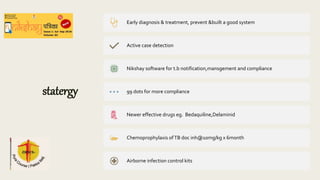
Early diagnosis & treatment, prevent &built a good system
Active case detection
Nikshay software for t.b notification,mansgement and compliance
99 dots for more compliance
Newer effective drugs eg. Bedaquiline,Delaminid
Chemoprophylaxis ofTB doc inh@10mg/kg x 6month
Airborne infection control kits
 Incentives –# private practioner for providing 1st lineTB tx-1000/-
# treatment provider for MDRTB -2000/- end of I.P
3000/-end of C.P
# patient gets 500/month for good nutrition under
“nikshay poshan yojna”
# Giving information about aT.B case-500/-
 TB notification within 30 days of dx/tx
 Fortnight clinical review of allTB cases
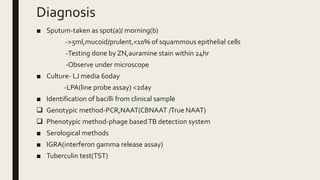
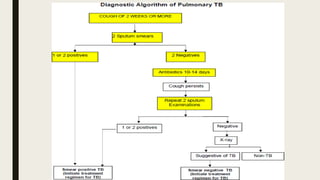
Diagnosis
■ Sputum-taken as spot(a)/ morning(b)
->5ml,mucoid/prulent,<10% of squammous epithelial cells
-Testing done by ZN,auramine stain within 24hr
-Observe under microscope
■ Culture- LJ media 60day
-LPA(line probe assay) <2day
■ Identification of bacilli from clinical sample
 Genotypic method-PCR,NAAT(CBNAAT /True NAAT)
 Phenotypic method-phage basedTB detection system
■ Serological methods
■ IGRA(interferon gamma release assay)
■ Tuberculin test(TST)
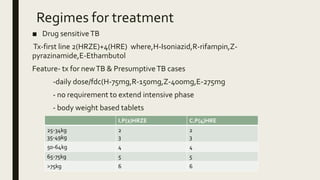
Regimes for treatment
■ Drug sensitiveTB
Tx-first line 2(HRZE)+4(HRE) where,H-Isoniazid,R-rifampin,Z-
pyrazinamide,E-Ethambutol
Feature- tx for newTB & PresumptiveTB cases
-daily dose/fdc(H-75mg,R-150mg,Z-400mg,E-275mg
- no requirement to extend intensive phase
- body weight based tablets
I.P(2)HRZE C.P(4)HRE
25-34kg
35-49kg
2
3
2
3
50-64kg 4 4
65-75kg 5 5
>75kg 6 6
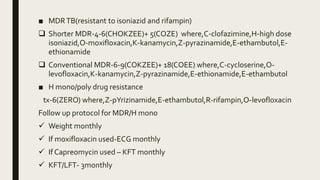
■ MDRTB(resistant to isoniazid and rifampin)
 Shorter MDR-4-6(CHOKZEE)+ 5(COZE) where,C-clofazimine,H-high dose
isoniazid,O-moxifloxacin,K-kanamycin,Z-pyrazinamide,E-ethambutol,E-
ethionamide
 Conventional MDR-6-9(COKZEE)+ 18(COEE) where,C-cycloserine,O-
levofloxacin,K-kanamycin,Z-pyrazinamide,E-ethionamide,E-ethambutol
■ H mono/poly drug resistance
tx-6(ZERO) where,Z-pYrizinamide,E-ethambutol,R-rifampin,O-levofloxacin
Follow up protocol for MDR/H mono
 Weight monthly
 If moxifloxacin used-ECG monthly
 If Capreomycin used – KFT monthly
 KFT/LFT- 3monthly
Monitoring and evaluation
■ Best indicator ofTB burden- prevalence ofTB disese
■ Best indicator of evaluation of program- incidence of
infection
■ ‘Ii’ k/a ARTI/TCI(Tubeculin conversion index) is defiend as
number of newly converted montoux positive individual
in a specific population in a year
■ IfARTI is 1% it means 50 new sputum positive patient
■ India ARTI-1.7
■ Incidence ofTB in India – 75/LAC/YR
References
PARKTEXTBOOK OF PREVENTIVE AND
SOCIAL MEDICINE by K.PARK(25th edi)
https://tbcindia.gov.in/
Google images
Conceptual Review of Preventative &
Social Medicine by Dr Mukhmohit
Singh(2019)
T
H
A
N
K
Y
O
U

RNTCP

  • 1.
    BY ABRARAHMAD Ro-1 AKASH CHAUHANRo-2 RNTCP(REVISED NATIONAL TUBERCULOSIS CONTROL PROGRAM)
  • 2.
    contents ■ Tuberculosis ■ Burden ■RNTCP ■ Goal & Objectives ■ Organization ■ Strategies ■ Diagnosis ■ Treatment ■ Monitoring and evaluation ■ References
  • 4.
     Pathogenesis-bacteria attacksfirst in hilar areas in lung because air flow is maximum & forms ghon’s focus. At this stage the person becomesTB infected but non-infectious k/a primaryTB PrimaryTB -95% case- healedTB - 2-4% case- latentTB -1-2% case-progressive primaryTB  The most common symptom of pulmonary TB is a productive cough for more than 2 weeks, which may be accompanied by other respiratory symptoms (shortness of breath, chest pains, haemoptysis) and/or constitutional symptoms (loss of appetite, weight loss, fever, night sweats, and fatigue)
  • 5.
    An HIV infectedperson has 10-30 times higher chances of developingTB than those without HIV. EveryTB patient should be referred to ICTC for HIV status Diabetes, malignancy, smoking tobacco, malnutrition and alcohol abuse also increase the risk of progression from infection to disease.
  • 6.
    BURDEN ■ 1TB caseuntreated 10-20 new t.B cases/year ■ TB incidence is 204/1lakh population/year ■ Incidence of MDRTB-10/1lakh population ■ Mortality rate- 32/1lakh population ■ Case fatality rate-0.16/1lakh population ■ Antibiotic resistance inTB –6.19% of allTB cases turn to MDRT.B 2.18% of newT.B cases become ab resistance 11.2% of previously treated become ab resistant ■ If treated a case ofTB-90% become non infectious within 48hr ->95% non infectious within 2 weeks
  • 7.
    RNTCP ■ The NationalTBProgramme (NTP) was started in 1962 forTB control in India. ■ This programme was not able to give expected results in India. ■ REASONS: More emphasis on detection rather than cure Inadequate budget and insufficient managerial capacity Shortage and interrupted supply of drugs Emphasis on x-ray diagnosis resulting in inaccurate diagnosis Poor quality sputum microscopy. Multiplicity of treatment regimens  As a result of the review and pilot studies in 1993, the DOTS strategy was adopted in India under the Revised NationalTB control Programme - RNTCP  The programme was implemented in a phase manner and by 24th March 2006, the entire country was covered under the programme.  The program is renamed as nationalTB eradication program in 2020
  • 8.
    Goals & objectives ■The goal of RNTCP is to decrease the mortality and morbidity due to tuberculosis and cut down the chain of transmission of infection until TB ceases to be a public health problem. ■ To achieve and maintain: ■ Cure rate of at least 90% among newly detected smear positive (infectious) pulmonaryTB cases and ■ Case detection of at least 90% of the expected new smear positiveTB cases in the community ■ EliminateTB from india by 2025
  • 9.
    One/ 100,000 (50,000 inhilly/ difficult/ tribal area) (200,000 population TB Health Visitors (TBHV), DOT Provider (MPW, NGO, PP, Medical Officer, paramedical staff And Laboratory Technician Medical officer-TB Control, Senior Treatment supervisor(STS), Senior TB Laboratory Supervisor(STLS) State TB cente District TB Centre Tuberculosis Unit Microscopy Centre DOT Centre Nodal point for TB control State Medical Officer and other supporting staff Central TB division District Collector DTO, MO-DTC , LT, DEO, Driver, Urban TB Coordinators, TBHVs, Communication Facilitators ORGANISATION
  • 10.
    statergy Early diagnosis &treatment, prevent &built a good system Active case detection Nikshay software for t.b notification,mansgement and compliance 99 dots for more compliance Newer effective drugs eg. Bedaquiline,Delaminid Chemoprophylaxis ofTB doc inh@10mg/kg x 6month Airborne infection control kits
  • 11.
     Incentives –#private practioner for providing 1st lineTB tx-1000/- # treatment provider for MDRTB -2000/- end of I.P 3000/-end of C.P # patient gets 500/month for good nutrition under “nikshay poshan yojna” # Giving information about aT.B case-500/-  TB notification within 30 days of dx/tx  Fortnight clinical review of allTB cases
  • 12.
    Diagnosis ■ Sputum-taken asspot(a)/ morning(b) ->5ml,mucoid/prulent,<10% of squammous epithelial cells -Testing done by ZN,auramine stain within 24hr -Observe under microscope ■ Culture- LJ media 60day -LPA(line probe assay) <2day ■ Identification of bacilli from clinical sample  Genotypic method-PCR,NAAT(CBNAAT /True NAAT)  Phenotypic method-phage basedTB detection system ■ Serological methods ■ IGRA(interferon gamma release assay) ■ Tuberculin test(TST)
  • 14.
    Regimes for treatment ■Drug sensitiveTB Tx-first line 2(HRZE)+4(HRE) where,H-Isoniazid,R-rifampin,Z- pyrazinamide,E-Ethambutol Feature- tx for newTB & PresumptiveTB cases -daily dose/fdc(H-75mg,R-150mg,Z-400mg,E-275mg - no requirement to extend intensive phase - body weight based tablets I.P(2)HRZE C.P(4)HRE 25-34kg 35-49kg 2 3 2 3 50-64kg 4 4 65-75kg 5 5 >75kg 6 6
  • 15.
    ■ MDRTB(resistant toisoniazid and rifampin)  Shorter MDR-4-6(CHOKZEE)+ 5(COZE) where,C-clofazimine,H-high dose isoniazid,O-moxifloxacin,K-kanamycin,Z-pyrazinamide,E-ethambutol,E- ethionamide  Conventional MDR-6-9(COKZEE)+ 18(COEE) where,C-cycloserine,O- levofloxacin,K-kanamycin,Z-pyrazinamide,E-ethionamide,E-ethambutol ■ H mono/poly drug resistance tx-6(ZERO) where,Z-pYrizinamide,E-ethambutol,R-rifampin,O-levofloxacin Follow up protocol for MDR/H mono  Weight monthly  If moxifloxacin used-ECG monthly  If Capreomycin used – KFT monthly  KFT/LFT- 3monthly
  • 16.
    Monitoring and evaluation ■Best indicator ofTB burden- prevalence ofTB disese ■ Best indicator of evaluation of program- incidence of infection ■ ‘Ii’ k/a ARTI/TCI(Tubeculin conversion index) is defiend as number of newly converted montoux positive individual in a specific population in a year ■ IfARTI is 1% it means 50 new sputum positive patient ■ India ARTI-1.7 ■ Incidence ofTB in India – 75/LAC/YR
  • 17.
    References PARKTEXTBOOK OF PREVENTIVEAND SOCIAL MEDICINE by K.PARK(25th edi) https://tbcindia.gov.in/ Google images Conceptual Review of Preventative & Social Medicine by Dr Mukhmohit Singh(2019)
  • 18.