Submitted by:
Tripti sharma
02822106617
4th year
*National filaria control
programme
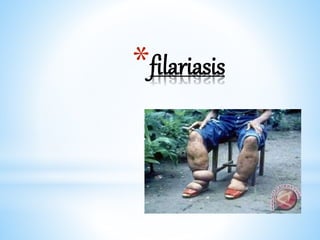
*filariasis
INTRODUCTION
❖Filariasis is a parasitic disease caused by an
infection with roundworms of the Filarioidea
type.
❖These are spread by blood-feeding insects
such as black flies and mosquitoes.
❖ They belong to the group of diseases called
helminthiases.
❖Disease is endemic
❖Major social and economic scourage is in
Africa, Asia and America.
*TYPES OF FILARIASIS
*LYMPHATIC FILARIASIS
oWuchereria bancrofti
oBrugia malai
oBrugia timori
*SUBCUTANEOUS FILARIASIS
oloa loa
*SEROUS CAVITY FILARIASIS
oMansonella
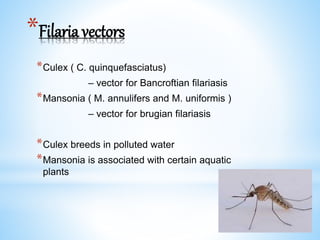
*Filaria vectors
*Culex ( C. quinquefasciatus)
– vector for Bancroftian filariasis
*Mansonia ( M. annulifers and M. uniformis )
– vector for brugian filariasis
*Culex breeds in polluted water
*Mansonia is associated with certain aquatic
plants
*TRANSMISSION OF LYMPHATIC FILARIASIS
*Lymphatic filariasis is transmitted through mosquito
bites.
*The persons having circulating microfilariae are
outwardly healthy but transmit the infection to others
through mosquitoes.
*The persons with chronic filarial swellings suffer
severely from the disease but no longer transmit the
infection
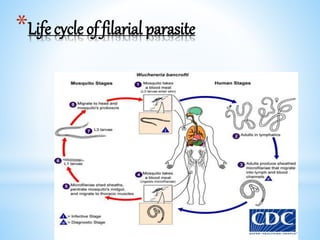
*Life cycle of filarial parasite
*Burden of Disease
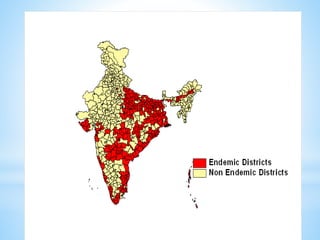
*Lymphatia filariasis is prevalent in 18 states and union
territories. Bancrftian filariasis is widely distributed while
brugian filariasis caused by Brugia malayi is restricted to 6
states - UP, Bihar, Andhra Pradesh, Orissa, Tamil Nadu,
Kerala, and Gujarat.
*The WHO has estimated that 600 million people are at risk of
infection in South east Asia and 60 million are actually
infected in the region (WHO-SEARO !999). There are about
454 million people (75.6%) at the risk of infection with 48
million (80%) infected with parasite are contributed only by
India.
*Economic Loss
*About 1.2 billion
man-days are lost
due to filariasis every
year leading to an
economic loss of Rs.
3500 crore
*National Filaria
Control Program
This program was started in 1955
In 1998 the operational component was merged with Urban
Malaria Scheme
In 2003 -04 it was merged with NVBDCP
Filariasis has been a major public health problem in India
next only to malaria.
Indigenous cases have been reported from about 250
districts in 20 states/Union Territories.
*OBJECTIVES:
To train professional and ancilliary personnel
required for the programme.
To carry survey in different parts of the
country.
Reduction of problem in un-surveyed area.
Control in urban area through recurrent anti-
parasitic measure
*CONTROL STRATEGY
*Vector control through anti larval spray/ application at
weekly intervals with appropriate larvicides.
*Biological control through larvivorous fishes
*Environmental engineering through source reduction and
water management
*Anti- parasitic measures through diagnosis and treatment
of microfilaria carriers and cases.
*Information , education and communication to generate
community awareness.
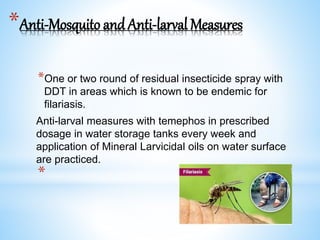
*Anti-Mosquito and Anti-larval Measures
*One or two round of residual insecticide spray with
DDT in areas which is known to be endemic for
filariasis.
Anti-larval measures with temephos in prescribed
dosage in water storage tanks every week and
application of Mineral Larvicidal oils on water surface
are practiced.
*
1
5
*Eliminationof Lymphatic
Filariasis
 In 1997, WHO and its Member States made a commitment to
eliminate Lymphatic Filariasis (LF) as public health problem
by 2020 through World Health Assembly Resolution.
 The National Health Policy (2002) has set the goal of
Elimination of Lymphatic Filariasis in India by 2015. Later
extended to 2021.
 Twin pillar strategies of Mass Drug Administration (MDA) for
interruption of transmission i.e. no new case and Morbidity
Management and Disability Prevention (MMDP) for catering
the disease afflicted patients were adopted for elimination.
*Mass Drug Administration (MDA)
*MDA started as mass campaign from 2004.
*Initially with single dose of DEC only.
*In the year of 2007 with DEC + Albendazole co-administration
*Form 2018 Triple Drug Therapy (IDA) i.e. DEC + Albendazole
+ Ivermectin is launched initially in five selected districts.
Since elimination target is approaching first all the left out
districts which are yet to achieve elimination will be brought
under IDA.
*
*TwinPillar Strategy for Elimination of Lymphatic
Filariasis
*Annual Mass Drug Administration (MDA) of single dose of
DEC (Diethylcarbamazine citrate) and Albendazole for 5 years
or more to the eligible population (except pregnant women,
children below 2 years of age and seriously ill persons) to
interrupt transmission of the disease.
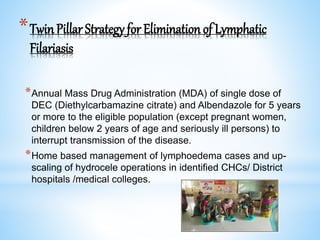
*Home based management of lymphoedema cases and up-
scaling of hydrocele operations in identified CHCs/ District
hospitals /medical colleges.
*Progressand
Achievement
*In pursuit of the goals, the Government of India launched
nationwide MDA in 2004 in endemic areas as well as
home based morbidity management, scaling up
hydrocelectomies in hospitals and CHCs.
*During the year 2004, only 202 districts could be covered
with coverage rate of 72.6%. The number of districts was
upscaled and in 2007 all the 250 known LF endemic
districts were brought under MDA
*Accelerated Plan which include Triple Drug Therapy (IDA)
was launched in the Global Alliance Elimination of
Lymphatic Filariasis (GAELF) meeting held during 13th to
15th June 2018 by Hon’ble Union Health Minister and
Hon’ble Minister of State.
*Meeting for Dissemination of the Accelerated Plan for
Elimination of Lymphatic Filariasis and Program
Progress Review held at New Delhi.
*The population coverage during MDA has improved
from 73% in 2004 to 87.33% in 2019 (Prov.)
*Intensive social mobilization during MDA, have been
carried out by various States/ UTs involving political/
opinion leaders, decision makers, local leaders and
community.
*For high level advocay - United to Eliminate Lymphatic
National Symposium Filariasis held on 30th October
2019 at Pravasi Bharatiya Kendra, New Delhi
inaugurated by Hon’ble Union Health Minister
*Milestones of ELF
*In 1997, The World Health Assembly adopted resolution WHA
50.29, for Elimination of Lymphatic Filariasis as a global public
health problem by 2020.
*In 2002, National Health Policy set a goal for ELF in India by
2015 (further extended to 2017). It implies that LF ceases to
be a public health problem when microfilaria rate is <1% and
the children born after initiation of MDA are free from
circulating antigenemia.
*In 2004, Elimination of Lymphatic Filariasis (ELF) programme
was launched covering 202 endemic districts in 20 States/UTs.
*Subsequently scaled up to cover all the 257 endemic districts
in 21 States/UTs targeting a population of about 650 million.
*In 2013 validation started through Transmission Assessment
Survey (TAS).
*The policy decision to implement global strategy of co-
administration of DEC with Albendazole during MDA was approved
by National Task Force on Elimination of Lymphatic Filariasis under
the Chairmanship of DGHS in 2006.
*Accelerated Plan for Elimination of Lymphatic Filariasis 2018
launched in 10 Global Alliance Elimination of Lymphatic Filariasis
(GAELF) on 13th June, 2018.
*Triple Drug Therapy (IDA) has been successfully implemented in 5
districts namely Arwal (Bihar) and Simdega (Jharkhand), Nagpur
(Maharashtra), Varanasi (Uttar Pradesh), Yadgiri (Karnataka) on
20th December 2018, 10th January 2019, 20th January, 2019,
20th February, 2019 and 13th November, 2019 respectively.
*GoI has revised the financial norms for Morbidity Management Kits
from Rs. 150/- to Rs. 500/- per kit in last MSG meeting held in
February 2019.
*Proposal for enhancement of budget under ELF programme
approved by EPC for consideration of MSG.
*TransmissionAssessmentSurvey(TAS)
*All the districts have completed more than
5 rounds of MDA by the end of 2014, and
are required to be evaluated to decide
whether to stop or continue MDA.
• Till august 2017, 94 districts with 152
evaluation units (approx. 221 million
population each) have been successfully
completed through TAS and
qualified for MDAstoppage.
*Morbidity Management andDisability
Alleviation
• The process involved updating the line-listing of
Lymphoedema & Hydrocele cases by door to door
survey in endemic district.
• Demonstration and training on simple foot hygiene to
affected persons and motivate them for self practice.
•Motivate for surgical intervention to hydrocele cases.
• The updated report from LF endemic states/UTs
indicated 8.7 lakh Lymphoedema and 3.8lakh
hydrocele cases.
• Since 2004, the states/UTs have reported 129572
hydrocele operations. Different states have
initiated management of Lymphodema cases
through demonstrating home based foot hygiene
method to patients at local levels.
*prevention
Avoiding mosquito bites is the best form of
prevention. The mosquitoes that carry the
microscopic worms usually bite between the hours
of dusk and dawn . If you live in or travel to an area
with lymphatic filariasis:
Sleep under a mosquito net.
Wear long sleeves and trousers.
Use mosquito repellent on exposed skin between
dusk and dawn.
*Role of nurse
*The functions of a community health nurse have
been classified as follows:
Administration
Communication
Nursing
Teaching
Research
*Administration
*She provides direction & leadership
to those whom she supervises.
*She is responsible for plannilg,
impementation, & evaluation of a
practical plan of nursing
administration in the primary health
centres & its assosiated subcenters
*Communication
*She should maintain good working
relationship with members of health
team
*She is a link between the patient ,the
family & the doctor.
*She participates in staff & community
meetings
*Nursing
*She provides comprehensive nursing
care to individuals & families.
* She should support to the
patient & family
*Provides proper health education &
proper administration of drug.
*Teaching
*Nurse should teach to the patient &
family regarding:
 Disease condition
 Risk factors
 Treatment
 Prevention
 Home care
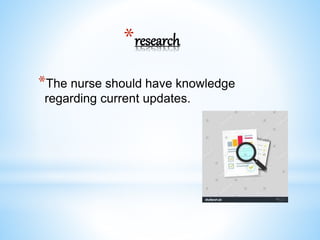
*research
*The nurse should have knowledge
regarding current updates.
*RESPONSIBILITIES OFNURSE
*Togo for home visit in community.
*Tofind out the cases of filariasis in the community
*Toprovide proper nursing care to the patients
*Toprovides health education to the patients & family
members
*Advise to the patients for follow-up
*Advise to patient & family for proper sanitation
*Questions:
National filarial control programme

National filarial control programme

  • 1.
    Submitted by: Tripti sharma 02822106617 4thyear *National filaria control programme
  • 2.
  • 3.
    INTRODUCTION ❖Filariasis is aparasitic disease caused by an infection with roundworms of the Filarioidea type. ❖These are spread by blood-feeding insects such as black flies and mosquitoes. ❖ They belong to the group of diseases called helminthiases. ❖Disease is endemic ❖Major social and economic scourage is in Africa, Asia and America.
  • 4.
    *TYPES OF FILARIASIS *LYMPHATICFILARIASIS oWuchereria bancrofti oBrugia malai oBrugia timori *SUBCUTANEOUS FILARIASIS oloa loa *SEROUS CAVITY FILARIASIS oMansonella
  • 5.
    *Filaria vectors *Culex (C. quinquefasciatus) – vector for Bancroftian filariasis *Mansonia ( M. annulifers and M. uniformis ) – vector for brugian filariasis *Culex breeds in polluted water *Mansonia is associated with certain aquatic plants
  • 6.
    *TRANSMISSION OF LYMPHATICFILARIASIS *Lymphatic filariasis is transmitted through mosquito bites. *The persons having circulating microfilariae are outwardly healthy but transmit the infection to others through mosquitoes. *The persons with chronic filarial swellings suffer severely from the disease but no longer transmit the infection
  • 7.
    *Life cycle offilarial parasite
  • 8.
    *Burden of Disease *Lymphatiafilariasis is prevalent in 18 states and union territories. Bancrftian filariasis is widely distributed while brugian filariasis caused by Brugia malayi is restricted to 6 states - UP, Bihar, Andhra Pradesh, Orissa, Tamil Nadu, Kerala, and Gujarat. *The WHO has estimated that 600 million people are at risk of infection in South east Asia and 60 million are actually infected in the region (WHO-SEARO !999). There are about 454 million people (75.6%) at the risk of infection with 48 million (80%) infected with parasite are contributed only by India.
  • 9.
    *Economic Loss *About 1.2billion man-days are lost due to filariasis every year leading to an economic loss of Rs. 3500 crore
  • 11.
    *National Filaria Control Program Thisprogram was started in 1955 In 1998 the operational component was merged with Urban Malaria Scheme In 2003 -04 it was merged with NVBDCP Filariasis has been a major public health problem in India next only to malaria. Indigenous cases have been reported from about 250 districts in 20 states/Union Territories.
  • 12.
    *OBJECTIVES: To train professionaland ancilliary personnel required for the programme. To carry survey in different parts of the country. Reduction of problem in un-surveyed area. Control in urban area through recurrent anti- parasitic measure
  • 13.
    *CONTROL STRATEGY *Vector controlthrough anti larval spray/ application at weekly intervals with appropriate larvicides. *Biological control through larvivorous fishes *Environmental engineering through source reduction and water management *Anti- parasitic measures through diagnosis and treatment of microfilaria carriers and cases. *Information , education and communication to generate community awareness.
  • 14.
    *Anti-Mosquito and Anti-larvalMeasures *One or two round of residual insecticide spray with DDT in areas which is known to be endemic for filariasis. Anti-larval measures with temephos in prescribed dosage in water storage tanks every week and application of Mineral Larvicidal oils on water surface are practiced. *
  • 15.
    1 5 *Eliminationof Lymphatic Filariasis  In1997, WHO and its Member States made a commitment to eliminate Lymphatic Filariasis (LF) as public health problem by 2020 through World Health Assembly Resolution.  The National Health Policy (2002) has set the goal of Elimination of Lymphatic Filariasis in India by 2015. Later extended to 2021.  Twin pillar strategies of Mass Drug Administration (MDA) for interruption of transmission i.e. no new case and Morbidity Management and Disability Prevention (MMDP) for catering the disease afflicted patients were adopted for elimination.
  • 16.
    *Mass Drug Administration(MDA) *MDA started as mass campaign from 2004. *Initially with single dose of DEC only. *In the year of 2007 with DEC + Albendazole co-administration *Form 2018 Triple Drug Therapy (IDA) i.e. DEC + Albendazole + Ivermectin is launched initially in five selected districts. Since elimination target is approaching first all the left out districts which are yet to achieve elimination will be brought under IDA. *
  • 17.
    *TwinPillar Strategy forElimination of Lymphatic Filariasis *Annual Mass Drug Administration (MDA) of single dose of DEC (Diethylcarbamazine citrate) and Albendazole for 5 years or more to the eligible population (except pregnant women, children below 2 years of age and seriously ill persons) to interrupt transmission of the disease. *Home based management of lymphoedema cases and up- scaling of hydrocele operations in identified CHCs/ District hospitals /medical colleges.
  • 18.
    *Progressand Achievement *In pursuit ofthe goals, the Government of India launched nationwide MDA in 2004 in endemic areas as well as home based morbidity management, scaling up hydrocelectomies in hospitals and CHCs. *During the year 2004, only 202 districts could be covered with coverage rate of 72.6%. The number of districts was upscaled and in 2007 all the 250 known LF endemic districts were brought under MDA *Accelerated Plan which include Triple Drug Therapy (IDA) was launched in the Global Alliance Elimination of Lymphatic Filariasis (GAELF) meeting held during 13th to 15th June 2018 by Hon’ble Union Health Minister and Hon’ble Minister of State.
  • 19.
    *Meeting for Disseminationof the Accelerated Plan for Elimination of Lymphatic Filariasis and Program Progress Review held at New Delhi. *The population coverage during MDA has improved from 73% in 2004 to 87.33% in 2019 (Prov.) *Intensive social mobilization during MDA, have been carried out by various States/ UTs involving political/ opinion leaders, decision makers, local leaders and community. *For high level advocay - United to Eliminate Lymphatic National Symposium Filariasis held on 30th October 2019 at Pravasi Bharatiya Kendra, New Delhi inaugurated by Hon’ble Union Health Minister
  • 20.
    *Milestones of ELF *In1997, The World Health Assembly adopted resolution WHA 50.29, for Elimination of Lymphatic Filariasis as a global public health problem by 2020. *In 2002, National Health Policy set a goal for ELF in India by 2015 (further extended to 2017). It implies that LF ceases to be a public health problem when microfilaria rate is <1% and the children born after initiation of MDA are free from circulating antigenemia. *In 2004, Elimination of Lymphatic Filariasis (ELF) programme was launched covering 202 endemic districts in 20 States/UTs. *Subsequently scaled up to cover all the 257 endemic districts in 21 States/UTs targeting a population of about 650 million. *In 2013 validation started through Transmission Assessment Survey (TAS).
  • 21.
    *The policy decisionto implement global strategy of co- administration of DEC with Albendazole during MDA was approved by National Task Force on Elimination of Lymphatic Filariasis under the Chairmanship of DGHS in 2006. *Accelerated Plan for Elimination of Lymphatic Filariasis 2018 launched in 10 Global Alliance Elimination of Lymphatic Filariasis (GAELF) on 13th June, 2018. *Triple Drug Therapy (IDA) has been successfully implemented in 5 districts namely Arwal (Bihar) and Simdega (Jharkhand), Nagpur (Maharashtra), Varanasi (Uttar Pradesh), Yadgiri (Karnataka) on 20th December 2018, 10th January 2019, 20th January, 2019, 20th February, 2019 and 13th November, 2019 respectively. *GoI has revised the financial norms for Morbidity Management Kits from Rs. 150/- to Rs. 500/- per kit in last MSG meeting held in February 2019. *Proposal for enhancement of budget under ELF programme approved by EPC for consideration of MSG.
  • 22.
    *TransmissionAssessmentSurvey(TAS) *All the districtshave completed more than 5 rounds of MDA by the end of 2014, and are required to be evaluated to decide whether to stop or continue MDA. • Till august 2017, 94 districts with 152 evaluation units (approx. 221 million population each) have been successfully completed through TAS and qualified for MDAstoppage.
  • 23.
    *Morbidity Management andDisability Alleviation •The process involved updating the line-listing of Lymphoedema & Hydrocele cases by door to door survey in endemic district. • Demonstration and training on simple foot hygiene to affected persons and motivate them for self practice. •Motivate for surgical intervention to hydrocele cases.
  • 24.
    • The updatedreport from LF endemic states/UTs indicated 8.7 lakh Lymphoedema and 3.8lakh hydrocele cases. • Since 2004, the states/UTs have reported 129572 hydrocele operations. Different states have initiated management of Lymphodema cases through demonstrating home based foot hygiene method to patients at local levels.
  • 25.
    *prevention Avoiding mosquito bitesis the best form of prevention. The mosquitoes that carry the microscopic worms usually bite between the hours of dusk and dawn . If you live in or travel to an area with lymphatic filariasis: Sleep under a mosquito net. Wear long sleeves and trousers. Use mosquito repellent on exposed skin between dusk and dawn.
  • 26.
    *Role of nurse *Thefunctions of a community health nurse have been classified as follows: Administration Communication Nursing Teaching Research
  • 27.
    *Administration *She provides direction& leadership to those whom she supervises. *She is responsible for plannilg, impementation, & evaluation of a practical plan of nursing administration in the primary health centres & its assosiated subcenters
  • 28.
    *Communication *She should maintaingood working relationship with members of health team *She is a link between the patient ,the family & the doctor. *She participates in staff & community meetings
  • 29.
    *Nursing *She provides comprehensivenursing care to individuals & families. * She should support to the patient & family *Provides proper health education & proper administration of drug.
  • 30.
    *Teaching *Nurse should teachto the patient & family regarding:  Disease condition  Risk factors  Treatment  Prevention  Home care
  • 31.
    *research *The nurse shouldhave knowledge regarding current updates.
  • 32.
    *RESPONSIBILITIES OFNURSE *Togo forhome visit in community. *Tofind out the cases of filariasis in the community *Toprovide proper nursing care to the patients *Toprovides health education to the patients & family members *Advise to the patients for follow-up *Advise to patient & family for proper sanitation
  • 33.

Editor's Notes

  • #31 Nurse should teach to the patient & family regarding: Disease condition Risk factors Treatment Prevention Home care 5. Researcher