Rmnch +a 2019
Rmnch +a 2019
Rmnch +a 2019
Rmnch +a 2019
Rmnch +a 2019
Rmnch +a 2019
Rmnch +a 2019
Rmnch +a 2019
Rmnch +a 2019
Rmnch +a 2019
Rmnch +a 2019
Rmnch +a 2019
Rmnch +a 2019
Rmnch +a 2019
Rmnch +a 2019
Rmnch +a 2019
Rmnch +a 2019
Rmnch +a 2019
Rmnch +a 2019
Rmnch +a 2019
Rmnch +a 2019
Rmnch +a 2019
Rmnch +a 2019
Rmnch +a 2019
Rmnch +a 2019
Rmnch +a 2019
Rmnch +a 2019
Rmnch +a 2019
Rmnch +a 2019
Rmnch +a 2019
Rmnch +a 2019
Rmnch +a 2019
Rmnch +a 2019
Rmnch +a 2019
Rmnch +a 2019
Rmnch +a 2019
Rmnch +a 2019
Rmnch +a 2019
Rmnch +a 2019
Rmnch +a 2019
Rmnch +a 2019

Editor's Notes

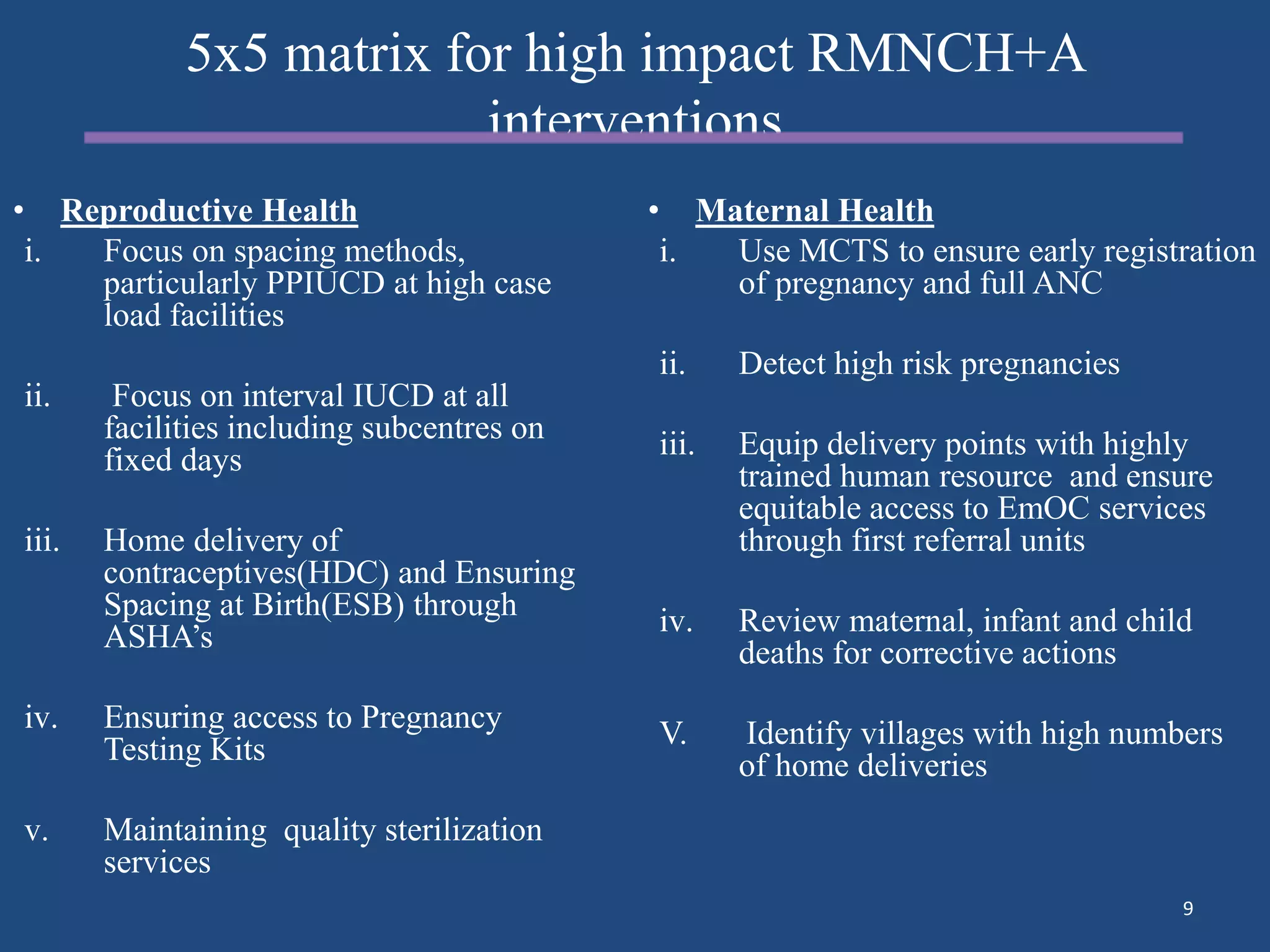
  • #2 The RMNCH+A strategy is built upon the continuum of care concept and is holistic in design, encompassing all interventions aimed at reproductive, maternal, newborn, child, and adolescent health under a broad umbrella, and focusing on the strategic lifecycle approach. At present the Government’s strategic approach in health sector is RMNCH+A (Reproductive, Maternal, New born, Child Health + Adolescent) in which ‘A’ denotes adolescents. 5 by 5 RMNCH+A matrix has been developed which lists out the 5 high impact interventions under each of the 5 pillars, all of which need to be implemented together, at the same time, with high coverage and quality. The programme is an effort to move away from a ‘doctor-driven’ effort towards a holistic and participative programme. Absence of systems approach to health is affecting the RCH plan implementation adversely. Some States & Districts are yet to use the Health Information Management System(HIMS) data to chart their progress against the target effectively Inadequate implementation of Strategy for fixed day static services for family planning
  • #5 Health outcome goals established in the 12th Five Year Plan
  • #8 . High levels of Anaemia: (55.8% of adolescent girls, 58.7% of pregnant women and 63.2 % of lactating women anemic) Vertical compartmentalised schemes do not work if goals & targets are to be achieved ! The mean BMI for adolescent girls (15-19 years) is 19, a little above the lower normal (range of 18.5-24.9). For boys of the same age group it is lower than normal at 18.3. Almost half of adolescents (both girls and boys) fall below the normal range varying from totally thin to severely thin. Almost. According to NFHS-3 more than half of women, more so in the rural areas, were anaemic in every age group. The prevalence of anaemia is higher for those aged 15-19 years in both women and men. It was found that there has been no change in the prevalence of anaemia among women aged 15-19 and 20-24 years across NFHS-1 and 2. In fact, as per NFHS-3, anaemia is more widespread among both women and children and has risen almost 5 percent since NFHS-2 in both the groups. Iodized salt was used only in approximately 50% of the households (NFHS-3).
  • #9 Developed to provide an understanding of “continum of care” to ensure equal focus on various life stages.
  • #10 Early registration Antenatal care(4 or more visits) Anemia prophylaxis & treatment Two doses of tetanus toxoid and boosters Institutional deliveries or by SBAs Referrals to FRUs Home based postnatal care Counseling for both spacing & limiting Increased facilities for MTP Priority interventions: 1. Preventive use of folic acid in peri -conception period 2. Delivery of antenatal care package and tracking of high- risk pregnancies 3. Skilled obstetric care 4. Immediate essential newborn care and resuscitation 5. Emergency obstetric and new born care 6. Postpartum care for mother and newborn 7. Postpartum IUCD and sterilization 8. Implementation of PC&PNDT Act To promote use of folic acid in planned pregnancies during peri -conception phase for prevention of neural tube defects & other congenital anomalies by frontline workers and facility-based service providers . National Iron +Initiative to address the issue of anemia across all age groups and comprehensive screening and early interventions for defects at birth, diseases and deficiencies among children and adolescents. From 8th May, 2013 conditionality's of mother like minimum age & parity have been removed. Incentives to ASHA has been revised Rs. 600 (rural) & Rs. 400 (Urban). A new development under JSY is the decision to make direct cash payments through AADHAR enabled payment system. Enrolment of all potential JSY beneficiaries on the MCTS portal , facilitating registration for AADHAR and opening / linking bank accounts to AADHAR for all potential JSY beneficiaries.
  • #15 1. Skilled care at birth 2. Early initiation and promotion of Exclusive Breast Feeding and appropriate complementary feeding 3. IMNCI for common childhood illness 4. Immunization 5. Management of children with malnutrition 6. Vitamin. A, iron and folic acid prophylaxis 7. Child health screening and early intervention services.
  • #20 Aims to immunize all children against seven vaccine preventable diseases namely diphtheria, whooping cough, tetanus, polio, tuberculosis, measles and hepatitis B by 2020.
  • #21 The ANMs can now give prereferral dose of inj. Dexamethasone in pregnant women in preterm labour. Administration of prereferral dose of inj. Gentamycine to newborns for management of sepsis. • Main intervention under RCH II for management of newborn & childhood illnesses. (IMNCI plus- skilled care at birth, inpatient care and immunization) In non IMNCI districts vertical program for common causes of mortality – diarrhea & pneumonia
  • #26 Weekly iron and folic acid supplementation scheme: It aims to cover adolescents enrolled in class VI–XII of government, government aided and municipal schools as well as ‘out of school’ girls (10-19) ‘Iron ki nili goli’ Mondays will be 'Iron' days: Azad
  • #35 Prepare and implement facility specific plans for ensuring quality and meeting service guarantees as specified under Indian Public Health Standard. b ) Assess the need for new infrastructure, extension of existing infrastructure on the basis of patient load & location of facilityd ) Engage private facilities for family planning services, management of sick newborns and children, & pregnancy complications. e) Strengthen referral mechanisms between facilities at various levels and communities. f) Provision for adequate infrastructure for waste management c) Equip health facilities to support forty-eight-hour stay of mother and newborn.