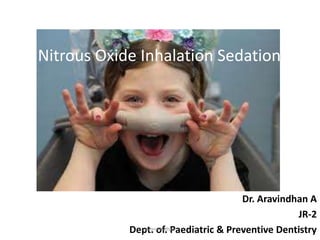
Nitrous Oxide Inhalation Sedation
Dr. Aravindhan A
JR-2
Dept. of. Paediatric & Preventive Dentistry1dr.aravindhan
Contents
• Introduction
• Physical characteristics, pharmacokinetics and
pharmacodynamics of N2O
• N2O and its interaction with body
• Patient assessment
• Signs and symptoms of N2O/O2 sedation
• Technique for N2O/O2 administration and its recovery
• Potential biohazards for health care personnel
• Ethical/ legal considerations N2O/O2 sedation
• N2O abuse
• Conclusion 2dr.aravindhan
Introduction
• N2O is discovered by Joseph priestly
(1771- 1777).
• Dr. Horace wells- dentist- Father of
Anaesthesia.
• First demonstrated extraction by using
nitrous oxide.
• Nowadays, N2O is used widely in almost
all the aspects of anaesthesia.
• Other uses: autoracing, food processing,
semiconductor manufacturing etc., 3dr.aravindhan
Physical characteristics
• Dinitrogen monoxide
• Boiling point : -88.5˚C
• It is gas in room temperature
• When it is compressed into cylinder, it becomes liquid.
• N2O supports combustion.
if its compressed = explosion
if its open in air = bright flame
• No hydrocarbon compounds should be used in contact
with N2O, which causes explosion.
• Specific gravity: 1.53
• Molecular weight: 44
4dr.aravindhan
Pharmacokinetics
• Uptake, distribution, metabolism,
elimination
• Partial pressure gradient, solubility
• High pressure to low pressure areas
• N2O is relatively insoluble drug (blood
gas partition co efficient: 0.47)
• Onset is very fast 30 seconds. Peak
clinical effect is in 3 to 5 minutes.
• N2O= 31 psi and N2 =1 psi
5dr.aravindhan
• Concept of concentration effect (Eger): especially
GA
• 2nd gas effect
• Not metabolised in the liver
• 99% eliminated through lungs without
biotransformation
• A miniscule of N2O is metabolised in GI tract
• Barometric pressure change makes it impossible
to use it in high altitude
6dr.aravindhan
Pharmacodynamics
• “Biochemical and physiological effects of the drugs
and the mechanisms of their actions”
• Mechanism: antagonism of NMDA receptors in
CNS
• Least potent of all inhalational anaesthetics.
• MAC 105%. ( MAC is defined as the amount of
drug necessary to prevent movement in 50% of
subjects for surgical incision)
• Combination is valuable while planning GA
• Safety level of N2O is tremendous.
7dr.aravindhan
Desirable properties of nitrous oxide
• Analgesic
• Anxiolytic
• Amnestic
• Titratable
• Rapid onset
• Rapid recovery
• Safety
• Acceptance
8dr.aravindhan
Interaction of N2O with body
1. CVS:
• Cardiotonic
• Doesn’t affect blood flow to organs
• Positive effect in MI ( O2 delivery)
2. Respiratory system:
• Non irritant nature. So it can be used in asthmatic
patients
• Contraindicated in patients with COPD, cystic
fibrosis, pneumothorax
• Upper respiratory tract infection reduces the
intake of the drug and also airway patency.
9dr.aravindhan
3. CNS:
• Depress central nervous system
• No alteration in cerebral blood flow
• N2O sedation is containdicated in patients
undergone pnemoencephalography recently.
• Chronic exposure leads to neuropathy
4. Hematopoietic system:
• Megaloblastic bone marrow changes occurs
after long exposure
• Contraindicated in pernicious anaemia and
vit.B12 deficiency
10dr.aravindhan
5. Endocrine, Genito urinary and Hepatic system:
• no clinically significant effect affects sedation
6. GI system:
• Expansion of spaces with non rigid walls.
• So, contra indicated in patients with bowel obstruction.
7. Reproductive system:
• N2O crosses placenta
• N2O affects folate metabolism (pregnancy: twice folate
demand)
• Affects organogenesis and causes congenital defects in
children.
• Causes spontaneous abortion in pregnant women in 3rd
trimester.
• Contraindicated in first trimester of pregnancy
11dr.aravindhan
8. Allergy :
• No allergy is reported in 160 years
• But patient may be allergic to latex, by which
nasal hood is made up of.
9. Cognitive and mind altering conditions:
• N2O /O2 sedation Should not be given to the
children with severe cognitive impairment.
• Not less than 3 years.
• Not indicated in
trypanophobic patients.
• Basic behavioural management technique-
AAPD
12dr.aravindhan
10. others:
• Patient under chemotherapy
(esp.,AML,ALL,lymphoma): if patient is under
BLEOMYCIN, N2O sedation is contraindicated
(increases pulmonary fibrosis)
• Doesn’t trigger Malignant Hyperthermia.
• Not direct neuromuscular relaxation.
• Increases middle ear pressure. (contra
indicated after middle ear surgeries)
• Contraindicated after eye surgeries.
(perfluoropropane and sulfur hexafluoride gas
 burst of gas bubble)
13dr.aravindhan
Patient assessment
“Never treat a stranger”
1.History : (information specific to sedation*)
• Disease/ disorders of major organs
• Previous hospitalisations with reasons
• Pregnancy status (if adult)
• Previous adverse experience during sedation
• Any drug allergy
• Current medication
• Time and nature of last oral intake
• Assessment of anxiety level 14dr.aravindhan
Ref: american society of anesthesiologist and american academy of pediatrics 15dr.aravindhan
2.Assessment of patient risk:
• ASA 1 :
• ASA 2:
• ASA 3: medical consultation is needed before sedation
• ASA 4:
• ASA 5:
• ASA 6:
Good category for n2o sedation
Strictly contraindicated
16dr.aravindhan
3. pre procedural patient evaluation:
a. Vital signs: (6)
-height, weight, body temperature, blood
pressure, pulse rate and respiratory rate.
b. airway analysis:
- auscultation of lung fields and heart.
Mallampati scoring of airway
17dr.aravindhan
4. Informed consent:
• Mandatory, never commence sedation without it.
• Verbal and written consent should be obtained
from parent/ caregiver of the children after
explaining the procedure and risks in their own
language.
5.Patient monitoring:
• Level of consciousness (by communication)
• Pulmonary ventilation ( by reservoir bag)
• Level of oxygenation ( by pulse oxymetry)
• Circulation (physical signs/ stethoscope)
18dr.aravindhan
Normal values
19dr.aravindhan
20dr.aravindhan
6. Emergency preparedness:
a. Personnel preparation:
- aware of diagnosing/ managing emergency
situations
- must be trained with CPR, Basic Life Support,
securing IV line
- emergency airway management skills ( airway
clearance, intubation)
- Automated External Defibrillator (AED) usage. 21dr.aravindhan
b. Emergency kit:
• All emergency drugs
• High suction (yankeur)
• IV catheters
• Oro pharyngeal airway
• Endotracheal tubes
• Laryngoscope
• Bag and mask airway
c. Access to emergency medical service
22dr.aravindhan
Signs and symptoms of N2O/O2 sedation
• Ultimate goal is to increase patient comfort through relaxation.
Appropriate (minimal) sedation oversedation
Comfort and relaxed Hallucination
Reduced fear and anxiety Drowsiness, diaphoresis
Spatial orientation and awareness Dissociation from environment
Responds well to questions Inability to communicate
Eyes become less active (glazed look) Fixed eyes
Peri oral numbness Nausea, vomitting
Heaviness in extremities Agitated behaviour (sometimes)
Flushing in face and neck Increased body temperature 23dr.aravindhan
Sedation machine
24dr.aravindhan
25dr.aravindhan
Basic circuit
26dr.aravindhan
Nasal hood
27dr.aravindhan
Technique for N2O/O2 administration
• The basic principle of N2O/O2 sedation is
changing in every decade
• Key to success: titration
1. Fundamental principle of administration:
• positive attitude of the operator
• Well educated, trained and capable to manage
emergency situation
• Informed consent
• Do not adopt fixed dose philosophy for N2O/O2
28dr.aravindhan
• Procedure begins and ends with 100% oxygen
for 5 minutes
• Patient should never be left unattended until
full recovery
• Constant monitoring
• Proper documentation
• Proper NPO guidelines
29dr.aravindhan
Sedation unit preparation
• Equipment should be current and accurate
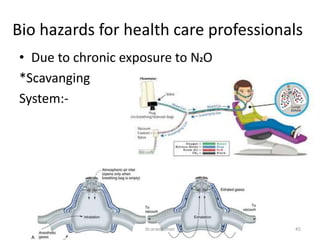
• Proper scavanging system to prevent
occupational exposure to dentists
• Vaccuum port and scavanging system should
exit at out of the operatory (safely)
• Ventilation system with fresh air exchange is
advisable.
30dr.aravindhan
• Check for cylinders (content)
• Check for leakages from cylinder. (by placing
soap water at the joint)
• Check for tight fit of tubings( audible hissing
will be there if its loose)
• Inspect tubings/ reservoir bags and fit them
properly.
31dr.aravindhan
Cylinder
32dr.aravindhan
Activating equipment
• Turning the knob counter clock wise
• Don’t use lubricant
• Keep additional cylinder always.
• Barrier for preventing the contamination of
instrument
• Make the flowmeter switch on
• Activate the scavanging system (flow 45
L/min)
33dr.aravindhan
Administration
• Measure pre op vitals
• Select appropriate nasal hood
• Start oxygen 100%
• The total litres of flow per minute is based on
patients RMV (respiratory minute volume)
• Average child (most of the scenarios) : 4-5
L/min
more gas supply = wastage of gas
less gas supply = suffocating feel 34dr.aravindhan
How to determine optimal flow (per min) ?
1. RMV (spirometry)
tidal volume × respiratory rate
2. Clinical average value (4- 5 L for most of the
children)
3. Reservoir bag
- 3L volume (small size is available)
- helps to monitor depth, rate of respiration
should be 2/3rd full at expiration (optimal)
if bag inflates like balloon = more gas is delivered.
if bag is collapsing/ flattening = less gas is delivered.35dr.aravindhan
• Once appropriate flow is established , it will be
remain constant for entire procedure.
• Make the nasal hood fit tightly
Administering methods:
1. titration (most common)
2. rapid induction
3. interrupted flow
Titration method:
• most of the machines are automatic now.
• Adjust the N2O flow , it will automatically adjust
oxygen
36dr.aravindhan
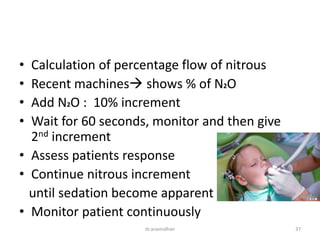
• Calculation of percentage flow of nitrous
• Recent machines shows % of N2O
• Add N2O : 10% increment
• Wait for 60 seconds, monitor and then give
2nd increment
• Assess patients response
• Continue nitrous increment
until sedation become apparent
• Monitor patient continuously
37dr.aravindhan
• Stop the nitrous flow at the end of the
procedure
• Administer 100% oxygen for 5 minutes
( prevents diffusion hypoxia)
• Watch for recovery
Remember :
1. No fixed dose of nitrous oxide
2. Reduce talking with patients while assessing
patient status and maintaining contact during
sedation
38dr.aravindhan
Recovery
• Generally, mirror image of induction
• Based on individual biovariability
• May need more post op oxygenation.
• In studies, full recovery is established in 3 – 5 mins.
• Methods of assessing recovery:
1. questioning
2. digit- symbol substitution test
3. hand- eye co ordination test
4. VAS for mood
Clinical tip:
stop N2O flow 5 min before completion of clinical
procedure ,which speeds up recovery. 39dr.aravindhan
• Vitals after recovery:
- mandatory
- blood pressure with 10mmHg variation from
pre op basal level,
- pulse rate within 10 beats/min variation,
- respiratory rate within 5 cycles/min
variation is acceptable.
* Vancouver sedation recovery scale
40dr.aravindhan
Vancouver sedation recovery scale
41dr.aravindhan
Other scales for recovery from
sedation
• Observer's Assessment of Alertness/Sedation
(OAA/S),
• Visual Analogue Scale (VAS),
• Post-Anaesthetic Discharge Scoring System
(PADS).
42dr.aravindhan
Post sedation procedure
• Turn off the master flow meter switch
• Turn off gas cylinder
• Allow proper ventilation
• Make sure scavanging system exits in safe way
• Sedation record keeping
• Sterilisation and disinfection
- tubings
- nasal hood
autoclave
43dr.aravindhan
• Sedation
record
(example)
44dr.aravindhan
Bio hazards for health care professionals
• Due to chronic exposure to N2O
*Scavanging
System:-
45dr.aravindhan
What are the health issues?
• Megaloblastic anaemia
• Leukopenia
• Decrease in cognition and psychomotor skill
level
• Congenital defects in newborns
• Peripheral neuropathy
• Myopathy
• Myelin degeneration in spinal cord
• Spontaneous abortion (experimental studies.
Lacks evidence) 46dr.aravindhan
Sources of exposure :
1. While patient is talking
2. If patient breathes through mouth
3. Ill fitting mask/ nasal hood
4. Any gas leakage from equipment
5. Sedation unit without scavanging system
6. Inadequate ventilation
47dr.aravindhan
Monitoring exposure
1. Infra red spectrophotometry
2. Time weighted average
dosimetry
3. Hand held monitoring device (via
sensor N2O gas analyser G 200)
4. Deoxyuridine suppression test for
operators- highly sensitive.
- detects early signs of
inactivation of methionine
synthase enzyme
48dr.aravindhan
How to prevent exposure
1. Always do treatment with
rubber dam
2. Well fitting nasal hood.
3. Proper scavanging system (45L
/ min)
4. Encourage nasal breathing
5. Monitor the level of N2O in
sedation room
49dr.aravindhan
Ethical considerations
• Obtain informed consent
• Basic is “ to do no harm”
• Be rational while taking decision ( not all cases need
sedation)
• N2O sedation causes sexual hallucination/ dreaming
or stimulation in patients. There are many
allegations filed against dentists in western world.
Most of the cases were dismissed.
• It is always wiser to do treatment with the presence
of third party / under CCTV to prevent false
allegations, especially for female patients.
50dr.aravindhan
N2O abuse
• Whippet (FDA approved)
• Aerosol whipping cream (FDA approved)
• Auto racing (engine booster)- legal in some parts
of world.
• Robbery attempts
51dr.aravindhan
• Performance enhancer for sports
(undetectable in urine/blood)
• However, it is less addictive. So abuse level is
low
partial opioid agonist (less potent than
morphine)
 quick tolerance development
52dr.aravindhan
Conclusion
• NOIS is not a mystery. It is an adjuvant in
dental treatment of the children.
• Non pharmacological behaviour modification
is the first choice when managing children,
always.
• With proper evaluation, good case selection,
monitoring and good skills, NOIS gives ideal
health care delivery to children need dental
care.
53dr.aravindhan
NOIS and COVID
• Proper PPE for operators
• Negative/ non suspected patients only treated
(urgent/ emergency dental care)
• Disposable nasal hood and tubings
• Viromax filter ( 99.99% filteration of
virus/bacteria) is recommended.
• It is safer to prefer NOIS rather than GA for un
co operative/ special children.
(www.rcseng.ac.uk/recommendations for
pediatric dentistry/covid)
54dr.aravindhan
Challenges
• Asymptomatic cases
• Kawasaki disease like features in children
- covid toes
- strawberry tongue
• Happy hypoxia
- decrease oxygen saturation
55dr.aravindhan
Thank you!
56dr.aravindhan
Head tilt chin lift procedure
57dr.aravindhan
Oro pharyngeal airway insertion
58dr.aravindhan
Bag and mask airway application
59dr.aravindhan
Questions
1. A pulse rate of 95 beats/min in a 6 yr old child is
considered
a. High
b. Low
c. Normal
2. N2O has significant negative impact on which of the
following systems
a. Renal
b. Hepatic
c. Endocrine
d. NOTA
60dr.aravindhan
3.An absolute contraindication for N2O usage in children is
a. Angina
b. Gastric ulcer
c. Parkinson disease
d. Cancer therapy using bleomycin
4.Which of the following SpO2 value would be considered
normal for a healthy individual
a. 68
b. 88
c. 98
d. 95
61dr.aravindhan
5. A full cylinder of nitrous oxide is
approximately -------% liquid and --------% gas
a. 50,50
b. 75,25
c. 95,5
d. 25,75
62dr.aravindhan

Nitrous oxide inhalation sedation

  • 1.
    Nitrous Oxide InhalationSedation Dr. Aravindhan A JR-2 Dept. of. Paediatric & Preventive Dentistry1dr.aravindhan
  • 2.
    Contents • Introduction • Physicalcharacteristics, pharmacokinetics and pharmacodynamics of N2O • N2O and its interaction with body • Patient assessment • Signs and symptoms of N2O/O2 sedation • Technique for N2O/O2 administration and its recovery • Potential biohazards for health care personnel • Ethical/ legal considerations N2O/O2 sedation • N2O abuse • Conclusion 2dr.aravindhan
  • 3.
    Introduction • N2O isdiscovered by Joseph priestly (1771- 1777). • Dr. Horace wells- dentist- Father of Anaesthesia. • First demonstrated extraction by using nitrous oxide. • Nowadays, N2O is used widely in almost all the aspects of anaesthesia. • Other uses: autoracing, food processing, semiconductor manufacturing etc., 3dr.aravindhan
  • 4.
    Physical characteristics • Dinitrogenmonoxide • Boiling point : -88.5˚C • It is gas in room temperature • When it is compressed into cylinder, it becomes liquid. • N2O supports combustion. if its compressed = explosion if its open in air = bright flame • No hydrocarbon compounds should be used in contact with N2O, which causes explosion. • Specific gravity: 1.53 • Molecular weight: 44 4dr.aravindhan
  • 5.
    Pharmacokinetics • Uptake, distribution,metabolism, elimination • Partial pressure gradient, solubility • High pressure to low pressure areas • N2O is relatively insoluble drug (blood gas partition co efficient: 0.47) • Onset is very fast 30 seconds. Peak clinical effect is in 3 to 5 minutes. • N2O= 31 psi and N2 =1 psi 5dr.aravindhan
  • 6.
    • Concept ofconcentration effect (Eger): especially GA • 2nd gas effect • Not metabolised in the liver • 99% eliminated through lungs without biotransformation • A miniscule of N2O is metabolised in GI tract • Barometric pressure change makes it impossible to use it in high altitude 6dr.aravindhan
  • 7.
    Pharmacodynamics • “Biochemical andphysiological effects of the drugs and the mechanisms of their actions” • Mechanism: antagonism of NMDA receptors in CNS • Least potent of all inhalational anaesthetics. • MAC 105%. ( MAC is defined as the amount of drug necessary to prevent movement in 50% of subjects for surgical incision) • Combination is valuable while planning GA • Safety level of N2O is tremendous. 7dr.aravindhan
  • 8.
    Desirable properties ofnitrous oxide • Analgesic • Anxiolytic • Amnestic • Titratable • Rapid onset • Rapid recovery • Safety • Acceptance 8dr.aravindhan
  • 9.
    Interaction of N2Owith body 1. CVS: • Cardiotonic • Doesn’t affect blood flow to organs • Positive effect in MI ( O2 delivery) 2. Respiratory system: • Non irritant nature. So it can be used in asthmatic patients • Contraindicated in patients with COPD, cystic fibrosis, pneumothorax • Upper respiratory tract infection reduces the intake of the drug and also airway patency. 9dr.aravindhan
  • 10.
    3. CNS: • Depresscentral nervous system • No alteration in cerebral blood flow • N2O sedation is containdicated in patients undergone pnemoencephalography recently. • Chronic exposure leads to neuropathy 4. Hematopoietic system: • Megaloblastic bone marrow changes occurs after long exposure • Contraindicated in pernicious anaemia and vit.B12 deficiency 10dr.aravindhan
  • 11.
    5. Endocrine, Genitourinary and Hepatic system: • no clinically significant effect affects sedation 6. GI system: • Expansion of spaces with non rigid walls. • So, contra indicated in patients with bowel obstruction. 7. Reproductive system: • N2O crosses placenta • N2O affects folate metabolism (pregnancy: twice folate demand) • Affects organogenesis and causes congenital defects in children. • Causes spontaneous abortion in pregnant women in 3rd trimester. • Contraindicated in first trimester of pregnancy 11dr.aravindhan
  • 12.
    8. Allergy : •No allergy is reported in 160 years • But patient may be allergic to latex, by which nasal hood is made up of. 9. Cognitive and mind altering conditions: • N2O /O2 sedation Should not be given to the children with severe cognitive impairment. • Not less than 3 years. • Not indicated in trypanophobic patients. • Basic behavioural management technique- AAPD 12dr.aravindhan
  • 13.
    10. others: • Patientunder chemotherapy (esp.,AML,ALL,lymphoma): if patient is under BLEOMYCIN, N2O sedation is contraindicated (increases pulmonary fibrosis) • Doesn’t trigger Malignant Hyperthermia. • Not direct neuromuscular relaxation. • Increases middle ear pressure. (contra indicated after middle ear surgeries) • Contraindicated after eye surgeries. (perfluoropropane and sulfur hexafluoride gas  burst of gas bubble) 13dr.aravindhan
  • 14.
    Patient assessment “Never treata stranger” 1.History : (information specific to sedation*) • Disease/ disorders of major organs • Previous hospitalisations with reasons • Pregnancy status (if adult) • Previous adverse experience during sedation • Any drug allergy • Current medication • Time and nature of last oral intake • Assessment of anxiety level 14dr.aravindhan
  • 15.
    Ref: american societyof anesthesiologist and american academy of pediatrics 15dr.aravindhan
  • 16.
    2.Assessment of patientrisk: • ASA 1 : • ASA 2: • ASA 3: medical consultation is needed before sedation • ASA 4: • ASA 5: • ASA 6: Good category for n2o sedation Strictly contraindicated 16dr.aravindhan
  • 17.
    3. pre proceduralpatient evaluation: a. Vital signs: (6) -height, weight, body temperature, blood pressure, pulse rate and respiratory rate. b. airway analysis: - auscultation of lung fields and heart. Mallampati scoring of airway 17dr.aravindhan
  • 18.
    4. Informed consent: •Mandatory, never commence sedation without it. • Verbal and written consent should be obtained from parent/ caregiver of the children after explaining the procedure and risks in their own language. 5.Patient monitoring: • Level of consciousness (by communication) • Pulmonary ventilation ( by reservoir bag) • Level of oxygenation ( by pulse oxymetry) • Circulation (physical signs/ stethoscope) 18dr.aravindhan
  • 19.
  • 20.
  • 21.
    6. Emergency preparedness: a.Personnel preparation: - aware of diagnosing/ managing emergency situations - must be trained with CPR, Basic Life Support, securing IV line - emergency airway management skills ( airway clearance, intubation) - Automated External Defibrillator (AED) usage. 21dr.aravindhan
  • 22.
    b. Emergency kit: •All emergency drugs • High suction (yankeur) • IV catheters • Oro pharyngeal airway • Endotracheal tubes • Laryngoscope • Bag and mask airway c. Access to emergency medical service 22dr.aravindhan
  • 23.
    Signs and symptomsof N2O/O2 sedation • Ultimate goal is to increase patient comfort through relaxation. Appropriate (minimal) sedation oversedation Comfort and relaxed Hallucination Reduced fear and anxiety Drowsiness, diaphoresis Spatial orientation and awareness Dissociation from environment Responds well to questions Inability to communicate Eyes become less active (glazed look) Fixed eyes Peri oral numbness Nausea, vomitting Heaviness in extremities Agitated behaviour (sometimes) Flushing in face and neck Increased body temperature 23dr.aravindhan
  • 24.
  • 25.
  • 26.
  • 27.
  • 28.
    Technique for N2O/O2administration • The basic principle of N2O/O2 sedation is changing in every decade • Key to success: titration 1. Fundamental principle of administration: • positive attitude of the operator • Well educated, trained and capable to manage emergency situation • Informed consent • Do not adopt fixed dose philosophy for N2O/O2 28dr.aravindhan
  • 29.
    • Procedure beginsand ends with 100% oxygen for 5 minutes • Patient should never be left unattended until full recovery • Constant monitoring • Proper documentation • Proper NPO guidelines 29dr.aravindhan
  • 30.
    Sedation unit preparation •Equipment should be current and accurate • Proper scavanging system to prevent occupational exposure to dentists • Vaccuum port and scavanging system should exit at out of the operatory (safely) • Ventilation system with fresh air exchange is advisable. 30dr.aravindhan
  • 31.
    • Check forcylinders (content) • Check for leakages from cylinder. (by placing soap water at the joint) • Check for tight fit of tubings( audible hissing will be there if its loose) • Inspect tubings/ reservoir bags and fit them properly. 31dr.aravindhan
  • 32.
  • 33.
    Activating equipment • Turningthe knob counter clock wise • Don’t use lubricant • Keep additional cylinder always. • Barrier for preventing the contamination of instrument • Make the flowmeter switch on • Activate the scavanging system (flow 45 L/min) 33dr.aravindhan
  • 34.
    Administration • Measure preop vitals • Select appropriate nasal hood • Start oxygen 100% • The total litres of flow per minute is based on patients RMV (respiratory minute volume) • Average child (most of the scenarios) : 4-5 L/min more gas supply = wastage of gas less gas supply = suffocating feel 34dr.aravindhan
  • 35.
    How to determineoptimal flow (per min) ? 1. RMV (spirometry) tidal volume × respiratory rate 2. Clinical average value (4- 5 L for most of the children) 3. Reservoir bag - 3L volume (small size is available) - helps to monitor depth, rate of respiration should be 2/3rd full at expiration (optimal) if bag inflates like balloon = more gas is delivered. if bag is collapsing/ flattening = less gas is delivered.35dr.aravindhan
  • 36.
    • Once appropriateflow is established , it will be remain constant for entire procedure. • Make the nasal hood fit tightly Administering methods: 1. titration (most common) 2. rapid induction 3. interrupted flow Titration method: • most of the machines are automatic now. • Adjust the N2O flow , it will automatically adjust oxygen 36dr.aravindhan
  • 37.
    • Calculation ofpercentage flow of nitrous • Recent machines shows % of N2O • Add N2O : 10% increment • Wait for 60 seconds, monitor and then give 2nd increment • Assess patients response • Continue nitrous increment until sedation become apparent • Monitor patient continuously 37dr.aravindhan
  • 38.
    • Stop thenitrous flow at the end of the procedure • Administer 100% oxygen for 5 minutes ( prevents diffusion hypoxia) • Watch for recovery Remember : 1. No fixed dose of nitrous oxide 2. Reduce talking with patients while assessing patient status and maintaining contact during sedation 38dr.aravindhan
  • 39.
    Recovery • Generally, mirrorimage of induction • Based on individual biovariability • May need more post op oxygenation. • In studies, full recovery is established in 3 – 5 mins. • Methods of assessing recovery: 1. questioning 2. digit- symbol substitution test 3. hand- eye co ordination test 4. VAS for mood Clinical tip: stop N2O flow 5 min before completion of clinical procedure ,which speeds up recovery. 39dr.aravindhan
  • 40.
    • Vitals afterrecovery: - mandatory - blood pressure with 10mmHg variation from pre op basal level, - pulse rate within 10 beats/min variation, - respiratory rate within 5 cycles/min variation is acceptable. * Vancouver sedation recovery scale 40dr.aravindhan
  • 41.
    Vancouver sedation recoveryscale 41dr.aravindhan
  • 42.
    Other scales forrecovery from sedation • Observer's Assessment of Alertness/Sedation (OAA/S), • Visual Analogue Scale (VAS), • Post-Anaesthetic Discharge Scoring System (PADS). 42dr.aravindhan
  • 43.
    Post sedation procedure •Turn off the master flow meter switch • Turn off gas cylinder • Allow proper ventilation • Make sure scavanging system exits in safe way • Sedation record keeping • Sterilisation and disinfection - tubings - nasal hood autoclave 43dr.aravindhan
  • 44.
  • 45.
    Bio hazards forhealth care professionals • Due to chronic exposure to N2O *Scavanging System:- 45dr.aravindhan
  • 46.
    What are thehealth issues? • Megaloblastic anaemia • Leukopenia • Decrease in cognition and psychomotor skill level • Congenital defects in newborns • Peripheral neuropathy • Myopathy • Myelin degeneration in spinal cord • Spontaneous abortion (experimental studies. Lacks evidence) 46dr.aravindhan
  • 47.
    Sources of exposure: 1. While patient is talking 2. If patient breathes through mouth 3. Ill fitting mask/ nasal hood 4. Any gas leakage from equipment 5. Sedation unit without scavanging system 6. Inadequate ventilation 47dr.aravindhan
  • 48.
    Monitoring exposure 1. Infrared spectrophotometry 2. Time weighted average dosimetry 3. Hand held monitoring device (via sensor N2O gas analyser G 200) 4. Deoxyuridine suppression test for operators- highly sensitive. - detects early signs of inactivation of methionine synthase enzyme 48dr.aravindhan
  • 49.
    How to preventexposure 1. Always do treatment with rubber dam 2. Well fitting nasal hood. 3. Proper scavanging system (45L / min) 4. Encourage nasal breathing 5. Monitor the level of N2O in sedation room 49dr.aravindhan
  • 50.
    Ethical considerations • Obtaininformed consent • Basic is “ to do no harm” • Be rational while taking decision ( not all cases need sedation) • N2O sedation causes sexual hallucination/ dreaming or stimulation in patients. There are many allegations filed against dentists in western world. Most of the cases were dismissed. • It is always wiser to do treatment with the presence of third party / under CCTV to prevent false allegations, especially for female patients. 50dr.aravindhan
  • 51.
    N2O abuse • Whippet(FDA approved) • Aerosol whipping cream (FDA approved) • Auto racing (engine booster)- legal in some parts of world. • Robbery attempts 51dr.aravindhan
  • 52.
    • Performance enhancerfor sports (undetectable in urine/blood) • However, it is less addictive. So abuse level is low partial opioid agonist (less potent than morphine)  quick tolerance development 52dr.aravindhan
  • 53.
    Conclusion • NOIS isnot a mystery. It is an adjuvant in dental treatment of the children. • Non pharmacological behaviour modification is the first choice when managing children, always. • With proper evaluation, good case selection, monitoring and good skills, NOIS gives ideal health care delivery to children need dental care. 53dr.aravindhan
  • 54.
    NOIS and COVID •Proper PPE for operators • Negative/ non suspected patients only treated (urgent/ emergency dental care) • Disposable nasal hood and tubings • Viromax filter ( 99.99% filteration of virus/bacteria) is recommended. • It is safer to prefer NOIS rather than GA for un co operative/ special children. (www.rcseng.ac.uk/recommendations for pediatric dentistry/covid) 54dr.aravindhan
  • 55.
    Challenges • Asymptomatic cases •Kawasaki disease like features in children - covid toes - strawberry tongue • Happy hypoxia - decrease oxygen saturation 55dr.aravindhan
  • 56.
  • 57.
    Head tilt chinlift procedure 57dr.aravindhan
  • 58.
    Oro pharyngeal airwayinsertion 58dr.aravindhan
  • 59.
    Bag and maskairway application 59dr.aravindhan
  • 60.
    Questions 1. A pulserate of 95 beats/min in a 6 yr old child is considered a. High b. Low c. Normal 2. N2O has significant negative impact on which of the following systems a. Renal b. Hepatic c. Endocrine d. NOTA 60dr.aravindhan
  • 61.
    3.An absolute contraindicationfor N2O usage in children is a. Angina b. Gastric ulcer c. Parkinson disease d. Cancer therapy using bleomycin 4.Which of the following SpO2 value would be considered normal for a healthy individual a. 68 b. 88 c. 98 d. 95 61dr.aravindhan
  • 62.
    5. A fullcylinder of nitrous oxide is approximately -------% liquid and --------% gas a. 50,50 b. 75,25 c. 95,5 d. 25,75 62dr.aravindhan