By
Dr olofin K.E
Anaesthetic Unit
Asokoro District Hospital
Outline
Introduction
Definition
Aims
Preanesthetic evaluation
Preanesthetic planning
Premedication and other prophylactic measures
Prediction of perioperative morbidity or mortality
Conclusion
References
Introduction
 All patients scheduled to undergo surgery should be
assessed in advance with a view to planning optimal
preparation and perioperative management.
 It is one mechanism by which the standard and
quality of care provided by the anaesthetist is
measured.
Definition
 Preanesthetic evaluation is a medical check-up and
laboratory investigations done by the anaesthesiologist
before an operation, to assess the patient's physical
condition and any other co-morbidities.
Aims
 To create rapport with the patient
 To ensure history, physical examination and proper
investigation optimise patient for anaesthesia.
 To confirm that the surgery proposed is realistic and
beneficial to the patient and the possible risks
involved.
 To anticipate potential problems and adequately plan
for them
Preanesthetic assessment
History
 Bio data: Age, gender
 Indication for surgery
 Surgical/Anaesthetic Hx: previous anaesthesia, surgery
and complications
 PMHx
hypertension, diabetes, asthma, sickle cell disease etc
Preanesthetic assessment
 Drug Hx. Medications, drug allergies,
 F/SHx: Cigarette smoking, alcohol consumption, use
of recreational drugs
Preanesthetic assessment
General examination
• General assessment of nutrition and mental status
Systemic examination
• CNS, CVS, and respiratory systems
Preanesthetic assessment
Airway assessment
It is done to determine intubation difficulty (no single
test is 100% specific or sensitive)
Relative to tongue/pharyngeal size using the
mallampatti classification.
Preanesthetic assessment
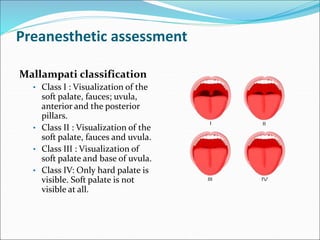
Mallampati classification
• Class I : Visualization of the
soft palate, fauces; uvula,
anterior and the posterior
pillars.
• Class II : Visualization of the
soft palate, fauces and uvula.
• Class III : Visualization of
soft palate and base of uvula.
• Class IV: Only hard palate is
visible. Soft palate is not
visible at all.
Preanesthetic assessment
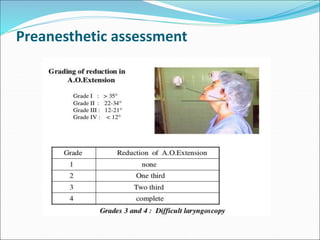
Atlanto occipital joint (AO) extension
• Grade I : >35°
• Grade II : 22°-34°
• Grade III : 12°-21°
• Grade IV : < 12°
• Normal angle of extension is 35° or more
Preanesthetic assessment
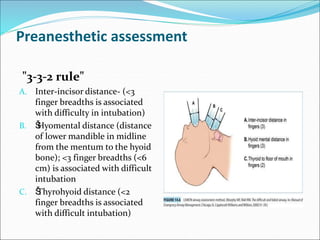
"3-3-2 rule"
A. Inter-incisor distance- (<3
finger breadths is associated
with difficulty in intubation)
B. Š
Hyomental distance (distance
of lower mandible in midline
from the mentum to the hyoid
bone); <3 finger breadths (<6
cm) is associated with difficult
intubation
C. Š
Thyrohyoid distance (<2
finger breadths is associated
with difficult intubation)
Preanesthetic assessment
LEMON airway assessment method
 The score with a maximum of 10 points is calculated by
assigning 1 point for each of the following LEMON
criteria:
Preanesthetic assessment
 L = Look externally (facial trauma, large incisors, beard
or moustache, large tongue)
 E = Evaluate the 3-3-2 rule
 M = Mallampati (Mallampati score > 3).
 O = Obstruction (presence of any condition like
epiglottitis, peritonsillar abscess, trauma).
 N = Neck mobility (limited neck mobility)
Preanesthetic assessment
Others
• Š
Anterior jaw subluxation (<1 finger breadth is
associated with difficult intubation)
• ƒ
Tongue size dentition, dental appliances/prosthetic
caps, existing chipped/loose teeth – must inform
patients of rare possibility of damage
• ƒ
Nasal passage patency (if planning nasotracheal
intubation)
Preanesthetic assessment
 examination of anatomical sites relevant to lines and
blocks
 ƒ
bony landmarks and suitability of anatomy for
regional anaesthesia (if relevant)
 ƒ
sites for IV, central venous pressure (CVP), and
pulmonary artery (PA) catheters
Preanesthetic assessment
Investigations
 FBC,Urinalysis, Urea, creatinine and electrolytes Blood
glucose, Liver function tests, Coagulation screen, ECG,
Chest X-ray
 Others: Echocardiography, Pulmonary Function Tests,
Cardiopulmonary Exercise Testing
Preanesthetic preparation
Having taken
 Full clinical history,
 Physical examination
 Reviewed the relevant investigations,
 Satisfied?
 Go ahead with surgery or reschedule
Preanesthetic preparation
 Preoperative fasting
 providing information to the patient and obtaining
consent to proceed
 Ensuring blood products are available during the
perioperative period if necessary
 organizing appropriate staff and equipment within the
operating theatre suite.
 Reschedule Surgery for Clinical Reasons
Preanesthetic preparation
Reasons include
 Acute upper respiratory tract infection
 Coexisting medical disease and drug therapy,
 Emergency surgery for which the patient has not been
resuscitated adequately
 Recent ingestion of food
 Failure to obtain consent
Premedication and other prophylactic
measures
Premedication refers to the administration of drugs in
the period 1–2 h before induction of anaesthesia.
Aim:
 allay anxiety and fear
 reduce postoperative nausea and vomiting
 assist with intra- and postoperative analgesia
 reduce secretions
Premedication and other
prophylactic measures
 reduce the volume and increase the pH of gastric
contents
 attenuate vagal reflexes
 attenuate sympathoadrenal responses.
Premedication and other
prophylactic measures
Pre-anesthetic medications to stop
 ƒ
oral antihyperglycemics: stop on morning of surgery
 ƒ
antidepressants: stop on morning of surgery
 ƒ
ACE inhibitors and angiotension receptor blockers: may
stop on morning of surgery (controversial)
 ƒ
anticoagulants
Prediction of perioperative morbidity or
mortality
 ASA (American Society ofAnesthesiologists) Grading
 Physiological and Operative Severity Score for the
enUmeration of Mortality and morbidity POSSUM score
 Lee’s Revised Cardiac Risk Index
Conclusion
Assessments made during the preanesthetic
evaluation may be used to:
• Educate the patient
• Organize resources for perioperative care
• Formulate plans for intra-operative care, postoperative
recovery, and postoperative pain management.
Conclusion
 These would help the patient and family prepare for
the best possible outcome.
 Failure to undertake this activity places the patient at
increased risk of perioperative morbidity or mortality.
References
 Smith and Aitkenhead’s Textbook of Anaesthesia Sixth
Edition By Alan R. Aitkenhead, Iain K. Moppett And
Jonathan P. Thompson
 Airway Assessment : Predictors Of Difficult Airway ,Dr.
Sunanda Gupta1 Dr. Rajesh Sharma Kr2 Dr. Dimpel Jain
 2016 Toronto Notes, Comprehensive medical reference and
review for the Medical Council of Canada Qualifying Exam
Part I and the United States Medical Licensing Exam Step 2
32nd Edition, Editors-in-Chief: Zamir Merali and Jason D.
Woodfine
Thank you

Pre-anaesthetic evaluation.ppt

  • 1.
    By Dr olofin K.E AnaestheticUnit Asokoro District Hospital
  • 2.
    Outline Introduction Definition Aims Preanesthetic evaluation Preanesthetic planning Premedicationand other prophylactic measures Prediction of perioperative morbidity or mortality Conclusion References
  • 3.
    Introduction  All patientsscheduled to undergo surgery should be assessed in advance with a view to planning optimal preparation and perioperative management.  It is one mechanism by which the standard and quality of care provided by the anaesthetist is measured.
  • 4.
    Definition  Preanesthetic evaluationis a medical check-up and laboratory investigations done by the anaesthesiologist before an operation, to assess the patient's physical condition and any other co-morbidities.
  • 5.
    Aims  To createrapport with the patient  To ensure history, physical examination and proper investigation optimise patient for anaesthesia.  To confirm that the surgery proposed is realistic and beneficial to the patient and the possible risks involved.  To anticipate potential problems and adequately plan for them
  • 6.
    Preanesthetic assessment History  Biodata: Age, gender  Indication for surgery  Surgical/Anaesthetic Hx: previous anaesthesia, surgery and complications  PMHx hypertension, diabetes, asthma, sickle cell disease etc
  • 7.
    Preanesthetic assessment  DrugHx. Medications, drug allergies,  F/SHx: Cigarette smoking, alcohol consumption, use of recreational drugs
  • 8.
    Preanesthetic assessment General examination •General assessment of nutrition and mental status Systemic examination • CNS, CVS, and respiratory systems
  • 9.
    Preanesthetic assessment Airway assessment Itis done to determine intubation difficulty (no single test is 100% specific or sensitive) Relative to tongue/pharyngeal size using the mallampatti classification.
  • 10.
    Preanesthetic assessment Mallampati classification •Class I : Visualization of the soft palate, fauces; uvula, anterior and the posterior pillars. • Class II : Visualization of the soft palate, fauces and uvula. • Class III : Visualization of soft palate and base of uvula. • Class IV: Only hard palate is visible. Soft palate is not visible at all.
  • 13.
    Preanesthetic assessment Atlanto occipitaljoint (AO) extension • Grade I : >35° • Grade II : 22°-34° • Grade III : 12°-21° • Grade IV : < 12° • Normal angle of extension is 35° or more
  • 14.
  • 15.
    Preanesthetic assessment "3-3-2 rule" A.Inter-incisor distance- (<3 finger breadths is associated with difficulty in intubation) B. Š Hyomental distance (distance of lower mandible in midline from the mentum to the hyoid bone); <3 finger breadths (<6 cm) is associated with difficult intubation C. Š Thyrohyoid distance (<2 finger breadths is associated with difficult intubation)
  • 18.
    Preanesthetic assessment LEMON airwayassessment method  The score with a maximum of 10 points is calculated by assigning 1 point for each of the following LEMON criteria:
  • 19.
    Preanesthetic assessment  L= Look externally (facial trauma, large incisors, beard or moustache, large tongue)  E = Evaluate the 3-3-2 rule  M = Mallampati (Mallampati score > 3).  O = Obstruction (presence of any condition like epiglottitis, peritonsillar abscess, trauma).  N = Neck mobility (limited neck mobility)
  • 20.
    Preanesthetic assessment Others • Š Anteriorjaw subluxation (<1 finger breadth is associated with difficult intubation) • ƒ Tongue size dentition, dental appliances/prosthetic caps, existing chipped/loose teeth – must inform patients of rare possibility of damage • ƒ Nasal passage patency (if planning nasotracheal intubation)
  • 21.
    Preanesthetic assessment  examinationof anatomical sites relevant to lines and blocks  ƒ bony landmarks and suitability of anatomy for regional anaesthesia (if relevant)  ƒ sites for IV, central venous pressure (CVP), and pulmonary artery (PA) catheters
  • 22.
    Preanesthetic assessment Investigations  FBC,Urinalysis,Urea, creatinine and electrolytes Blood glucose, Liver function tests, Coagulation screen, ECG, Chest X-ray  Others: Echocardiography, Pulmonary Function Tests, Cardiopulmonary Exercise Testing
  • 23.
    Preanesthetic preparation Having taken Full clinical history,  Physical examination  Reviewed the relevant investigations,  Satisfied?  Go ahead with surgery or reschedule
  • 24.
    Preanesthetic preparation  Preoperativefasting  providing information to the patient and obtaining consent to proceed  Ensuring blood products are available during the perioperative period if necessary  organizing appropriate staff and equipment within the operating theatre suite.  Reschedule Surgery for Clinical Reasons
  • 25.
    Preanesthetic preparation Reasons include Acute upper respiratory tract infection  Coexisting medical disease and drug therapy,  Emergency surgery for which the patient has not been resuscitated adequately  Recent ingestion of food  Failure to obtain consent
  • 26.
    Premedication and otherprophylactic measures Premedication refers to the administration of drugs in the period 1–2 h before induction of anaesthesia. Aim:  allay anxiety and fear  reduce postoperative nausea and vomiting  assist with intra- and postoperative analgesia  reduce secretions
  • 27.
    Premedication and other prophylacticmeasures  reduce the volume and increase the pH of gastric contents  attenuate vagal reflexes  attenuate sympathoadrenal responses.
  • 28.
    Premedication and other prophylacticmeasures Pre-anesthetic medications to stop  ƒ oral antihyperglycemics: stop on morning of surgery  ƒ antidepressants: stop on morning of surgery  ƒ ACE inhibitors and angiotension receptor blockers: may stop on morning of surgery (controversial)  ƒ anticoagulants
  • 29.
    Prediction of perioperativemorbidity or mortality  ASA (American Society ofAnesthesiologists) Grading  Physiological and Operative Severity Score for the enUmeration of Mortality and morbidity POSSUM score  Lee’s Revised Cardiac Risk Index
  • 32.
    Conclusion Assessments made duringthe preanesthetic evaluation may be used to: • Educate the patient • Organize resources for perioperative care • Formulate plans for intra-operative care, postoperative recovery, and postoperative pain management.
  • 33.
    Conclusion  These wouldhelp the patient and family prepare for the best possible outcome.  Failure to undertake this activity places the patient at increased risk of perioperative morbidity or mortality.
  • 34.
    References  Smith andAitkenhead’s Textbook of Anaesthesia Sixth Edition By Alan R. Aitkenhead, Iain K. Moppett And Jonathan P. Thompson  Airway Assessment : Predictors Of Difficult Airway ,Dr. Sunanda Gupta1 Dr. Rajesh Sharma Kr2 Dr. Dimpel Jain  2016 Toronto Notes, Comprehensive medical reference and review for the Medical Council of Canada Qualifying Exam Part I and the United States Medical Licensing Exam Step 2 32nd Edition, Editors-in-Chief: Zamir Merali and Jason D. Woodfine
  • 35.