LOCAL ANAESTHETICS IN CENTRAL
NEURAXIAL BLOCK AND THEIR
TOXICITY
PRESENTER- DR ASHISH GUPTA
CONTENTS
 INTRODUCTION
 LOCAL ANESTHETICS IN CENTRAL NEURAXIAL
BLOCK
 DRUGS AND THEIR DOSES
 LOCAL ANAESTHETIC SYSTEMIC TOXICITY(LAST)
 PREVENTION
INTRODUCTION
 Local anesthetics are the agents used to provide analgesia and
anesthesia for various surgical and nonsurgical procedures.
 These drugs are also used for
• Acute and chronic pain management
• To reduce perioperative stress
• To improve perioperative outcomes, and
• To treat dysrhythmias.
CONTD…
 Local anesthetics bind to specific sites in voltage-gated Na
channels.
 They block Nacurrent, thereby reducing excitability of neuronal,
cardiac or central nervous system tissue.
 They prevent transmission of nerve impulses (conduction
blockade) by inhibiting passage of sodium ions through ion-
selective sodium channels in nerve membranes.
Local anaesthetics in central neuraxial block
Local anesthetic solutions placed in the epidural or sacral caudal space
produce epidural anesthesia by two presumed mechanisms-
• First, local anesthetic diffuses across the dura to act on nerve roots.
• Second, they also diffuse into the paravertebral area through the
intervertebral foramina, producing multiple paravertebral nerve blocks.
CONTD…
• These slow diffusion processes account for the 15- to 30-minute
delay in onset of sensory anesthesia after placement of local
anesthetic solutions in the epidural space.
 Spinal anesthesia is produced by injection of local anesthetic
solutions into the lumbar subarachnoid space.
 They act on superficial layers of the spinal cord, but the principal
site of action is the preganglionic fibers as they leave the spinal
cord in the anterior rami.
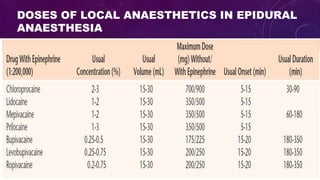
DOSES OF LOCAL ANAESTHETICS IN EPIDURAL
ANAESTHESIA
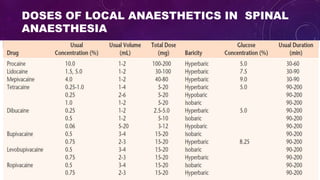
DOSES OF LOCAL ANAESTHETICS IN SPINAL
ANAESTHESIA
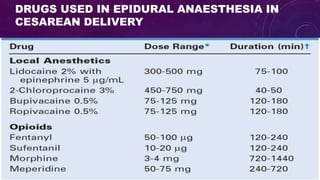
DRUGS USED IN EPIDURAL ANAESTHESIA IN
CESAREAN DELIVERY
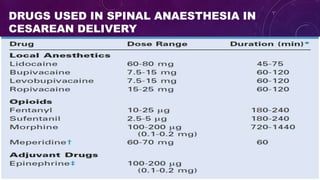
DRUGS USED IN SPINAL ANAESTHESIA IN
CESAREAN DELIVERY
Local Anaesthetic Systemic Toxicity
 Local anaesthetic systemic toxicity (LAST) is due to an excess
plasma concentration of the drug.
 Plasma concentrations are determined by the rate of drug
entrance into the systemic circulation relative to their redistribution
to inactive tissue sites and clearance by metabolism.
Risk Factors For Toxicity
 LA related
 Block related
 Patient related
CONTD..
 LA related
• Type of LA
• Dose
 Block related
• Site of block
• Conduct of block
• Single administration vs continuous infusion
CONTD..
 Patient related
• Comorbidities(renal, liver, cardiac disease)
• Elderly
• Paediatric
• Pregnant
Systemic and localized toxic reactions
can occur because of
 Accidental intravascular or
 Intrathecal injection or
 Administration of an unwanted excessive dose.
SYSTEMIC TOXICITY
Central Nervous System Toxicity
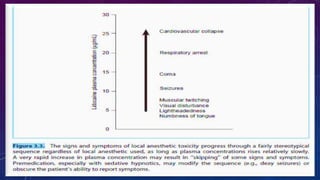
 Early Stage( Subjective)-
 Lightheadedness and dizziness
 Visual and auditory disturbances
 Disorientation
 Drowsiness
Late Stage(Objective)-
 Shivering, muscular twitching, and tremors.
 Generalized convulsions of a tonic-clonic nature.
 If a sufficiently large dose or rapid intravenous injection
administered, the initial signs of CNS excitation are
rapidly followed by a state of generalized CNS
depression.
 Respiratory depression and later on Respiratory arrest
Cardiovascular System Toxicity
 Local anesthetics can exert
 Direct actions on both the heart and peripheral blood
vessels
 Indirect actions on the circulation by blockade of
sympathetic or parasympathetic efferent activity.
 Initial phase-Hypertension and tachycardia.
 Intermediate phase- Myocardial depression and
hypotension.
 Terminal phase- Peripheral vasodilatation, severe
hypotension, and a variety of arrhythmias such as sinus
bradycardia, conduction blocks, ventricular
tachyarrhythmias, and asystole.
BUPIVACAINE INDUCED CARDIOTOXICITY
Bupivacaine depresses the rapid phase of depolarization (Vmax)
in Purkinje fibers and ventricular muscle more than lidocaine
does.
The rate of recovery from a use-dependent block is slower in
bupivacaine-treated papillary muscles than in lidocaine-treated
muscles.
 The ratio of the dosage required for irreversible cardiovascular
collapse (CC) and the dosage that will produce CNS toxicity
(convulsions; i.e., the CC/CNS ratio) is lower for bupivacaine
and etidocaine than for lidocaine.
Ventricular arrhythmias and fatal ventricular fibrillation can occur
more often after the rapid intravenous administration of a large
dose of bupivacaine, but far less frequently with lidocaine.
Cardiac resuscitation is more difficult after bupivacaine- induced
cardiovascular collapse, and acidosis and hypoxia markedly
potentiate the cardiotoxicity of bupivacaine.
CHECK LIST FOR THE TREAMENT OF LOCAL
ANAESTHETIC TOXICITY
 Stop Injecting local anaesthetic
 Get Help
 Initial Focus
 Airway management: Ventilate with 100% Oxygen
 Control seizures: Benzodiazapines are preferred
 Avoid Propofol specially in haemodynamically unstable patients.
 Alert the nearest facility with Cardiopulmonary bypass capability.
 MANAGEMENT OF CARDIAC ARRHYTHMIAS
 Basic and Advanced Cardiac Life Support will require
adjustment of medications and perhaps prolonged efforts.
 AVOID vasopressin, calcium channel blockers, beta blockers or
local anaesthetic.
 REDUCE individual epinephrine dose to less than 1 mcg/kg.
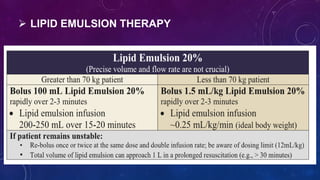
 LIPID EMULSION THERAPY
METHEMOGLOBINEMIA
 Hepatic metabolism of prilocaine generates O-toluidine, which
oxidizes hemoglobin to methemoglobin.
 Methemoglobinemia is readily reversed by the administration
of methylene blue, 1 to 2 mg/kg intravenously, over 5 minutes
(total dose should not exceed 7 to 8 mg/ kg).
 Methylene blue is reduced to leuko-methylene blue, which
then acts as an electron donor and nonenzymatically reduces
methemoglobin to haemoglobin.
Neural Toxicity of Local Anesthetics
 Direct application of local anesthetics can result in
histopathologic changes consistent with neuronal injury
 Demyelination
 Wallerian degeneration
 Dysregulation of axonal transport
 Disruption of the blood–nerve barrier
 Decreased blood flow to the vasa-nervorum
 Loss of cell membrane integrity
 Transient Neurologic Symptoms
 Moderate to severe pain in the lower back, buttocks, and
posterior thighs that appears within 6 to 36 hours after complete
recovery from uneventful single-shot spinal anesthesia.
• The sensory and motor neurologic examination is not abnormal
and full recovery from symptoms usually occurs within 1 to 7
days.
• The incidence of transient neurologic symptoms is greatest
following the intrathecal injection of lidocaine (as high as 30%).
 Cauda Equina Syndrome
• Cauda equina syndrome (CES) occurs when diffuse injury across
the lumbosacral plexus produces varying degrees of sensory
anesthesia, bowel and bladder sphincter dysfunction, and
paraplegia.
• It is most frequently associated with large central lumbar disc
herniation, prolapse or sequestration with 50% to 60% patients
having urinary retention on presentation.
Anterior Spinal Artery Syndrome
• Anterior spinal artery syndrome consists of lower extremity paresis
with a variable sensory deficit that is usually diagnosed as the
neural blockade resolves.
• The etiology of this syndrome is uncertain, although thrombosis or
spasm of the anterior spinal artery is possible, as well as effects of
hypotension or vasoconstrictor drugs.
• Advanced age and the presence of peripheral vascular disease may
predispose patients to development of anterior spinal artery
syndrome.
PREVENTION OF LOCAL ANESTHETIC TOXICITY
Patient assessment
• Perform a history and physical examination with careful attention to
the patient’s age and coexisting medical conditions.
• Ensure that the patient is an appropriate candidate for the regional
anesthetic technique and the local anesthetic dose selected.
• Choose a local anesthetic agent with the best safety profile and in
an appropriate concentration and volume.
 Preparation
Ensure availability of:
• Resuscitative equipment and drugs,
• Airway equipment
• Obtain consent for the procedure.
• Attach standard monitors (ECG, pulse oximetry and non-invasive
blood pressure).
• Establish intravenous access.
• Administer supplemental oxygen.
• Consider pre-medication with a benzodiazepine.
 Technique
• Choose the appropriate block and determine if the patient really
needs a continuous block.
• Ensure that the patient remains in a monitored setting
until the catheter is removed.
• Check the dose and concentration of local anesthetic and
epinephrine prior to performing the block.
• Draw up and label the local anesthetic and keep it with the nerve
block equipment away from your anaesthetic drugs.
• While performing the block, aspirate before each injection and
discard solution if discolored by blood.
• Inject the total volume in 4-5ml increments and monitor the patient
for signs of toxicity between each injection.
• Maintain verbal contact with the patient during and after the
injection.
• Do not leave the patient unattended after a regional anesthetic
has been performed
THANK YOU

Local anaesthetic toxicity

  • 1.
    LOCAL ANAESTHETICS INCENTRAL NEURAXIAL BLOCK AND THEIR TOXICITY PRESENTER- DR ASHISH GUPTA
  • 2.
    CONTENTS  INTRODUCTION  LOCALANESTHETICS IN CENTRAL NEURAXIAL BLOCK  DRUGS AND THEIR DOSES  LOCAL ANAESTHETIC SYSTEMIC TOXICITY(LAST)  PREVENTION
  • 3.
    INTRODUCTION  Local anestheticsare the agents used to provide analgesia and anesthesia for various surgical and nonsurgical procedures.  These drugs are also used for • Acute and chronic pain management • To reduce perioperative stress • To improve perioperative outcomes, and • To treat dysrhythmias.
  • 4.
    CONTD…  Local anestheticsbind to specific sites in voltage-gated Na channels.  They block Nacurrent, thereby reducing excitability of neuronal, cardiac or central nervous system tissue.  They prevent transmission of nerve impulses (conduction blockade) by inhibiting passage of sodium ions through ion- selective sodium channels in nerve membranes.
  • 5.
    Local anaesthetics incentral neuraxial block Local anesthetic solutions placed in the epidural or sacral caudal space produce epidural anesthesia by two presumed mechanisms- • First, local anesthetic diffuses across the dura to act on nerve roots. • Second, they also diffuse into the paravertebral area through the intervertebral foramina, producing multiple paravertebral nerve blocks.
  • 6.
    CONTD… • These slowdiffusion processes account for the 15- to 30-minute delay in onset of sensory anesthesia after placement of local anesthetic solutions in the epidural space.  Spinal anesthesia is produced by injection of local anesthetic solutions into the lumbar subarachnoid space.  They act on superficial layers of the spinal cord, but the principal site of action is the preganglionic fibers as they leave the spinal cord in the anterior rami.
  • 7.
    DOSES OF LOCALANAESTHETICS IN EPIDURAL ANAESTHESIA
  • 8.
    DOSES OF LOCALANAESTHETICS IN SPINAL ANAESTHESIA
  • 9.
    DRUGS USED INEPIDURAL ANAESTHESIA IN CESAREAN DELIVERY
  • 10.
    DRUGS USED INSPINAL ANAESTHESIA IN CESAREAN DELIVERY
  • 11.
    Local Anaesthetic SystemicToxicity  Local anaesthetic systemic toxicity (LAST) is due to an excess plasma concentration of the drug.  Plasma concentrations are determined by the rate of drug entrance into the systemic circulation relative to their redistribution to inactive tissue sites and clearance by metabolism.
  • 12.
    Risk Factors ForToxicity  LA related  Block related  Patient related
  • 13.
    CONTD..  LA related •Type of LA • Dose  Block related • Site of block • Conduct of block • Single administration vs continuous infusion
  • 14.
    CONTD..  Patient related •Comorbidities(renal, liver, cardiac disease) • Elderly • Paediatric • Pregnant
  • 15.
    Systemic and localizedtoxic reactions can occur because of  Accidental intravascular or  Intrathecal injection or  Administration of an unwanted excessive dose.
  • 16.
    SYSTEMIC TOXICITY Central NervousSystem Toxicity  Early Stage( Subjective)-  Lightheadedness and dizziness  Visual and auditory disturbances  Disorientation  Drowsiness
  • 17.
    Late Stage(Objective)-  Shivering,muscular twitching, and tremors.  Generalized convulsions of a tonic-clonic nature.  If a sufficiently large dose or rapid intravenous injection administered, the initial signs of CNS excitation are rapidly followed by a state of generalized CNS depression.  Respiratory depression and later on Respiratory arrest
  • 18.
    Cardiovascular System Toxicity Local anesthetics can exert  Direct actions on both the heart and peripheral blood vessels  Indirect actions on the circulation by blockade of sympathetic or parasympathetic efferent activity.
  • 19.
     Initial phase-Hypertensionand tachycardia.  Intermediate phase- Myocardial depression and hypotension.  Terminal phase- Peripheral vasodilatation, severe hypotension, and a variety of arrhythmias such as sinus bradycardia, conduction blocks, ventricular tachyarrhythmias, and asystole.
  • 20.
    BUPIVACAINE INDUCED CARDIOTOXICITY Bupivacainedepresses the rapid phase of depolarization (Vmax) in Purkinje fibers and ventricular muscle more than lidocaine does. The rate of recovery from a use-dependent block is slower in bupivacaine-treated papillary muscles than in lidocaine-treated muscles.
  • 21.
     The ratioof the dosage required for irreversible cardiovascular collapse (CC) and the dosage that will produce CNS toxicity (convulsions; i.e., the CC/CNS ratio) is lower for bupivacaine and etidocaine than for lidocaine. Ventricular arrhythmias and fatal ventricular fibrillation can occur more often after the rapid intravenous administration of a large dose of bupivacaine, but far less frequently with lidocaine. Cardiac resuscitation is more difficult after bupivacaine- induced cardiovascular collapse, and acidosis and hypoxia markedly potentiate the cardiotoxicity of bupivacaine.
  • 23.
    CHECK LIST FORTHE TREAMENT OF LOCAL ANAESTHETIC TOXICITY  Stop Injecting local anaesthetic  Get Help  Initial Focus  Airway management: Ventilate with 100% Oxygen  Control seizures: Benzodiazapines are preferred  Avoid Propofol specially in haemodynamically unstable patients.  Alert the nearest facility with Cardiopulmonary bypass capability.
  • 24.
     MANAGEMENT OFCARDIAC ARRHYTHMIAS  Basic and Advanced Cardiac Life Support will require adjustment of medications and perhaps prolonged efforts.  AVOID vasopressin, calcium channel blockers, beta blockers or local anaesthetic.  REDUCE individual epinephrine dose to less than 1 mcg/kg.
  • 25.
  • 26.
    METHEMOGLOBINEMIA  Hepatic metabolismof prilocaine generates O-toluidine, which oxidizes hemoglobin to methemoglobin.  Methemoglobinemia is readily reversed by the administration of methylene blue, 1 to 2 mg/kg intravenously, over 5 minutes (total dose should not exceed 7 to 8 mg/ kg).  Methylene blue is reduced to leuko-methylene blue, which then acts as an electron donor and nonenzymatically reduces methemoglobin to haemoglobin.
  • 27.
    Neural Toxicity ofLocal Anesthetics  Direct application of local anesthetics can result in histopathologic changes consistent with neuronal injury  Demyelination  Wallerian degeneration  Dysregulation of axonal transport  Disruption of the blood–nerve barrier  Decreased blood flow to the vasa-nervorum  Loss of cell membrane integrity
  • 28.
     Transient NeurologicSymptoms  Moderate to severe pain in the lower back, buttocks, and posterior thighs that appears within 6 to 36 hours after complete recovery from uneventful single-shot spinal anesthesia. • The sensory and motor neurologic examination is not abnormal and full recovery from symptoms usually occurs within 1 to 7 days. • The incidence of transient neurologic symptoms is greatest following the intrathecal injection of lidocaine (as high as 30%).
  • 29.
     Cauda EquinaSyndrome • Cauda equina syndrome (CES) occurs when diffuse injury across the lumbosacral plexus produces varying degrees of sensory anesthesia, bowel and bladder sphincter dysfunction, and paraplegia. • It is most frequently associated with large central lumbar disc herniation, prolapse or sequestration with 50% to 60% patients having urinary retention on presentation.
  • 30.
    Anterior Spinal ArterySyndrome • Anterior spinal artery syndrome consists of lower extremity paresis with a variable sensory deficit that is usually diagnosed as the neural blockade resolves. • The etiology of this syndrome is uncertain, although thrombosis or spasm of the anterior spinal artery is possible, as well as effects of hypotension or vasoconstrictor drugs. • Advanced age and the presence of peripheral vascular disease may predispose patients to development of anterior spinal artery syndrome.
  • 31.
    PREVENTION OF LOCALANESTHETIC TOXICITY Patient assessment • Perform a history and physical examination with careful attention to the patient’s age and coexisting medical conditions. • Ensure that the patient is an appropriate candidate for the regional anesthetic technique and the local anesthetic dose selected. • Choose a local anesthetic agent with the best safety profile and in an appropriate concentration and volume.
  • 32.
     Preparation Ensure availabilityof: • Resuscitative equipment and drugs, • Airway equipment • Obtain consent for the procedure. • Attach standard monitors (ECG, pulse oximetry and non-invasive blood pressure). • Establish intravenous access. • Administer supplemental oxygen. • Consider pre-medication with a benzodiazepine.
  • 33.
     Technique • Choosethe appropriate block and determine if the patient really needs a continuous block. • Ensure that the patient remains in a monitored setting until the catheter is removed. • Check the dose and concentration of local anesthetic and epinephrine prior to performing the block. • Draw up and label the local anesthetic and keep it with the nerve block equipment away from your anaesthetic drugs.
  • 34.
    • While performingthe block, aspirate before each injection and discard solution if discolored by blood. • Inject the total volume in 4-5ml increments and monitor the patient for signs of toxicity between each injection. • Maintain verbal contact with the patient during and after the injection. • Do not leave the patient unattended after a regional anesthetic has been performed
  • 35.