• The provision of adequate anxiety control is
  an integral part of the practice of dentistry.
• It is of fundamental importance that the level
  of sedation must be such that the patient
  remains conscious, and is able to both
  understand and respond to verbal commands.
• A minimally depressed level of consciousness,
  that retains patient’s ability to maintain an
  airway independently and respond
  appropriately to physical stimulation and
  verbal command.
                                       {ADA(1993)}
• Goals for sedation to control behavior to allow
  procedure to be completed successfully.
• Kids under age 5 or 6 (chronologically or
  developmentally) may require deep sedation.
• Anatomical and physiological differences must
  be considered.
• May be more vulnerable to respiratory
  depression and may pass into deeper sedation
  state than was intended.
• It is important that a wide margin of safety
  between conscious sedation and the
  unconscious state
• provided by general anesthesia is maintained.
  In conscious sedation, verbal contact and
  protective
• reflexes are maintained, whereas in general
  anesthesia these are lost.
• Good sedation practice requires practitioners to
  consider the range of non-pharmacological and
  pharmacological methods of anxiety management in
  treatment planning for individual patients.
• It is essential that conscious sedation is provided to the
  highest possible standards, respecting the rights of
  patients as individuals.
• The provision of safe and effective conscious sedation
  requires both regulation and, more importantly,
  education of the profession and patients.
•   A fully recorded medical history.
•   Blood pressure.
•   Weight, if recorded.
•   ASA status.
•   A dental history.
•   A conscious sedation and general anaesthetic
    history.
• Dental treatment plan.
• The selected conscious sedation technique.
• Any individual patient requirements.
• Provision of pre- and post-operative written
  instructions provided before treatment.
• Written consent for conscious sedation and
  dental treatment.
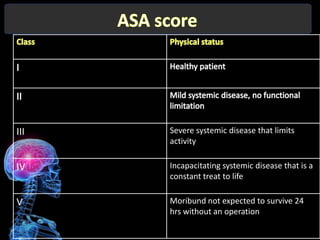
III   Severe systemic disease that limits
      activity

IV    Incapacitating systemic disease that is a
      constant treat to life

V     Moribund not expected to survive 24
      hrs without an operation
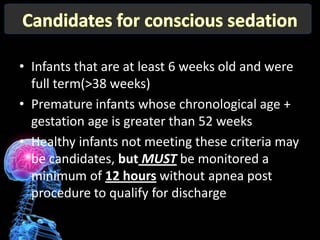
• Infants that are at least 6 weeks old and were
  full term(>38 weeks)
• Premature infants whose chronological age +
  gestation age is greater than 52 weeks
• Healthy infants not meeting these criteria may
  be candidates, but MUST be monitored a
  minimum of 12 hours without apnea post
  procedure to qualify for discharge
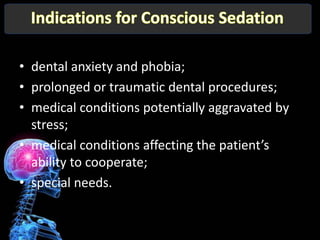
• dental anxiety and phobia;
• prolonged or traumatic dental procedures;
• medical conditions potentially aggravated by
  stress;
• medical conditions affecting the patient’s
  ability to cooperate;
• special needs.
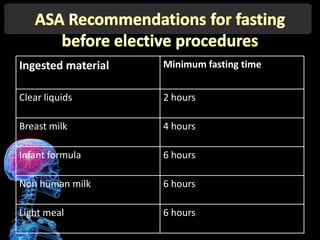
Ingested material   Minimum fasting time


Clear liquids       2 hours

Breast milk         4 hours

Infant formula      6 hours

Non human milk      6 hours

Light meal          6 hours
Conscious Sedation for Children

• Nitrous oxide/oxygen is usually the technique
  of choice for conscious sedation of paediatric
  dental patients
• Few randomised controlled trials were found in which
  intravenous sedation of paediatric dental patients has
  been reported as a safe and effective technique 24,76.
• Intravenous sedation for children must be provided
  only by those who are trained in these techniques for
  patients of this age group 9,11.
• Intravenous sedation for children is appropriate in a
  minority of cases.
• If practical, a topical anaesthetic should be used prior
  to venous cannulation.
• Recovery from sedation is a progressive step-
  down from completion of treatment, through to
  the patient’s discharge into the care of a
  responsible adult escort.
• A trained member of the dental team must be
  responsible for and monitor the patient
  throughout this period, and both equipment and
  drugs for dealing with sedation complications
  must be immediately to hand.
• The sedationist must be available to see the
  patient urgently in the event of any problems
  arising
• All patients must be individually assessed for
  their suitability for discharge and should be
  allowed to leave only when they have returned to
  a normal level of responsiveness and orientation
  for age and mental status and can walk unaided
  (if appropriate).
• Where a cannula has been inserted, it should be
  left in situ until the patient is assessed as fit for
  discharge
• The decision to discharge a patient following any
  type of sedation must be the responsibility of the
  sedationist
• The patient and escort should be provided
  with written details of post-operative risks,
  pain control and management of possible
  complications.
• Information regarding aftercare arrangements
  and emergency contacts must also be
  provided.
• Patients should eat normally on the day of
  their appointment and must avoid alcoholic
• drinks.
• Patients should take routine medication as
  normal unless advised not to by the treating
• dentist or anaesthetist.
• A responsible adult escort must accompany the
  patient to their appointment and escort them
  home after treatment under conscious sedation.
• Arrangements must be made to ensure the
  patient is supervised for a minimum of the rest of
  the day.
• It is essential that the escort gives attention to
  the patient and therefore should not be
  responsible for children, elderly and/or
  dependent relatives.
• Wherever possible there should be arrangements
  in place for the patient and escort to travel home
  by private car or taxi rather than public transport.
  If this is impossible, the escort must be made
  fully aware of the added responsibilities of caring
  for the patient during the journey home. If either
  the patient or the escort appears to be unwilling
  or unable to comply with these requirements
  conscious sedation should not be administered.
• Sensible clothing is advised, avoiding tight sleeves
  and high-heeled shoes.
• For the remainder of the day, patients must not:
• - return to work;
• - drive a car or other vehicle;
• - consume alcohol;
• - operate machinery (including kitchen
  equipment);
• - climb heights (e.g. ladders, scaffolding);
• - be in charge of other people;
• - make important decisions (e.g. signing legal
  documents).
• Patients who are trying to conceive, are
  pregnant or are breast-feeding must inform
  their dentist in advance of their appointment.
• Patients should eat normally on the day of
  their appointment avoiding alcoholic drinks.
• Routine medication should be taken as
  normal.
• Children must be accompanied to their
  appointments by a responsible parent or
  guardian who is able to give consent
• . Adults should be accompanied to their first
  appointment by a responsible adult escort but
  may be permitted to attend subsequent
  appointments unaccompanied at the
  discretion of the treating dentist.
• Unaccompanied adult patients who have
  received nitrous oxide/oxygen inhalation sedation
  must adopt caution before driving, operating
  machinery or signing legal documents and may
  be asked to remain in the clinic for up to 30
  minutes after treatment is complete.
• Sensible clothing is advised, avoiding tight sleeves
  and high-heeled shoes.
• Patients who are trying to conceive or who are
  pregnant must inform their dentist in advance of
  their appointment.
Conscious  sedation
Conscious  sedation
Conscious  sedation
Conscious  sedation
Conscious  sedation
Conscious  sedation
Conscious  sedation

Conscious sedation

  • 2.
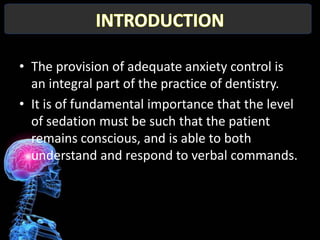
    • The provisionof adequate anxiety control is an integral part of the practice of dentistry. • It is of fundamental importance that the level of sedation must be such that the patient remains conscious, and is able to both understand and respond to verbal commands.
  • 3.
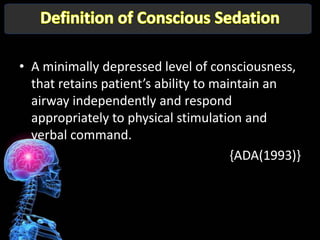
    • A minimallydepressed level of consciousness, that retains patient’s ability to maintain an airway independently and respond appropriately to physical stimulation and verbal command. {ADA(1993)}
  • 4.
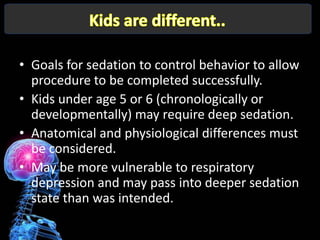
    • Goals forsedation to control behavior to allow procedure to be completed successfully. • Kids under age 5 or 6 (chronologically or developmentally) may require deep sedation. • Anatomical and physiological differences must be considered. • May be more vulnerable to respiratory depression and may pass into deeper sedation state than was intended.
  • 5.
    • It isimportant that a wide margin of safety between conscious sedation and the unconscious state • provided by general anesthesia is maintained. In conscious sedation, verbal contact and protective • reflexes are maintained, whereas in general anesthesia these are lost.
  • 6.
    • Good sedationpractice requires practitioners to consider the range of non-pharmacological and pharmacological methods of anxiety management in treatment planning for individual patients. • It is essential that conscious sedation is provided to the highest possible standards, respecting the rights of patients as individuals. • The provision of safe and effective conscious sedation requires both regulation and, more importantly, education of the profession and patients.
  • 7.
    A fully recorded medical history. • Blood pressure. • Weight, if recorded. • ASA status. • A dental history. • A conscious sedation and general anaesthetic history.
  • 8.
    • Dental treatmentplan. • The selected conscious sedation technique. • Any individual patient requirements. • Provision of pre- and post-operative written instructions provided before treatment. • Written consent for conscious sedation and dental treatment.
  • 9.
    III Severe systemic disease that limits activity IV Incapacitating systemic disease that is a constant treat to life V Moribund not expected to survive 24 hrs without an operation
  • 10.
    • Infants thatare at least 6 weeks old and were full term(>38 weeks) • Premature infants whose chronological age + gestation age is greater than 52 weeks • Healthy infants not meeting these criteria may be candidates, but MUST be monitored a minimum of 12 hours without apnea post procedure to qualify for discharge
  • 11.
    • dental anxietyand phobia; • prolonged or traumatic dental procedures; • medical conditions potentially aggravated by stress; • medical conditions affecting the patient’s ability to cooperate; • special needs.
  • 12.
    Ingested material Minimum fasting time Clear liquids 2 hours Breast milk 4 hours Infant formula 6 hours Non human milk 6 hours Light meal 6 hours
  • 14.
    Conscious Sedation forChildren • Nitrous oxide/oxygen is usually the technique of choice for conscious sedation of paediatric dental patients
  • 15.
    • Few randomisedcontrolled trials were found in which intravenous sedation of paediatric dental patients has been reported as a safe and effective technique 24,76. • Intravenous sedation for children must be provided only by those who are trained in these techniques for patients of this age group 9,11. • Intravenous sedation for children is appropriate in a minority of cases. • If practical, a topical anaesthetic should be used prior to venous cannulation.
  • 16.
    • Recovery fromsedation is a progressive step- down from completion of treatment, through to the patient’s discharge into the care of a responsible adult escort. • A trained member of the dental team must be responsible for and monitor the patient throughout this period, and both equipment and drugs for dealing with sedation complications must be immediately to hand. • The sedationist must be available to see the patient urgently in the event of any problems arising
  • 17.
    • All patientsmust be individually assessed for their suitability for discharge and should be allowed to leave only when they have returned to a normal level of responsiveness and orientation for age and mental status and can walk unaided (if appropriate). • Where a cannula has been inserted, it should be left in situ until the patient is assessed as fit for discharge • The decision to discharge a patient following any type of sedation must be the responsibility of the sedationist
  • 18.
    • The patientand escort should be provided with written details of post-operative risks, pain control and management of possible complications. • Information regarding aftercare arrangements and emergency contacts must also be provided.
  • 19.
    • Patients shouldeat normally on the day of their appointment and must avoid alcoholic • drinks. • Patients should take routine medication as normal unless advised not to by the treating • dentist or anaesthetist.
  • 20.
    • A responsibleadult escort must accompany the patient to their appointment and escort them home after treatment under conscious sedation. • Arrangements must be made to ensure the patient is supervised for a minimum of the rest of the day. • It is essential that the escort gives attention to the patient and therefore should not be responsible for children, elderly and/or dependent relatives.
  • 21.
    • Wherever possiblethere should be arrangements in place for the patient and escort to travel home by private car or taxi rather than public transport. If this is impossible, the escort must be made fully aware of the added responsibilities of caring for the patient during the journey home. If either the patient or the escort appears to be unwilling or unable to comply with these requirements conscious sedation should not be administered. • Sensible clothing is advised, avoiding tight sleeves and high-heeled shoes.
  • 22.
    • For theremainder of the day, patients must not: • - return to work; • - drive a car or other vehicle; • - consume alcohol; • - operate machinery (including kitchen equipment); • - climb heights (e.g. ladders, scaffolding); • - be in charge of other people; • - make important decisions (e.g. signing legal documents).
  • 23.
    • Patients whoare trying to conceive, are pregnant or are breast-feeding must inform their dentist in advance of their appointment.
  • 24.
    • Patients shouldeat normally on the day of their appointment avoiding alcoholic drinks. • Routine medication should be taken as normal. • Children must be accompanied to their appointments by a responsible parent or guardian who is able to give consent
  • 25.
    • . Adultsshould be accompanied to their first appointment by a responsible adult escort but may be permitted to attend subsequent appointments unaccompanied at the discretion of the treating dentist.
  • 26.
    • Unaccompanied adultpatients who have received nitrous oxide/oxygen inhalation sedation must adopt caution before driving, operating machinery or signing legal documents and may be asked to remain in the clinic for up to 30 minutes after treatment is complete. • Sensible clothing is advised, avoiding tight sleeves and high-heeled shoes. • Patients who are trying to conceive or who are pregnant must inform their dentist in advance of their appointment.