Earth’s Atmosphere:
          A Brief Intro
(and Ocean Circulation Patterns)
         Dr. Mark A. McGinley
   Honors College and Department of
          Biological Sciences
         Texas Tech University
Atmosphere
• An atmosphere is a layer of gases that may
  surround a material body of sufficient mass and
  that is held in place by the gravity of the body.
• An atmosphere may be retained for a longer
  duration, if the gravity is high and the
  atmosphere's temperature is low.
• Some planets consist mainly of various gases, but
  only their outer layer is their atmosphere

• Wikipedia
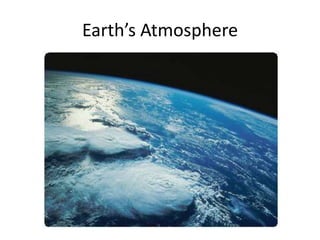
Earth’s Atmosphere
Earth’s Atmosphere
• The atmosphere of Earth is a layer
  of gases surrounding the planet Earth that is
  retained by Earth's gravity.
• The atmosphere becomes thinner and thinner
  with increasing altitude, with no definite
  boundary between the atmosphere and outer
  space.
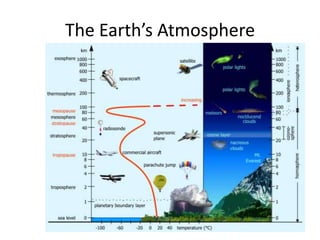
The Earth’s Atmosphere
– The atmosphere has a mass of about 5×10¹⁸ kg
   • three quarters of which is within about 11 km (6.8 mi;
     36,000 ft) of the surface.
– An altitude of 120 km (75 mi) is where
  atmospheric effects become noticeable
  during atmospheric reentry of spacecraft.
– The Kármán line, at 100 km (62 mi), also is often
  regarded as the boundary between atmosphere
  and outer space.
The Earth’s Atmosphere
The Layers of Earth’s Atmosphere
• We will talk about the layers of earth’s
  atmosphere in more detail later on.
• The layer closest to the earth is known as the
  troposphere
  – We live in the troposphere
  – Factors that affect climate and weather occur in
    the troposphere
Composition of dry atmosphere, by volume[2]

ppmv: parts per million by volume (note: volume fraction is equal to mole fraction for ideal gas only, see volume
(thermodynamics))

Gas                                                          Volume

Nitrogen (N2)                                                780,840 ppmv (78.084%)

Oxygen (O2)                                                  209,460 ppmv (20.946%)

Argon (Ar)                                                   9,340 ppmv (0.9340%)

Carbon dioxide (CO2)                                         394.45 ppmv (0.039445%)

Neon (Ne)                                                    18.18 ppmv (0.001818%)

Helium (He)                                                  5.24 ppmv (0.000524%)

Methane (CH4)                                                1.79 ppmv (0.000179%)

Krypton (Kr)                                                 1.14 ppmv (0.000114%)

Hydrogen (H2)                                                0.55 ppmv (0.000055%)

Nitrous oxide (N2O)                                          0.325 ppmv (0.0000325%)

Carbon monoxide (CO)                                         0.1 ppmv (0.00001%)

Xenon (Xe)                                                   0.09 ppmv (9×10⁻⁶%) (0.000009%)

Ozone (O3)                                                   0.0 to 0.07 ppmv (0 to 7×10⁻⁶%)

Nitrogen dioxide (NO2)                                       0.02 ppmv (2×10⁻⁶%) (0.000002%)

Iodine (I2)                                                  0.01 ppmv (1×10⁻⁶%) (0.000001%)

Ammonia (NH3)                                                trace

Not included in above dry atmosphere:


Water vapor (H2O)                                            ~0.40% over full atmosphere, typically 1%-4% at surface
Gases of the Atmosphere
• Nitrogen gas is the most common gas in the
  atmosphere
  – N2
  – Two atoms of Nitrogen held together by a triple
    bond
     • Second strongest bond in nature (I think)
• Thus, nitrogen gas is fairly non-reactive
  – We are surrounded by Nitrogen, but we can not
    use atmospheric nitrogen to help make proteins,
    nucleic acids, etc.
Gases of the Atmosphere
• Oxygen gas is the second most common gas in
  the atmosphere. O2
• Oxygen is required for aerobic respiration
  – Break down sugar to release energy that can be used
    by our bodies
     • This process is much more efficient in the the presence of
       oxygen
• O2 can be converted to O3 (ozone) in the
  atmosphere
  – We will talk about the importance of ozone later on
Gases of the Atmosphere
• Carbon dioxide (CO2)
• Terrestrial plants convert carbon dioxide into
  sugar during the process of photosynthesis
  – Energy stored in sugar is required to power most
    life on earth
• Carbon dioxide is a “greenhouse gas”
Wind
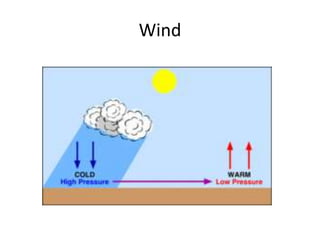
• Wind can be defined simply as air in motion. This
  motion can be in any direction, but in most cases
  the horizontal component of wind flow greatly
  exceeds the flow that occurs vertically.
• Wind develops as a result of spatial differences
  in atmospheric pressure. Generally, these
  differences occur because of uneven absorption
  of solar radiation at the Earth's surface.
Wind
Unequal Distribution of Solar Energy
         Across the Earth
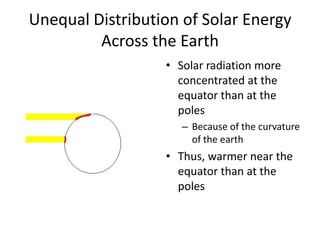
                  • Solar radiation more
                    concentrated at the
                    equator than at the
                    poles
                     – Because of the curvature
                       of the earth
                  • Thus, warmer near the
                    equator than at the
                    poles
Effect of Increasing Temperature on
                 Gasses
• When gasses are heated the molecules start
  to “move” more which results in a lower
  density of gas molecules
  – Fewer molecules per volume
• As the density decreases, the mass of the gas
  decreases
Hot Air Rises
• As air warms its density decreases which
  causes the warmer air to become lighter than
  the cooler air surrounding it
• Thus, the more dense, cooler air replaces the
  warmer, lighter air near the surface of the
  ground
• HOT AIR RISES
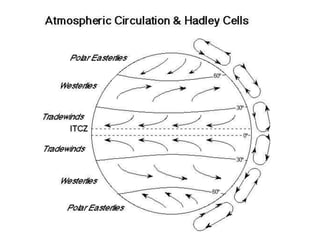
Hadley Cells
Hadley Cells
• Warm air at the equator rises and is replaced
  by cooler air moving from higher latitudes
   – From North to South in Northern Hemisphere
   – From South to North in the Southern Hemisphere
• As air rises it cools.
   – In the Northern Hemisphere high altitude winds
     blow from South to North
   – In the Southern Hemisphere high altitude winds
     blow from North to South
Hadley Cells
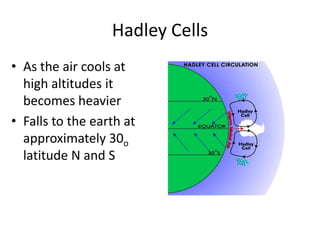
• As the air cools at
  high altitudes it
  becomes heavier
• Falls to the earth at
  approximately 30o
  latitude N and S
Importance of Hadley Cells
• Influence global wind patterns
• Also have profound effects of global patterns
  of precipitation
  – We will talk much more about this later on
Earth’s Atmosphere: A Basic Intro

Earth’s Atmosphere: A Basic Intro

  • 1.
    Earth’s Atmosphere: A Brief Intro (and Ocean Circulation Patterns) Dr. Mark A. McGinley Honors College and Department of Biological Sciences Texas Tech University
  • 2.
    Atmosphere • An atmosphereis a layer of gases that may surround a material body of sufficient mass and that is held in place by the gravity of the body. • An atmosphere may be retained for a longer duration, if the gravity is high and the atmosphere's temperature is low. • Some planets consist mainly of various gases, but only their outer layer is their atmosphere • Wikipedia
  • 3.
  • 4.
    Earth’s Atmosphere • Theatmosphere of Earth is a layer of gases surrounding the planet Earth that is retained by Earth's gravity. • The atmosphere becomes thinner and thinner with increasing altitude, with no definite boundary between the atmosphere and outer space.
  • 5.
    The Earth’s Atmosphere –The atmosphere has a mass of about 5×10¹⁸ kg • three quarters of which is within about 11 km (6.8 mi; 36,000 ft) of the surface. – An altitude of 120 km (75 mi) is where atmospheric effects become noticeable during atmospheric reentry of spacecraft. – The Kármán line, at 100 km (62 mi), also is often regarded as the boundary between atmosphere and outer space.
  • 6.
  • 7.
    The Layers ofEarth’s Atmosphere • We will talk about the layers of earth’s atmosphere in more detail later on. • The layer closest to the earth is known as the troposphere – We live in the troposphere – Factors that affect climate and weather occur in the troposphere
  • 8.
    Composition of dryatmosphere, by volume[2] ppmv: parts per million by volume (note: volume fraction is equal to mole fraction for ideal gas only, see volume (thermodynamics)) Gas Volume Nitrogen (N2) 780,840 ppmv (78.084%) Oxygen (O2) 209,460 ppmv (20.946%) Argon (Ar) 9,340 ppmv (0.9340%) Carbon dioxide (CO2) 394.45 ppmv (0.039445%) Neon (Ne) 18.18 ppmv (0.001818%) Helium (He) 5.24 ppmv (0.000524%) Methane (CH4) 1.79 ppmv (0.000179%) Krypton (Kr) 1.14 ppmv (0.000114%) Hydrogen (H2) 0.55 ppmv (0.000055%) Nitrous oxide (N2O) 0.325 ppmv (0.0000325%) Carbon monoxide (CO) 0.1 ppmv (0.00001%) Xenon (Xe) 0.09 ppmv (9×10⁻⁶%) (0.000009%) Ozone (O3) 0.0 to 0.07 ppmv (0 to 7×10⁻⁶%) Nitrogen dioxide (NO2) 0.02 ppmv (2×10⁻⁶%) (0.000002%) Iodine (I2) 0.01 ppmv (1×10⁻⁶%) (0.000001%) Ammonia (NH3) trace Not included in above dry atmosphere: Water vapor (H2O) ~0.40% over full atmosphere, typically 1%-4% at surface
  • 9.
    Gases of theAtmosphere • Nitrogen gas is the most common gas in the atmosphere – N2 – Two atoms of Nitrogen held together by a triple bond • Second strongest bond in nature (I think) • Thus, nitrogen gas is fairly non-reactive – We are surrounded by Nitrogen, but we can not use atmospheric nitrogen to help make proteins, nucleic acids, etc.
  • 10.
    Gases of theAtmosphere • Oxygen gas is the second most common gas in the atmosphere. O2 • Oxygen is required for aerobic respiration – Break down sugar to release energy that can be used by our bodies • This process is much more efficient in the the presence of oxygen • O2 can be converted to O3 (ozone) in the atmosphere – We will talk about the importance of ozone later on
  • 11.
    Gases of theAtmosphere • Carbon dioxide (CO2) • Terrestrial plants convert carbon dioxide into sugar during the process of photosynthesis – Energy stored in sugar is required to power most life on earth • Carbon dioxide is a “greenhouse gas”
  • 12.
    Wind • Wind canbe defined simply as air in motion. This motion can be in any direction, but in most cases the horizontal component of wind flow greatly exceeds the flow that occurs vertically. • Wind develops as a result of spatial differences in atmospheric pressure. Generally, these differences occur because of uneven absorption of solar radiation at the Earth's surface.
  • 13.
  • 14.
    Unequal Distribution ofSolar Energy Across the Earth • Solar radiation more concentrated at the equator than at the poles – Because of the curvature of the earth • Thus, warmer near the equator than at the poles
  • 16.
    Effect of IncreasingTemperature on Gasses • When gasses are heated the molecules start to “move” more which results in a lower density of gas molecules – Fewer molecules per volume • As the density decreases, the mass of the gas decreases
  • 17.
    Hot Air Rises •As air warms its density decreases which causes the warmer air to become lighter than the cooler air surrounding it • Thus, the more dense, cooler air replaces the warmer, lighter air near the surface of the ground • HOT AIR RISES
  • 18.
  • 19.
    Hadley Cells • Warmair at the equator rises and is replaced by cooler air moving from higher latitudes – From North to South in Northern Hemisphere – From South to North in the Southern Hemisphere • As air rises it cools. – In the Northern Hemisphere high altitude winds blow from South to North – In the Southern Hemisphere high altitude winds blow from North to South
  • 20.
    Hadley Cells • Asthe air cools at high altitudes it becomes heavier • Falls to the earth at approximately 30o latitude N and S
  • 21.
    Importance of HadleyCells • Influence global wind patterns • Also have profound effects of global patterns of precipitation – We will talk much more about this later on