19th Century Progress
Chapter 26 Section 4
Presented by: Essence Perry
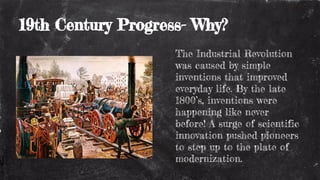
19th Century Progress- Why?
The Industrial Revolution
was caused by simple
inventions that improved
everyday life. By the late
1800’s, inventions were
happening like never
before! A surge of scientific
innovation pushed pioneers
to step up to the plate of
modernization.
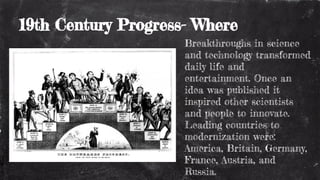
19th Century Progress- Where
Breakthroughs in science
and technology transformed
daily life and
entertainment. Once an
idea was published it
inspired other scientists
and people to innovate.
Leading countries to
modernization were:
America, Britain, Germany,
France, Austria, and
Russia.
The Scientists
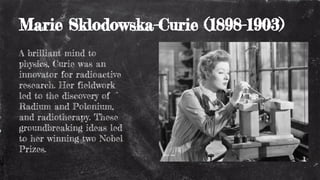
Marie Sklodowska-Curie (1898-1903)
A brilliant mind to
physics, Curie was an
innovator for radioactive
research. Her fieldwork
led to the discovery of
Radium and Polonium,
and radiotherapy. These
groundbreaking ideas led
to her winning two Nobel
Prizes.
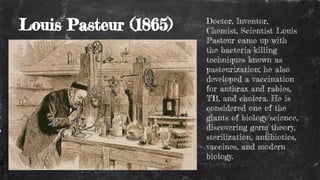
Louis Pasteur (1865) Doctor, Inventor,
Chemist, Scientist Louis
Pasteur came up with
the bacteria-killing
techniques known as
pasteurization; he also
developed a vaccination
for anthrax and rabies,
TB, and cholera. He is
considered one of the
giants of biology/science,
discovering germ theory,
sterilization, antibiotics,
vaccines, and modern
biology.
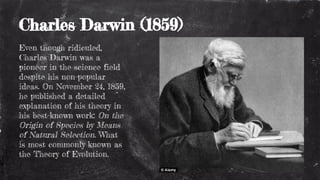
Even though ridiculed,
Charles Darwin was a
pioneer in the science field
despite his non-popular
ideas. On November 24, 1859,
he published a detailed
explanation of his theory in
his best-known work: On the
Origin of Species by Means
of Natural Selection. What
is most commonly known as
the Theory of Evolution.
Charles Darwin (1859)
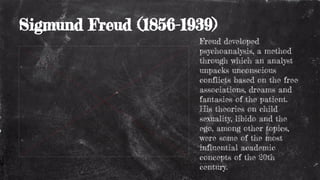
Sigmund Freud (1856-1939)
Freud developed
psychoanalysis, a method
through which an analyst
unpacks unconscious
conflicts based on the free
associations, dreams and
fantasies of the patient.
His theories on child
sexuality, libido and the
ego, among other topics,
were some of the most
influential academic
concepts of the 20th
century.
The Inventors
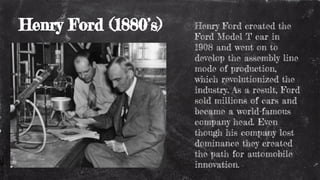
Henry Ford (1880’s) Henry Ford created the
Ford Model T car in
1908 and went on to
develop the assembly line
mode of production,
which revolutionized the
industry. As a result, Ford
sold millions of cars and
became a world-famous
company head. Even
though his company lost
dominance they created
the path for automobile
innovation.
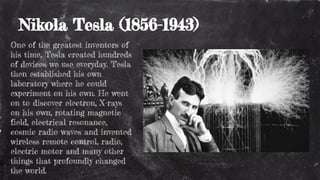
Nikola Tesla (1856-1943)
One of the greatest inventors of
his time, Tesla created hundreds
of devices we use everyday. Tesla
then established his own
laboratory where he could
experiment on his own. He went
on to discover electron, X-rays
on his own, rotating magnetic
field, electrical resonance,
cosmic radio waves and invented
wireless remote control, radio,
electric motor and many other
things that profoundly changed
the world.
19th Century Progress
“The WHAT”
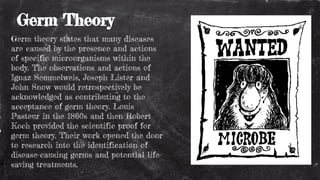
Germ Theory
Germ theory states that many diseases
are caused by the presence and actions
of specific microorganisms within the
body. The observations and actions of
Ignaz Semmelweis, Joseph Lister and
John Snow would retrospectively be
acknowledged as contributing to the
acceptance of germ theory. Louis
Pasteur in the 1860s and then Robert
Koch provided the scientific proof for
germ theory. Their work opened the door
to research into the identification of
disease-causing germs and potential life-
saving treatments.
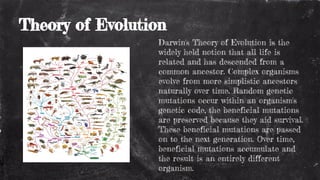
Theory of Evolution
Darwin's Theory of Evolution is the
widely held notion that all life is
related and has descended from a
common ancestor. Complex organisms
evolve from more simplistic ancestors
naturally over time. Random genetic
mutations occur within an organism's
genetic code, the beneficial mutations
are preserved because they aid survival.
These beneficial mutations are passed
on to the next generation. Over time,
beneficial mutations accumulate and
the result is an entirely different
organism.
Psychoanalysis
Psychoanalysis is a set of techniques
for exploring underlying motives and
a method of treating various mental
disorders; based on the theories of
Sigmund Freud; "his physician
recommended psychoanalysis"Freud's
psychoanalytic theory of personality
implicated the structure of the mind,
namely the identity, ego, and
superego, and how conflicts among
these constituent parts are resolved
in shaping human personality.
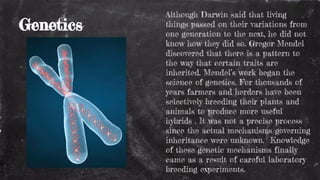
Genetics
Although Darwin said that living
things passed on their variations from
one generation to the next, he did not
know how they did so. Gregor Mendel
discovered that there is a pattern to
the way that certain traits are
inherited. Mendel’s work began the
science of genetics. For thousands of
years farmers and herders have been
selectively breeding their plants and
animals to produce more useful
hybrids . It was not a precise process
since the actual mechanisms governing
inheritance were unknown. Knowledge
of these genetic mechanisms finally
came as a result of careful laboratory
breeding experiments.
Connection to TODAY!
Social Sciences
Freud and Pavlov spearheaded
ideas in psychology that led to
the development of social
sciences. For the first time
people were studying world
culture and ancient
civilization. Currently people
gave careers in anthropology,
sociology, psychology, and
archeology.
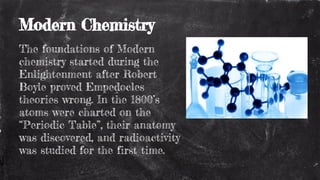
Modern Chemistry
The foundations of Modern
chemistry started during the
Enlightenment after Robert
Boyle proved Empedocles
theories wrong. In the 1800’s
atoms were charted on the
“Periodic Table”, their anatomy
was discovered, and radioactivity
was studied for the first time.
Energy
Scientists now and
during the 1800’s
were/are looking for
other means of energy.
Gasoline currently is the
major energy supplier,
but we use water, steam,
wind, electricity, and
radiation.

Nineteenth Century Progress -Science

  • 1.
    19th Century Progress Chapter26 Section 4 Presented by: Essence Perry
  • 2.
    19th Century Progress-Why? The Industrial Revolution was caused by simple inventions that improved everyday life. By the late 1800’s, inventions were happening like never before! A surge of scientific innovation pushed pioneers to step up to the plate of modernization.
  • 3.
    19th Century Progress-Where Breakthroughs in science and technology transformed daily life and entertainment. Once an idea was published it inspired other scientists and people to innovate. Leading countries to modernization were: America, Britain, Germany, France, Austria, and Russia.
  • 4.
  • 5.
    Marie Sklodowska-Curie (1898-1903) Abrilliant mind to physics, Curie was an innovator for radioactive research. Her fieldwork led to the discovery of Radium and Polonium, and radiotherapy. These groundbreaking ideas led to her winning two Nobel Prizes.
  • 6.
    Louis Pasteur (1865)Doctor, Inventor, Chemist, Scientist Louis Pasteur came up with the bacteria-killing techniques known as pasteurization; he also developed a vaccination for anthrax and rabies, TB, and cholera. He is considered one of the giants of biology/science, discovering germ theory, sterilization, antibiotics, vaccines, and modern biology.
  • 7.
    Even though ridiculed, CharlesDarwin was a pioneer in the science field despite his non-popular ideas. On November 24, 1859, he published a detailed explanation of his theory in his best-known work: On the Origin of Species by Means of Natural Selection. What is most commonly known as the Theory of Evolution. Charles Darwin (1859)
  • 8.
    Sigmund Freud (1856-1939) Freuddeveloped psychoanalysis, a method through which an analyst unpacks unconscious conflicts based on the free associations, dreams and fantasies of the patient. His theories on child sexuality, libido and the ego, among other topics, were some of the most influential academic concepts of the 20th century.
  • 9.
  • 10.
    Henry Ford (1880’s)Henry Ford created the Ford Model T car in 1908 and went on to develop the assembly line mode of production, which revolutionized the industry. As a result, Ford sold millions of cars and became a world-famous company head. Even though his company lost dominance they created the path for automobile innovation.
  • 11.
    Nikola Tesla (1856-1943) Oneof the greatest inventors of his time, Tesla created hundreds of devices we use everyday. Tesla then established his own laboratory where he could experiment on his own. He went on to discover electron, X-rays on his own, rotating magnetic field, electrical resonance, cosmic radio waves and invented wireless remote control, radio, electric motor and many other things that profoundly changed the world.
  • 12.
  • 13.
    Germ Theory Germ theorystates that many diseases are caused by the presence and actions of specific microorganisms within the body. The observations and actions of Ignaz Semmelweis, Joseph Lister and John Snow would retrospectively be acknowledged as contributing to the acceptance of germ theory. Louis Pasteur in the 1860s and then Robert Koch provided the scientific proof for germ theory. Their work opened the door to research into the identification of disease-causing germs and potential life- saving treatments.
  • 14.
    Theory of Evolution Darwin'sTheory of Evolution is the widely held notion that all life is related and has descended from a common ancestor. Complex organisms evolve from more simplistic ancestors naturally over time. Random genetic mutations occur within an organism's genetic code, the beneficial mutations are preserved because they aid survival. These beneficial mutations are passed on to the next generation. Over time, beneficial mutations accumulate and the result is an entirely different organism.
  • 15.
    Psychoanalysis Psychoanalysis is aset of techniques for exploring underlying motives and a method of treating various mental disorders; based on the theories of Sigmund Freud; "his physician recommended psychoanalysis"Freud's psychoanalytic theory of personality implicated the structure of the mind, namely the identity, ego, and superego, and how conflicts among these constituent parts are resolved in shaping human personality.
  • 16.
    Genetics Although Darwin saidthat living things passed on their variations from one generation to the next, he did not know how they did so. Gregor Mendel discovered that there is a pattern to the way that certain traits are inherited. Mendel’s work began the science of genetics. For thousands of years farmers and herders have been selectively breeding their plants and animals to produce more useful hybrids . It was not a precise process since the actual mechanisms governing inheritance were unknown. Knowledge of these genetic mechanisms finally came as a result of careful laboratory breeding experiments.
  • 17.
  • 18.
    Social Sciences Freud andPavlov spearheaded ideas in psychology that led to the development of social sciences. For the first time people were studying world culture and ancient civilization. Currently people gave careers in anthropology, sociology, psychology, and archeology.
  • 19.
    Modern Chemistry The foundationsof Modern chemistry started during the Enlightenment after Robert Boyle proved Empedocles theories wrong. In the 1800’s atoms were charted on the “Periodic Table”, their anatomy was discovered, and radioactivity was studied for the first time.
  • 20.
    Energy Scientists now and duringthe 1800’s were/are looking for other means of energy. Gasoline currently is the major energy supplier, but we use water, steam, wind, electricity, and radiation.