Bioethics/Biotechnology
Chapter 13: Essence Perry
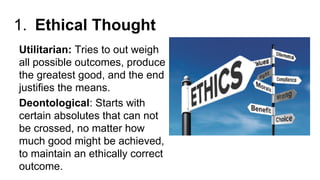
1. Ethical Thought
Utilitarian: Tries to out weigh
all possible outcomes, produce
the greatest good, and the end
justifies the means.
Deontological: Starts with
certain absolutes that can not
be crossed, no matter how
much good might be achieved,
to maintain an ethically correct
outcome.
2. Molly and Adam Case
Most bioethicists conclude that this
was appropriate because Adam was
not physically harmed by providing
cord blood for his sister Molly. In
addition, no evidence was indicated
that Adam was being abused at home
or that he was only conceived to save
his sister. If a parent doesn’t mistreat
the child after birth and gives a child
an option to refuse, in my opinion it is
ethical.
3. Pros/Cons of GM crops
Pros
● Easier adoption of no- or reduced
till farming
● Saves time, equipment usage, fuel
and carbon emissions
● Improved weed control
● Soil preservation & moisture
retention
● Less worry about pest damage
● Less time spent on crop walking
and/or insecticide application
● Reduces carbon emissions
● Improved quality (e.g., lower levels
of mycotoxins in GM insect-
resistant maize)
Cons
● Impact on non-target organisms
in the environment
● Whether the modified crop might
persist in the environment longer
than usual
● Invade new habitats
● Likelihood and consequences of
a gene being transferred
unintentionally from the modified
crop to other species
4. Applying growth hormone in plants.
● Will this hormone affect other
organisms around it?
● Will this crop be harmful to
humans?
● What group will be used to test
this crop?
● Will consumers be notified that
they are eating a GM crop?
● Is it safe to expose people to
foreign hormones?
5. Human Being vs. Person
A human-being is an
entity that has been
given legal and social
rights but a person
exhibits certain qualities
that are characteristics
that only people have:
creed, emotions,
empathy, etc.
6. Government funding for science.
The government should pay
for scientific research if their
hypotheses and goals are
clearly stated. There should
be proper documentation,
and a started trial for at least
one year, so information can
be gathered.
7.Cholesterol gene therapy
A bioethicist following a
deontological approach would
propose a “greatest good for
the greatest number. If this
can lower cholesterol levels
and allow people to enjoy
fatty foods, then it is safe to
assume some number of
people will die prematurely
because of this therapy.
8. Informing other drug companies.
From an ethics perspective
one could argue that for the
overall benefit of improving
human health, drug
companies should share
information to help facilitate
the development of drugs
that cure. However, there is
no legal requirement for
companies to do so.
9. Food allergens and liability.
If a company can afford to use
GM sources than they should
be using them to get rid of
unwarranted allergies.
Companies that can’t afford to
use GM sources should clearly
state on the label the allergies
their product can cause.
10. Cells and in vitro.
If the embryo is not
harmed in the process
then it should be used
for two purposes: stem
cell tissue and a
potential baby.

Bioethics and Biotechnology

  • 1.
  • 2.
    1. Ethical Thought Utilitarian:Tries to out weigh all possible outcomes, produce the greatest good, and the end justifies the means. Deontological: Starts with certain absolutes that can not be crossed, no matter how much good might be achieved, to maintain an ethically correct outcome.
  • 3.
    2. Molly andAdam Case Most bioethicists conclude that this was appropriate because Adam was not physically harmed by providing cord blood for his sister Molly. In addition, no evidence was indicated that Adam was being abused at home or that he was only conceived to save his sister. If a parent doesn’t mistreat the child after birth and gives a child an option to refuse, in my opinion it is ethical.
  • 4.
    3. Pros/Cons ofGM crops Pros ● Easier adoption of no- or reduced till farming ● Saves time, equipment usage, fuel and carbon emissions ● Improved weed control ● Soil preservation & moisture retention ● Less worry about pest damage ● Less time spent on crop walking and/or insecticide application ● Reduces carbon emissions ● Improved quality (e.g., lower levels of mycotoxins in GM insect- resistant maize) Cons ● Impact on non-target organisms in the environment ● Whether the modified crop might persist in the environment longer than usual ● Invade new habitats ● Likelihood and consequences of a gene being transferred unintentionally from the modified crop to other species
  • 5.
    4. Applying growthhormone in plants. ● Will this hormone affect other organisms around it? ● Will this crop be harmful to humans? ● What group will be used to test this crop? ● Will consumers be notified that they are eating a GM crop? ● Is it safe to expose people to foreign hormones?
  • 6.
    5. Human Beingvs. Person A human-being is an entity that has been given legal and social rights but a person exhibits certain qualities that are characteristics that only people have: creed, emotions, empathy, etc.
  • 7.
    6. Government fundingfor science. The government should pay for scientific research if their hypotheses and goals are clearly stated. There should be proper documentation, and a started trial for at least one year, so information can be gathered.
  • 8.
    7.Cholesterol gene therapy Abioethicist following a deontological approach would propose a “greatest good for the greatest number. If this can lower cholesterol levels and allow people to enjoy fatty foods, then it is safe to assume some number of people will die prematurely because of this therapy.
  • 9.
    8. Informing otherdrug companies. From an ethics perspective one could argue that for the overall benefit of improving human health, drug companies should share information to help facilitate the development of drugs that cure. However, there is no legal requirement for companies to do so.
  • 10.
    9. Food allergensand liability. If a company can afford to use GM sources than they should be using them to get rid of unwarranted allergies. Companies that can’t afford to use GM sources should clearly state on the label the allergies their product can cause.
  • 11.
    10. Cells andin vitro. If the embryo is not harmed in the process then it should be used for two purposes: stem cell tissue and a potential baby.