INTELLECTUAL
REVOLUTIONS
CHAPTER 2
OBJECTIVES
Add a Footer 2
1. Discuss the paradigm shifts
through history;
2. Explain how the Intellectual
Revolution changed the way
we perceive the world;
3. Describe the technological
advancements that happen
in this era.
WHAT
CONNECTS
CHAPTERS
1 & 2?
Add a Footer 3
REVIEW ON THE
INTRODUCTION OF STS
• Science is system of knowledge of the natural world
gained through scientific method.
• Technology is practical applications of what we know
about nature
• People living together in organized communities with
shared laws, traditions and values.
• Science and Technology have positive and negative
effects in community life, work, health and in
communication.
• It is up to the human usage on how to use technology
in a good way such that technology will not consumed
humanity.
REVIEW ON THE
INTRODUCTION OF STS
Add a Footer
• Inventions were due to human
needs and wants
• Brilliant minds responded to
the call of the time and
created things
REVIEW HISTORICAL
ANTECEDENTS: ANCIENT TIMES
6
CONCERNS OF PEOPLE
• TRANSPORTATION
• travel places
• discover new horizon and better locations for settlement
• search for food
• exchange goods
• COMMUNICATION
• discover and occupy new places
• record keeping for places, trades, history and culture
CONCERNS OF PEOPLE
•WEAPONS AND ARMORS
• establishment of new alliances from other tribes
• stronger tribes tend to invade weaker tribes
• security and protection
• CONSERVATION OF LIFE
• discovery of cure for diseases
CONCERNS OF PEOPLE
• INFRASTRUCTURE
• address specific needs and wants
• protection against human attack and natural diseases
• ARCHITECTURE
• style (today)
• nation’s identity; status symbol of technological
advancement of a certain civilization
REVIEW: IMPORTANT EVENTS/ACTIVITIES
DURING THE MIDDLE AGES
• Known as the Age of Exploration
• Massive invasions and migrations
• Wars were prevalent during this time
• Population decline due to wars however, during
the late period there is an increased in number.
• Trade and commerce increased
1. Printing Press
2. Microscope
3. Telescope
4. War Weapons
11
REVIEW: EVENTS/ACTIVITIES DURING THE
MIDDLE AGES
• 19th century onwards
• Greater demand for goods, transportation, and
communication
• During this period, food processing and medicine
posed some of the bigger challenges since health
was a great concern.
REVIEW: IMPORTANT EVENTS/ACTIVITIES DURING THE
MODERN TIMES
REVIEW: IMPORTANT EVENTS/ACTIVITIES DURING
THE MODERN TIMES
13
1. Pasteurization
2. Petroleum Refinery (Animal oil to
Kerosene)
3. Telephone
4. Calculator
14
REVIEW: PHILIPPINE INVENTIONS
• Vulnerable in natural disasters
• Discoveries and inventions were built from
indigenous materials or created to adapt harsh
tropical environment.
15
REVIEW: PHILIPPINE INVENTIONS
1. Salamander Amphibious Tricycle
2. Salt Lamp (Sustainable Alternative Lightning)
3. Medical Incubator
4. Mosquito Ovicidal or Larvicidal Trap System
5. E-jeepney
INTELLECTUAL
REVOLUTIONS
• Science and Technology changed
people’s perceptions and beliefs
• The developments during the
Intellectual Revolution showed
how society was transformed
Add a Footer 16
COPERNICAN
REVOLUTION
Add a Footer 17
Add a Footer
PEOPLE WERE
CURIOUS
18
• What created days and nights?
• How heavenly bodies like stars,
moons, and planets work?
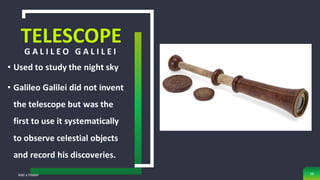
TELESCOPE
G A L I L E O G A L I L E I
• Used to study the night sky
• Galileo Galilei did not invent
the telescope but was the
first to use it systematically
to observe celestial objects
and record his discoveries.
Add a Footer 19
THEORY OF THE
MOVEMENTS OF
HEAVENLY BODIES
• Many Greek philosophers and intellectuals
wrote about planets to explain its
movements and effects on us
• Many of them agreed that planets moved
around in circular motion, and thus created
days and nights
Add a Footer 20
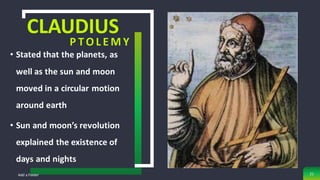
CLAUDIUS
P TO L E M Y
• Stated that the planets, as
well as the sun and moon
moved in a circular motion
around earth
• Sun and moon’s revolution
explained the existence of
days and nights
Add a Footer 21
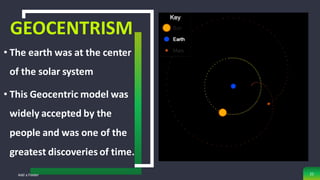
GEOCENTRISM
• The earth was at the center
of the solar system
• This Geocentric model was
widely accepted by the
people and was one of the
greatest discoveries of time.
Add a Footer 22
Add a Footer 23
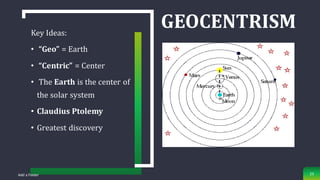
Key Ideas:
• “Geo” = Earth
• “Centric” = Center
• The Earth is the center of
the solar system
• Claudius Ptolemy
• Greatest discovery
GEOCENTRISM
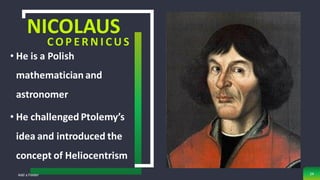
NICOLAUS
C O P E R N I C U S
• He is a Polish
mathematician and
astronomer
• He challenged Ptolemy’s
idea and introduced the
concept of Heliocentrism
Add a Footer 24
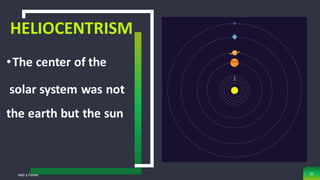
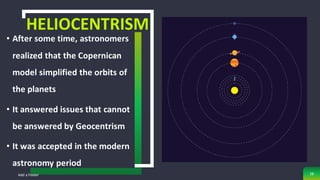
HELIOCENTRISM
•The center of the
solar system was not
the earth but the sun
Add a Footer 25
Add a Footer 26
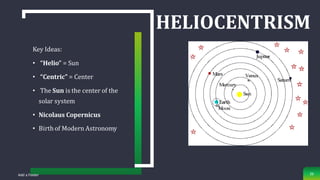
Key Ideas:
• “Helio” = Sun
• “Centric” = Center
• The Sun is the center of the
solar system
• Nicolaus Copernicus
• Birth of Modern Astronomy
HELIOCENTRISM
HELIOCENTRISM
• This idea was rejected at
first by the public since
their religion taught them
that earth was created first
among others
• Copernicus was even
persecuted as a heretic
Add a Footer 27
HELIOCENTRISM
• After some time, astronomers
realized that the Copernican
model simplified the orbits of
the planets
• It answered issues that cannot
be answered by Geocentrism
• It was accepted in the modern
astronomy period
Add a Footer 28
DARWINIAN
REVOLUTION
Add a Footer 29
Add a Footer
CONSIDERED
TO BE ONE
OF THE
CONTROVERSIAL
REVOLUTIONS
30
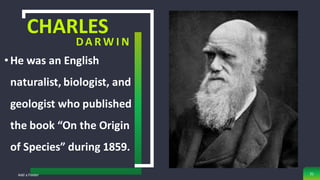
CHARLES
DA R W I N
•He was an English
naturalist, biologist, and
geologist who published
the book “On the Origin
of Species” during 1859.
Add a Footer 31
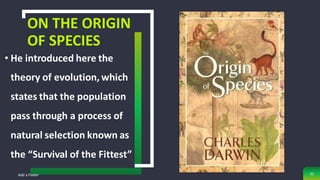
ON THE ORIGIN
OF SPECIES
• He introduced here the
theory of evolution, which
states that the population
pass through a process of
natural selection known as
the “Survival of the Fittest”
Add a Footer 32
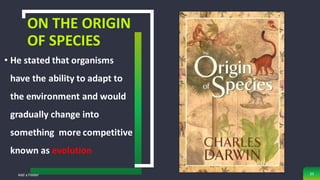
ON THE ORIGIN
OF SPECIES
• He stated that organisms
have the ability to adapt to
the environment and would
gradually change into
something more competitive
known as evolution
Add a Footer 33
WHY DID IT
BECOME
CONTROVERSIAL?
Add a Footer 34
CONTRADICTORY TO
RELIGIOUS BELIEFS
• According to the church, the source
of life is a powerful creator
• The theory emerged at time when
most of the population believed and
accepted the biblical version of the
earth’s creation
Add a Footer 35
CONTRADICTORY TO
RELIGIOUS BELIEFS
• It created conflicts that lead to social
division
• Some believedthat the theory
explained the origin of life but those
religious ones strongly refuted it
Add a Footer 36
SCIENCE
• According to Darwin’s
theory, people came
from the first monkey
• There is a natural
explanation of the
environment
RELIGION
• We are created
by a powerful
source, God
• The creation
Add a Footer 37
THE END OF THE
CONFLICT
•After some time, people came to
understand that Darwin’s Theory
of evolution was not in fact
against the teachings of the
church and both can coexist.
Add a Footer 38
FREUDIAN
REVOLUTION
Add a Footer 39
Add a Footer
• In the past, the field
psychology was
considered an art rather
than science
PSYCHOLOGY
40
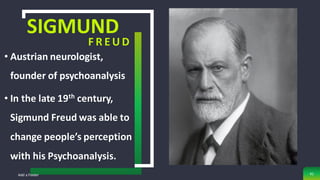
SIGMUND
F R E U D
• Austrian neurologist,
founder of psychoanalysis
• In the late 19th century,
Sigmund Freud was able to
change people’s perception
with his Psychoanalysis.
Add a Footer 41
PSYCHOANALYSIS
• The study of the human behavior
• In this, Freud explained that there
are many unconscious and
conscious factors that can
influencebehavior and emotions
Add a Footer 42
THE THREE
CONFLICTING
ELEMENTS OF
PERSONALITY
Add a Footer 43
Add a Footer
Instincts
ID
44
ID
• Operates pleasure principles
• It consists of all the inherited (i.e., biological)
components of personality present at birth,
including the sex (life) instinct and the
aggressive (death) instinct.
• Personality of the newborn child is all id
Add a Footer 45
ID
• The idea that every wishful impulse should be
satisfied immediately, regardless of the
consequences.
• When the id achieves its demands, we
experience pleasure when it is denied we
experience ‘unpleasure’ or tension.
Add a Footer 46
ID
• The id engages in primary process thinking,
which is primitive, illogical, irrational, and
fantasy oriented.
• This form of process thinking has no
comprehension of objective reality, and is selfish
and wishful in nature.
Add a Footer 47
Add a Footer
Reality
EGO
48
EGO
• Operates reality principles
• Working out realistic ways of satisfying the id’s
demands, often compromising or postponing
satisfaction to avoid negative consequences of
society.
Add a Footer 49
EGO
• The ego considers social realities and norms, etiquette
and rules in deciding how to behave.
• If the ego fails in its attempt to use the reality principle,
and anxiety is experienced, unconscious defense
mechanisms are employed, to help ward off unpleasant
feelings (i.e., anxiety) or make good things feel better
for the individual.
Add a Footer 50
EGO
• Freud made the analogy of the id being a horse
while the ego is the rider. The ego is 'like a man
on horseback, who has to hold in check the
superior strength of the horse.‘
(Freud, 1923, p.15)
Add a Footer 51
Add a Footer
Morality
SUPEREGO
52
SUPEREGO
• The superego incorporates the values and
morals of society which are learned from
one's parents and others. It develops
around the age of 3 – 5 during the phallic
stage of psychosexual development.
Add a Footer 53
SUPEREGO
• It also has the function of persuading the
ego to turn to moralistic goals rather than
simply realistic ones and to strive for
perfection.
• The superego consists of two systems: The
conscience and the ideal self.
Add a Footer 54
SUPEREGO
• The conscience can punish the ego through causing
feelings of guilt. For example, if the ego gives in to
the id's demands, the superego may make the
person feel bad through guilt.
• The ideal self (or ego-ideal) is an imaginary
picture of how you ought to be, and represents
career aspirations, how to treat other people, and
how to behave as a member of society.
Add a Footer 55
WHY DID IT BECOME
A PART OF SCIENCE?
•Science hardliners found out
that its concepts were
philosophical and supernatural
Add a Footer 56
• Many believed that Freud’s theory had
no scientific basis as no empirical or
experimentaldata could support it.
• Despite criticisms, he still continued to
work on refining his theory and how it
can be of great help in treating mental
disorders thus it becomes a science
Add a Footer 57
CONCLUSION
These theories have brought
changes to the perspectives and
perceptions of the scientific
community and the public is the
evidence of science and
technology’s link to humanity.
Add a Footer 58
SCIENCE, TECHNOLOGY, &
NATION-BUILDING
PRE-COLONIAL PERIOD
•Scientific & technological developments in the
Philippines began.
•Filipino Settlers were already using certain plants and
herbs & medicines. As well as farming and animal-
raising were implemented.
•Also developed modes of transportation.(e.g.
carabao cart)
PRE-COLONIAL PERIOD
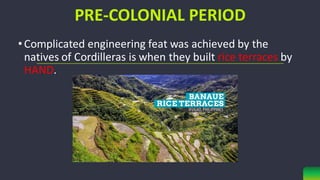
•Complicated engineering feat was achieved by the
natives of Cordilleras is when they built rice terraces by
HAND.
COLONIAL PERIOD
•Also known as Spanish Colonial Period.
•Provided the Philippines with modern means of
construction.
•Spanish government developed health and education
systems that were enjoyed by the principalia class.
COLONIAL PERIOD
•The establishment of government agency which is
the BUREAU OF SCIENCE.
POST-COLONIAL PERIOD
• Philippine presidents posted more developments in the
field of science and technology.
• Ferdinand Marcos ushered in the advancements in
science and technology.
POST COLONIAL PERIOD
•During his period many agencies were established
and strengthened. These include:
• PAGASA (Philippine Atmospheric Geophysical and Astronomical
Service Administration)
• NAST (National Academy of Science and Technology)
• DOST (Department of Science and Technology)

Intellectual Revolution Philippine Building .pdf

  • 1.
  • 2.
    OBJECTIVES Add a Footer2 1. Discuss the paradigm shifts through history; 2. Explain how the Intellectual Revolution changed the way we perceive the world; 3. Describe the technological advancements that happen in this era.
  • 3.
  • 4.
    REVIEW ON THE INTRODUCTIONOF STS • Science is system of knowledge of the natural world gained through scientific method. • Technology is practical applications of what we know about nature • People living together in organized communities with shared laws, traditions and values.
  • 5.
    • Science andTechnology have positive and negative effects in community life, work, health and in communication. • It is up to the human usage on how to use technology in a good way such that technology will not consumed humanity. REVIEW ON THE INTRODUCTION OF STS
  • 6.
    Add a Footer •Inventions were due to human needs and wants • Brilliant minds responded to the call of the time and created things REVIEW HISTORICAL ANTECEDENTS: ANCIENT TIMES 6
  • 7.
    CONCERNS OF PEOPLE •TRANSPORTATION • travel places • discover new horizon and better locations for settlement • search for food • exchange goods • COMMUNICATION • discover and occupy new places • record keeping for places, trades, history and culture
  • 8.
    CONCERNS OF PEOPLE •WEAPONSAND ARMORS • establishment of new alliances from other tribes • stronger tribes tend to invade weaker tribes • security and protection • CONSERVATION OF LIFE • discovery of cure for diseases
  • 9.
    CONCERNS OF PEOPLE •INFRASTRUCTURE • address specific needs and wants • protection against human attack and natural diseases • ARCHITECTURE • style (today) • nation’s identity; status symbol of technological advancement of a certain civilization
  • 10.
    REVIEW: IMPORTANT EVENTS/ACTIVITIES DURINGTHE MIDDLE AGES • Known as the Age of Exploration • Massive invasions and migrations • Wars were prevalent during this time • Population decline due to wars however, during the late period there is an increased in number. • Trade and commerce increased
  • 11.
    1. Printing Press 2.Microscope 3. Telescope 4. War Weapons 11 REVIEW: EVENTS/ACTIVITIES DURING THE MIDDLE AGES
  • 12.
    • 19th centuryonwards • Greater demand for goods, transportation, and communication • During this period, food processing and medicine posed some of the bigger challenges since health was a great concern. REVIEW: IMPORTANT EVENTS/ACTIVITIES DURING THE MODERN TIMES
  • 13.
    REVIEW: IMPORTANT EVENTS/ACTIVITIESDURING THE MODERN TIMES 13 1. Pasteurization 2. Petroleum Refinery (Animal oil to Kerosene) 3. Telephone 4. Calculator
  • 14.
    14 REVIEW: PHILIPPINE INVENTIONS •Vulnerable in natural disasters • Discoveries and inventions were built from indigenous materials or created to adapt harsh tropical environment.
  • 15.
    15 REVIEW: PHILIPPINE INVENTIONS 1.Salamander Amphibious Tricycle 2. Salt Lamp (Sustainable Alternative Lightning) 3. Medical Incubator 4. Mosquito Ovicidal or Larvicidal Trap System 5. E-jeepney
  • 16.
    INTELLECTUAL REVOLUTIONS • Science andTechnology changed people’s perceptions and beliefs • The developments during the Intellectual Revolution showed how society was transformed Add a Footer 16
  • 17.
  • 18.
    Add a Footer PEOPLEWERE CURIOUS 18 • What created days and nights? • How heavenly bodies like stars, moons, and planets work?
  • 19.
    TELESCOPE G A LI L E O G A L I L E I • Used to study the night sky • Galileo Galilei did not invent the telescope but was the first to use it systematically to observe celestial objects and record his discoveries. Add a Footer 19
  • 20.
    THEORY OF THE MOVEMENTSOF HEAVENLY BODIES • Many Greek philosophers and intellectuals wrote about planets to explain its movements and effects on us • Many of them agreed that planets moved around in circular motion, and thus created days and nights Add a Footer 20
  • 21.
    CLAUDIUS P TO LE M Y • Stated that the planets, as well as the sun and moon moved in a circular motion around earth • Sun and moon’s revolution explained the existence of days and nights Add a Footer 21
  • 22.
    GEOCENTRISM • The earthwas at the center of the solar system • This Geocentric model was widely accepted by the people and was one of the greatest discoveries of time. Add a Footer 22
  • 23.
    Add a Footer23 Key Ideas: • “Geo” = Earth • “Centric” = Center • The Earth is the center of the solar system • Claudius Ptolemy • Greatest discovery GEOCENTRISM
  • 24.
    NICOLAUS C O PE R N I C U S • He is a Polish mathematician and astronomer • He challenged Ptolemy’s idea and introduced the concept of Heliocentrism Add a Footer 24
  • 25.
    HELIOCENTRISM •The center ofthe solar system was not the earth but the sun Add a Footer 25
  • 26.
    Add a Footer26 Key Ideas: • “Helio” = Sun • “Centric” = Center • The Sun is the center of the solar system • Nicolaus Copernicus • Birth of Modern Astronomy HELIOCENTRISM
  • 27.
    HELIOCENTRISM • This ideawas rejected at first by the public since their religion taught them that earth was created first among others • Copernicus was even persecuted as a heretic Add a Footer 27
  • 28.
    HELIOCENTRISM • After sometime, astronomers realized that the Copernican model simplified the orbits of the planets • It answered issues that cannot be answered by Geocentrism • It was accepted in the modern astronomy period Add a Footer 28
  • 29.
  • 30.
    Add a Footer CONSIDERED TOBE ONE OF THE CONTROVERSIAL REVOLUTIONS 30
  • 31.
    CHARLES DA R WI N •He was an English naturalist, biologist, and geologist who published the book “On the Origin of Species” during 1859. Add a Footer 31
  • 32.
    ON THE ORIGIN OFSPECIES • He introduced here the theory of evolution, which states that the population pass through a process of natural selection known as the “Survival of the Fittest” Add a Footer 32
  • 33.
    ON THE ORIGIN OFSPECIES • He stated that organisms have the ability to adapt to the environment and would gradually change into something more competitive known as evolution Add a Footer 33
  • 34.
  • 35.
    CONTRADICTORY TO RELIGIOUS BELIEFS •According to the church, the source of life is a powerful creator • The theory emerged at time when most of the population believed and accepted the biblical version of the earth’s creation Add a Footer 35
  • 36.
    CONTRADICTORY TO RELIGIOUS BELIEFS •It created conflicts that lead to social division • Some believedthat the theory explained the origin of life but those religious ones strongly refuted it Add a Footer 36
  • 37.
    SCIENCE • According toDarwin’s theory, people came from the first monkey • There is a natural explanation of the environment RELIGION • We are created by a powerful source, God • The creation Add a Footer 37
  • 38.
    THE END OFTHE CONFLICT •After some time, people came to understand that Darwin’s Theory of evolution was not in fact against the teachings of the church and both can coexist. Add a Footer 38
  • 39.
  • 40.
    Add a Footer •In the past, the field psychology was considered an art rather than science PSYCHOLOGY 40
  • 41.
    SIGMUND F R EU D • Austrian neurologist, founder of psychoanalysis • In the late 19th century, Sigmund Freud was able to change people’s perception with his Psychoanalysis. Add a Footer 41
  • 42.
    PSYCHOANALYSIS • The studyof the human behavior • In this, Freud explained that there are many unconscious and conscious factors that can influencebehavior and emotions Add a Footer 42
  • 43.
  • 44.
  • 45.
    ID • Operates pleasureprinciples • It consists of all the inherited (i.e., biological) components of personality present at birth, including the sex (life) instinct and the aggressive (death) instinct. • Personality of the newborn child is all id Add a Footer 45
  • 46.
    ID • The ideathat every wishful impulse should be satisfied immediately, regardless of the consequences. • When the id achieves its demands, we experience pleasure when it is denied we experience ‘unpleasure’ or tension. Add a Footer 46
  • 47.
    ID • The idengages in primary process thinking, which is primitive, illogical, irrational, and fantasy oriented. • This form of process thinking has no comprehension of objective reality, and is selfish and wishful in nature. Add a Footer 47
  • 48.
  • 49.
    EGO • Operates realityprinciples • Working out realistic ways of satisfying the id’s demands, often compromising or postponing satisfaction to avoid negative consequences of society. Add a Footer 49
  • 50.
    EGO • The egoconsiders social realities and norms, etiquette and rules in deciding how to behave. • If the ego fails in its attempt to use the reality principle, and anxiety is experienced, unconscious defense mechanisms are employed, to help ward off unpleasant feelings (i.e., anxiety) or make good things feel better for the individual. Add a Footer 50
  • 51.
    EGO • Freud madethe analogy of the id being a horse while the ego is the rider. The ego is 'like a man on horseback, who has to hold in check the superior strength of the horse.‘ (Freud, 1923, p.15) Add a Footer 51
  • 52.
  • 53.
    SUPEREGO • The superegoincorporates the values and morals of society which are learned from one's parents and others. It develops around the age of 3 – 5 during the phallic stage of psychosexual development. Add a Footer 53
  • 54.
    SUPEREGO • It alsohas the function of persuading the ego to turn to moralistic goals rather than simply realistic ones and to strive for perfection. • The superego consists of two systems: The conscience and the ideal self. Add a Footer 54
  • 55.
    SUPEREGO • The consciencecan punish the ego through causing feelings of guilt. For example, if the ego gives in to the id's demands, the superego may make the person feel bad through guilt. • The ideal self (or ego-ideal) is an imaginary picture of how you ought to be, and represents career aspirations, how to treat other people, and how to behave as a member of society. Add a Footer 55
  • 56.
    WHY DID ITBECOME A PART OF SCIENCE? •Science hardliners found out that its concepts were philosophical and supernatural Add a Footer 56
  • 57.
    • Many believedthat Freud’s theory had no scientific basis as no empirical or experimentaldata could support it. • Despite criticisms, he still continued to work on refining his theory and how it can be of great help in treating mental disorders thus it becomes a science Add a Footer 57
  • 58.
    CONCLUSION These theories havebrought changes to the perspectives and perceptions of the scientific community and the public is the evidence of science and technology’s link to humanity. Add a Footer 58
  • 59.
  • 60.
    PRE-COLONIAL PERIOD •Scientific &technological developments in the Philippines began. •Filipino Settlers were already using certain plants and herbs & medicines. As well as farming and animal- raising were implemented. •Also developed modes of transportation.(e.g. carabao cart)
  • 61.
    PRE-COLONIAL PERIOD •Complicated engineeringfeat was achieved by the natives of Cordilleras is when they built rice terraces by HAND.
  • 62.
    COLONIAL PERIOD •Also knownas Spanish Colonial Period. •Provided the Philippines with modern means of construction. •Spanish government developed health and education systems that were enjoyed by the principalia class.
  • 63.
    COLONIAL PERIOD •The establishmentof government agency which is the BUREAU OF SCIENCE.
  • 64.
    POST-COLONIAL PERIOD • Philippinepresidents posted more developments in the field of science and technology. • Ferdinand Marcos ushered in the advancements in science and technology.
  • 65.
    POST COLONIAL PERIOD •Duringhis period many agencies were established and strengthened. These include: • PAGASA (Philippine Atmospheric Geophysical and Astronomical Service Administration) • NAST (National Academy of Science and Technology) • DOST (Department of Science and Technology)