FIELD OF
EARTH SCIENCES
Benjamin Franklin
published the first chart
of Ocean-Current in
1969
Franklin’s Chart of the Gulf Stream
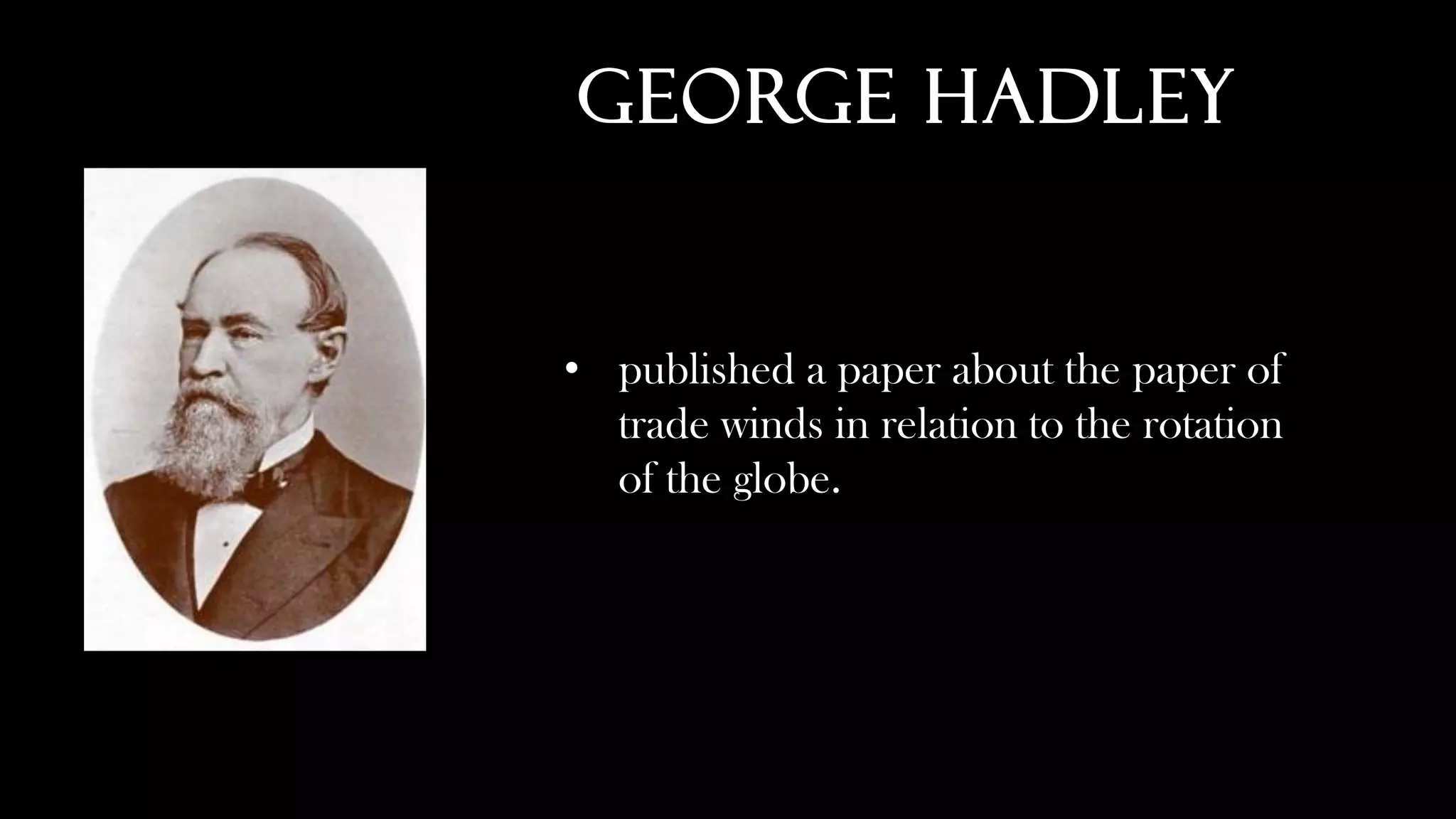
George Hadley
• published a paper about the paper of
trade winds in relation to the rotation
of the globe.
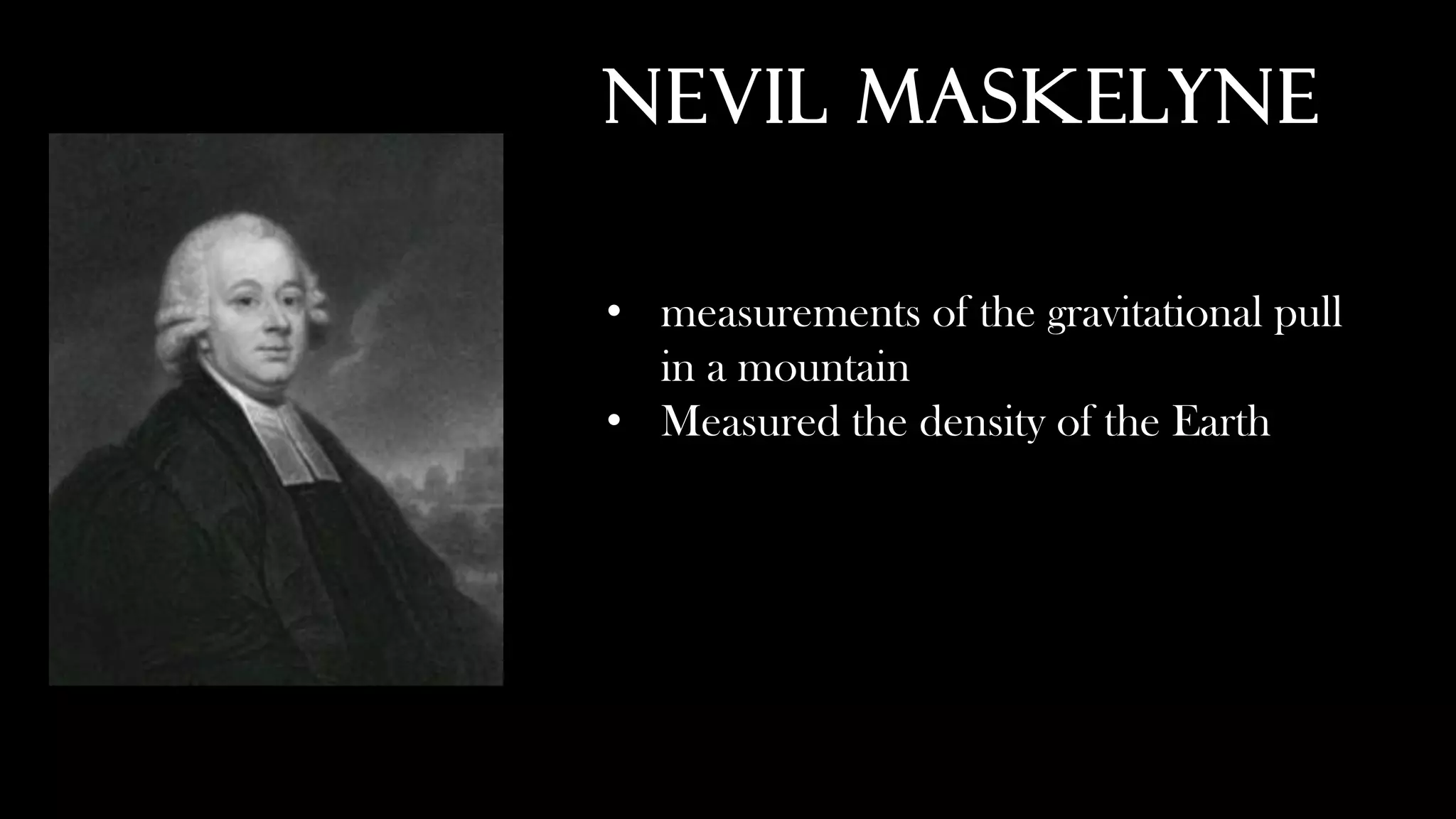
Nevil maskelyne
• measurements of the gravitational pull
in a mountain
• Measured the density of the Earth
James Hutton
• Father of Modern Geology
• Geologic change is VERY slow, so the
Earth must be VERY old
• Believed in Uniformitarianism
The Basis of Life
• made a fundamental contribution to our
understanding of the role insects play in plant
fertilization…. “Pollination”
• studied sex in plants that led him to a general
theory of Fertilization
Christian
Sprengel
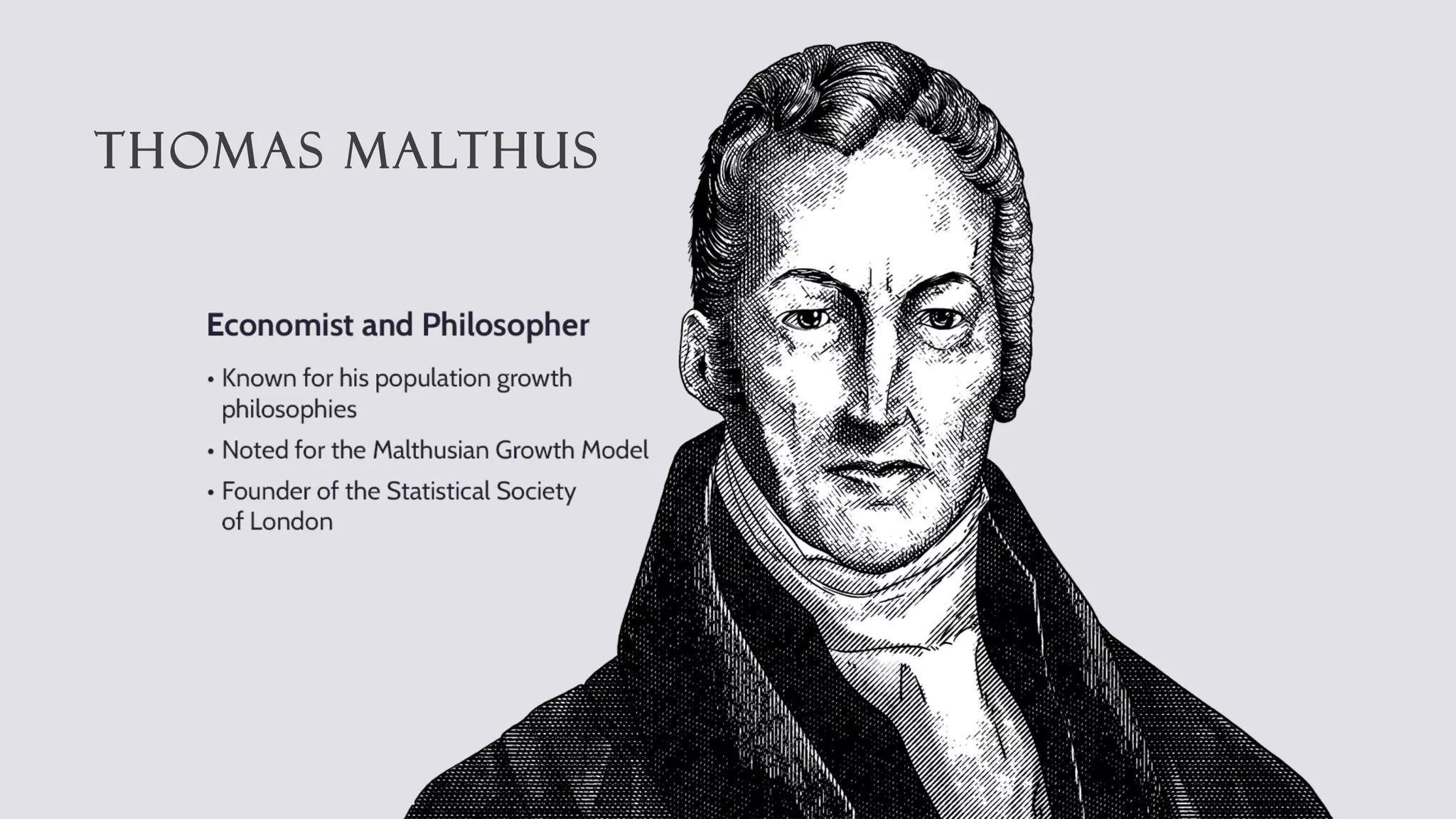
Thomas MAlthus
Alessandro Volta
Italian physicist whose invention
of the electric battery provided
the first source of continuous
current
“there is something in the sky awaiting discovery”
Hans Christian Orsted
discovered accidentally, in 1820, that
magnetic needle is deflected when the current
in a nearby wire varies –
a phenomenon establishing a relationship
between electricity and magnetism.
Moving electrons can generate a magnetic
field, as demonstrated by Oersted. The
magnetic field formed by the current, circles
the wire.
Michael Faraday
took the work of Oersted & Ampere on the
magnetic characteristics of electrical currents
and achieved an electrical current from a
changing magnetic field in 1831.
Faraday is credited with discovering
“electromagnetic induction” on August 29,
1831.
His theory is still used to generate electricity
on a large scale in power plants today.
James Clerk MAxwell
proposed Faraday’s electromagnetic induction to
happen even in empty space. Added two basic
principles of electromagnetism: (1) a changing
electric field in space produces a magnetic field, (2)
a changing magnetic field in space produces electric
field.
Maxwell developed a scientific theory to explain
“electromagnetic waves.”
Using Faraday’s experiments, he concluded that the
speed of electromagnetic waves must be 3 x 10⁸
m/s .
William Herschel
Herschel conducted an experiment measuring the
difference in temperature between the colors in the
visible spectrum.
He discovered the “Infrared Radiation” rays.
William Roentgen
He considered the Father of Diagnostic Radiology,
the medical speciality which uses imaging to
diagnose disease.
He discovered the “X-Rays”.
Thomas Young
“Whether light was a wave or a particle,” Young
came up with the basic idea for the now-famous
Double-slit Experiment to demonstrate the
interference of light waves.
He discovered that the way in which the “lens of the
eye changes shape to focus on objects at differing
distances”.
Christian Doppler
He observed frequency of light and sound waves is
dependent upon how fast the source and observer
are moving relative to each other.
The “Doppler Effects” – expounding on the color
of binary stars.
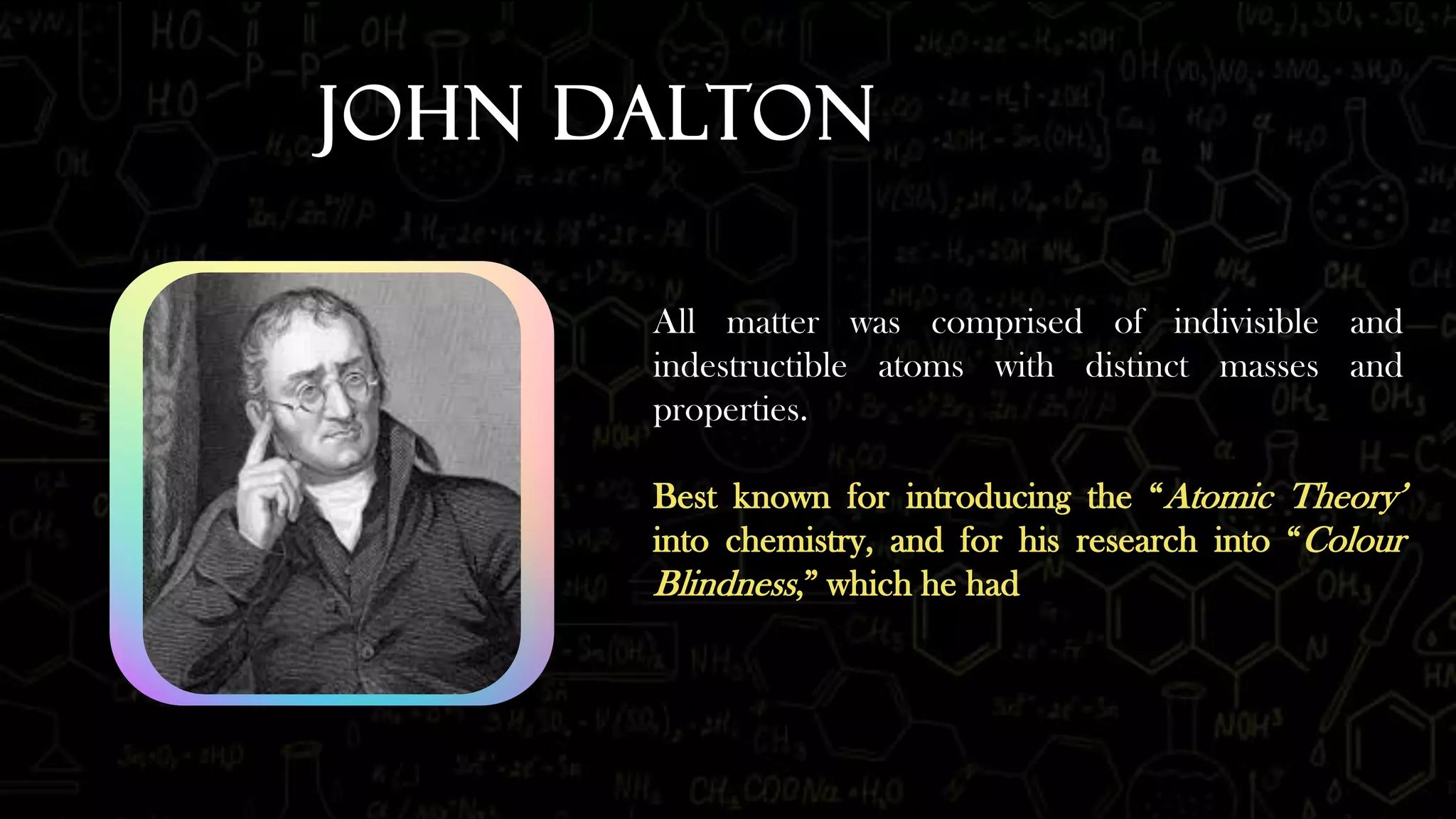
John Dalton
All matter was comprised of indivisible and
indestructible atoms with distinct masses and
properties.
Best known for introducing the “Atomic Theory’
into chemistry, and for his research into “Colour
Blindness,” which he had
Jons Jacob Berzelius
Berzelius introduced into chemistry the chemical
formula notation showing the composition of
compounds. Considered to be one of the founders
of modern chemistry.
He formulated the difference between inorganic
and organic compounds.
Louis Pasteur
Pasteur produced the vaccine by attenuating the
virus in rabbits and subsequently harvesting it from
their spinal cords. He was the first to demonstrate
that infectious diseases are caused by microbes.
Renowned for his discoveries of the principles of
Vaccination, Microbial Fermentation, and
Pasteurization, which was named after him.
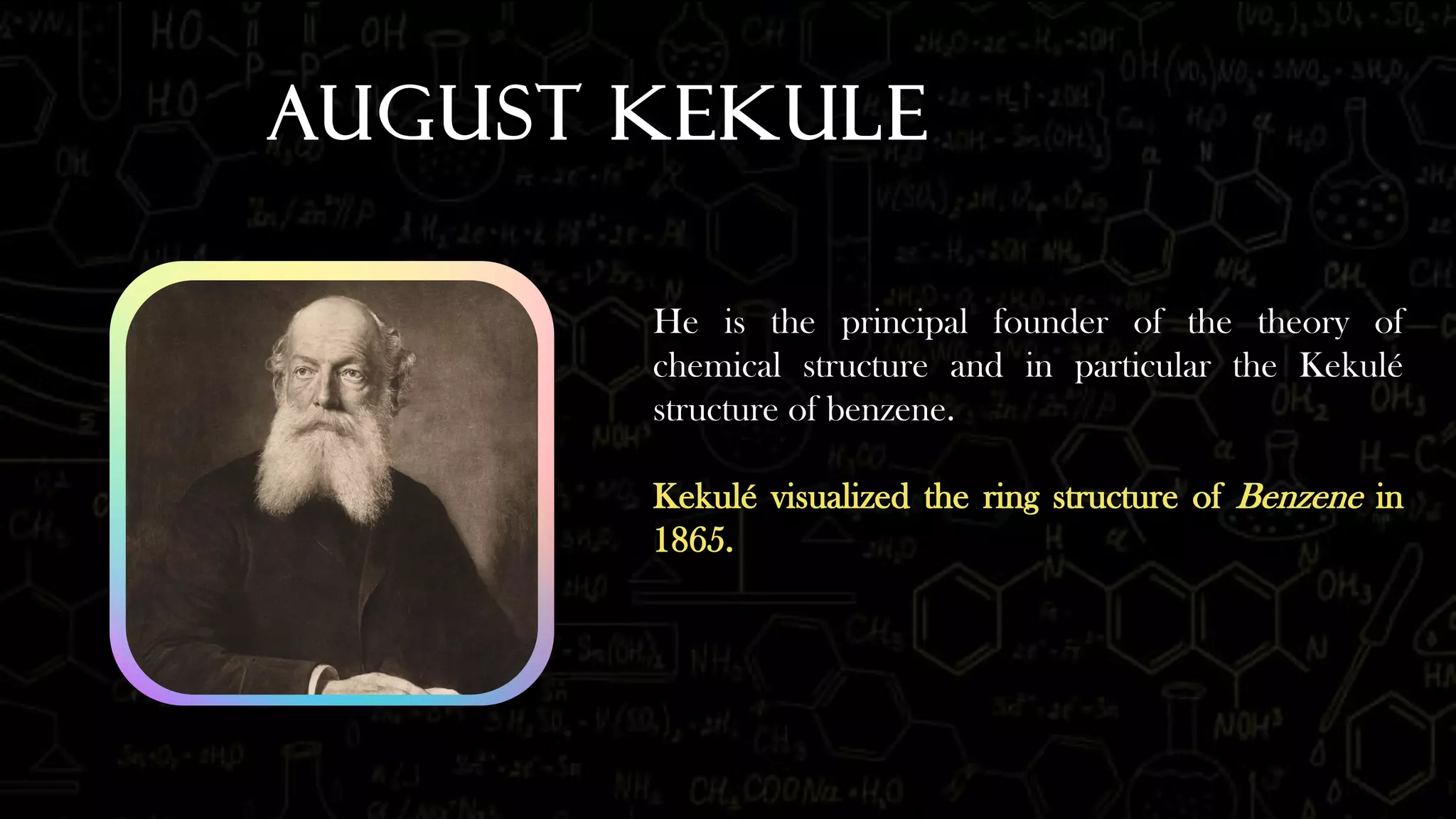
August Kekule
He is the principal founder of the theory of
chemical structure and in particular the Kekulé
structure of benzene.
Kekulé visualized the ring structure of Benzene in
1865.
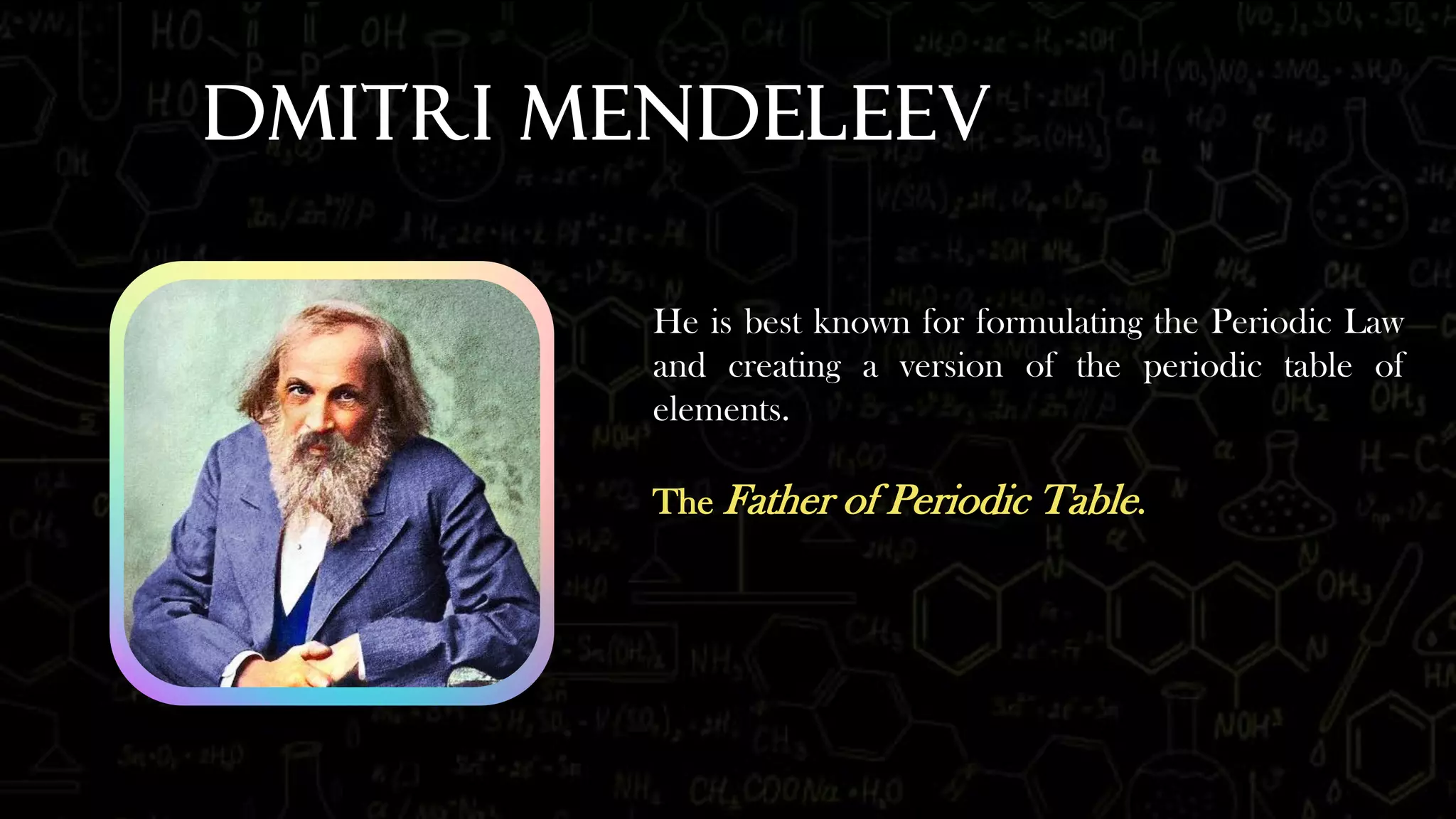
Dmitri Mendeleev
He is best known for formulating the Periodic Law
and creating a version of the periodic table of
elements.
The Father of Periodic Table.
RELICS OF THE
PAST
Mary Anning
Became known around the world for
the discoveries she made in Jurassic
marine fossil beds.
discovery of the first “Plesiosaur”
Richard Owen
A controversial figure, he is
perhaps best known for coining
the word – “DINOSAUR”
Louis Agassiz
Agassiz' hypothesis says that much
of the continent of North America
was covered by Glacial Ice.
Alexander von Humboldt
considered to be the ‘Father' of
Ecology’ particularly for his work
describing vegetation zones
(geobotany) and climate using
latitude and altitude
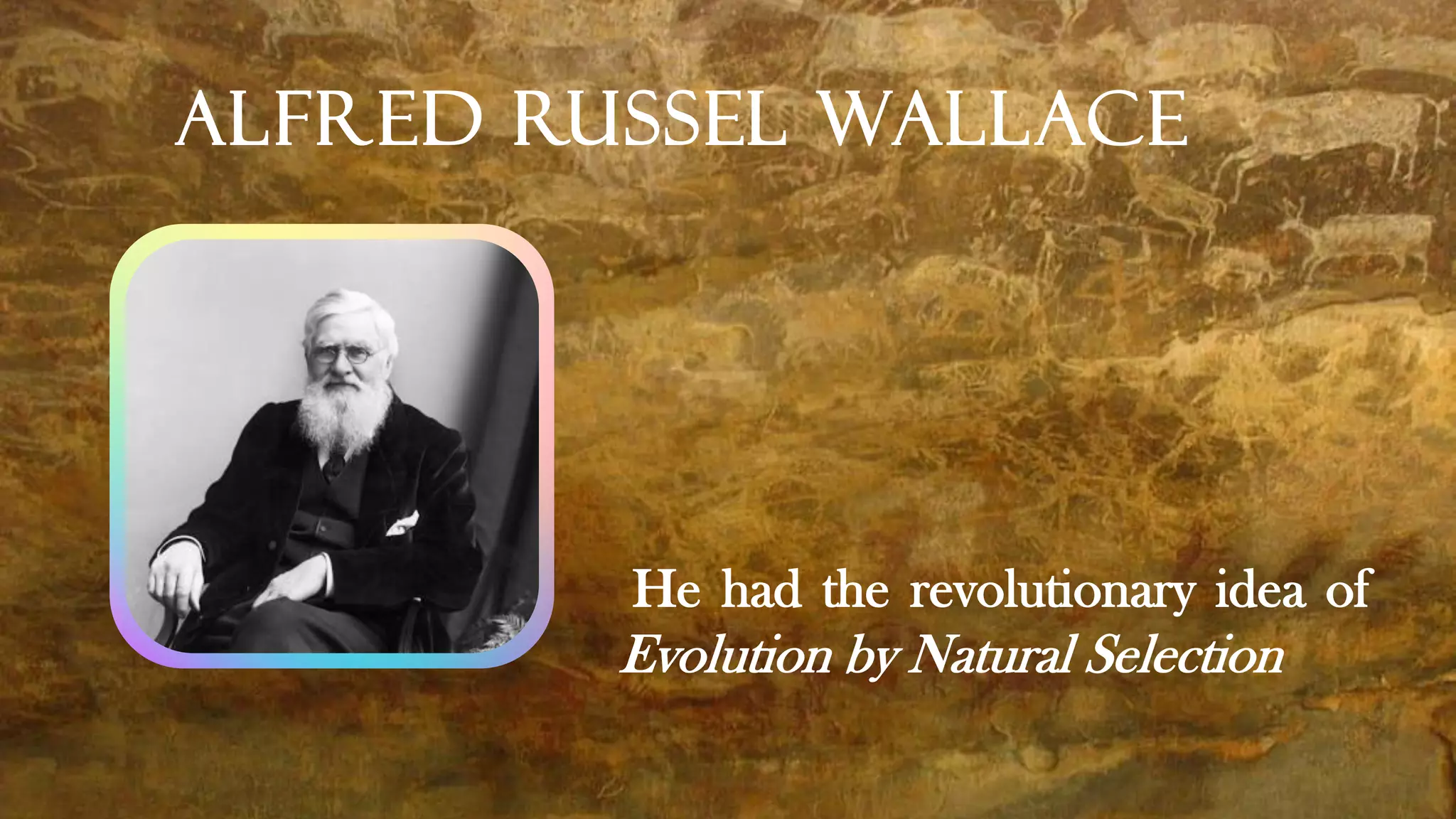
Alfred Russel Wallace
He had the revolutionary idea of
Evolution by Natural Selection
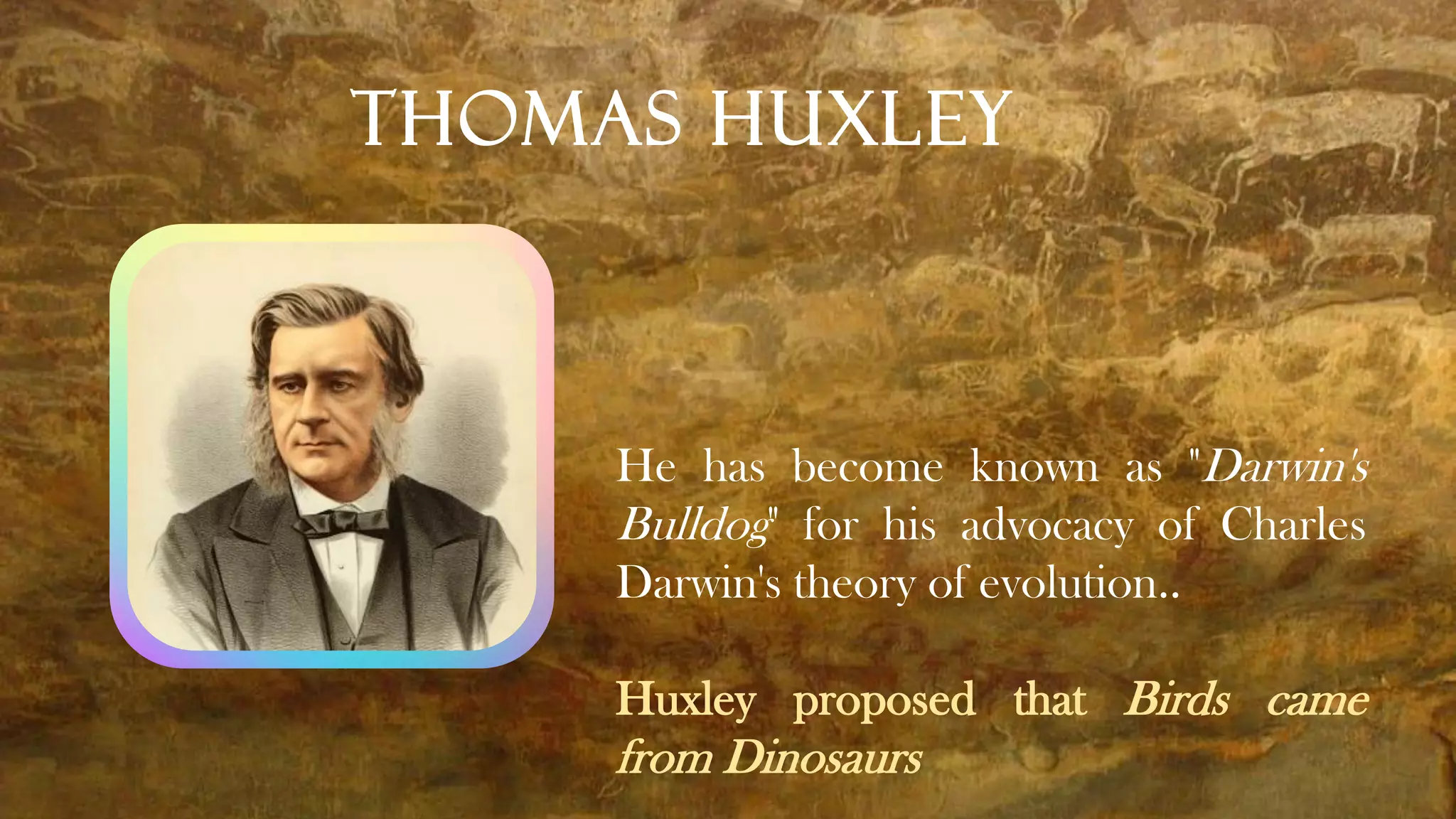
Thomas Huxley
He has become known as "Darwin's
Bulldog" for his advocacy of Charles
Darwin's theory of evolution..
Huxley proposed that Birds came
from Dinosaurs
Gregor Mendel
discovered the fundamental Laws of
Inheritance through his study on Pea
Plants
he is the Father of Genetics
Lord Kelvin
Scottish-Irish physicist William
Thomson, better known as Lord
Kelvin is best known today for
inventing the international system of
Absolute Temperature – the KELVIN
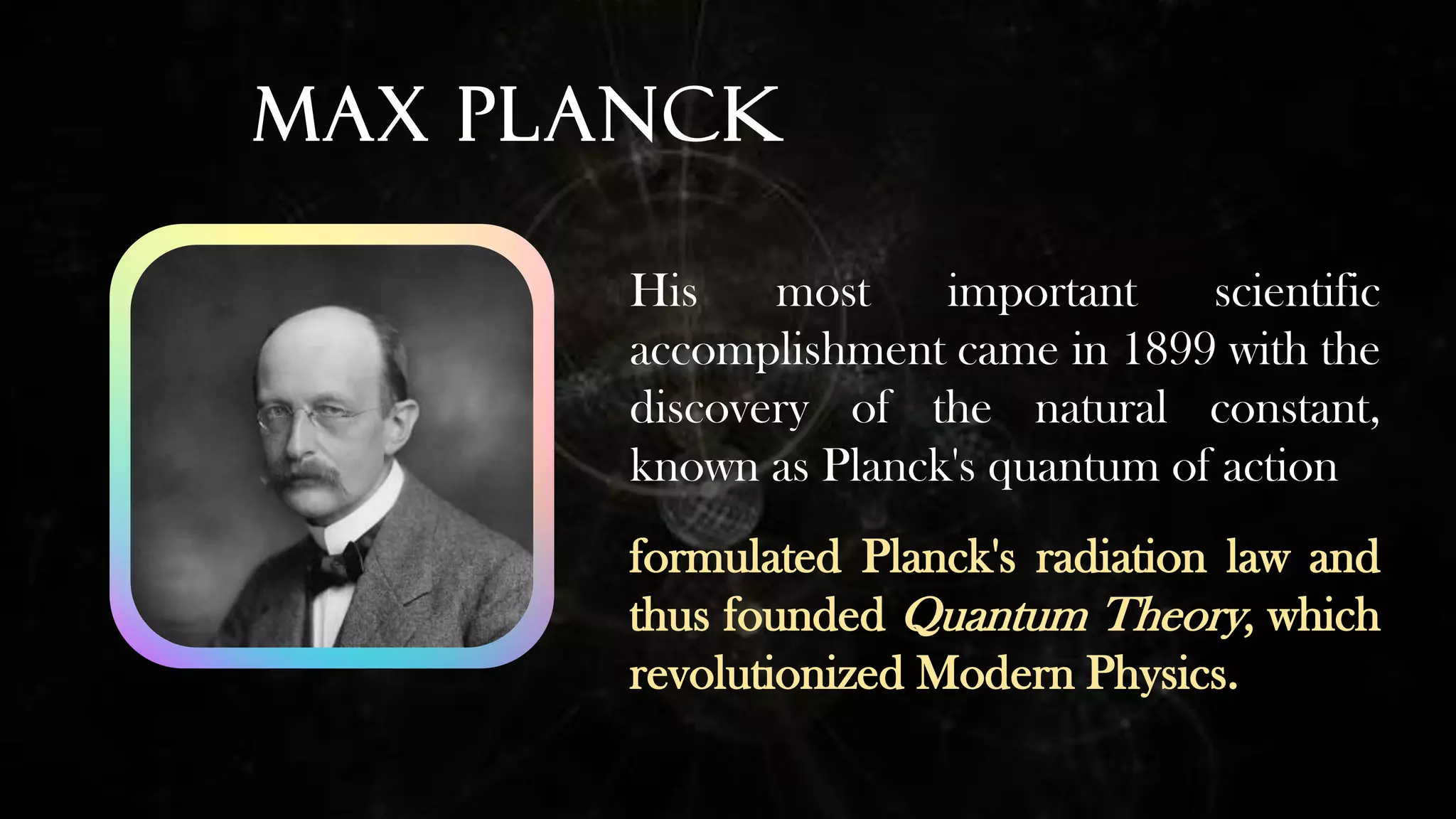
Max Planck
His most important scientific
accomplishment came in 1899 with the
discovery of the natural constant,
known as Planck's quantum of action
formulated Planck's radiation law and
thus founded Quantum Theory, which
revolutionized Modern Physics.
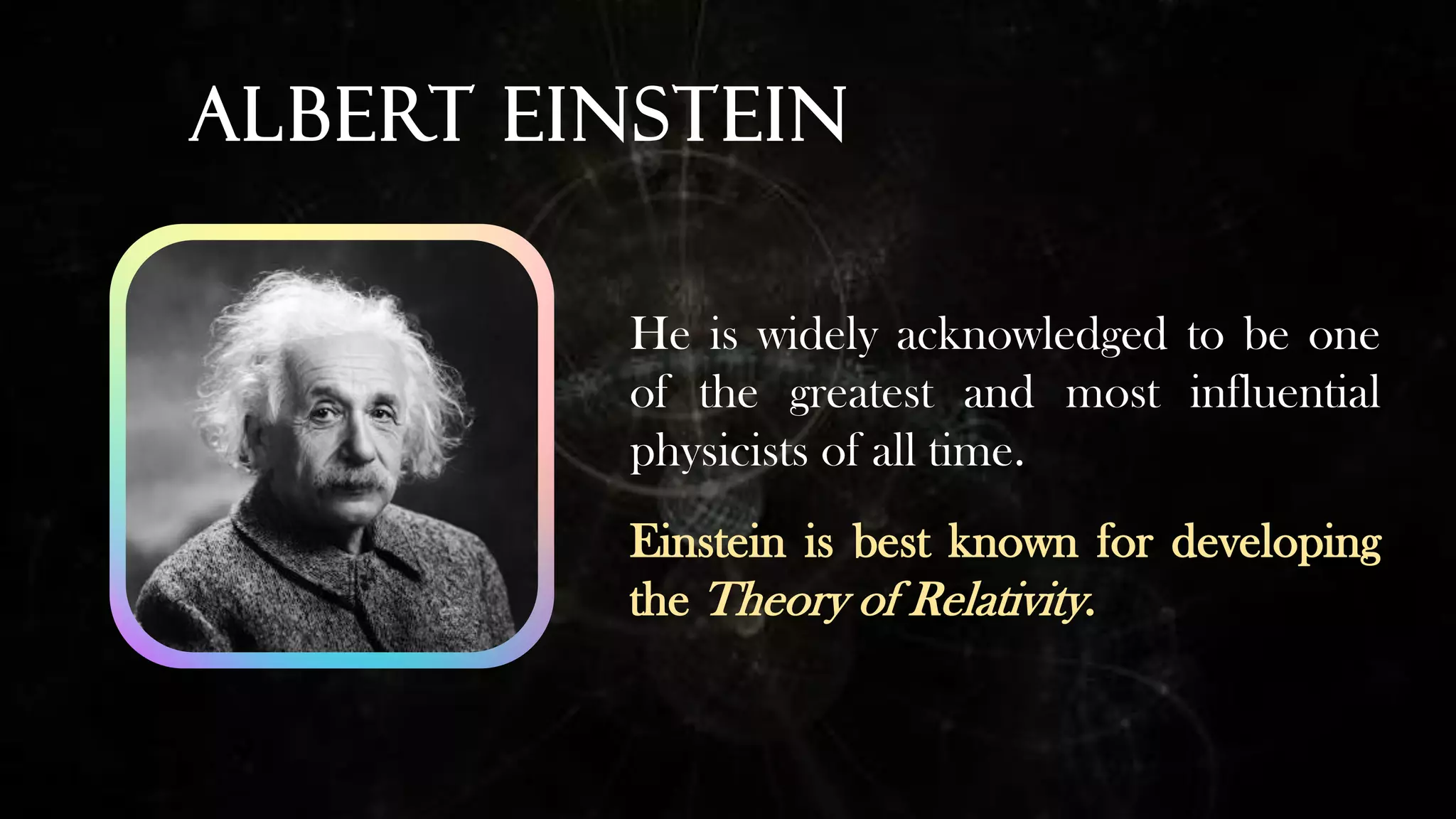
Albert Einstein
He is widely acknowledged to be one
of the greatest and most influential
physicists of all time.
Einstein is best known for developing
the Theory of Relativity.
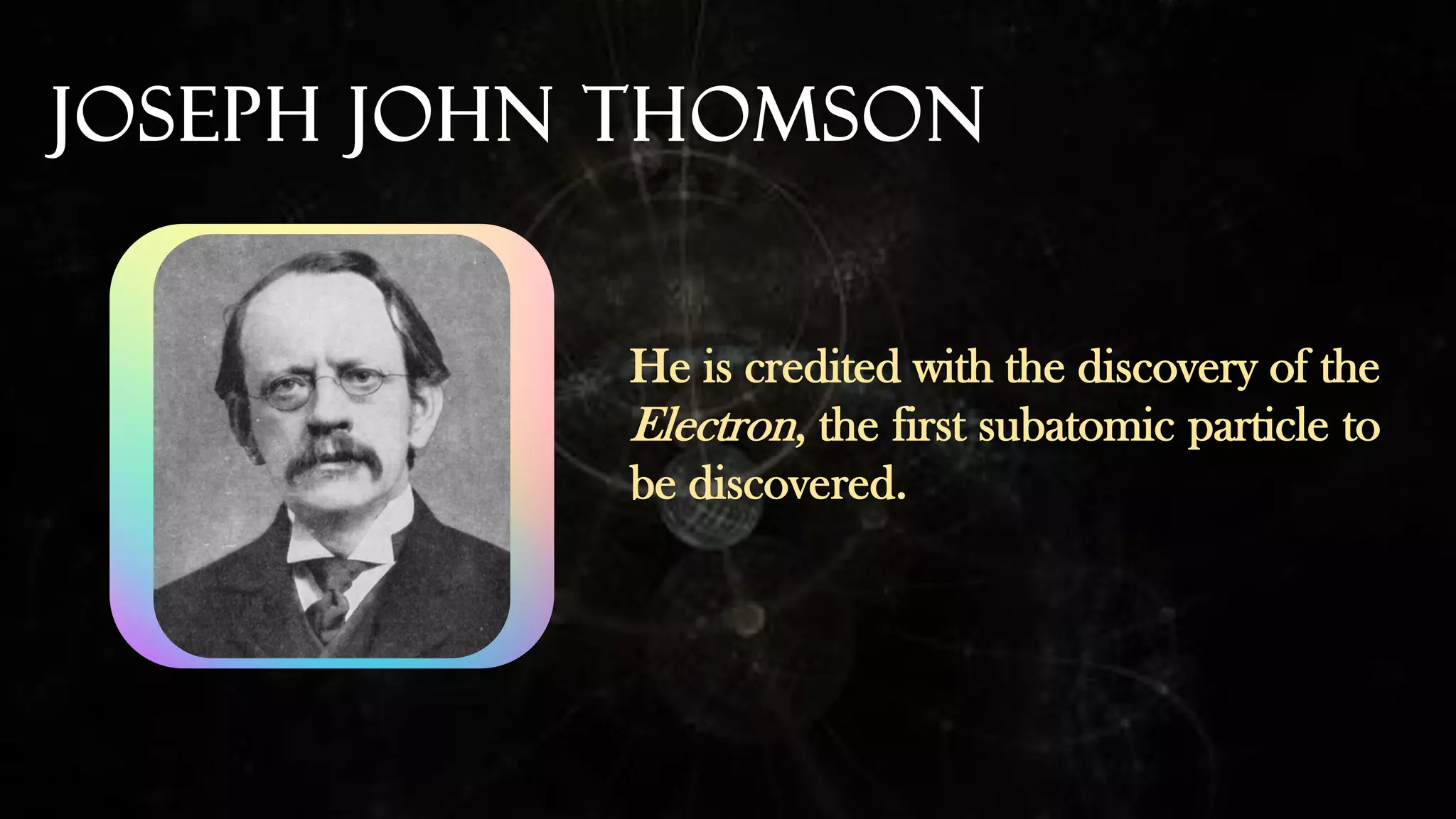
Joseph John Thomson
He is credited with the discovery of the
Electron, the first subatomic particle to
be discovered.
Erwin Schrodinger
known for the Schrödinger equation,
which describes the evolution of the
wave function, a quantity that describes
the wave properties of a particle.
Fully described the probability of
finding a particle in a specific position
& state..
Werner Heisenberg
one of the main pioneers of the theory
of quantum mechanics.
Known for the Heisnberg Uncertainty
Principle
Ernest Rutherford
Atom was made basically of space,
comprising of a small, dense nucleus
and electrons orbiting around it.
the Father of Nuclear Physics
John Robert Oppenheimer
responsible for the research and
design of an Atomic Bomb.
the “Manhattan Project”
The first atomic bomb detonated over a
populated area occurred on August 6, 1945
at 8:15 AM over the Japanese city of
Hiroshima.
1. In what period would you like to time travel to make your
own invention? Explain your answer.
2. Do you think religion will play a big role in the
progression of science and technology? Explain your answer.
3. What are the negative effects of scienctific and
technological advancements? Explain your answer.

STS 3.pdf

  • 2.
  • 3.
    Benjamin Franklin published thefirst chart of Ocean-Current in 1969 Franklin’s Chart of the Gulf Stream
  • 4.
    George Hadley • publisheda paper about the paper of trade winds in relation to the rotation of the globe.
  • 6.
    Nevil maskelyne • measurementsof the gravitational pull in a mountain • Measured the density of the Earth
  • 7.
    James Hutton • Fatherof Modern Geology • Geologic change is VERY slow, so the Earth must be VERY old • Believed in Uniformitarianism
  • 8.
  • 10.
    • made afundamental contribution to our understanding of the role insects play in plant fertilization…. “Pollination” • studied sex in plants that led him to a general theory of Fertilization Christian Sprengel
  • 11.
  • 12.
    Alessandro Volta Italian physicistwhose invention of the electric battery provided the first source of continuous current
  • 13.
    “there is somethingin the sky awaiting discovery”
  • 14.
    Hans Christian Orsted discoveredaccidentally, in 1820, that magnetic needle is deflected when the current in a nearby wire varies – a phenomenon establishing a relationship between electricity and magnetism. Moving electrons can generate a magnetic field, as demonstrated by Oersted. The magnetic field formed by the current, circles the wire.
  • 15.
    Michael Faraday took thework of Oersted & Ampere on the magnetic characteristics of electrical currents and achieved an electrical current from a changing magnetic field in 1831. Faraday is credited with discovering “electromagnetic induction” on August 29, 1831. His theory is still used to generate electricity on a large scale in power plants today.
  • 16.
    James Clerk MAxwell proposedFaraday’s electromagnetic induction to happen even in empty space. Added two basic principles of electromagnetism: (1) a changing electric field in space produces a magnetic field, (2) a changing magnetic field in space produces electric field. Maxwell developed a scientific theory to explain “electromagnetic waves.” Using Faraday’s experiments, he concluded that the speed of electromagnetic waves must be 3 x 10⁸ m/s .
  • 17.
    William Herschel Herschel conductedan experiment measuring the difference in temperature between the colors in the visible spectrum. He discovered the “Infrared Radiation” rays.
  • 18.
    William Roentgen He consideredthe Father of Diagnostic Radiology, the medical speciality which uses imaging to diagnose disease. He discovered the “X-Rays”.
  • 19.
    Thomas Young “Whether lightwas a wave or a particle,” Young came up with the basic idea for the now-famous Double-slit Experiment to demonstrate the interference of light waves. He discovered that the way in which the “lens of the eye changes shape to focus on objects at differing distances”.
  • 20.
    Christian Doppler He observedfrequency of light and sound waves is dependent upon how fast the source and observer are moving relative to each other. The “Doppler Effects” – expounding on the color of binary stars.
  • 22.
    John Dalton All matterwas comprised of indivisible and indestructible atoms with distinct masses and properties. Best known for introducing the “Atomic Theory’ into chemistry, and for his research into “Colour Blindness,” which he had
  • 24.
    Jons Jacob Berzelius Berzeliusintroduced into chemistry the chemical formula notation showing the composition of compounds. Considered to be one of the founders of modern chemistry. He formulated the difference between inorganic and organic compounds.
  • 25.
    Louis Pasteur Pasteur producedthe vaccine by attenuating the virus in rabbits and subsequently harvesting it from their spinal cords. He was the first to demonstrate that infectious diseases are caused by microbes. Renowned for his discoveries of the principles of Vaccination, Microbial Fermentation, and Pasteurization, which was named after him.
  • 26.
    August Kekule He isthe principal founder of the theory of chemical structure and in particular the Kekulé structure of benzene. Kekulé visualized the ring structure of Benzene in 1865.
  • 27.
    Dmitri Mendeleev He isbest known for formulating the Periodic Law and creating a version of the periodic table of elements. The Father of Periodic Table.
  • 28.
  • 29.
    Mary Anning Became knownaround the world for the discoveries she made in Jurassic marine fossil beds. discovery of the first “Plesiosaur”
  • 31.
    Richard Owen A controversialfigure, he is perhaps best known for coining the word – “DINOSAUR”
  • 32.
    Louis Agassiz Agassiz' hypothesissays that much of the continent of North America was covered by Glacial Ice.
  • 33.
    Alexander von Humboldt consideredto be the ‘Father' of Ecology’ particularly for his work describing vegetation zones (geobotany) and climate using latitude and altitude
  • 34.
    Alfred Russel Wallace Hehad the revolutionary idea of Evolution by Natural Selection
  • 35.
    Thomas Huxley He hasbecome known as "Darwin's Bulldog" for his advocacy of Charles Darwin's theory of evolution.. Huxley proposed that Birds came from Dinosaurs
  • 37.
    Gregor Mendel discovered thefundamental Laws of Inheritance through his study on Pea Plants he is the Father of Genetics
  • 38.
    Lord Kelvin Scottish-Irish physicistWilliam Thomson, better known as Lord Kelvin is best known today for inventing the international system of Absolute Temperature – the KELVIN
  • 40.
    Max Planck His mostimportant scientific accomplishment came in 1899 with the discovery of the natural constant, known as Planck's quantum of action formulated Planck's radiation law and thus founded Quantum Theory, which revolutionized Modern Physics.
  • 41.
    Albert Einstein He iswidely acknowledged to be one of the greatest and most influential physicists of all time. Einstein is best known for developing the Theory of Relativity.
  • 42.
    Joseph John Thomson Heis credited with the discovery of the Electron, the first subatomic particle to be discovered.
  • 43.
    Erwin Schrodinger known forthe Schrödinger equation, which describes the evolution of the wave function, a quantity that describes the wave properties of a particle. Fully described the probability of finding a particle in a specific position & state..
  • 44.
    Werner Heisenberg one ofthe main pioneers of the theory of quantum mechanics. Known for the Heisnberg Uncertainty Principle
  • 45.
    Ernest Rutherford Atom wasmade basically of space, comprising of a small, dense nucleus and electrons orbiting around it. the Father of Nuclear Physics
  • 46.
    John Robert Oppenheimer responsiblefor the research and design of an Atomic Bomb. the “Manhattan Project” The first atomic bomb detonated over a populated area occurred on August 6, 1945 at 8:15 AM over the Japanese city of Hiroshima.
  • 47.
    1. In whatperiod would you like to time travel to make your own invention? Explain your answer. 2. Do you think religion will play a big role in the progression of science and technology? Explain your answer. 3. What are the negative effects of scienctific and technological advancements? Explain your answer.