The Industrial Revolution happened because of the inventions
such as the spinning jenny and the steam engine. By the late
1800s, advances in both industry and technology were occurring
faster than ever before. In turn, the demands of growing industries
spurred even greater advances in technology. A surge of scientific
discovery pushed frontiers of knowledge forward. At the same
time, in industrialized countries, economic growth produced many
social changes.
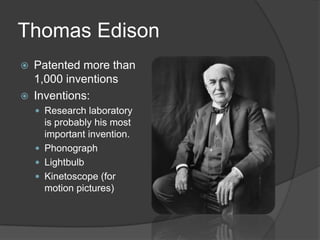
Thomas Edison
 Patented more than
1,000 inventions
 Inventions:
 Research laboratory
is probably his most
important invention.
 Phonograph
 Lightbulb
 Kinetoscope (for
motion pictures)
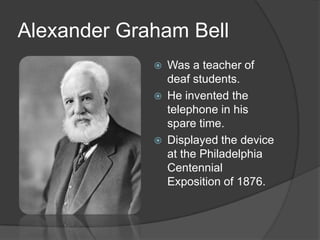
Alexander Graham Bell
 Was a teacher of
deaf students.
 He invented the
telephone in his
spare time.
 Displayed the device
at the Philadelphia
Centennial
Exposition of 1876.
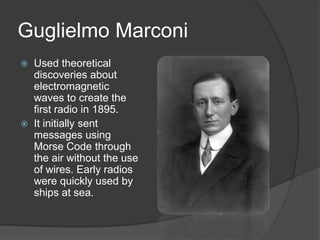
Guglielmo Marconi
 Used theoretical
discoveries about
electromagnetic
waves to create the
first radio in 1895.
 It initially sent
messages using
Morse Code through
the air without the use
of wires. Early radios
were quickly used by
ships at sea.
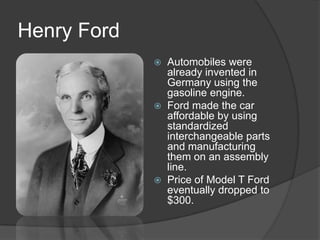
Henry Ford
 Automobiles were
already invented in
Germany using the
gasoline engine.
 Ford made the car
affordable by using
standardized
interchangeable parts
and manufacturing
them on an assembly
line.
 Price of Model T Ford
eventually dropped to
$300.
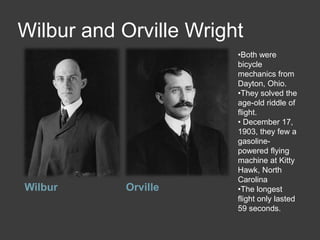
Wilbur and Orville Wright
Wilbur Orville
•Both were
bicycle
mechanics from
Dayton, Ohio.
•They solved the
age-old riddle of
flight.
• December 17,
1903, they few a
gasoline-
powered flying
machine at Kitty
Hawk, North
Carolina
•The longest
flight only lasted
59 seconds.
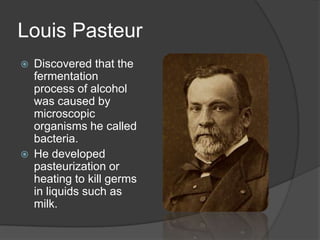
Louis Pasteur
 Discovered that the
fermentation
process of alcohol
was caused by
microscopic
organisms he called
bacteria.
 He developed
pasteurization or
heating to kill germs
in liquids such as
milk.
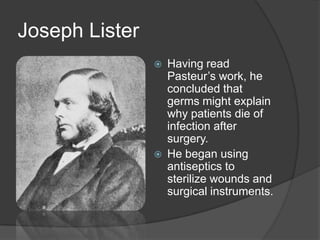
Joseph Lister
 Having read
Pasteur’s work, he
concluded that
germs might explain
why patients die of
infection after
surgery.
 He began using
antiseptics to
sterilize wounds and
surgical instruments.
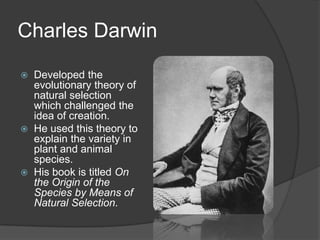
Charles Darwin
 Developed the
evolutionary theory of
natural selection
which challenged the
idea of creation.
 He used this theory to
explain the variety in
plant and animal
species.
 His book is titled On
the Origin of the
Species by Means of
Natural Selection.
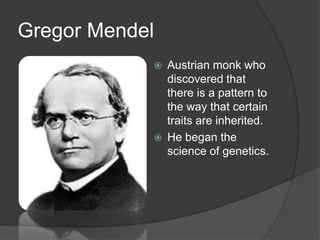
Gregor Mendel
 Austrian monk who
discovered that
there is a pattern to
the way that certain
traits are inherited.
 He began the
science of genetics.
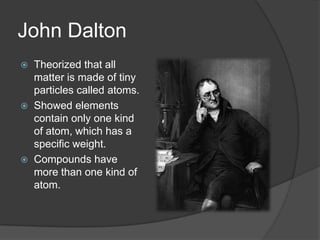
John Dalton
 Theorized that all
matter is made of tiny
particles called atoms.
 Showed elements
contain only one kind
of atom, which has a
specific weight.
 Compounds have
more than one kind of
atom.
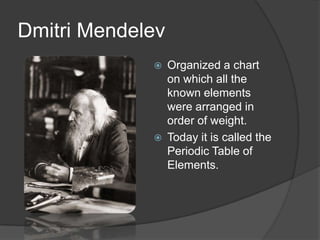
Dmitri Mendelev
 Organized a chart
on which all the
known elements
were arranged in
order of weight.
 Today it is called the
Periodic Table of
Elements.
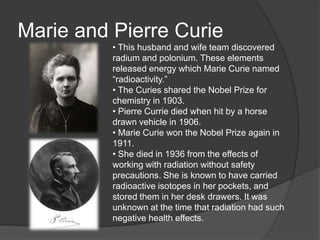
Marie and Pierre Curie
• This husband and wife team discovered
radium and polonium. These elements
released energy which Marie Curie named
―radioactivity.‖
• The Curies shared the Nobel Prize for
chemistry in 1903.
• Pierre Currie died when hit by a horse
drawn vehicle in 1906.
• Marie Curie won the Nobel Prize again in
1911.
• She died in 1936 from the effects of
working with radiation without safety
precautions. She is known to have carried
radioactive isotopes in her pockets, and
stored them in her desk drawers. It was
unknown at the time that radiation had such
negative health effects.
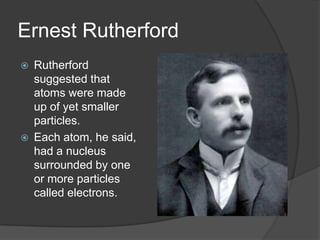
Ernest Rutherford
 Rutherford
suggested that
atoms were made
up of yet smaller
particles.
 Each atom, he said,
had a nucleus
surrounded by one
or more particles
called electrons.
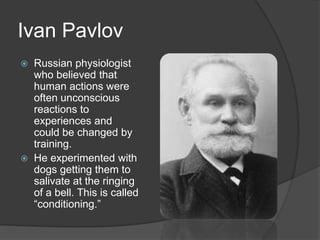
Ivan Pavlov
 Russian physiologist
who believed that
human actions were
often unconscious
reactions to
experiences and
could be changed by
training.
 He experimented with
dogs getting them to
salivate at the ringing
of a bell. This is called
―conditioning.‖
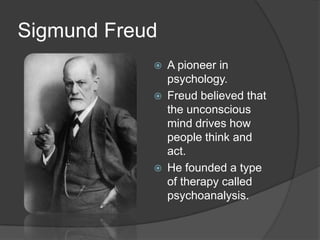
Sigmund Freud
 A pioneer in
psychology.
 Freud believed that
the unconscious
mind drives how
people think and
act.
 He founded a type
of therapy called
psychoanalysis.
Mass Culture—sometimes
called ―popular culture‖ or ―pop
culture‖ ―A set of cultural values and ideas that arise from
common exposure of a population to the same
cultural activities, communications media, music and
art, etc. Mass culture becomes possible only with
modern communications and electronic media. A
mass culture is transmitted to individuals, rather than
arising from people's daily interactions, and therefore
lacks the distinctive content of cultures rooted in
community and region. Mass culture tends to
reproduce the liberal value of individualism and to
foster a view of the citizen as consumer.‖
Retrieved from Online Dictionary of the Social Studies on April 6, 2011,
http://bitbucket.icaap.org/dict.pl?term=MASS%20CULTURE
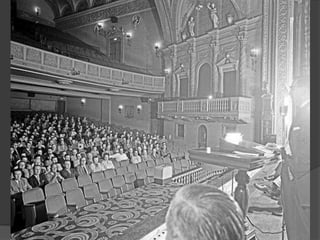
Vaudeville
 Vaudeville was a theatrical genre of variety
entertainment in the United States and Canada
from the early 1880s until the early 1930s.
Each performance was made up of a series of
separate, unrelated acts grouped together on a
common bill. Types of acts included popular
and classical musicians, dancers, comedians,
trained animals, magicians, female and male
impersonators, acrobats, illustrated songs,
jugglers, one-act plays or scenes from plays,
athletes, lecturing celebrities, minstrels, and
movies.
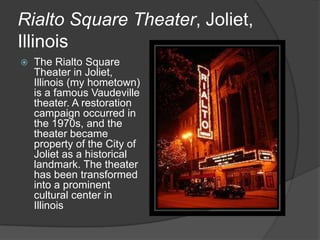
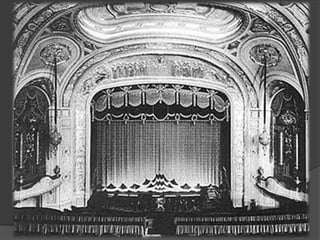
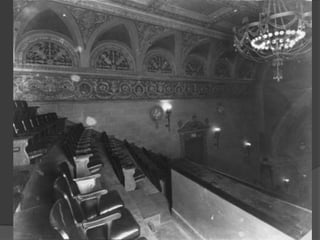
Rialto Square Theater, Joliet,
Illinois
 The Rialto Square
Theater in Joliet,
Illinois (my hometown)
is a famous Vaudeville
theater. A restoration
campaign occurred in
the 1970s, and the
theater became
property of the City of
Joliet as a historical
landmark. The theater
has been transformed
into a prominent
cultural center in
Illinois
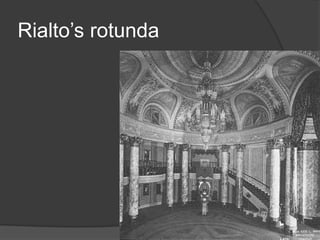
Rialto’s rotunda
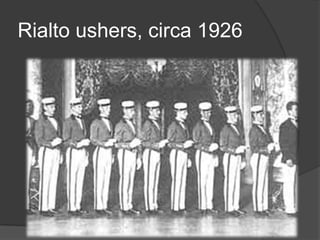
Rialto ushers, circa 1926
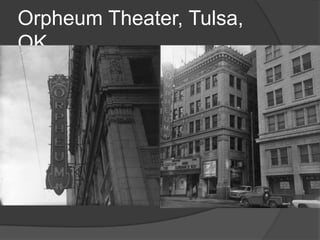
Orpheum Theater, Tulsa,
OK
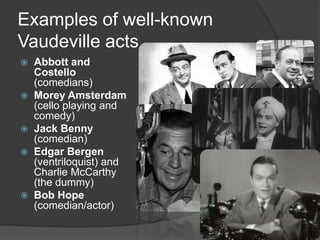
Examples of well-known
Vaudeville acts
 Abbott and
Costello
(comedians)
 Morey Amsterdam
(cello playing and
comedy)
 Jack Benny
(comedian)
 Edgar Bergen
(ventriloquist) and
Charlie McCarthy
(the dummy)
 Bob Hope
(comedian/actor)
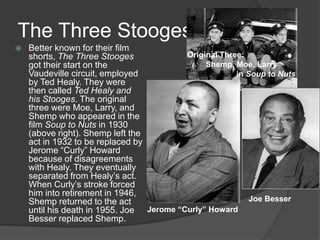
The Three Stooges
 Better known for their film
shorts, The Three Stooges
got their start on the
Vaudeville circuit, employed
by Ted Healy. They were
then called Ted Healy and
his Stooges. The original
three were Moe, Larry, and
Shemp who appeared in the
film Soup to Nuts in 1930
(above right). Shemp left the
act in 1932 to be replaced by
Jerome ―Curly‖ Howard
because of disagreements
with Healy. They eventually
separated from Healy’s act.
When Curly’s stroke forced
him into retirement in 1946,
Shemp returned to the act
until his death in 1955. Joe
Besser replaced Shemp.
Jerome “Curly” Howard
Joe Besser
Original Three:
Shemp, Moe, Larry
in Soup to Nuts
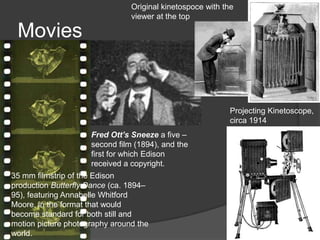
Movies
Fred Ott’s Sneeze a five –
second film (1894), and the
first for which Edison
received a copyright.
35 mm filmstrip of the Edison
production Butterfly Dance (ca. 1894–
95), featuring Annabelle Whitford
Moore, in the format that would
become standard for both still and
motion picture photography around the
world.
Projecting Kinetoscope,
circa 1914
Original kinetospoce with the
viewer at the top
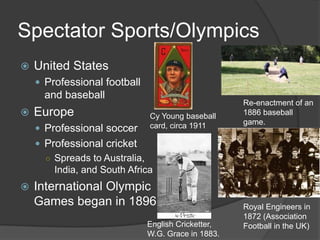
Spectator Sports/Olympics
 United States
 Professional football
and baseball
 Europe
 Professional soccer
 Professional cricket
○ Spreads to Australia,
India, and South Africa
 International Olympic
Games began in 1896
Cy Young baseball
card, circa 1911
Re-enactment of an
1886 baseball
game.
Royal Engineers in
1872 (Association
Football in the UK)English Cricketter,
W.G. Grace in 1883.

26.4 nineteenth century progress (1)

  • 1.
    The Industrial Revolutionhappened because of the inventions such as the spinning jenny and the steam engine. By the late 1800s, advances in both industry and technology were occurring faster than ever before. In turn, the demands of growing industries spurred even greater advances in technology. A surge of scientific discovery pushed frontiers of knowledge forward. At the same time, in industrialized countries, economic growth produced many social changes.
  • 2.
    Thomas Edison  Patentedmore than 1,000 inventions  Inventions:  Research laboratory is probably his most important invention.  Phonograph  Lightbulb  Kinetoscope (for motion pictures)
  • 3.
    Alexander Graham Bell Was a teacher of deaf students.  He invented the telephone in his spare time.  Displayed the device at the Philadelphia Centennial Exposition of 1876.
  • 4.
    Guglielmo Marconi  Usedtheoretical discoveries about electromagnetic waves to create the first radio in 1895.  It initially sent messages using Morse Code through the air without the use of wires. Early radios were quickly used by ships at sea.
  • 5.
    Henry Ford  Automobileswere already invented in Germany using the gasoline engine.  Ford made the car affordable by using standardized interchangeable parts and manufacturing them on an assembly line.  Price of Model T Ford eventually dropped to $300.
  • 6.
    Wilbur and OrvilleWright Wilbur Orville •Both were bicycle mechanics from Dayton, Ohio. •They solved the age-old riddle of flight. • December 17, 1903, they few a gasoline- powered flying machine at Kitty Hawk, North Carolina •The longest flight only lasted 59 seconds.
  • 7.
    Louis Pasteur  Discoveredthat the fermentation process of alcohol was caused by microscopic organisms he called bacteria.  He developed pasteurization or heating to kill germs in liquids such as milk.
  • 8.
    Joseph Lister  Havingread Pasteur’s work, he concluded that germs might explain why patients die of infection after surgery.  He began using antiseptics to sterilize wounds and surgical instruments.
  • 9.
    Charles Darwin  Developedthe evolutionary theory of natural selection which challenged the idea of creation.  He used this theory to explain the variety in plant and animal species.  His book is titled On the Origin of the Species by Means of Natural Selection.
  • 10.
    Gregor Mendel  Austrianmonk who discovered that there is a pattern to the way that certain traits are inherited.  He began the science of genetics.
  • 11.
    John Dalton  Theorizedthat all matter is made of tiny particles called atoms.  Showed elements contain only one kind of atom, which has a specific weight.  Compounds have more than one kind of atom.
  • 12.
    Dmitri Mendelev  Organizeda chart on which all the known elements were arranged in order of weight.  Today it is called the Periodic Table of Elements.
  • 13.
    Marie and PierreCurie • This husband and wife team discovered radium and polonium. These elements released energy which Marie Curie named ―radioactivity.‖ • The Curies shared the Nobel Prize for chemistry in 1903. • Pierre Currie died when hit by a horse drawn vehicle in 1906. • Marie Curie won the Nobel Prize again in 1911. • She died in 1936 from the effects of working with radiation without safety precautions. She is known to have carried radioactive isotopes in her pockets, and stored them in her desk drawers. It was unknown at the time that radiation had such negative health effects.
  • 14.
    Ernest Rutherford  Rutherford suggestedthat atoms were made up of yet smaller particles.  Each atom, he said, had a nucleus surrounded by one or more particles called electrons.
  • 15.
    Ivan Pavlov  Russianphysiologist who believed that human actions were often unconscious reactions to experiences and could be changed by training.  He experimented with dogs getting them to salivate at the ringing of a bell. This is called ―conditioning.‖
  • 16.
    Sigmund Freud  Apioneer in psychology.  Freud believed that the unconscious mind drives how people think and act.  He founded a type of therapy called psychoanalysis.
  • 17.
    Mass Culture—sometimes called ―popularculture‖ or ―pop culture‖ ―A set of cultural values and ideas that arise from common exposure of a population to the same cultural activities, communications media, music and art, etc. Mass culture becomes possible only with modern communications and electronic media. A mass culture is transmitted to individuals, rather than arising from people's daily interactions, and therefore lacks the distinctive content of cultures rooted in community and region. Mass culture tends to reproduce the liberal value of individualism and to foster a view of the citizen as consumer.‖ Retrieved from Online Dictionary of the Social Studies on April 6, 2011, http://bitbucket.icaap.org/dict.pl?term=MASS%20CULTURE
  • 18.
    Vaudeville  Vaudeville wasa theatrical genre of variety entertainment in the United States and Canada from the early 1880s until the early 1930s. Each performance was made up of a series of separate, unrelated acts grouped together on a common bill. Types of acts included popular and classical musicians, dancers, comedians, trained animals, magicians, female and male impersonators, acrobats, illustrated songs, jugglers, one-act plays or scenes from plays, athletes, lecturing celebrities, minstrels, and movies.
  • 19.
    Rialto Square Theater,Joliet, Illinois  The Rialto Square Theater in Joliet, Illinois (my hometown) is a famous Vaudeville theater. A restoration campaign occurred in the 1970s, and the theater became property of the City of Joliet as a historical landmark. The theater has been transformed into a prominent cultural center in Illinois
  • 20.
  • 21.
  • 23.
  • 26.
    Examples of well-known Vaudevilleacts  Abbott and Costello (comedians)  Morey Amsterdam (cello playing and comedy)  Jack Benny (comedian)  Edgar Bergen (ventriloquist) and Charlie McCarthy (the dummy)  Bob Hope (comedian/actor)
  • 27.
    The Three Stooges Better known for their film shorts, The Three Stooges got their start on the Vaudeville circuit, employed by Ted Healy. They were then called Ted Healy and his Stooges. The original three were Moe, Larry, and Shemp who appeared in the film Soup to Nuts in 1930 (above right). Shemp left the act in 1932 to be replaced by Jerome ―Curly‖ Howard because of disagreements with Healy. They eventually separated from Healy’s act. When Curly’s stroke forced him into retirement in 1946, Shemp returned to the act until his death in 1955. Joe Besser replaced Shemp. Jerome “Curly” Howard Joe Besser Original Three: Shemp, Moe, Larry in Soup to Nuts
  • 28.
    Movies Fred Ott’s Sneezea five – second film (1894), and the first for which Edison received a copyright. 35 mm filmstrip of the Edison production Butterfly Dance (ca. 1894– 95), featuring Annabelle Whitford Moore, in the format that would become standard for both still and motion picture photography around the world. Projecting Kinetoscope, circa 1914 Original kinetospoce with the viewer at the top
  • 29.
    Spectator Sports/Olympics  UnitedStates  Professional football and baseball  Europe  Professional soccer  Professional cricket ○ Spreads to Australia, India, and South Africa  International Olympic Games began in 1896 Cy Young baseball card, circa 1911 Re-enactment of an 1886 baseball game. Royal Engineers in 1872 (Association Football in the UK)English Cricketter, W.G. Grace in 1883.