Intellectual Revolutions
That Defined Society
BY: GROUP1
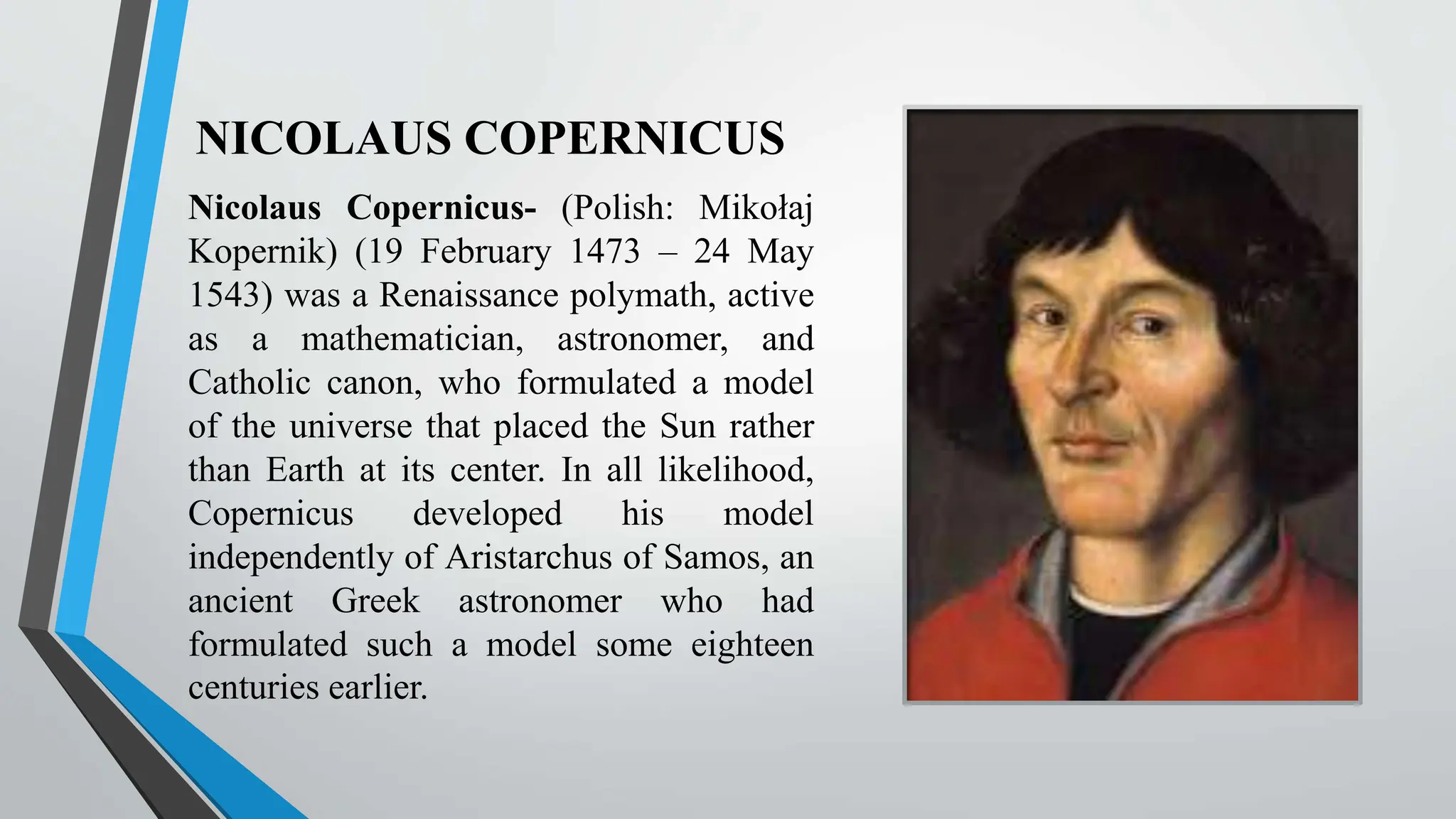
NICOLAUS COPERNICUS
Nicolaus Copernicus- (Polish: Mikołaj
Kopernik) (19 February 1473 – 24 May
1543) was a Renaissance polymath, active
as a mathematician, astronomer, and
Catholic canon, who formulated a model
of the universe that placed the Sun rather
than Earth at its center. In all likelihood,
Copernicus developed his model
independently of Aristarchus of Samos, an
ancient Greek astronomer who had
formulated such a model some eighteen
centuries earlier.
COPERNICAN REVOLUTION
•Copernican Revolution, a shift in the field of
astronomy from a geocentric understanding of the
universe, centered around Earth, to a heliocentric
understanding, centered around the Sun, as
articulated by the Polish astronomer Nicolaus
Copernicus in the 16th century.
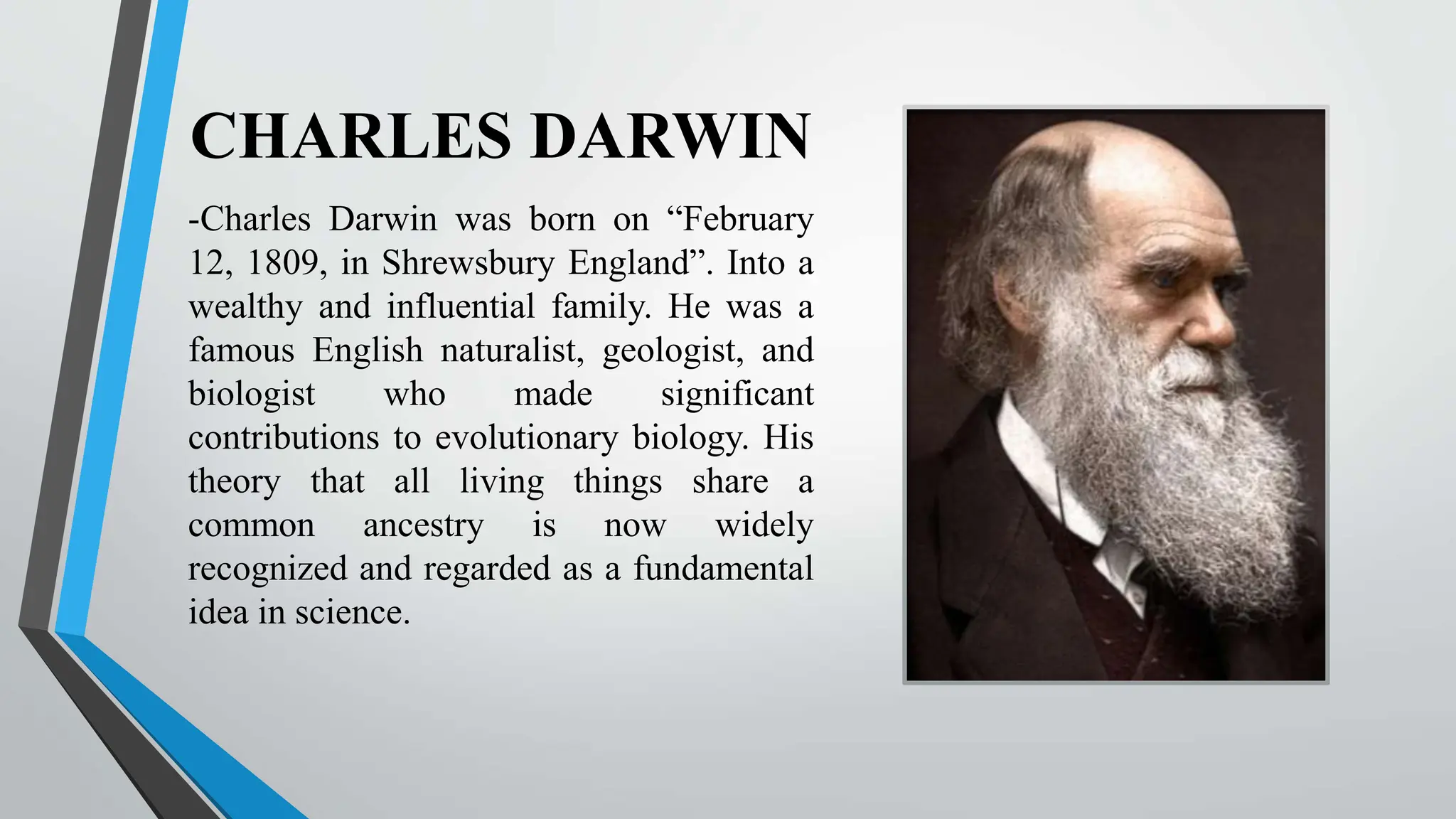
CHARLES DARWIN
-Charles Darwin was born on “February
12, 1809, in Shrewsbury England”. Into a
wealthy and influential family. He was a
famous English naturalist, geologist, and
biologist who made significant
contributions to evolutionary biology. His
theory that all living things share a
common ancestry is now widely
recognized and regarded as a fundamental
idea in science.
DARWINIANS REVOLUTION:
•Darwin’s revolution refers to the profound and
revolutionary impact of “Charles Darwin’s” theory of
evolution by natural selection on the field of biology and
our understanding of the natural world. This scientific
revolution, often referred to as the “Darwinian’s
Revolution” occurred in the mid-19th century.
1. Theory of Evolution: Darwin proposed the idea that species evolved over time
through a process he called “natural selection.” This theory suggests that species
change in response to their environment, and those individuals with advantageous
traits are more likely to survive and reproduce, passing those traits to their offspring.
2. Common Ancestry: Darwin’s theory suggested that all species, including humans,
share a common ancestry and are part of a branching tree of life. This idea had
profound implications for our understanding of all living organism
3. Evidence : Darwin provided substantial evidence for his theory, including
observations from his travels on the HMS “ His Majesty’s Ship Beagle.” It was a
Royal Navy ship that is famous for its role in Charles Darwin’s historic voyage
around the world from 1831 to 1836.
4.Controversy and Impact: The publication of Darwin’s book, “On the Origin
Species” in 1859, sparked intense debate and controversy.
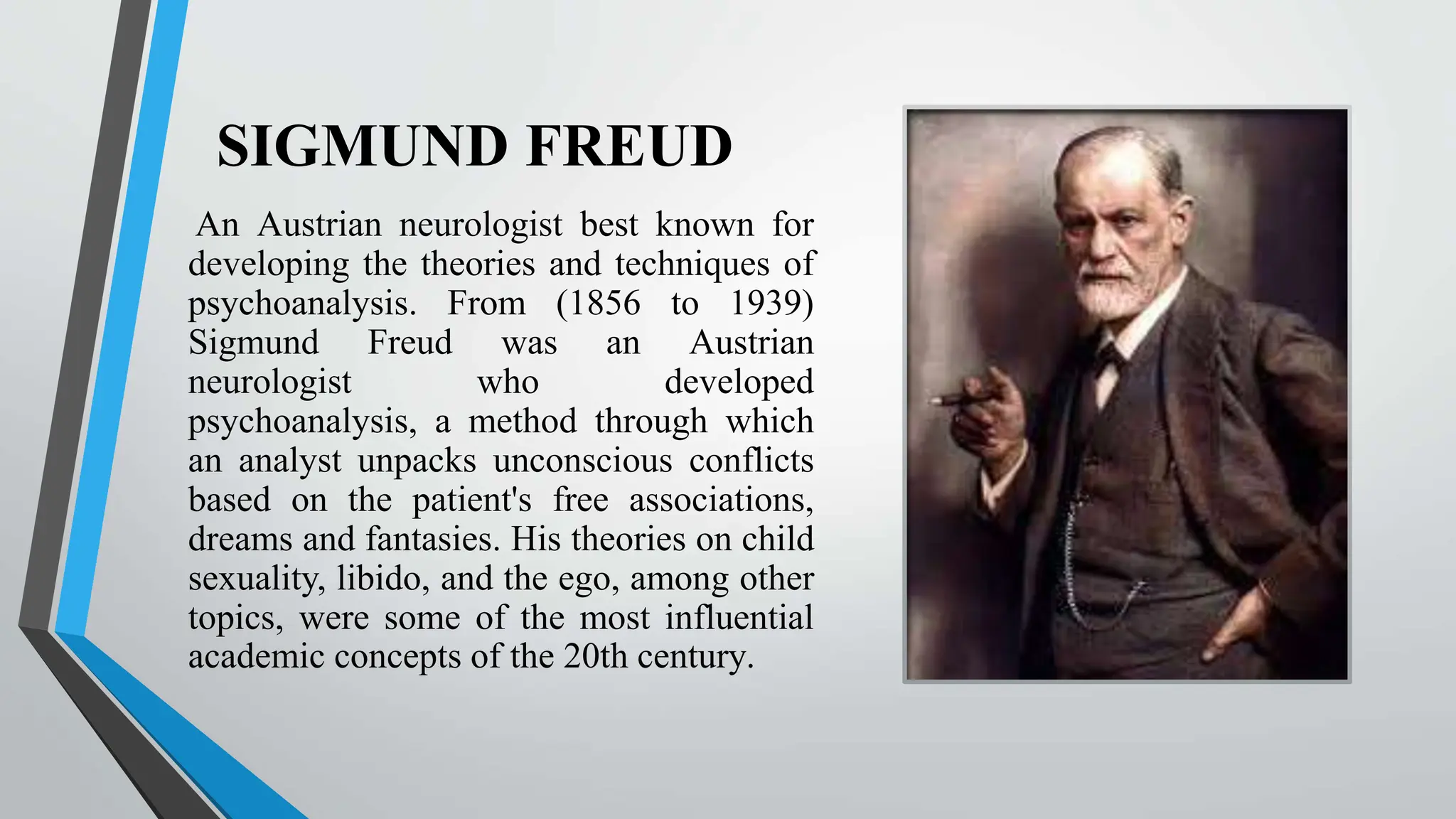
SIGMUND FREUD
An Austrian neurologist best known for
developing the theories and techniques of
psychoanalysis. From (1856 to 1939)
Sigmund Freud was an Austrian
neurologist who developed
psychoanalysis, a method through which
an analyst unpacks unconscious conflicts
based on the patient's free associations,
dreams and fantasies. His theories on child
sexuality, libido, and the ego, among other
topics, were some of the most influential
academic concepts of the 20th century.
FREUDIAN REVOLUTION:
• Freud revolutionized how we think about and treat mental health conditions.
Freud founded psychoanalysis as a way of listening to patients and better
understanding how their minds work. Psychoanalysis continues to have an
enormous influence on modern psychology and psychiatry.
• Sigmund Freud's theories and work helped shape current views of dreams,
childhood, personality, memory, sexuality, and therapy. Freud's work also laid
the foundation for many other theorists to formulate ideas, while others
developed new theories in opposition to his ideas.
INFORMATION:
The Intellectual Revolution was a transformative scientific and
technological advancement that shifted fundamental perspectives and
beliefs. Scientists were driven by curiosity, critical thinking, and
innovation to explore and understand the physical and natural world.
The three most known Intellectual revolution was Copernican by
Nicolaus Copernicus, Darwinian by Charles Darwin, and Freudian by
Sigmund Freud. These events changed the beliefs of most people in
society in the field of science, especially in astronomy, biology, and
Psychology leading to new ideas of how those things are working
and have been used up until this time.
THANK YOU!!!!
GROUP 1 MEMBERS:
JOHN BENEDICT D. SEBIAL
JOHN RAYMOND G. CALZADA
JONALYN BACALSO
KATHLEEN GONZALES
ROSS ANN RULE

Intellectual Revolution (STS)

  • 1.
  • 2.
    NICOLAUS COPERNICUS Nicolaus Copernicus-(Polish: Mikołaj Kopernik) (19 February 1473 – 24 May 1543) was a Renaissance polymath, active as a mathematician, astronomer, and Catholic canon, who formulated a model of the universe that placed the Sun rather than Earth at its center. In all likelihood, Copernicus developed his model independently of Aristarchus of Samos, an ancient Greek astronomer who had formulated such a model some eighteen centuries earlier.
  • 3.
    COPERNICAN REVOLUTION •Copernican Revolution,a shift in the field of astronomy from a geocentric understanding of the universe, centered around Earth, to a heliocentric understanding, centered around the Sun, as articulated by the Polish astronomer Nicolaus Copernicus in the 16th century.
  • 4.
    CHARLES DARWIN -Charles Darwinwas born on “February 12, 1809, in Shrewsbury England”. Into a wealthy and influential family. He was a famous English naturalist, geologist, and biologist who made significant contributions to evolutionary biology. His theory that all living things share a common ancestry is now widely recognized and regarded as a fundamental idea in science.
  • 5.
    DARWINIANS REVOLUTION: •Darwin’s revolutionrefers to the profound and revolutionary impact of “Charles Darwin’s” theory of evolution by natural selection on the field of biology and our understanding of the natural world. This scientific revolution, often referred to as the “Darwinian’s Revolution” occurred in the mid-19th century.
  • 6.
    1. Theory ofEvolution: Darwin proposed the idea that species evolved over time through a process he called “natural selection.” This theory suggests that species change in response to their environment, and those individuals with advantageous traits are more likely to survive and reproduce, passing those traits to their offspring. 2. Common Ancestry: Darwin’s theory suggested that all species, including humans, share a common ancestry and are part of a branching tree of life. This idea had profound implications for our understanding of all living organism 3. Evidence : Darwin provided substantial evidence for his theory, including observations from his travels on the HMS “ His Majesty’s Ship Beagle.” It was a Royal Navy ship that is famous for its role in Charles Darwin’s historic voyage around the world from 1831 to 1836. 4.Controversy and Impact: The publication of Darwin’s book, “On the Origin Species” in 1859, sparked intense debate and controversy.
  • 7.
    SIGMUND FREUD An Austrianneurologist best known for developing the theories and techniques of psychoanalysis. From (1856 to 1939) Sigmund Freud was an Austrian neurologist who developed psychoanalysis, a method through which an analyst unpacks unconscious conflicts based on the patient's free associations, dreams and fantasies. His theories on child sexuality, libido, and the ego, among other topics, were some of the most influential academic concepts of the 20th century.
  • 8.
    FREUDIAN REVOLUTION: • Freudrevolutionized how we think about and treat mental health conditions. Freud founded psychoanalysis as a way of listening to patients and better understanding how their minds work. Psychoanalysis continues to have an enormous influence on modern psychology and psychiatry. • Sigmund Freud's theories and work helped shape current views of dreams, childhood, personality, memory, sexuality, and therapy. Freud's work also laid the foundation for many other theorists to formulate ideas, while others developed new theories in opposition to his ideas.
  • 9.
    INFORMATION: The Intellectual Revolutionwas a transformative scientific and technological advancement that shifted fundamental perspectives and beliefs. Scientists were driven by curiosity, critical thinking, and innovation to explore and understand the physical and natural world. The three most known Intellectual revolution was Copernican by Nicolaus Copernicus, Darwinian by Charles Darwin, and Freudian by Sigmund Freud. These events changed the beliefs of most people in society in the field of science, especially in astronomy, biology, and Psychology leading to new ideas of how those things are working and have been used up until this time.
  • 10.
  • 11.
    GROUP 1 MEMBERS: JOHNBENEDICT D. SEBIAL JOHN RAYMOND G. CALZADA JONALYN BACALSO KATHLEEN GONZALES ROSS ANN RULE