19th
Century Progress
Inventions and Developments
Setting the Stage
• The Industrial Revolution happened because of
inventions such as the spinning jenny and the
steam engine. By the late 1800s, advances in
both industry and technology were occurring
faster than ever before. In turn, the demands of
growing industries spurred even greater advances
in technology. A surge of scientific discovery
pushed the frontiers of knowledge forward. At the
same time, in industrialized countries, economic
growth produced many social changes.
-World History, Patterns in Interaction
Inventions Make Life Easier
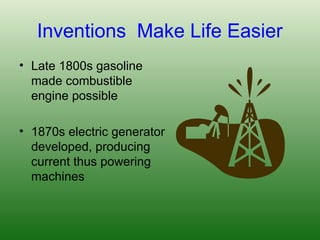
• Late 1800s gasoline
made combustible
engine possible
• 1870s electric generator
developed, producing
current thus powering
machines
Inventions Make Life Easier
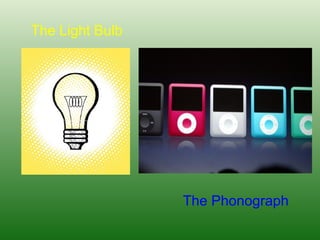
• Thomas Edison created over 1,000
inventions
• These were created in his research lab at
Menlo Park, NJ
• Two of his most important inventions
were…
The Light Bulb
The Phonograph
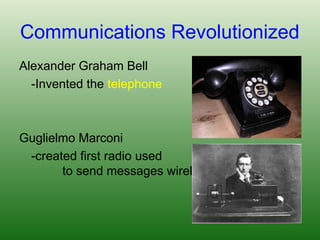
Communications Revolutionized
Alexander Graham Bell
-Invented the telephone
Guglielmo Marconi
-created first radio used
to send messages wirelessly
Automobile Industry
• In the 1880s Germans had developed the
automobile with a gasoline engine
• Cars were made by hand and extremely
expensive
• Henry Ford used standardized
interchangeable parts to make
automobiles cheaper and faster to
assemble
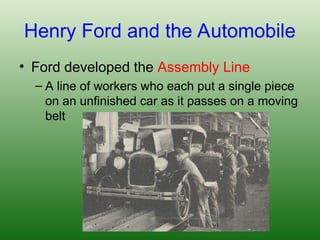
Henry Ford and the Automobile
• Ford developed the Assembly Line
– A line of workers who each put a single piece
on an unfinished car as it passes on a moving
belt
Ford Makes Cheaper Cars
• As production costs fell so did the price
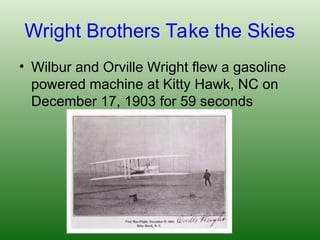
Wright Brothers Take the Skies
• Wilbur and Orville Wright flew a gasoline
powered machine at Kitty Hawk, NC on
December 17, 1903 for 59 seconds
Medical Advancements
• Louis Pasteur develops
pasteurization to kill germs in liquids
• Joseph Lister ordered surgical wards
sterilized and washing wounds in
antiseptics
• Cities built plumbing and sewer
systems to prevent spread of
disease
• Vaccines were developed for deadly
diseases
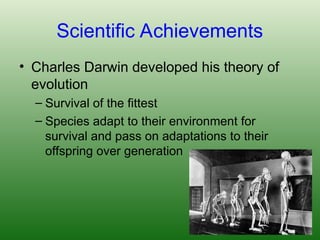
Scientific Achievements
• Charles Darwin developed his theory of
evolution
– Survival of the fittest
– Species adapt to their environment for
survival and pass on adaptations to their
offspring over generation
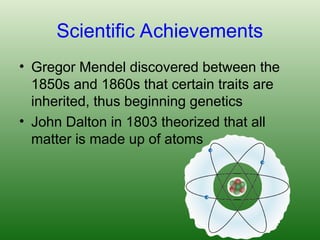
Scientific Achievements
• Gregor Mendel discovered between the
1850s and 1860s that certain traits are
inherited, thus beginning genetics
• John Dalton in 1803 theorized that all
matter is made up of atoms
Scientific Achievements
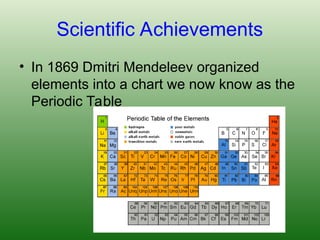
• In 1869 Dmitri Mendeleev organized
elements into a chart we now know as the
Periodic Table
Scientific Achievements
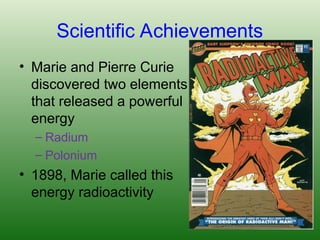
• Marie and Pierre Curie
discovered two elements
that released a powerful
energy
– Radium
– Polonium
• 1898, Marie called this
energy radioactivity
Social Sciences
• Scholars begin to study ancient
civilizations and world cultures leading to
developments in the sciences of
– Archaeology
– Anthropology
– Sociology
– Psychology- the study of the human mind and
behavior
Social Sciences
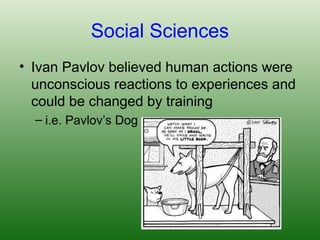
• Ivan Pavlov believed human actions were
unconscious reactions to experiences and
could be changed by training
– i.e. Pavlov’s Dog
Social Science
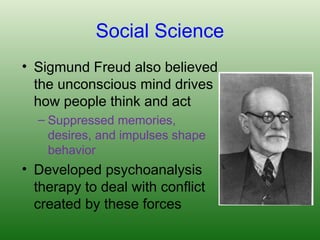
• Sigmund Freud also believed
the unconscious mind drives
how people think and act
– Suppressed memories,
desires, and impulses shape
behavior
• Developed psychoanalysis
therapy to deal with conflict
created by these forces
Mass Culture on the Rise
• Prior to the 20th
Century art, music, and
theatre were only enjoyed by the wealthy
• Around 1900 came Mass Culture- the
appeal of art, writing, music, and other
forms of entertainment for the masses
• More leisure time for people led them to
demand more activities and entertainment
Entertainment
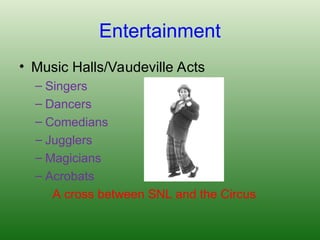
• Music Halls/Vaudeville Acts
– Singers
– Dancers
– Comedians
– Jugglers
– Magicians
– Acrobats
A cross between SNL and the Circus
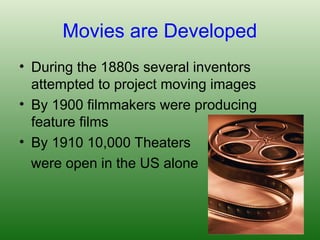
Movies are Developed
• During the 1880s several inventors
attempted to project moving images
• By 1900 filmmakers were producing
feature films
• By 1910 10,000 Theaters
were open in the US alone
Sports Entertainment
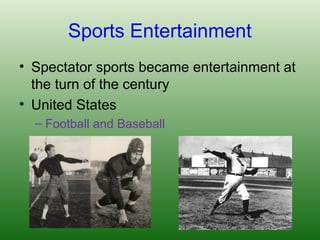
• Spectator sports became entertainment at
the turn of the century
• United States
– Football and Baseball
Sports Entertainment
• European professional soccer clubs drew
large crowds of spectators
• Cricket also was a popular British sport
Sports Entertainment
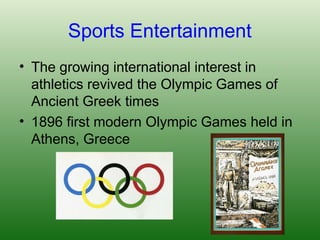
• The growing international interest in
athletics revived the Olympic Games of
Ancient Greek times
• 1896 first modern Olympic Games held in
Athens, Greece

19th_Century_Progress1.ppt19th_Century_P

  • 1.
  • 3.
    Setting the Stage •The Industrial Revolution happened because of inventions such as the spinning jenny and the steam engine. By the late 1800s, advances in both industry and technology were occurring faster than ever before. In turn, the demands of growing industries spurred even greater advances in technology. A surge of scientific discovery pushed the frontiers of knowledge forward. At the same time, in industrialized countries, economic growth produced many social changes. -World History, Patterns in Interaction
  • 4.
    Inventions Make LifeEasier • Late 1800s gasoline made combustible engine possible • 1870s electric generator developed, producing current thus powering machines
  • 5.
    Inventions Make LifeEasier • Thomas Edison created over 1,000 inventions • These were created in his research lab at Menlo Park, NJ • Two of his most important inventions were…
  • 6.
  • 7.
    Communications Revolutionized Alexander GrahamBell -Invented the telephone Guglielmo Marconi -created first radio used to send messages wirelessly
  • 8.
    Automobile Industry • Inthe 1880s Germans had developed the automobile with a gasoline engine • Cars were made by hand and extremely expensive • Henry Ford used standardized interchangeable parts to make automobiles cheaper and faster to assemble
  • 9.
    Henry Ford andthe Automobile • Ford developed the Assembly Line – A line of workers who each put a single piece on an unfinished car as it passes on a moving belt
  • 10.
    Ford Makes CheaperCars • As production costs fell so did the price
  • 11.
    Wright Brothers Takethe Skies • Wilbur and Orville Wright flew a gasoline powered machine at Kitty Hawk, NC on December 17, 1903 for 59 seconds
  • 12.
    Medical Advancements • LouisPasteur develops pasteurization to kill germs in liquids • Joseph Lister ordered surgical wards sterilized and washing wounds in antiseptics • Cities built plumbing and sewer systems to prevent spread of disease • Vaccines were developed for deadly diseases
  • 13.
    Scientific Achievements • CharlesDarwin developed his theory of evolution – Survival of the fittest – Species adapt to their environment for survival and pass on adaptations to their offspring over generation
  • 14.
    Scientific Achievements • GregorMendel discovered between the 1850s and 1860s that certain traits are inherited, thus beginning genetics • John Dalton in 1803 theorized that all matter is made up of atoms
  • 15.
    Scientific Achievements • In1869 Dmitri Mendeleev organized elements into a chart we now know as the Periodic Table
  • 16.
    Scientific Achievements • Marieand Pierre Curie discovered two elements that released a powerful energy – Radium – Polonium • 1898, Marie called this energy radioactivity
  • 17.
    Social Sciences • Scholarsbegin to study ancient civilizations and world cultures leading to developments in the sciences of – Archaeology – Anthropology – Sociology – Psychology- the study of the human mind and behavior
  • 18.
    Social Sciences • IvanPavlov believed human actions were unconscious reactions to experiences and could be changed by training – i.e. Pavlov’s Dog
  • 19.
    Social Science • SigmundFreud also believed the unconscious mind drives how people think and act – Suppressed memories, desires, and impulses shape behavior • Developed psychoanalysis therapy to deal with conflict created by these forces
  • 20.
    Mass Culture onthe Rise • Prior to the 20th Century art, music, and theatre were only enjoyed by the wealthy • Around 1900 came Mass Culture- the appeal of art, writing, music, and other forms of entertainment for the masses • More leisure time for people led them to demand more activities and entertainment
  • 23.
    Entertainment • Music Halls/VaudevilleActs – Singers – Dancers – Comedians – Jugglers – Magicians – Acrobats A cross between SNL and the Circus
  • 24.
    Movies are Developed •During the 1880s several inventors attempted to project moving images • By 1900 filmmakers were producing feature films • By 1910 10,000 Theaters were open in the US alone
  • 25.
    Sports Entertainment • Spectatorsports became entertainment at the turn of the century • United States – Football and Baseball
  • 26.
    Sports Entertainment • Europeanprofessional soccer clubs drew large crowds of spectators • Cricket also was a popular British sport
  • 27.
    Sports Entertainment • Thegrowing international interest in athletics revived the Olympic Games of Ancient Greek times • 1896 first modern Olympic Games held in Athens, Greece