The EnlightenmentThe Enlightenment
““Age of Reason”Age of Reason”
Learning ObjectiveLearning Objective
Day 1Day 1
► Students will be able toStudents will be able to
define thedefine the
Enlightenment and keyEnlightenment and key
vocabulary, andvocabulary, and
identify the historicalidentify the historical
roots of this timeroots of this time
period.period.
Key VocabularyKey Vocabulary
► EnlightenmentEnlightenment: a period during the 1600s and: a period during the 1600s and
1700s in which educated Europeans changed their1700s in which educated Europeans changed their
outlook on life by seeing reason as the key tooutlook on life by seeing reason as the key to
human progress.human progress.
► Age of ReasonAge of Reason: another name for the: another name for the
EnlightenmentEnlightenment
► SalonsSalons: in France, a simple meeting of: in France, a simple meeting of
philosophers to discuss ideas during thephilosophers to discuss ideas during the
EnlightenmentEnlightenment
► PhilosopherPhilosopher: a scholar or thinker: a scholar or thinker
► ReasonReason: Using logical thinking, not superstition: Using logical thinking, not superstition
Roots of the EnlightenmentRoots of the Enlightenment
►The Enlightenment grew out of theThe Enlightenment grew out of the
Renaissance, Reformation, and theRenaissance, Reformation, and the
Scientific Revolution.Scientific Revolution.
►What’s the sameWhat’s the same?: Like all of these other?: Like all of these other
movements, much Enlightenment thinkingmovements, much Enlightenment thinking
challenged accepted beliefs.challenged accepted beliefs.
►What’s newWhat’s new?: Enlightenment philosophers?: Enlightenment philosophers
wanted to use the ideas and reason of thewanted to use the ideas and reason of the
Scientific Revolution for problems inScientific Revolution for problems in
government and society.government and society.
Think/Pair/Share
• In what ways are the periods of the
Renaissance, Reformation, and Scientific
Revolution similar to the Enlightenment?
• A’s share with B’s
• B’s share with A’s
• I will now choose someone to explain to
the class.
• Ans: They are similar because they all
challenged accepted beliefs.
Think/Pair/Share
• In what new areas did Enlightenment
philosophers want to use reason?
• B’s share with A’s
• A’s share with B’s
• I will now choose someone to explain to
the class.
• Ans: They wanted to use reason for
problems in government and society.
Light out of the DarknessLight out of the Darkness
►A Frenchman, Bernard de Fontenelle,A Frenchman, Bernard de Fontenelle,
expressed this optimistic faith in reason andexpressed this optimistic faith in reason and
progress. In 1702, he wrote that the newprogress. In 1702, he wrote that the new
century “will become more enlightened daycentury “will become more enlightened day
by day, so that all previous centuries will beby day, so that all previous centuries will be
lost in darkness by comparison.”lost in darkness by comparison.”
The SalonsThe Salons
► In France, thinkers calledIn France, thinkers called philosophesphilosophes (French for(French for
“philosophers”) championed the idea of reason in“philosophers”) championed the idea of reason in
government.government.
► Philosophers often gathered in informal meetings,Philosophers often gathered in informal meetings,
calledcalled salonssalons. There they exchanged and. There they exchanged and
debated ideas for hours.debated ideas for hours.
► Many salons were organized by women.Many salons were organized by women.
Gatherings like these helped to shape and spreadGatherings like these helped to shape and spread
the ideas of the Enlightenment.the ideas of the Enlightenment.
► Think/Pair/Share: Describe the purpose of a salon.Think/Pair/Share: Describe the purpose of a salon.
Why is this important?Why is this important?
► Many of our own ideasMany of our own ideas
about government, suchabout government, such
as the Declaration ofas the Declaration of
Independence and theIndependence and the
American Constitution gotAmerican Constitution got
their ideas directly from thetheir ideas directly from the
Enlightenment.Enlightenment.
► In fact, many of America’sIn fact, many of America’s
founding fathers studiedfounding fathers studied
the ideas of thethe ideas of the
Enlightenment thinkersEnlightenment thinkers
during the Americanduring the American
Revolution.Revolution.
Left to right: Benjamin Franklin, John Adams,
Thomas Jefferson
Whiteboard
• Which of these was greatly influenced by
the Enlightenment?
A. The mandate of Heaven
B. The Magna Carta
C. The Catholic Church
D. The American Revolution
Whiteboard
• Which of these was greatly influenced by
the Enlightenment?
D. The American Revolution
What a concept!What a concept!
► Enlightenment thinkersEnlightenment thinkers
rejected authority andrejected authority and
upheld the freedom ofupheld the freedom of
individuals to think forindividuals to think for
themselves.themselves.
► Rene Descartes: “IRene Descartes: “I
think, therefore I am.”think, therefore I am.”
Enlightenment and GovernmentEnlightenment and Government
► Enlightenment thinkers criticized accepted ideasEnlightenment thinkers criticized accepted ideas
about government. Some questioned theabout government. Some questioned the
medieval belief in themedieval belief in the divine right of kingsdivine right of kings [the[the
idea that God chose a country’s king, and that theidea that God chose a country’s king, and that the
king got his authority from God.]king got his authority from God.]
► Many Enlightenment thinkers stressed individualMany Enlightenment thinkers stressed individual
rights that governments must respect.rights that governments must respect.
► Enlightenment thinkers also felt that people shouldEnlightenment thinkers also felt that people should
have a say in their government.have a say in their government.
Whiteboard
• What old, medieval concept about
government did Enlightenment thinkers
reject?
• Divine Right of Kings
• Name one thing they did believe about
government:
• Possible answers: Individual rights,
people having a say in government.
Enlightenment and ReligionEnlightenment and Religion
►Enlightenment thinkers believed humansEnlightenment thinkers believed humans
were capable of discovering truth forwere capable of discovering truth for
themselves.themselves.
►Many believed in an all powerful deity (orMany believed in an all powerful deity (or
God), but not in a specific church or holyGod), but not in a specific church or holy
book. Some called themselves Deistsbook. Some called themselves Deists
[Dee-ists].[Dee-ists].
►Right and Wrong should be based onRight and Wrong should be based on
rational insight.rational insight.
Whiteboard
• In what way was the Enlightenment similar
to the Scientific Revolution?
A. BOTH focused on government and society
B. BOTH highly valued reason and
observation.
C. BOTH denied the existence of God.
D. BOTH were unimportant.
Whiteboard
• In what way was the Enlightenment similar
to the Scientific Revolution?
B. BOTH highly valued reason and
observation.
Whiteboard closing questions
• What is another name for Enlightenment?
• Age of Reason
• Where would people meet to discuss ideas during the
Enlightenment?
• A salon
• What is the period during the 1600s and 1700s in which
educated Europeans changed their outlook on life by
seeing reason as the key to human progress?
• The Enlightenment
• The Enlightenment took the reason of the Scientific
Revolution and used it for_________
• Government
Learning ObjectiveLearning Objective
Days 2-4Days 2-4
► Students will be able toStudents will be able to
describe the ideas ofdescribe the ideas of
major Enlightenmentmajor Enlightenment
thinkers.thinkers.
► Fill out the chart as theFill out the chart as the
presentationpresentation
progresses.progresses.
Thomas HobbesThomas Hobbes
► Hobbes believed people are naturallyHobbes believed people are naturally
selfish, cruel, and greedy.selfish, cruel, and greedy.
► In 1651, he published a book calledIn 1651, he published a book called
LeviathanLeviathan. In this book, he wrote that. In this book, he wrote that
people are driven by a restless desirepeople are driven by a restless desire
for power.for power.
► Without laws, people would alwaysWithout laws, people would always
be in conflict.be in conflict.
► In such a “state of nature”, life wouldIn such a “state of nature”, life would
be “nasty, brutish, and short.”be “nasty, brutish, and short.”
► His ideaHis idea: Governments were created: Governments were created
to protect people from their ownto protect people from their own
selfishness.selfishness.
Hobbes continued….Hobbes continued….
►Later Enlightenment thinkers might not haveLater Enlightenment thinkers might not have
agreed with Hobbes…agreed with Hobbes…
►But, he was important because he was oneBut, he was important because he was one
of the first thinkers to apply reason to theof the first thinkers to apply reason to the
problem of politicsproblem of politics
►His ideas may sound harsh, but it wasHis ideas may sound harsh, but it was
based on his own observations of humanbased on his own observations of human
nature and reasoning.nature and reasoning.
Think/Pair/Share
• Hobbes’ ideas are based on the idea that
people are naturally selfish. Do you agree
with this? Why or why not?
• What does Hobbes mean when he said
that if there was no government, life would
be “nasty, brutish, and short.”?
• Do you agree with this idea? Tell your
partner why or why not. Be prepared to
share your answer with the class.
Add these definitions to yourAdd these definitions to your
vocabulary listvocabulary list
► Social ContractSocial Contract: an agreement between people: an agreement between people
and their government, in which people give upand their government, in which people give up
some things in return for the benefit of havingsome things in return for the benefit of having
government.government.
► Natural rightsNatural rights: rights that people have simply for: rights that people have simply for
being human.being human.
► Bill of rightsBill of rights: a list of basic rights a government: a list of basic rights a government
must protect.must protect.
► Constitutional MonarchyConstitutional Monarchy: a form of government in: a form of government in
which the king’s power is limited by a basic set ofwhich the king’s power is limited by a basic set of
laws, or Constitution.laws, or Constitution.
Think/Pair/Share
• Look at the definition for natural rights.
With your partner, list as many rights as
you can think of on your whiteboards that
you believe people have just for being
human.
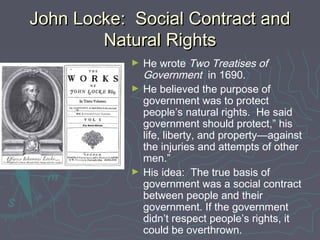
John Locke: Social Contract andJohn Locke: Social Contract and
Natural RightsNatural Rights
► He wrote Two Treatises of
Government in 1690.
► He believed the purpose of
government was to protect
people’s natural rights. He said
government should protect,” his
life, liberty, and property—against
the injuries and attempts of other
men.”
► His idea: The true basis of
government was a social contract
between people and their
government. If the government
didn’t respect people’s rights, it
could be overthrown.
John Locke: Social Contract andJohn Locke: Social Contract and
Natural RightsNatural Rights
►In exchange protection, people gave
government the power to rule on their
behalf. We call this idea the “consent of the
governed.”
►Lasting Impact:Lasting Impact: the idea that government
could be overthrown if it failed to respect
people’s rights had wide influence and was
ultimately echoed in the American
Declaration of Independence.
Locke’s ideas in EnglandLocke’s ideas in England
►Locke was in favor of constitutional
monarchies. This meant laws or a
constitution limited the power of the
monarchs (or kings).
►In 1689, the English set down a new set of
rules called the English Bill of Rights. This
strengthened the power of the people and
their representatives in Parliament (an
English congress.)
Whiteboard
• The following ideas come from the
Declaration of Independence and the U.S.
Constitution's Bill of Rights. Which most
closely relates to the work of John Locke?
• A. speedy and public trial
• B. innocent until proven guilty
• C. life, liberty and the pursuit of happiness
• D. Freedom of speech and the press
Whiteboard
• The following ideas come from the
Declaration of Independence and the U.S.
Constitution's Bill of Rights. Which most
closely relates to the work of John Locke?
• C. life, liberty and the pursuit of happiness
Whiteboard
• Approved in 1689, the new set of rights for
Parliament and the English people were
set down in the
• A. Magna Carta
• B. Orders of Parliament
• C. Laws of William & Mary
• D. English Bill of Rights
Whiteboard
• Approved in 1689, the new set of rights for
Parliament and the English people were
set down in the
D. English Bill of Rights
Montesquieu: Separation of PowersMontesquieu: Separation of Powers
► Like Locke, Montesquieu was concerned with howLike Locke, Montesquieu was concerned with how
to protect liberty from a bad government.to protect liberty from a bad government.
► He WroteHe Wrote The Spirit of LawsThe Spirit of Laws in 1748. In this book,in 1748. In this book,
he described how governments should behe described how governments should be
organized.organized.
► His idea: TheHis idea: The separation of powersseparation of powers : By: By
dividing different powers among more than onedividing different powers among more than one
branch of government, no one group in thebranch of government, no one group in the
government could grow too powerful.government could grow too powerful.
Montesquieu continued….Montesquieu continued….
► Each branch of government checked the otherEach branch of government checked the other
branches. When powers were not separated thisbranches. When powers were not separated this
way, Montesquieu warned, liberty was soon lost.way, Montesquieu warned, liberty was soon lost.
He said: “When the legislative and executive
powers are united in the same person…, there can
be no liberty.”
► Lasting Impact: He greatly influenced the men
who wrote the U.S. Constitution. We now have a
separate legislative (Congress), judicial (courts),
and executive (President) branch.
Whiteboard
If Baron de Montesquieu were to visit the
United States today, he might be most
pleased to see the
• A. Bill of Rights.
• B. Three branches of government.
• C. Government-run tax system.
• D. Declaration of Independence.
Whiteboard
If Baron de Montesquieu were to visit the
United States today, he might be most
pleased to see the
• B. Three branches of government.
Whiteboard Closing Questions
• What is it called when the people give up certain powers in return for
the benefits of government?
• A social contract
• What are rights that you have simply for being human?
• Natural rights
• What did Locke say these natural rights included?
• Life, Liberty, Property
• When we split the powers of government among three branches,
what is this called?
• Separation of Powers
• Who came up with that idea?
• Montesquieu
• If the government becomes corrupt, what does Locke say to do?
• Overthrow the government
Voltaire: Religious tolerance andVoltaire: Religious tolerance and
free speechfree speech
► Voltaire was an EnlightenmentVoltaire was an Enlightenment
writer.writer.
► His most famous novel wasHis most famous novel was
CandideCandide, in which he poked fun at, in which he poked fun at
old religious ideas.old religious ideas.
► Voltaire was especially concernedVoltaire was especially concerned
with freedom of thought andwith freedom of thought and
expression.expression.
► His ideaHis idea: He had a strong belief in: He had a strong belief in
religious tolerance and free speech.religious tolerance and free speech.
ToleranceTolerance means the acceptancemeans the acceptance
of different beliefs and customs.of different beliefs and customs.
Voltaire Continued…Voltaire Continued…
►Voltaire said, “I disapprove of what you say,Voltaire said, “I disapprove of what you say,
but I will defend to the death your right tobut I will defend to the death your right to
say it.”say it.”
►Lasting ImpactLasting Impact: Voltaire met Benjamin: Voltaire met Benjamin
Franklin, and when the U.S. Bill of RightsFranklin, and when the U.S. Bill of Rights
was written, the ideas of freedom of religionwas written, the ideas of freedom of religion
and freedom of speech were added to ourand freedom of speech were added to our
11stst
amendment to the Constitution.amendment to the Constitution.
Think/Pair/Share
• What does Voltaire mean when he says, “I
disapprove of what you say, but I will
defend to the death your right to say it.”?
• Do you agree with Voltaire? Why or why
not?
Whiteboard
• Which of the following statements would
most likely have been made by Voltaire?
A. "The king needs absolute power."
B. "The government protects people's natural
rights."
C. "We should do away with the death penalty."
D. "People must be free to speak their minds."
Whiteboard
• Which of the following statements would
most likely have been made by Voltaire?
D. "People must be free to speak their minds."
Cesare Beccaria: The Rights of theCesare Beccaria: The Rights of the
AccusedAccused
► In the Middle Ages,In the Middle Ages,
torture of criminals wastorture of criminals was
common. The rackcommon. The rack
was often used, aswas often used, as
well as devices likewell as devices like
thumbscrews.thumbscrews.
► Beccaria, an Italian,Beccaria, an Italian,
wrote a book calledwrote a book called OnOn
Crimes andCrimes and
PunishmentsPunishments in whichin which
he argued againsthe argued against
brutal punishments.brutal punishments.
Beccaria continued….Beccaria continued….
► His ideasHis ideas: A person accused of a crime should: A person accused of a crime should
receive a fair and speedy trial. Torture shouldreceive a fair and speedy trial. Torture should
never be used. Capital Punishment (deathnever be used. Capital Punishment (death
sentences) should be done away with.sentences) should be done away with.
► “For a punishment to be just it, should consist of
only such gradations of intensity as to suffice to
deter men from committing crimes.” This means
that “punishment should fit the crime” and not be
more than necessary to stop someone else from
doing it again.
Think/Pair/Share
• How were Beccaria’s ideas different from
the usual ways of treating prisoners in the
Middle Ages?
• What does the phrase, “the punishment
should fit the crime,” mean to you?
• Do you think this is important? Why or
why not?
Beccaria’s impactBeccaria’s impact
►Beccaria’s ideas were adopted straight intoBeccaria’s ideas were adopted straight into
our Constitution’s Bill of Rights. In fact ourour Constitution’s Bill of Rights. In fact our
88thth
amendment prevents “cruel and unusualamendment prevents “cruel and unusual
punishment” for crimes, and our 6punishment” for crimes, and our 6thth
amendment provides for a speedy trial.amendment provides for a speedy trial.
(The only exception is the Death Penalty,(The only exception is the Death Penalty,
which we still have in the United Stateswhich we still have in the United States
today.)today.)
Whiteboard closing questions
• What freedoms did Voltaire want for the people?
• Freedom of Religion and Speech
• What types of punishments was Beccaria
against?
• Torture and excessive punishment
• Where can we see examples of Voltaire’s ideas
in America?
• Bill of Rights, 1st
ammendment
• What idea of Beccaria’s did the U.S. NOT use?
• Getting rid of the death penalty
Learning ObjectiveLearning Objective
► Students will be able toStudents will be able to
describe howdescribe how
democratic thoughtsdemocratic thoughts
and governments wereand governments were
influenced by theinfluenced by the
Enlightenment.Enlightenment.
Impact of the Enlightenment onImpact of the Enlightenment on
GovernmentGovernment
►Modern views of government owe a greatModern views of government owe a great
deal to Enlightenment thinkers. Thedeal to Enlightenment thinkers. The
Enlightenment influenced monarchs inEnlightenment influenced monarchs in
Europe, especially "enlightened despots,"Europe, especially "enlightened despots,"
and greatly affected revolutions in Americaand greatly affected revolutions in America
and France.and France.
Enlightened Rule by MonarchsEnlightened Rule by Monarchs
► DespotDespot: a king or other ruler with absolute,: a king or other ruler with absolute,
unlimited power.unlimited power.
► The Enlightenment did not change EuropeThe Enlightenment did not change Europe
overnight. Many countries still had kings. Someovernight. Many countries still had kings. Some
of them became “enlightened despots” by usingof them became “enlightened despots” by using
enlightenment ideas in their countries.enlightenment ideas in their countries.
► Examples: Some kings ended the use of torture,Examples: Some kings ended the use of torture,
started universities, and used religious tolerance.started universities, and used religious tolerance.
They wanted to keep the people happy withoutThey wanted to keep the people happy without
losing their power.losing their power.
The American and FrenchThe American and French
RevolutionsRevolutions
► Both America and France had revolutionsBoth America and France had revolutions
overthrowing their kings. However, the revolutionoverthrowing their kings. However, the revolution
in France was much more violent.in France was much more violent.
Whiteboard
• The Enlightenment led to revolutions in
which two countries?
A. America and France
B. France and Ireland
C. England and Italy
D. America and Spain
Whiteboard
• The Enlightenment led to revolutions in
which two countries?
A. America and France
The Enlightenment in AmericaThe Enlightenment in America
► Enlightenment ideas had a major influence on theEnlightenment ideas had a major influence on the
leaders of the American Revolution. Englishleaders of the American Revolution. English
leaders in America shared with John Locke theleaders in America shared with John Locke the
traditions of the Magna Carta and the English Billtraditions of the Magna Carta and the English Bill
of Rights.of Rights.
► When the Americans rebelled in 1775, theyWhen the Americans rebelled in 1775, they
pointed to the abuse of their rights by the Englishpointed to the abuse of their rights by the English
king.king.
► The Declaration of Independence echoed Locke’sThe Declaration of Independence echoed Locke’s
ideas on natural rights and the purpose ofideas on natural rights and the purpose of
government.government.
““We the People”We the People”
► Other Enlightenment ideasOther Enlightenment ideas
can be seen in the U.S.can be seen in the U.S.
Constitution. America’sConstitution. America’s
basic law includesbasic law includes
Montesquieu’s idea ofMontesquieu’s idea of
separation of powers.separation of powers.
► The Bill of Rights protectsThe Bill of Rights protects
the freedom of religion andthe freedom of religion and
speech championed byspeech championed by
Voltaire. It also includesVoltaire. It also includes
some of the rightssome of the rights
supported by Beccaria,supported by Beccaria,
such as the right to asuch as the right to a
speedy trial.speedy trial.
Think/Pair/Share
• Name two Enlightenment ideas that are
included in our Declaration of
Independence, Constitution or Bill of
Rights.
• Which Enlightenment idea do you think is
the most important for us to follow in
America today? Why do you think that?
Enlightenment in FranceEnlightenment in France
►In 1789, revolution broke out in France.In 1789, revolution broke out in France.
The National Assembly adopted theThe National Assembly adopted the
Declaration of Rights of Man and Citizen.Declaration of Rights of Man and Citizen.
This document talked about liberty andThis document talked about liberty and
equality. It upheld the rights to ownequality. It upheld the rights to own
property, and freedom of speech andproperty, and freedom of speech and
religion.religion.
Violence of the FrenchViolence of the French
RevolutionRevolution
► Soon, however, terribleSoon, however, terrible
violence erupted.violence erupted.
Thousands of wealthyThousands of wealthy
Frenchmen and membersFrenchmen and members
of the Royal family wereof the Royal family were
beheaded on the guillotine.beheaded on the guillotine.
► Guillotine: a machine thatGuillotine: a machine that
cut off people’s heads bycut off people’s heads by
dropping a sharp blade.dropping a sharp blade.
► The bloody chaos broughtThe bloody chaos brought
a strange end to thea strange end to the
Enlightenment dreamEnlightenment dream
based on reason.based on reason.
Learning ObjectiveLearning Objective
► Students will be able toStudents will be able to
list the contributions oflist the contributions of
women to thewomen to the
Enlightenment.Enlightenment.
Women of the EnlightenmentWomen of the Enlightenment
►Several women, such as Madame Geoffrin,Several women, such as Madame Geoffrin,
Abigail Adams, Olympe de Gouges, andAbigail Adams, Olympe de Gouges, and
Mary Wollstonecraft, worked to extendMary Wollstonecraft, worked to extend
ideas of liberty and equality to women.ideas of liberty and equality to women.
►Once the ideas of the Enlightenment wereOnce the ideas of the Enlightenment were
expressed, women wanted these rights asexpressed, women wanted these rights as
well as men.well as men.
Whiteboard
• What was at the heart of women’s
contributions to the Enlightenment?
A. They wanted the abolition of slavery
B. They wanted women to have the same
rights as men
C. They wanted women to be absolute ruler
D. They wanted a separation of powers
Whiteboard
• What was at the heart of women’s
contributions to the Enlightenment?
B. They wanted women to have the same
rights as men
French Enlightenment WomenFrench Enlightenment Women
► Madame Geoffrin used her home for many of theMadame Geoffrin used her home for many of the
salon meetings in France. She not only hostedsalon meetings in France. She not only hosted
the meetings, but often directed the conversationsthe meetings, but often directed the conversations
and settled arguments.and settled arguments.
► Olympe de Gouges published the female versionOlympe de Gouges published the female version
of the document of the French Revolution. Sheof the document of the French Revolution. She
called it thecalled it the Declaration of the Rights of WomanDeclaration of the Rights of Woman
and the Female Citizen.and the Female Citizen. She called for equality inShe called for equality in
all things. When she spoke out against theall things. When she spoke out against the
bloodshed of the French Revolution, they sent herbloodshed of the French Revolution, they sent her
to the guillotine.to the guillotine.
Think/ Pair/Share
• Who were the two famous French women
of the Enlightenment?
Abigail AdamsAbigail Adams
► Wife to John Adams, whoWife to John Adams, who
was a leader of thewas a leader of the
American Revolution andAmerican Revolution and
later President.later President.
► She reminded John not toShe reminded John not to
forget women in theforget women in the
Revolution. “Remember,Revolution. “Remember,
all men would be tyranntsall men would be tyrannts
if they could. If particularif they could. If particular
care and attention is notcare and attention is not
paid to the Ladies, we arepaid to the Ladies, we are
determined to start adetermined to start a
rebellion…we will not holdrebellion…we will not hold
ourselves bound to anyourselves bound to any
Laws in which we have noLaws in which we have no
voice.”voice.”
Mary WollstonecraftMary Wollstonecraft
► An English writer. In 1792,An English writer. In 1792,
she argued that womenshe argued that women
deserved the same rightsdeserved the same rights
and opportunities as men.and opportunities as men.
► Wollstonecraft believedWollstonecraft believed
education was the key foreducation was the key for
women wanting equalitywomen wanting equality
and freedom. She inspiredand freedom. She inspired
many later leaders of themany later leaders of the
women’s rights movementwomen’s rights movement
in America.in America.
Think/ Pair/Share
• List the contributions of Mary
Wollstonecraft.

The enlightenment (2)

  • 1.
  • 2.
    Learning ObjectiveLearning Objective Day1Day 1 ► Students will be able toStudents will be able to define thedefine the Enlightenment and keyEnlightenment and key vocabulary, andvocabulary, and identify the historicalidentify the historical roots of this timeroots of this time period.period.
  • 3.
    Key VocabularyKey Vocabulary ►EnlightenmentEnlightenment: a period during the 1600s and: a period during the 1600s and 1700s in which educated Europeans changed their1700s in which educated Europeans changed their outlook on life by seeing reason as the key tooutlook on life by seeing reason as the key to human progress.human progress. ► Age of ReasonAge of Reason: another name for the: another name for the EnlightenmentEnlightenment ► SalonsSalons: in France, a simple meeting of: in France, a simple meeting of philosophers to discuss ideas during thephilosophers to discuss ideas during the EnlightenmentEnlightenment ► PhilosopherPhilosopher: a scholar or thinker: a scholar or thinker ► ReasonReason: Using logical thinking, not superstition: Using logical thinking, not superstition
  • 4.
    Roots of theEnlightenmentRoots of the Enlightenment ►The Enlightenment grew out of theThe Enlightenment grew out of the Renaissance, Reformation, and theRenaissance, Reformation, and the Scientific Revolution.Scientific Revolution. ►What’s the sameWhat’s the same?: Like all of these other?: Like all of these other movements, much Enlightenment thinkingmovements, much Enlightenment thinking challenged accepted beliefs.challenged accepted beliefs. ►What’s newWhat’s new?: Enlightenment philosophers?: Enlightenment philosophers wanted to use the ideas and reason of thewanted to use the ideas and reason of the Scientific Revolution for problems inScientific Revolution for problems in government and society.government and society.
  • 5.
    Think/Pair/Share • In whatways are the periods of the Renaissance, Reformation, and Scientific Revolution similar to the Enlightenment? • A’s share with B’s • B’s share with A’s • I will now choose someone to explain to the class. • Ans: They are similar because they all challenged accepted beliefs.
  • 6.
    Think/Pair/Share • In whatnew areas did Enlightenment philosophers want to use reason? • B’s share with A’s • A’s share with B’s • I will now choose someone to explain to the class. • Ans: They wanted to use reason for problems in government and society.
  • 7.
    Light out ofthe DarknessLight out of the Darkness ►A Frenchman, Bernard de Fontenelle,A Frenchman, Bernard de Fontenelle, expressed this optimistic faith in reason andexpressed this optimistic faith in reason and progress. In 1702, he wrote that the newprogress. In 1702, he wrote that the new century “will become more enlightened daycentury “will become more enlightened day by day, so that all previous centuries will beby day, so that all previous centuries will be lost in darkness by comparison.”lost in darkness by comparison.”
  • 8.
    The SalonsThe Salons ►In France, thinkers calledIn France, thinkers called philosophesphilosophes (French for(French for “philosophers”) championed the idea of reason in“philosophers”) championed the idea of reason in government.government. ► Philosophers often gathered in informal meetings,Philosophers often gathered in informal meetings, calledcalled salonssalons. There they exchanged and. There they exchanged and debated ideas for hours.debated ideas for hours. ► Many salons were organized by women.Many salons were organized by women. Gatherings like these helped to shape and spreadGatherings like these helped to shape and spread the ideas of the Enlightenment.the ideas of the Enlightenment. ► Think/Pair/Share: Describe the purpose of a salon.Think/Pair/Share: Describe the purpose of a salon.
  • 9.
    Why is thisimportant?Why is this important? ► Many of our own ideasMany of our own ideas about government, suchabout government, such as the Declaration ofas the Declaration of Independence and theIndependence and the American Constitution gotAmerican Constitution got their ideas directly from thetheir ideas directly from the Enlightenment.Enlightenment. ► In fact, many of America’sIn fact, many of America’s founding fathers studiedfounding fathers studied the ideas of thethe ideas of the Enlightenment thinkersEnlightenment thinkers during the Americanduring the American Revolution.Revolution. Left to right: Benjamin Franklin, John Adams, Thomas Jefferson
  • 10.
    Whiteboard • Which ofthese was greatly influenced by the Enlightenment? A. The mandate of Heaven B. The Magna Carta C. The Catholic Church D. The American Revolution
  • 11.
    Whiteboard • Which ofthese was greatly influenced by the Enlightenment? D. The American Revolution
  • 12.
    What a concept!Whata concept! ► Enlightenment thinkersEnlightenment thinkers rejected authority andrejected authority and upheld the freedom ofupheld the freedom of individuals to think forindividuals to think for themselves.themselves. ► Rene Descartes: “IRene Descartes: “I think, therefore I am.”think, therefore I am.”
  • 13.
    Enlightenment and GovernmentEnlightenmentand Government ► Enlightenment thinkers criticized accepted ideasEnlightenment thinkers criticized accepted ideas about government. Some questioned theabout government. Some questioned the medieval belief in themedieval belief in the divine right of kingsdivine right of kings [the[the idea that God chose a country’s king, and that theidea that God chose a country’s king, and that the king got his authority from God.]king got his authority from God.] ► Many Enlightenment thinkers stressed individualMany Enlightenment thinkers stressed individual rights that governments must respect.rights that governments must respect. ► Enlightenment thinkers also felt that people shouldEnlightenment thinkers also felt that people should have a say in their government.have a say in their government.
  • 14.
    Whiteboard • What old,medieval concept about government did Enlightenment thinkers reject? • Divine Right of Kings • Name one thing they did believe about government: • Possible answers: Individual rights, people having a say in government.
  • 15.
    Enlightenment and ReligionEnlightenmentand Religion ►Enlightenment thinkers believed humansEnlightenment thinkers believed humans were capable of discovering truth forwere capable of discovering truth for themselves.themselves. ►Many believed in an all powerful deity (orMany believed in an all powerful deity (or God), but not in a specific church or holyGod), but not in a specific church or holy book. Some called themselves Deistsbook. Some called themselves Deists [Dee-ists].[Dee-ists]. ►Right and Wrong should be based onRight and Wrong should be based on rational insight.rational insight.
  • 16.
    Whiteboard • In whatway was the Enlightenment similar to the Scientific Revolution? A. BOTH focused on government and society B. BOTH highly valued reason and observation. C. BOTH denied the existence of God. D. BOTH were unimportant.
  • 17.
    Whiteboard • In whatway was the Enlightenment similar to the Scientific Revolution? B. BOTH highly valued reason and observation.
  • 18.
    Whiteboard closing questions •What is another name for Enlightenment? • Age of Reason • Where would people meet to discuss ideas during the Enlightenment? • A salon • What is the period during the 1600s and 1700s in which educated Europeans changed their outlook on life by seeing reason as the key to human progress? • The Enlightenment • The Enlightenment took the reason of the Scientific Revolution and used it for_________ • Government
  • 19.
    Learning ObjectiveLearning Objective Days2-4Days 2-4 ► Students will be able toStudents will be able to describe the ideas ofdescribe the ideas of major Enlightenmentmajor Enlightenment thinkers.thinkers. ► Fill out the chart as theFill out the chart as the presentationpresentation progresses.progresses.
  • 20.
    Thomas HobbesThomas Hobbes ►Hobbes believed people are naturallyHobbes believed people are naturally selfish, cruel, and greedy.selfish, cruel, and greedy. ► In 1651, he published a book calledIn 1651, he published a book called LeviathanLeviathan. In this book, he wrote that. In this book, he wrote that people are driven by a restless desirepeople are driven by a restless desire for power.for power. ► Without laws, people would alwaysWithout laws, people would always be in conflict.be in conflict. ► In such a “state of nature”, life wouldIn such a “state of nature”, life would be “nasty, brutish, and short.”be “nasty, brutish, and short.” ► His ideaHis idea: Governments were created: Governments were created to protect people from their ownto protect people from their own selfishness.selfishness.
  • 21.
    Hobbes continued….Hobbes continued…. ►LaterEnlightenment thinkers might not haveLater Enlightenment thinkers might not have agreed with Hobbes…agreed with Hobbes… ►But, he was important because he was oneBut, he was important because he was one of the first thinkers to apply reason to theof the first thinkers to apply reason to the problem of politicsproblem of politics ►His ideas may sound harsh, but it wasHis ideas may sound harsh, but it was based on his own observations of humanbased on his own observations of human nature and reasoning.nature and reasoning.
  • 22.
    Think/Pair/Share • Hobbes’ ideasare based on the idea that people are naturally selfish. Do you agree with this? Why or why not? • What does Hobbes mean when he said that if there was no government, life would be “nasty, brutish, and short.”? • Do you agree with this idea? Tell your partner why or why not. Be prepared to share your answer with the class.
  • 23.
    Add these definitionsto yourAdd these definitions to your vocabulary listvocabulary list ► Social ContractSocial Contract: an agreement between people: an agreement between people and their government, in which people give upand their government, in which people give up some things in return for the benefit of havingsome things in return for the benefit of having government.government. ► Natural rightsNatural rights: rights that people have simply for: rights that people have simply for being human.being human. ► Bill of rightsBill of rights: a list of basic rights a government: a list of basic rights a government must protect.must protect. ► Constitutional MonarchyConstitutional Monarchy: a form of government in: a form of government in which the king’s power is limited by a basic set ofwhich the king’s power is limited by a basic set of laws, or Constitution.laws, or Constitution.
  • 24.
    Think/Pair/Share • Look atthe definition for natural rights. With your partner, list as many rights as you can think of on your whiteboards that you believe people have just for being human.
  • 25.
    John Locke: SocialContract andJohn Locke: Social Contract and Natural RightsNatural Rights ► He wrote Two Treatises of Government in 1690. ► He believed the purpose of government was to protect people’s natural rights. He said government should protect,” his life, liberty, and property—against the injuries and attempts of other men.” ► His idea: The true basis of government was a social contract between people and their government. If the government didn’t respect people’s rights, it could be overthrown.
  • 26.
    John Locke: SocialContract andJohn Locke: Social Contract and Natural RightsNatural Rights ►In exchange protection, people gave government the power to rule on their behalf. We call this idea the “consent of the governed.” ►Lasting Impact:Lasting Impact: the idea that government could be overthrown if it failed to respect people’s rights had wide influence and was ultimately echoed in the American Declaration of Independence.
  • 27.
    Locke’s ideas inEnglandLocke’s ideas in England ►Locke was in favor of constitutional monarchies. This meant laws or a constitution limited the power of the monarchs (or kings). ►In 1689, the English set down a new set of rules called the English Bill of Rights. This strengthened the power of the people and their representatives in Parliament (an English congress.)
  • 28.
    Whiteboard • The followingideas come from the Declaration of Independence and the U.S. Constitution's Bill of Rights. Which most closely relates to the work of John Locke? • A. speedy and public trial • B. innocent until proven guilty • C. life, liberty and the pursuit of happiness • D. Freedom of speech and the press
  • 29.
    Whiteboard • The followingideas come from the Declaration of Independence and the U.S. Constitution's Bill of Rights. Which most closely relates to the work of John Locke? • C. life, liberty and the pursuit of happiness
  • 30.
    Whiteboard • Approved in1689, the new set of rights for Parliament and the English people were set down in the • A. Magna Carta • B. Orders of Parliament • C. Laws of William & Mary • D. English Bill of Rights
  • 31.
    Whiteboard • Approved in1689, the new set of rights for Parliament and the English people were set down in the D. English Bill of Rights
  • 32.
    Montesquieu: Separation ofPowersMontesquieu: Separation of Powers ► Like Locke, Montesquieu was concerned with howLike Locke, Montesquieu was concerned with how to protect liberty from a bad government.to protect liberty from a bad government. ► He WroteHe Wrote The Spirit of LawsThe Spirit of Laws in 1748. In this book,in 1748. In this book, he described how governments should behe described how governments should be organized.organized. ► His idea: TheHis idea: The separation of powersseparation of powers : By: By dividing different powers among more than onedividing different powers among more than one branch of government, no one group in thebranch of government, no one group in the government could grow too powerful.government could grow too powerful.
  • 33.
    Montesquieu continued….Montesquieu continued…. ►Each branch of government checked the otherEach branch of government checked the other branches. When powers were not separated thisbranches. When powers were not separated this way, Montesquieu warned, liberty was soon lost.way, Montesquieu warned, liberty was soon lost. He said: “When the legislative and executive powers are united in the same person…, there can be no liberty.” ► Lasting Impact: He greatly influenced the men who wrote the U.S. Constitution. We now have a separate legislative (Congress), judicial (courts), and executive (President) branch.
  • 34.
    Whiteboard If Baron deMontesquieu were to visit the United States today, he might be most pleased to see the • A. Bill of Rights. • B. Three branches of government. • C. Government-run tax system. • D. Declaration of Independence.
  • 35.
    Whiteboard If Baron deMontesquieu were to visit the United States today, he might be most pleased to see the • B. Three branches of government.
  • 36.
    Whiteboard Closing Questions •What is it called when the people give up certain powers in return for the benefits of government? • A social contract • What are rights that you have simply for being human? • Natural rights • What did Locke say these natural rights included? • Life, Liberty, Property • When we split the powers of government among three branches, what is this called? • Separation of Powers • Who came up with that idea? • Montesquieu • If the government becomes corrupt, what does Locke say to do? • Overthrow the government
  • 37.
    Voltaire: Religious toleranceandVoltaire: Religious tolerance and free speechfree speech ► Voltaire was an EnlightenmentVoltaire was an Enlightenment writer.writer. ► His most famous novel wasHis most famous novel was CandideCandide, in which he poked fun at, in which he poked fun at old religious ideas.old religious ideas. ► Voltaire was especially concernedVoltaire was especially concerned with freedom of thought andwith freedom of thought and expression.expression. ► His ideaHis idea: He had a strong belief in: He had a strong belief in religious tolerance and free speech.religious tolerance and free speech. ToleranceTolerance means the acceptancemeans the acceptance of different beliefs and customs.of different beliefs and customs.
  • 38.
    Voltaire Continued…Voltaire Continued… ►Voltairesaid, “I disapprove of what you say,Voltaire said, “I disapprove of what you say, but I will defend to the death your right tobut I will defend to the death your right to say it.”say it.” ►Lasting ImpactLasting Impact: Voltaire met Benjamin: Voltaire met Benjamin Franklin, and when the U.S. Bill of RightsFranklin, and when the U.S. Bill of Rights was written, the ideas of freedom of religionwas written, the ideas of freedom of religion and freedom of speech were added to ourand freedom of speech were added to our 11stst amendment to the Constitution.amendment to the Constitution.
  • 39.
    Think/Pair/Share • What doesVoltaire mean when he says, “I disapprove of what you say, but I will defend to the death your right to say it.”? • Do you agree with Voltaire? Why or why not?
  • 40.
    Whiteboard • Which ofthe following statements would most likely have been made by Voltaire? A. "The king needs absolute power." B. "The government protects people's natural rights." C. "We should do away with the death penalty." D. "People must be free to speak their minds."
  • 41.
    Whiteboard • Which ofthe following statements would most likely have been made by Voltaire? D. "People must be free to speak their minds."
  • 42.
    Cesare Beccaria: TheRights of theCesare Beccaria: The Rights of the AccusedAccused ► In the Middle Ages,In the Middle Ages, torture of criminals wastorture of criminals was common. The rackcommon. The rack was often used, aswas often used, as well as devices likewell as devices like thumbscrews.thumbscrews. ► Beccaria, an Italian,Beccaria, an Italian, wrote a book calledwrote a book called OnOn Crimes andCrimes and PunishmentsPunishments in whichin which he argued againsthe argued against brutal punishments.brutal punishments.
  • 43.
    Beccaria continued….Beccaria continued…. ►His ideasHis ideas: A person accused of a crime should: A person accused of a crime should receive a fair and speedy trial. Torture shouldreceive a fair and speedy trial. Torture should never be used. Capital Punishment (deathnever be used. Capital Punishment (death sentences) should be done away with.sentences) should be done away with. ► “For a punishment to be just it, should consist of only such gradations of intensity as to suffice to deter men from committing crimes.” This means that “punishment should fit the crime” and not be more than necessary to stop someone else from doing it again.
  • 44.
    Think/Pair/Share • How wereBeccaria’s ideas different from the usual ways of treating prisoners in the Middle Ages? • What does the phrase, “the punishment should fit the crime,” mean to you? • Do you think this is important? Why or why not?
  • 45.
    Beccaria’s impactBeccaria’s impact ►Beccaria’sideas were adopted straight intoBeccaria’s ideas were adopted straight into our Constitution’s Bill of Rights. In fact ourour Constitution’s Bill of Rights. In fact our 88thth amendment prevents “cruel and unusualamendment prevents “cruel and unusual punishment” for crimes, and our 6punishment” for crimes, and our 6thth amendment provides for a speedy trial.amendment provides for a speedy trial. (The only exception is the Death Penalty,(The only exception is the Death Penalty, which we still have in the United Stateswhich we still have in the United States today.)today.)
  • 46.
    Whiteboard closing questions •What freedoms did Voltaire want for the people? • Freedom of Religion and Speech • What types of punishments was Beccaria against? • Torture and excessive punishment • Where can we see examples of Voltaire’s ideas in America? • Bill of Rights, 1st ammendment • What idea of Beccaria’s did the U.S. NOT use? • Getting rid of the death penalty
  • 47.
    Learning ObjectiveLearning Objective ►Students will be able toStudents will be able to describe howdescribe how democratic thoughtsdemocratic thoughts and governments wereand governments were influenced by theinfluenced by the Enlightenment.Enlightenment.
  • 48.
    Impact of theEnlightenment onImpact of the Enlightenment on GovernmentGovernment ►Modern views of government owe a greatModern views of government owe a great deal to Enlightenment thinkers. Thedeal to Enlightenment thinkers. The Enlightenment influenced monarchs inEnlightenment influenced monarchs in Europe, especially "enlightened despots,"Europe, especially "enlightened despots," and greatly affected revolutions in Americaand greatly affected revolutions in America and France.and France.
  • 49.
    Enlightened Rule byMonarchsEnlightened Rule by Monarchs ► DespotDespot: a king or other ruler with absolute,: a king or other ruler with absolute, unlimited power.unlimited power. ► The Enlightenment did not change EuropeThe Enlightenment did not change Europe overnight. Many countries still had kings. Someovernight. Many countries still had kings. Some of them became “enlightened despots” by usingof them became “enlightened despots” by using enlightenment ideas in their countries.enlightenment ideas in their countries. ► Examples: Some kings ended the use of torture,Examples: Some kings ended the use of torture, started universities, and used religious tolerance.started universities, and used religious tolerance. They wanted to keep the people happy withoutThey wanted to keep the people happy without losing their power.losing their power.
  • 50.
    The American andFrenchThe American and French RevolutionsRevolutions ► Both America and France had revolutionsBoth America and France had revolutions overthrowing their kings. However, the revolutionoverthrowing their kings. However, the revolution in France was much more violent.in France was much more violent.
  • 51.
    Whiteboard • The Enlightenmentled to revolutions in which two countries? A. America and France B. France and Ireland C. England and Italy D. America and Spain
  • 52.
    Whiteboard • The Enlightenmentled to revolutions in which two countries? A. America and France
  • 53.
    The Enlightenment inAmericaThe Enlightenment in America ► Enlightenment ideas had a major influence on theEnlightenment ideas had a major influence on the leaders of the American Revolution. Englishleaders of the American Revolution. English leaders in America shared with John Locke theleaders in America shared with John Locke the traditions of the Magna Carta and the English Billtraditions of the Magna Carta and the English Bill of Rights.of Rights. ► When the Americans rebelled in 1775, theyWhen the Americans rebelled in 1775, they pointed to the abuse of their rights by the Englishpointed to the abuse of their rights by the English king.king. ► The Declaration of Independence echoed Locke’sThe Declaration of Independence echoed Locke’s ideas on natural rights and the purpose ofideas on natural rights and the purpose of government.government.
  • 54.
    ““We the People”Wethe People” ► Other Enlightenment ideasOther Enlightenment ideas can be seen in the U.S.can be seen in the U.S. Constitution. America’sConstitution. America’s basic law includesbasic law includes Montesquieu’s idea ofMontesquieu’s idea of separation of powers.separation of powers. ► The Bill of Rights protectsThe Bill of Rights protects the freedom of religion andthe freedom of religion and speech championed byspeech championed by Voltaire. It also includesVoltaire. It also includes some of the rightssome of the rights supported by Beccaria,supported by Beccaria, such as the right to asuch as the right to a speedy trial.speedy trial.
  • 55.
    Think/Pair/Share • Name twoEnlightenment ideas that are included in our Declaration of Independence, Constitution or Bill of Rights. • Which Enlightenment idea do you think is the most important for us to follow in America today? Why do you think that?
  • 56.
    Enlightenment in FranceEnlightenmentin France ►In 1789, revolution broke out in France.In 1789, revolution broke out in France. The National Assembly adopted theThe National Assembly adopted the Declaration of Rights of Man and Citizen.Declaration of Rights of Man and Citizen. This document talked about liberty andThis document talked about liberty and equality. It upheld the rights to ownequality. It upheld the rights to own property, and freedom of speech andproperty, and freedom of speech and religion.religion.
  • 57.
    Violence of theFrenchViolence of the French RevolutionRevolution ► Soon, however, terribleSoon, however, terrible violence erupted.violence erupted. Thousands of wealthyThousands of wealthy Frenchmen and membersFrenchmen and members of the Royal family wereof the Royal family were beheaded on the guillotine.beheaded on the guillotine. ► Guillotine: a machine thatGuillotine: a machine that cut off people’s heads bycut off people’s heads by dropping a sharp blade.dropping a sharp blade. ► The bloody chaos broughtThe bloody chaos brought a strange end to thea strange end to the Enlightenment dreamEnlightenment dream based on reason.based on reason.
  • 58.
    Learning ObjectiveLearning Objective ►Students will be able toStudents will be able to list the contributions oflist the contributions of women to thewomen to the Enlightenment.Enlightenment.
  • 59.
    Women of theEnlightenmentWomen of the Enlightenment ►Several women, such as Madame Geoffrin,Several women, such as Madame Geoffrin, Abigail Adams, Olympe de Gouges, andAbigail Adams, Olympe de Gouges, and Mary Wollstonecraft, worked to extendMary Wollstonecraft, worked to extend ideas of liberty and equality to women.ideas of liberty and equality to women. ►Once the ideas of the Enlightenment wereOnce the ideas of the Enlightenment were expressed, women wanted these rights asexpressed, women wanted these rights as well as men.well as men.
  • 60.
    Whiteboard • What wasat the heart of women’s contributions to the Enlightenment? A. They wanted the abolition of slavery B. They wanted women to have the same rights as men C. They wanted women to be absolute ruler D. They wanted a separation of powers
  • 61.
    Whiteboard • What wasat the heart of women’s contributions to the Enlightenment? B. They wanted women to have the same rights as men
  • 62.
    French Enlightenment WomenFrenchEnlightenment Women ► Madame Geoffrin used her home for many of theMadame Geoffrin used her home for many of the salon meetings in France. She not only hostedsalon meetings in France. She not only hosted the meetings, but often directed the conversationsthe meetings, but often directed the conversations and settled arguments.and settled arguments. ► Olympe de Gouges published the female versionOlympe de Gouges published the female version of the document of the French Revolution. Sheof the document of the French Revolution. She called it thecalled it the Declaration of the Rights of WomanDeclaration of the Rights of Woman and the Female Citizen.and the Female Citizen. She called for equality inShe called for equality in all things. When she spoke out against theall things. When she spoke out against the bloodshed of the French Revolution, they sent herbloodshed of the French Revolution, they sent her to the guillotine.to the guillotine.
  • 63.
    Think/ Pair/Share • Whowere the two famous French women of the Enlightenment?
  • 64.
    Abigail AdamsAbigail Adams ►Wife to John Adams, whoWife to John Adams, who was a leader of thewas a leader of the American Revolution andAmerican Revolution and later President.later President. ► She reminded John not toShe reminded John not to forget women in theforget women in the Revolution. “Remember,Revolution. “Remember, all men would be tyranntsall men would be tyrannts if they could. If particularif they could. If particular care and attention is notcare and attention is not paid to the Ladies, we arepaid to the Ladies, we are determined to start adetermined to start a rebellion…we will not holdrebellion…we will not hold ourselves bound to anyourselves bound to any Laws in which we have noLaws in which we have no voice.”voice.”
  • 65.
    Mary WollstonecraftMary Wollstonecraft ►An English writer. In 1792,An English writer. In 1792, she argued that womenshe argued that women deserved the same rightsdeserved the same rights and opportunities as men.and opportunities as men. ► Wollstonecraft believedWollstonecraft believed education was the key foreducation was the key for women wanting equalitywomen wanting equality and freedom. She inspiredand freedom. She inspired many later leaders of themany later leaders of the women’s rights movementwomen’s rights movement in America.in America.
  • 66.
    Think/ Pair/Share • Listthe contributions of Mary Wollstonecraft.