Notes: Newton’s Laws of Motion CW: Action-Reaction Forces
Newton’s  Laws of Motion March 18, 2009
Objectives Explain the three laws of motion
1 st  Law of Motion  (Law of Inertia) An object at rest will stay at rest, and an object in motion will stay in motion traveling in a straight line, unless acted upon by an unbalanced force.
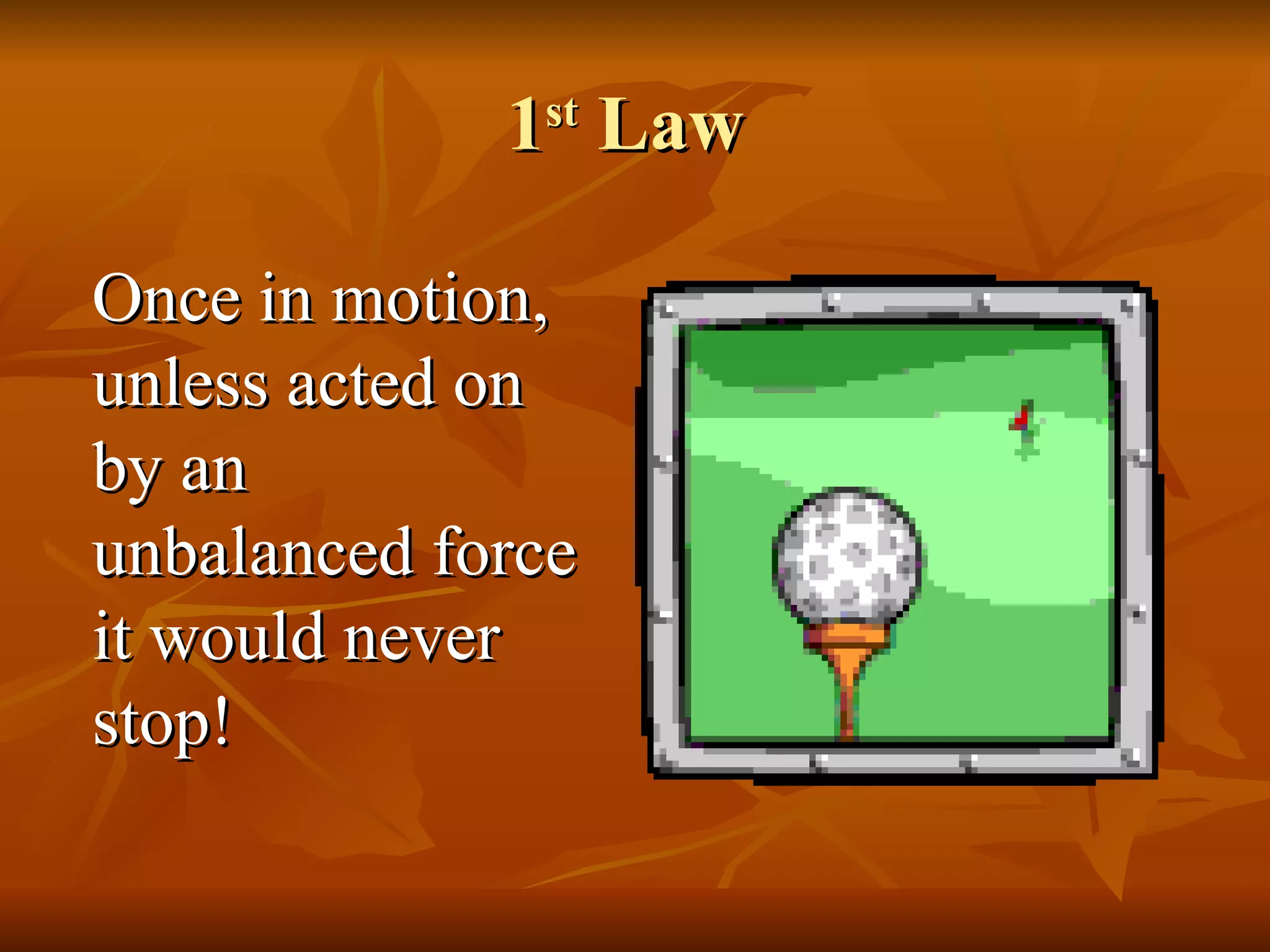
1 st  Law  Once in motion, unless acted on by an unbalanced force it would never stop!
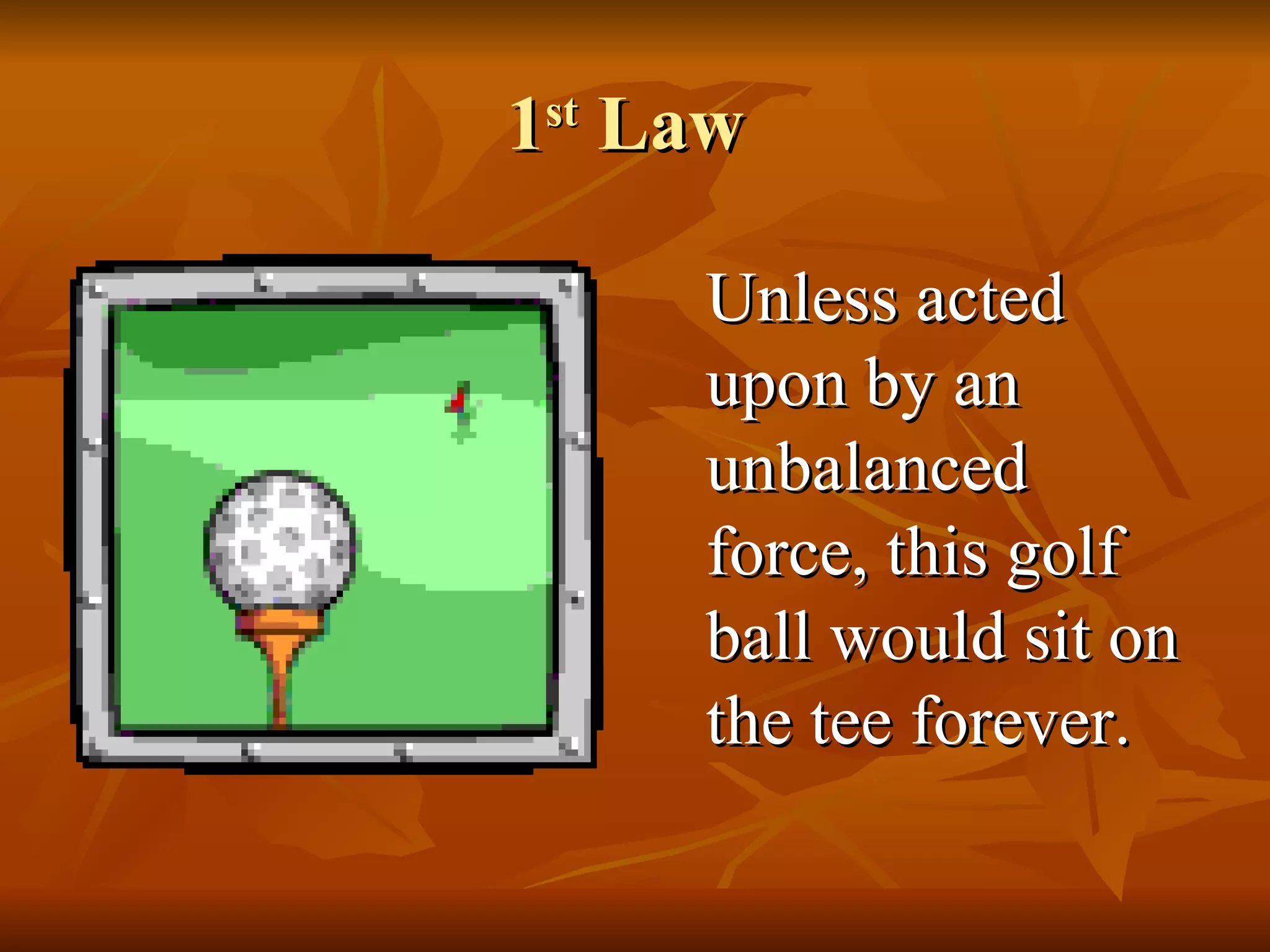
1 st  Law  Unless acted upon by an unbalanced force, this golf ball would sit on the tee forever.
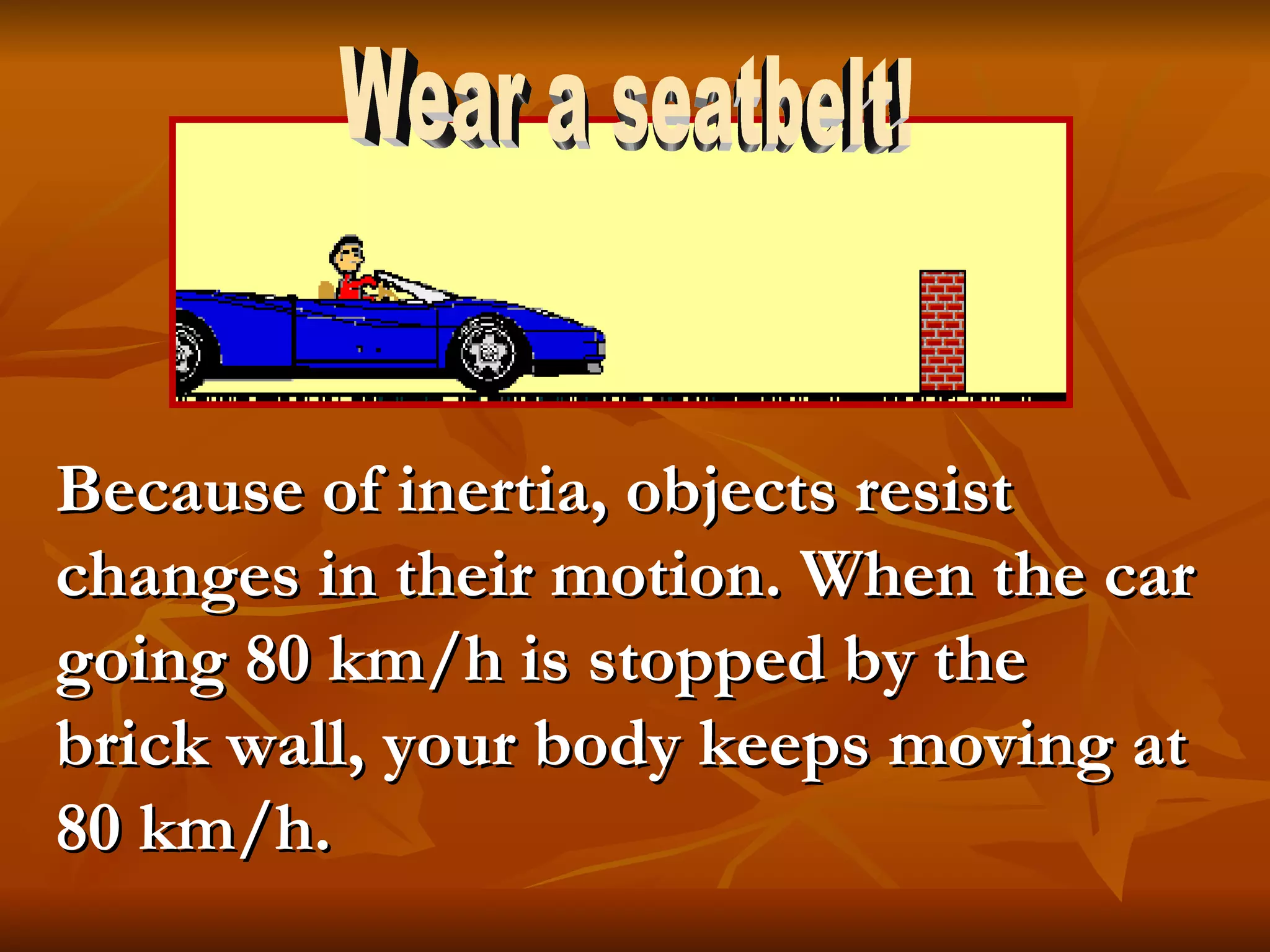
Because of inertia, objects resist changes in their motion. When the car going 80 km/h is stopped by the brick wall, your body keeps moving at 80 km/h. Wear a seatbelt!
Why then, do we observe every day objects in motion slowing down and becoming motionless seemingly without an outside force?
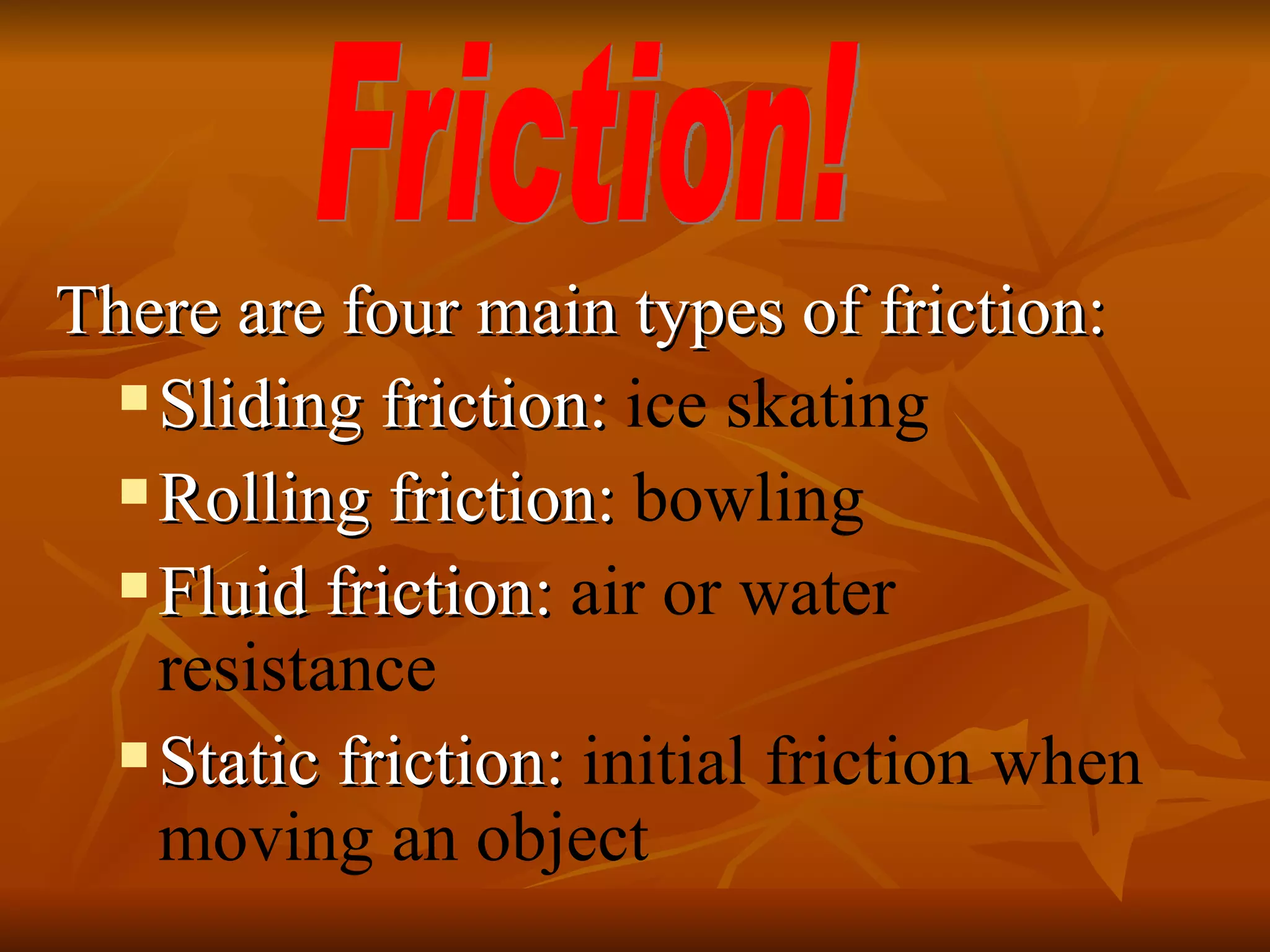
There are four main types of friction: Sliding friction:  ice skating Rolling friction:  bowling Fluid friction:  air or water resistance Static friction:  initial friction when moving an object Friction!
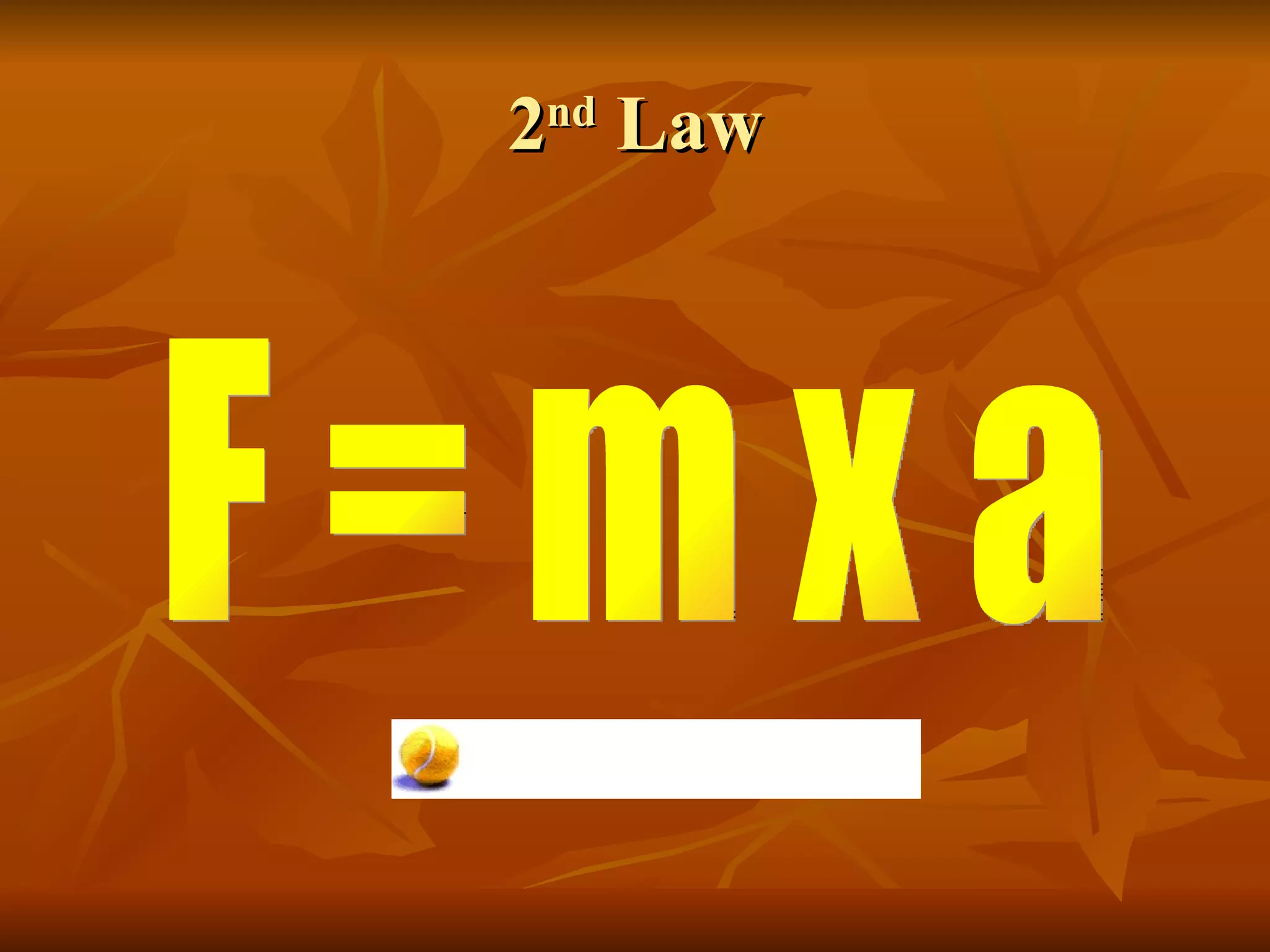
2 nd  Law F = m x a
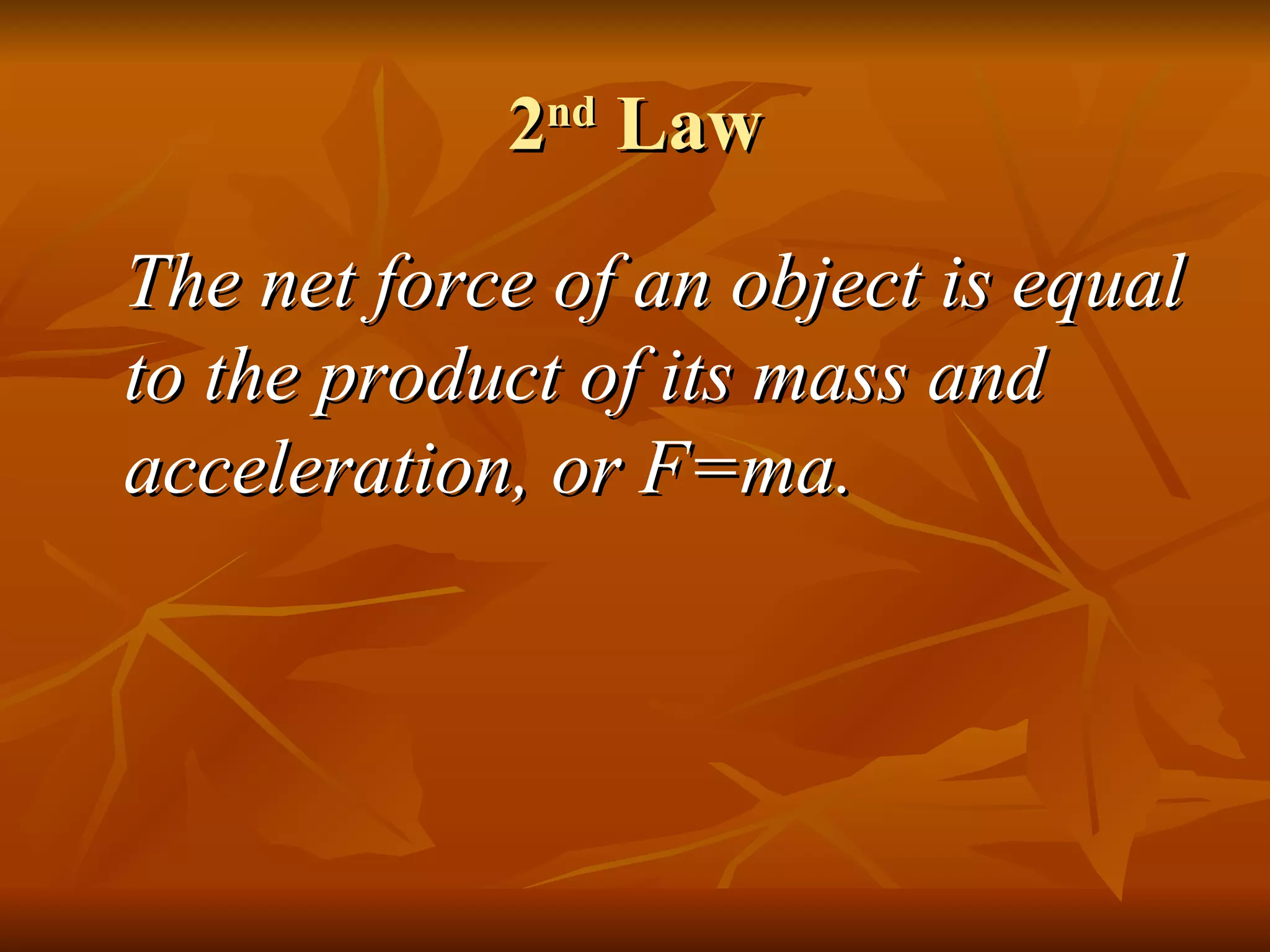
2 nd  Law The net force of an object is equal to the product of its mass and acceleration, or F=ma.
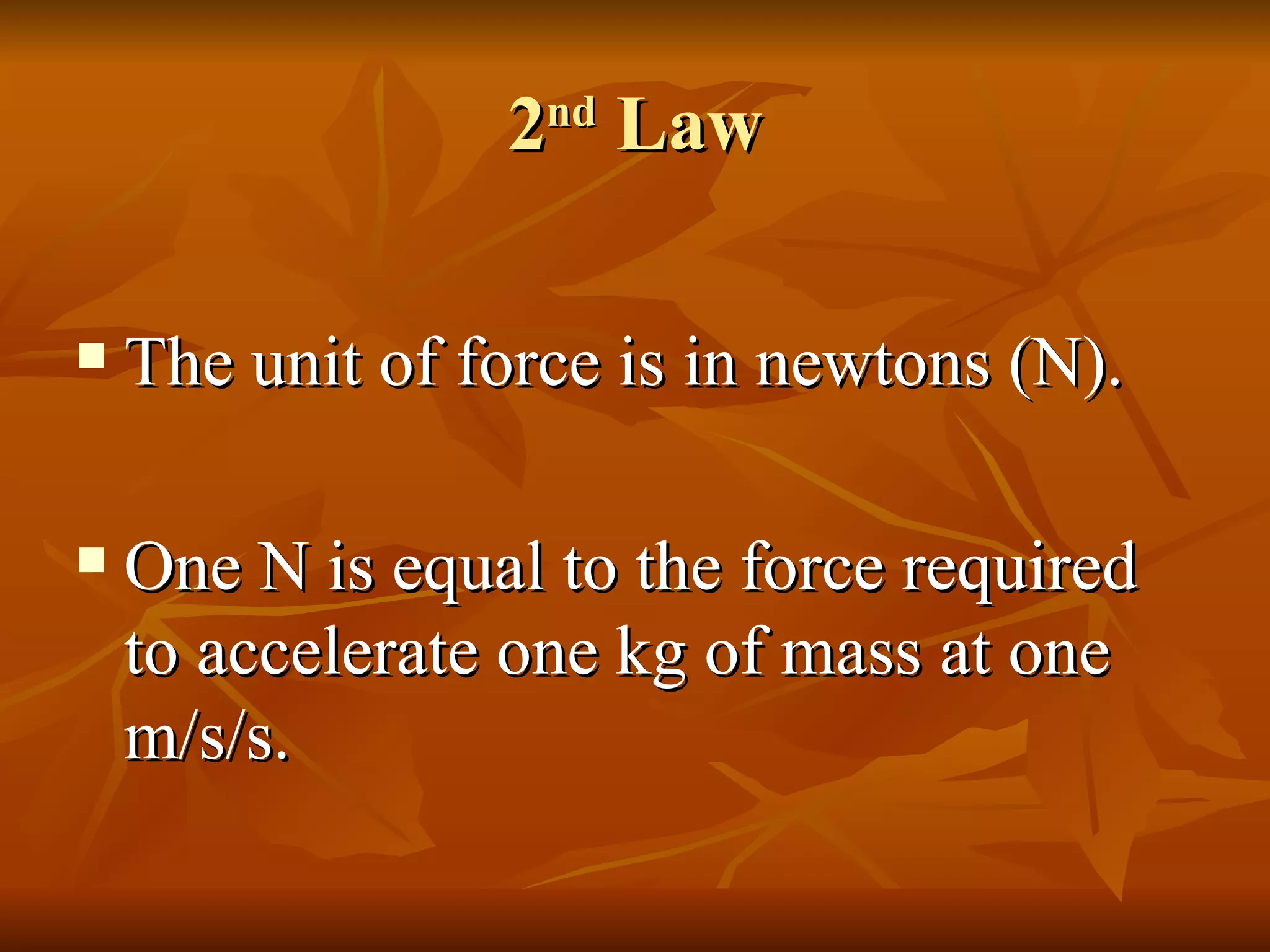
2 nd  Law The unit of force is in newtons (N). One N is equal to the force required to accelerate one kg of mass at one m/s/s.
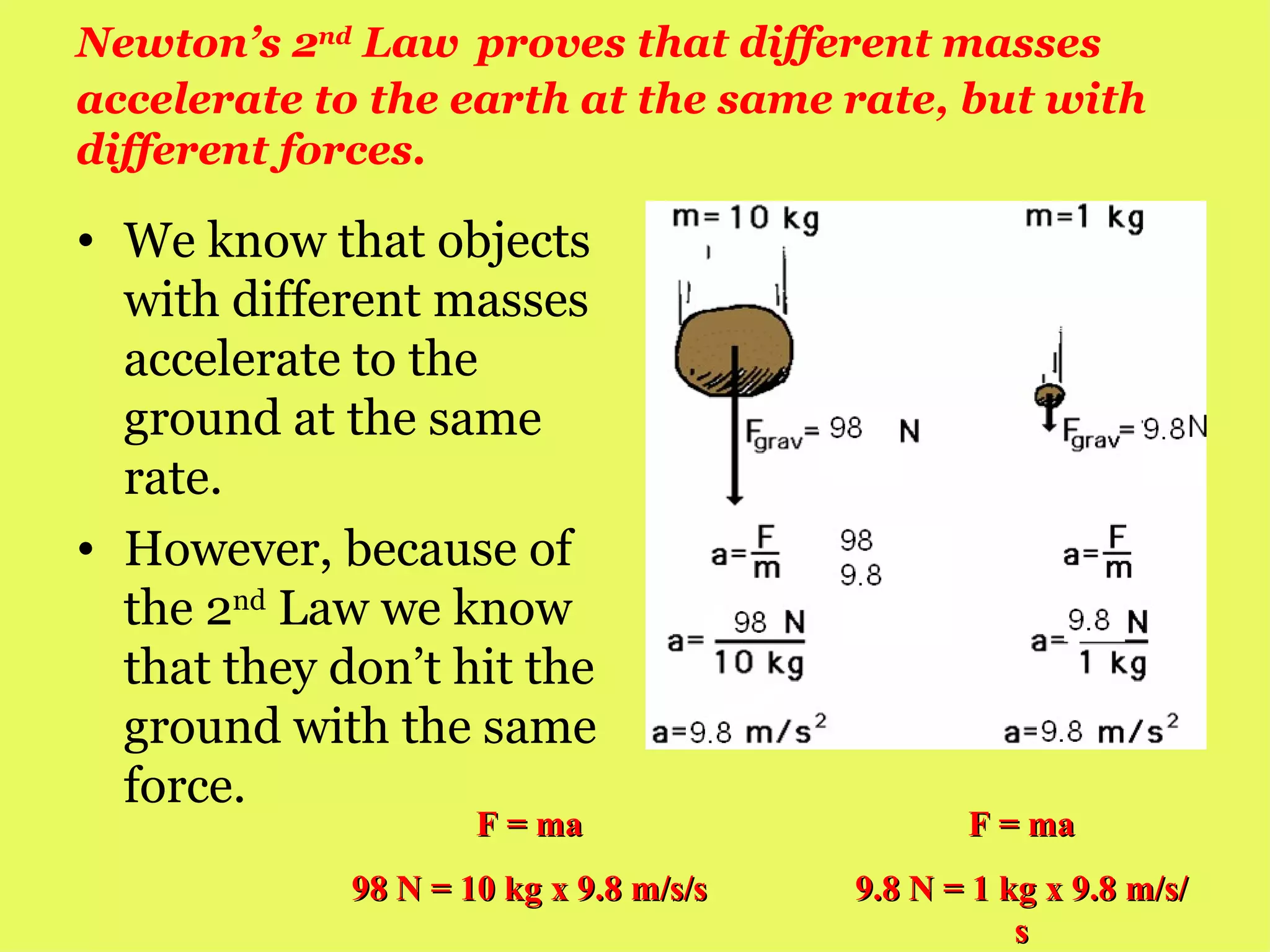
Newton’s 2 nd  Law   proves that different masses accelerate to the earth at the same rate, but with different forces. We know that objects with different masses accelerate to the ground at the same rate. However, because of the 2 nd  Law we know that they don’t hit the ground with the same force. F = ma 98 N = 10 kg x 9.8 m/s/s F = ma 9.8 N = 1 kg x 9.8 m/s/s
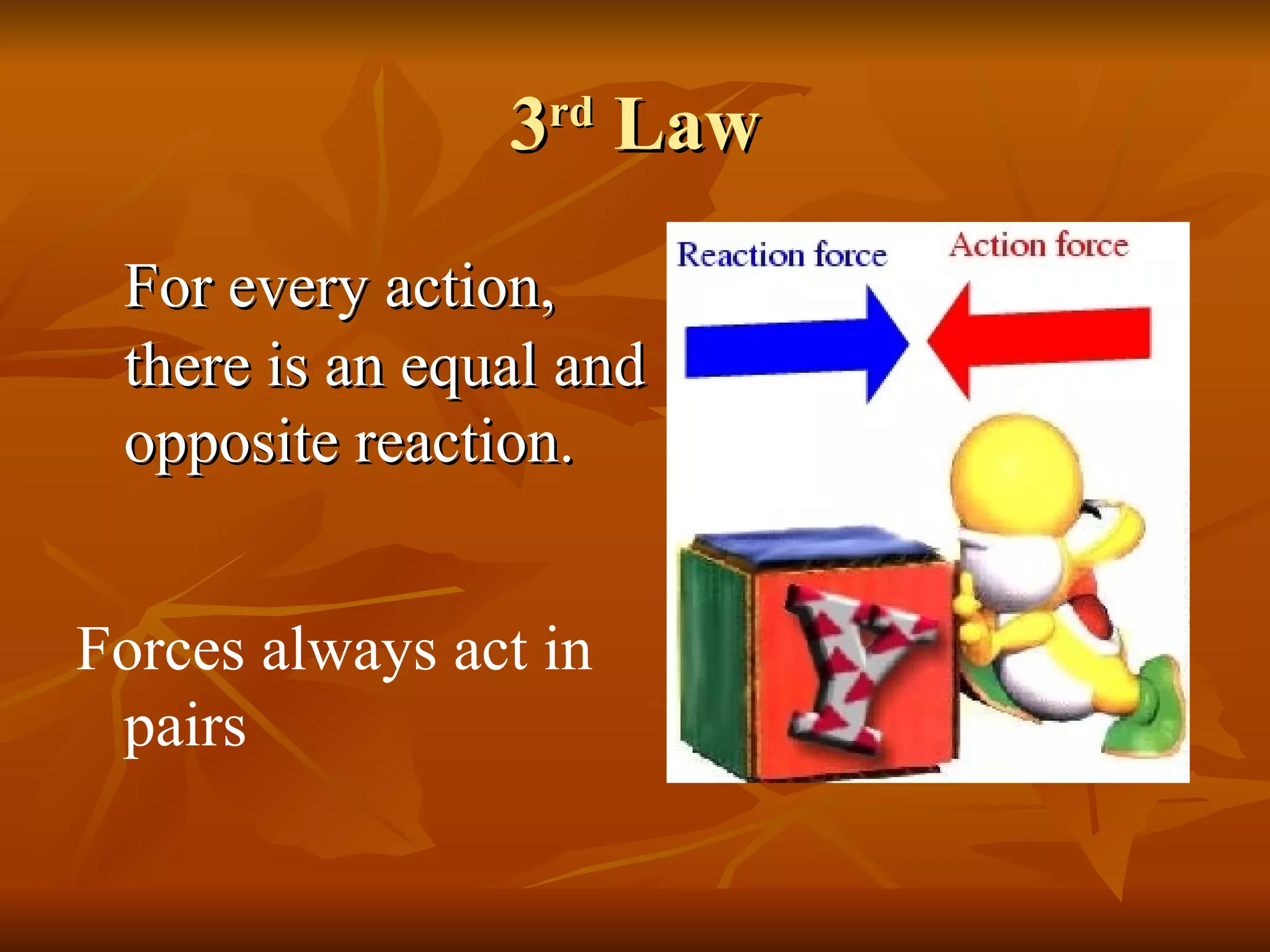
3 rd  Law For every action, there is an equal and opposite reaction. Forces always act in pairs
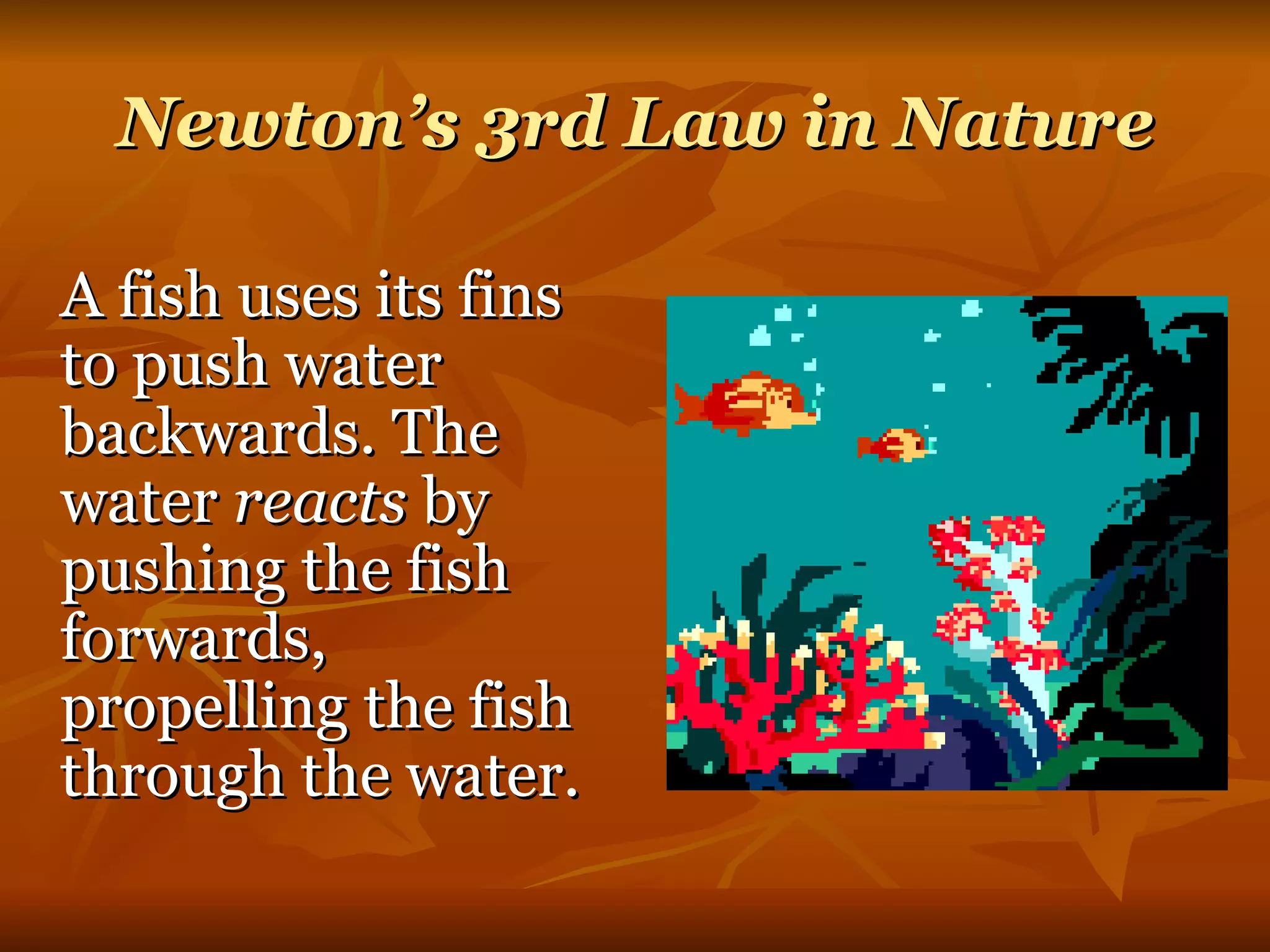
Newton’s 3rd Law in Nature A fish uses its fins to push water backwards. The water  reacts  by pushing the fish forwards, propelling the fish through the water.
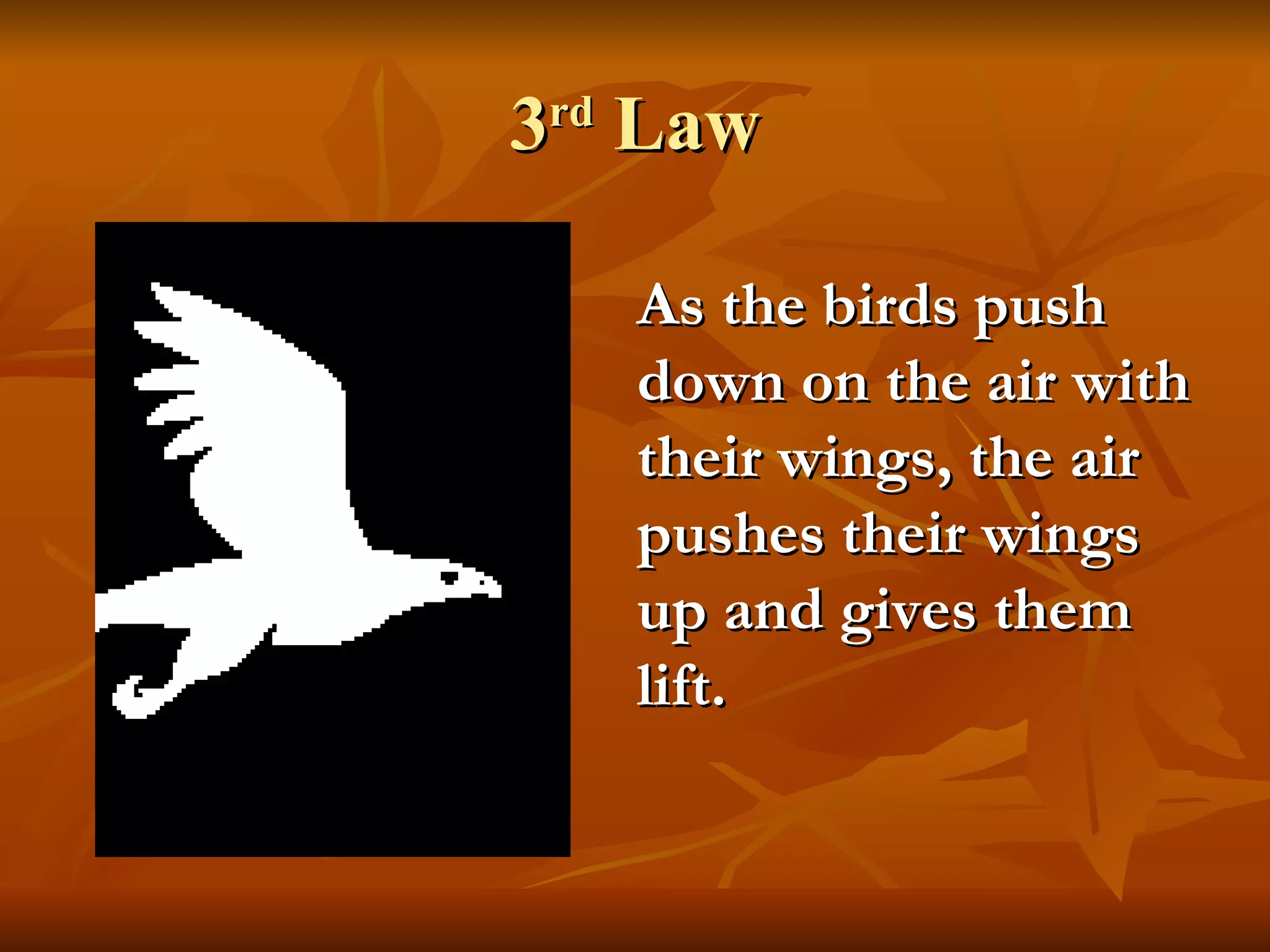
3 rd  Law As the birds push down on the air with their wings, the air pushes their wings up and gives them lift.
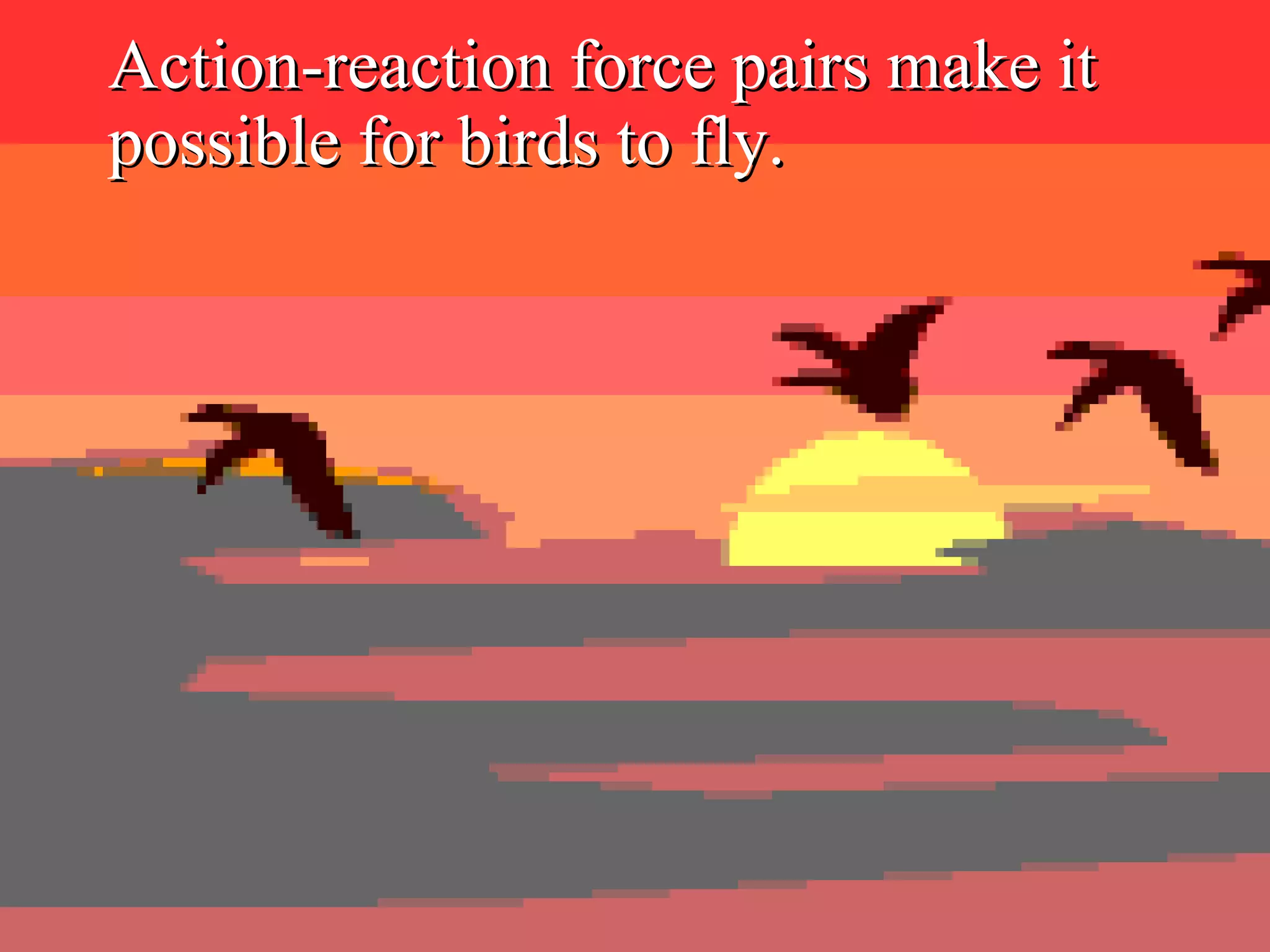
Action-reaction force pairs make it possible for birds to fly.
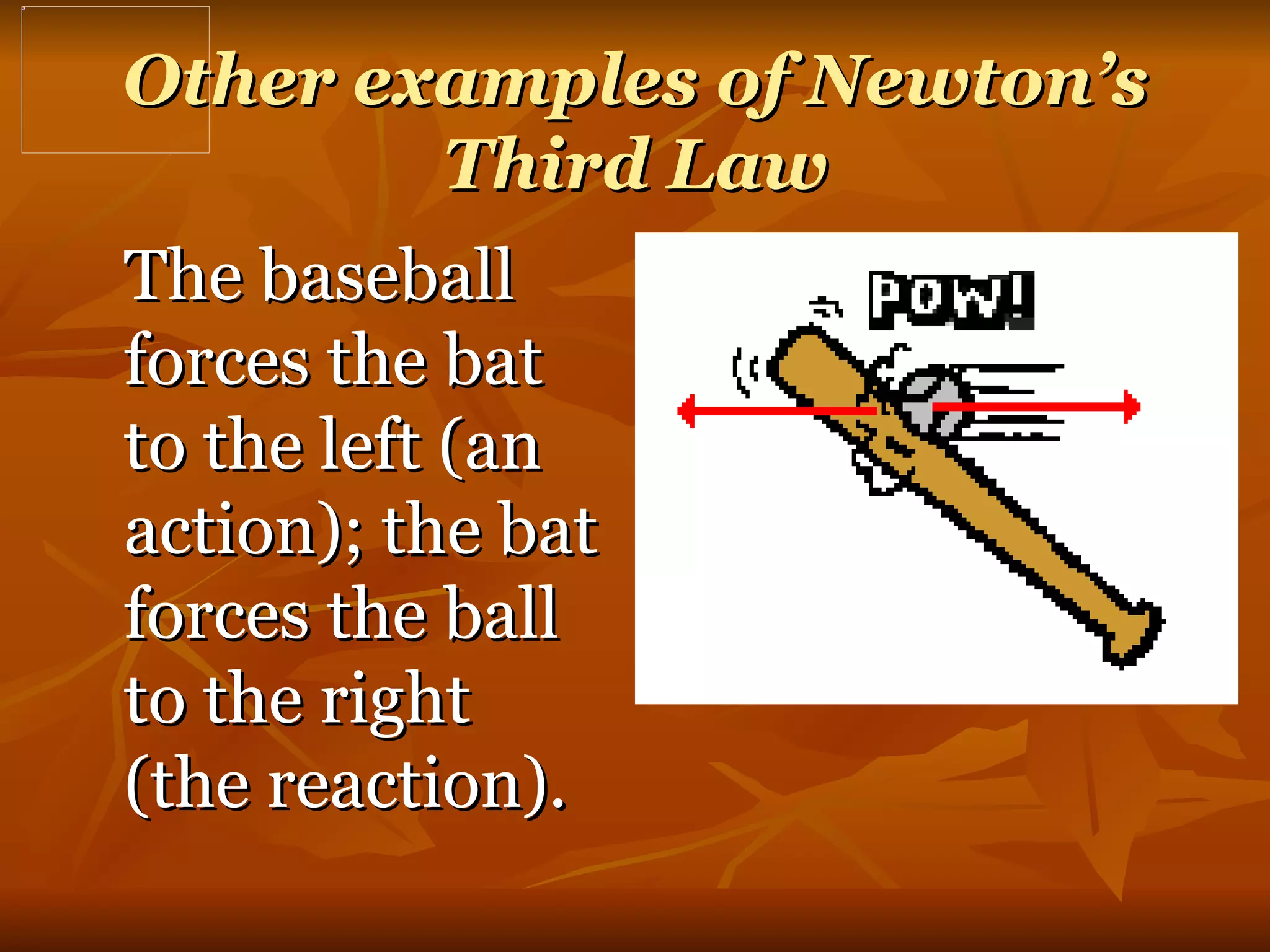
Other examples of Newton’s Third Law The baseball forces the bat to the left (an action); the bat forces the ball to the right (the reaction).
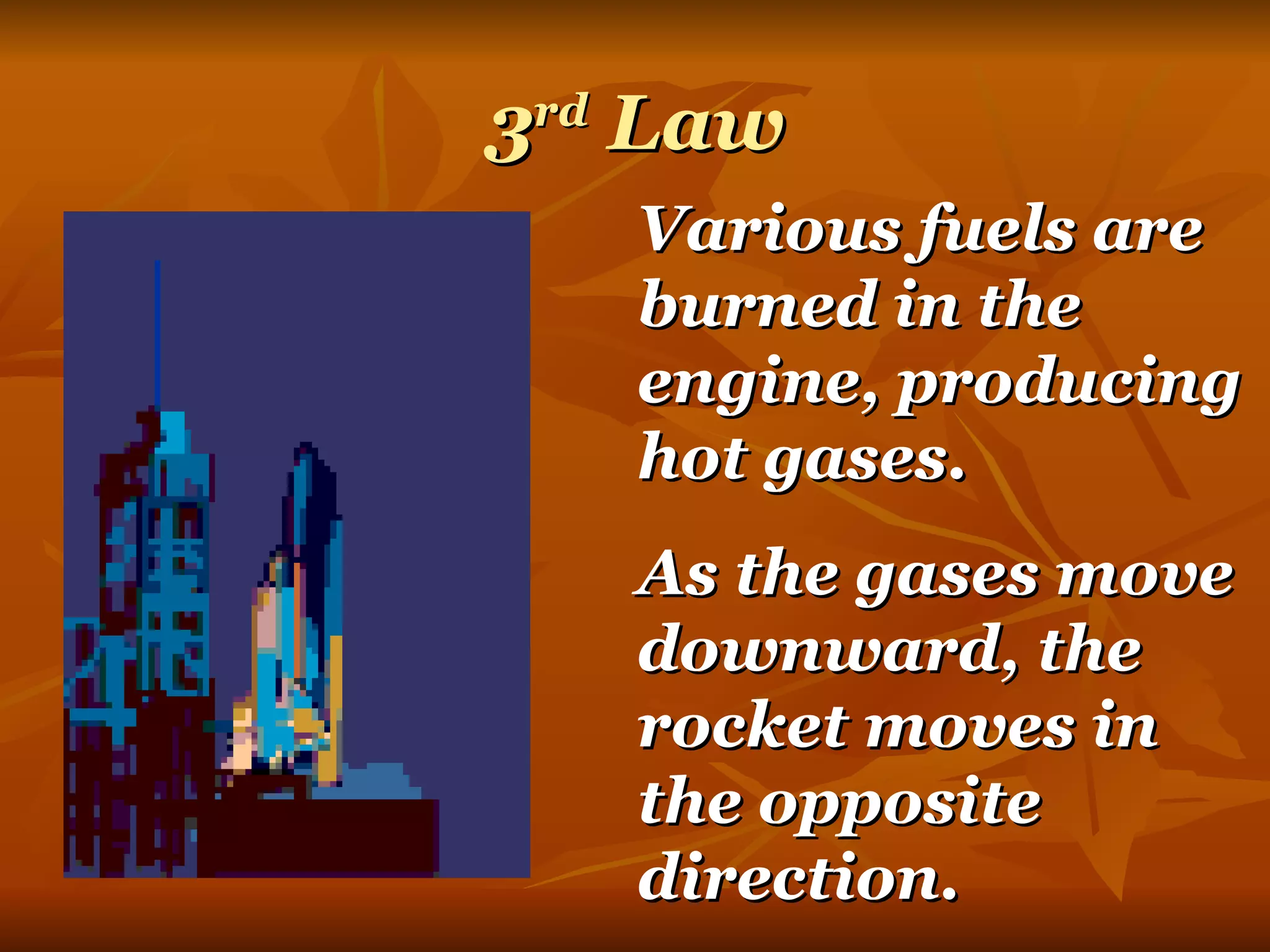
3 rd  Law Various fuels are burned in the engine, producing hot gases.  As the gases move downward, the rocket moves in the opposite direction.
 

Newtons Laws Of Motion2008

  • 1.
    Notes: Newton’s Lawsof Motion CW: Action-Reaction Forces
  • 2.
    Newton’s Lawsof Motion March 18, 2009
  • 3.
    Objectives Explain thethree laws of motion
  • 4.
    1 st Law of Motion (Law of Inertia) An object at rest will stay at rest, and an object in motion will stay in motion traveling in a straight line, unless acted upon by an unbalanced force.
  • 5.
    1 st Law Once in motion, unless acted on by an unbalanced force it would never stop!
  • 6.
    1 st Law Unless acted upon by an unbalanced force, this golf ball would sit on the tee forever.
  • 7.
    Because of inertia,objects resist changes in their motion. When the car going 80 km/h is stopped by the brick wall, your body keeps moving at 80 km/h. Wear a seatbelt!
  • 8.
    Why then, dowe observe every day objects in motion slowing down and becoming motionless seemingly without an outside force?
  • 9.
    There are fourmain types of friction: Sliding friction: ice skating Rolling friction: bowling Fluid friction: air or water resistance Static friction: initial friction when moving an object Friction!
  • 10.
    2 nd Law F = m x a
  • 11.
    2 nd Law The net force of an object is equal to the product of its mass and acceleration, or F=ma.
  • 12.
    2 nd Law The unit of force is in newtons (N). One N is equal to the force required to accelerate one kg of mass at one m/s/s.
  • 13.
    Newton’s 2 nd Law proves that different masses accelerate to the earth at the same rate, but with different forces. We know that objects with different masses accelerate to the ground at the same rate. However, because of the 2 nd Law we know that they don’t hit the ground with the same force. F = ma 98 N = 10 kg x 9.8 m/s/s F = ma 9.8 N = 1 kg x 9.8 m/s/s
  • 14.
    3 rd Law For every action, there is an equal and opposite reaction. Forces always act in pairs
  • 15.
    Newton’s 3rd Lawin Nature A fish uses its fins to push water backwards. The water reacts by pushing the fish forwards, propelling the fish through the water.
  • 16.
    3 rd Law As the birds push down on the air with their wings, the air pushes their wings up and gives them lift.
  • 17.
    Action-reaction force pairsmake it possible for birds to fly.
  • 18.
    Other examples ofNewton’s Third Law The baseball forces the bat to the left (an action); the bat forces the ball to the right (the reaction).
  • 19.
    3 rd Law Various fuels are burned in the engine, producing hot gases. As the gases move downward, the rocket moves in the opposite direction.
  • 20.