ENDOTRACHEAL INTUBATION
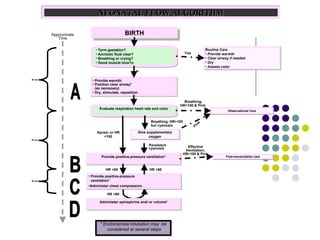
NEONATAL FLOW ALGORITHM BIRTH Term gestation? Amnlotic fluid clear? Breathing or crying? Good muscle tone?u Provide warmth Position clear airway*  (as necessary) Dry, stimulate, reposition Routine Care Provide warmth Clear airway if needed Dry Assess color Evaluate respiration heart rate and color Give supplementary oxygen Observational Care Provide positive-pressure ventilation* Post-resuscitation care Provide positive-pressure  ventilation* Administer chest compression  Administer epinephrine and/ or volume* * Endotracheal intubation may  be considered at several steps HR <60 HR <60 HR >60 Persistent cyanosis  Effective Ventilation, HR>100 & Pink Pink  Breathing, HR>100 but cyanosis  Breathing, HR>100 & Pink  Yes No Apneic or HR <100 Approximate Time A B C D 30 sec 30 sec 30 sec
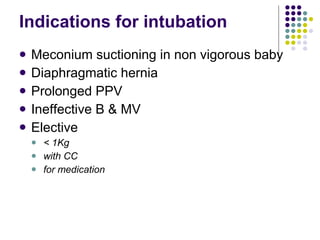
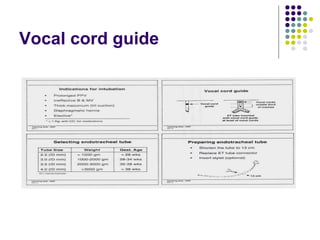
Indications for intubation Meconium suctioning in non vigorous baby Diaphragmatic hernia Prolonged PPV Ineffective B & MV Elective < 1Kg with CC for medication
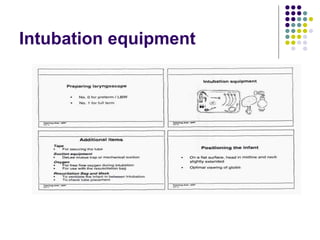
Intubation equipment
Preparing laryngoscope No. 1 for full term No. 0 for preterm / LBW No. 00 for extremely preterm (optional)
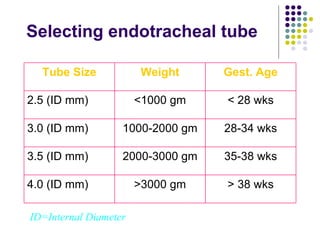
Selecting endotracheal tube ID=Internal Diameter > 38 wks >3000 gm 4.0 (ID mm) 35-38 wks 2000-3000 gm 3.5 (ID mm) 28-34 wks 1000-2000 gm 3.0 (ID mm) < 28 wks <1000 gm 2.5 (ID mm) Gest. Age Weight Tube Size
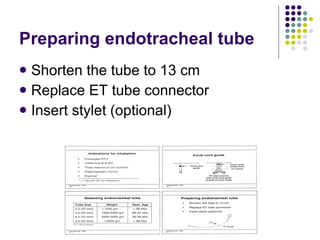
Preparing endotracheal tube Shorten the tube to 13 cm Replace ET tube connector Insert stylet (optional)
Additional items Tape For securing the tube Suction equipment DeLee mucus trap or mechanical suction Oxygen For free flow oxygen during intubation For Use with the resuscitation bag Resuscitation Bag and Mask To ventilate the infant in between intubation To check tube placement
Positioning the infant On a flat surface, head in midline and neck slightly extended Optimal viewing of glottis
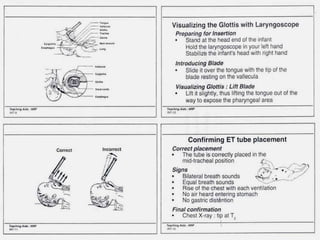
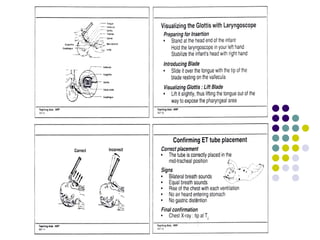
Visualizing the Glottis with Laryngoscope Preparing for insertion Stand at the head end of the infant Hold the laryngoscope in your left hand Stabilize the infant’s head with right hand Introducing Blade Slide it over the tongue with the tip of the blade resting on the vallecula Visualizing Glottis : Lift Blade Lift it slightly, thus lifting the tongue out of the way to expose the pharyngeal area
 
 
Vocal cord guide
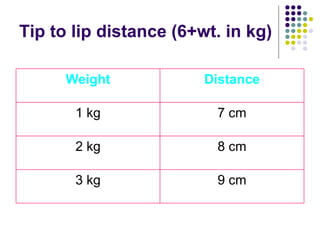
Tip to lip distance (6+wt. in kg) 9 cm 3 kg 8 cm 2 kg 7 cm 1 kg Distance Weight
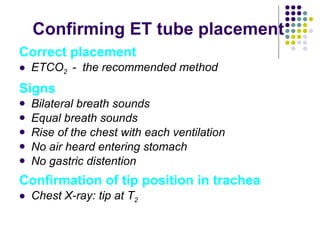
Confirming ET tube placement Correct placement ETCO 2  -  the recommended method Signs Bilateral breath sounds Equal breath sounds Rise of the chest with each ventilation No air heard entering stomach No gastric distention Confirmation of tip position in trachea Chest X-ray: tip at T 2
Tube in Rt. Main bronchus Breath sounds only on right chest No air heard entering stomach No gastric distention Action: Withdraw the tube, recheck
Tube in esophagus No breath sounds heard Air heard entering stomach Gastric distention may be seen No mist in tube No CO 2  in exhaled air Action : Remove the tube, oxygen the infant with a bag and mask, reintroduce ET tube
Three actions after intubation 1. Note the cm. Mark on the tube at level of the upper lip 2. Secure the tube to the infant’s face 3. Shorten tube 4 cm. from the lip margin
Complications of intubation Hypoxia Bradycardia Apnea Pneumothorax Soft tissue injury Infection
Minimizing hypoxia during intubation Providing free-flow oxygen (Assistant’s responsibility) Limiting each intubation attempt to 20 seconds
LMA – its role in neonatal resuscitation Effective for ventilation during resuscitation in term and near term newborns Used by trained care providers NOT TO BE USED IN: In the setting of meconium stained amniotic fluid When chest compression is required In VLBW babies For delivery of medications

Newborn intubation

  • 1.
  • 2.
    NEONATAL FLOW ALGORITHMBIRTH Term gestation? Amnlotic fluid clear? Breathing or crying? Good muscle tone?u Provide warmth Position clear airway* (as necessary) Dry, stimulate, reposition Routine Care Provide warmth Clear airway if needed Dry Assess color Evaluate respiration heart rate and color Give supplementary oxygen Observational Care Provide positive-pressure ventilation* Post-resuscitation care Provide positive-pressure ventilation* Administer chest compression Administer epinephrine and/ or volume* * Endotracheal intubation may be considered at several steps HR <60 HR <60 HR >60 Persistent cyanosis Effective Ventilation, HR>100 & Pink Pink Breathing, HR>100 but cyanosis Breathing, HR>100 & Pink Yes No Apneic or HR <100 Approximate Time A B C D 30 sec 30 sec 30 sec
  • 3.
    Indications for intubationMeconium suctioning in non vigorous baby Diaphragmatic hernia Prolonged PPV Ineffective B & MV Elective < 1Kg with CC for medication
  • 4.
  • 5.
    Preparing laryngoscope No.1 for full term No. 0 for preterm / LBW No. 00 for extremely preterm (optional)
  • 6.
    Selecting endotracheal tubeID=Internal Diameter > 38 wks >3000 gm 4.0 (ID mm) 35-38 wks 2000-3000 gm 3.5 (ID mm) 28-34 wks 1000-2000 gm 3.0 (ID mm) < 28 wks <1000 gm 2.5 (ID mm) Gest. Age Weight Tube Size
  • 7.
    Preparing endotracheal tubeShorten the tube to 13 cm Replace ET tube connector Insert stylet (optional)
  • 8.
    Additional items TapeFor securing the tube Suction equipment DeLee mucus trap or mechanical suction Oxygen For free flow oxygen during intubation For Use with the resuscitation bag Resuscitation Bag and Mask To ventilate the infant in between intubation To check tube placement
  • 9.
    Positioning the infantOn a flat surface, head in midline and neck slightly extended Optimal viewing of glottis
  • 10.
    Visualizing the Glottiswith Laryngoscope Preparing for insertion Stand at the head end of the infant Hold the laryngoscope in your left hand Stabilize the infant’s head with right hand Introducing Blade Slide it over the tongue with the tip of the blade resting on the vallecula Visualizing Glottis : Lift Blade Lift it slightly, thus lifting the tongue out of the way to expose the pharyngeal area
  • 11.
  • 12.
  • 13.
  • 14.
    Tip to lipdistance (6+wt. in kg) 9 cm 3 kg 8 cm 2 kg 7 cm 1 kg Distance Weight
  • 15.
    Confirming ET tubeplacement Correct placement ETCO 2 - the recommended method Signs Bilateral breath sounds Equal breath sounds Rise of the chest with each ventilation No air heard entering stomach No gastric distention Confirmation of tip position in trachea Chest X-ray: tip at T 2
  • 16.
    Tube in Rt.Main bronchus Breath sounds only on right chest No air heard entering stomach No gastric distention Action: Withdraw the tube, recheck
  • 17.
    Tube in esophagusNo breath sounds heard Air heard entering stomach Gastric distention may be seen No mist in tube No CO 2 in exhaled air Action : Remove the tube, oxygen the infant with a bag and mask, reintroduce ET tube
  • 18.
    Three actions afterintubation 1. Note the cm. Mark on the tube at level of the upper lip 2. Secure the tube to the infant’s face 3. Shorten tube 4 cm. from the lip margin
  • 19.
    Complications of intubationHypoxia Bradycardia Apnea Pneumothorax Soft tissue injury Infection
  • 20.
    Minimizing hypoxia duringintubation Providing free-flow oxygen (Assistant’s responsibility) Limiting each intubation attempt to 20 seconds
  • 21.
    LMA – itsrole in neonatal resuscitation Effective for ventilation during resuscitation in term and near term newborns Used by trained care providers NOT TO BE USED IN: In the setting of meconium stained amniotic fluid When chest compression is required In VLBW babies For delivery of medications