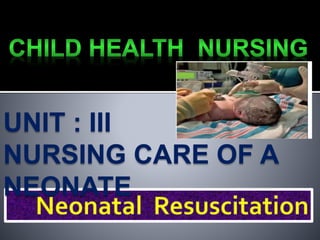
UNIT : III
NURSING CARE OF A
NEONATE
Effective resuscitation at birth can prevent
large proportion of deaths. The need for all clinical
guidelines on basic new born resuscitation suitable
for settings with limited resources it universally
recognised.
• Neonatal resuscitation is defined at the set of
intervention at the time of birth to support the
establishment of breathing and circulation.
• To restore breathing and blood circulation
• To maintain perfusion of oxygenated blood to
cells
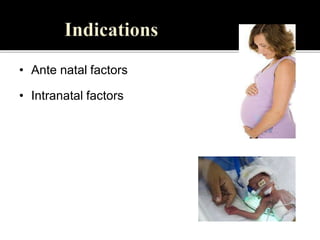
• Ante natal factors
• Intranatal factors
• Maternal diabetes
• Maternal infection
• Hydromnias
• Post term gestation
• Maternal drug abuse like rrspiridone, lithium
carbonate
• Abnormal presentation
• Premature labor
• Early rupture of membrane
• Fetal bradycardia
• Cord prolapse
• Meconium stained aminiotic fluid
• Every birth as high risk all resuscitation arrangement and
essential to be kept ready.
• At least one health personnel should be skilled in neonatal
resuscitation, who should present at the delivery room .
• Heat Sourse should be kept ready to use.
• The resuscitation room/ area in the delivery room must be
well lighted,warm with arrangement for resuscitation.
• The essential articles must be checked by the nursing
personnel in every day shift.
• Resuscitation procedure should be performed with full
 Mucous aspirator
 Meconium aspirator
 Mechanical suction apparatus
 Suction catheter 10F or 12F
 Feeding tube 6 F ,10 or 20 ml syringe
• Suction equipment
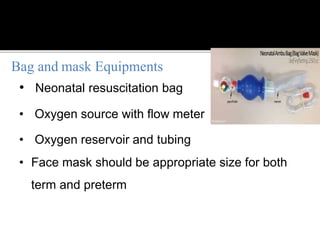
• Neonatal resuscitation bag
• Oxygen source with flow meter
• Oxygen reservoir and tubing
• Face mask should be appropriate size for both
term and preterm
Bag and mask Equipments
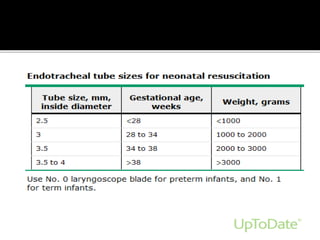
• Neonatal laryngoscope with stright blade( no.00- 0:
for preterm,no:1 for term babies)
• Extra bulb and batteries for laryngoscope
• Entotracheal tube ( size- 2.5,3.0,3.5,4.0mm ID)
• Stylet
• scissors
• Epinephrine
• Naloxone hydrochloride
• Normal saline
• Ringer’ s lactatae solution
• Sodium bicarbonate
• Albumin
• Dopamine
• Watch with second hand
• Towel shoulder roll
• Prewarmed linen
• Radient warmer or heat
source
• Stethoscope
• Syringes(1,2,5,10,20,50
ml)Needles
• Umblical catheter
• Three way stopclocks
• Gloves
• Gauze
• Thermometer
• Scalp vein set
• Air way tube
• Sport light
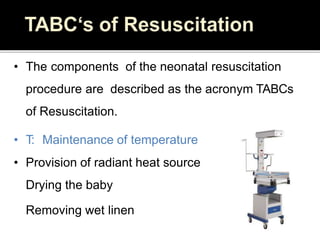
• The components of the neonatal resuscitation
procedure are described as the acronym TABCs
of Resuscitation.
• T: Maintenance of temperature
• Provision of radiant heat source
Drying the baby
Removing wet linen
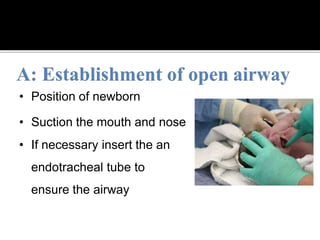
• Position of newborn
• Suction the mouth and nose
• If necessary insert the an
endotracheal tube to
ensure the airway
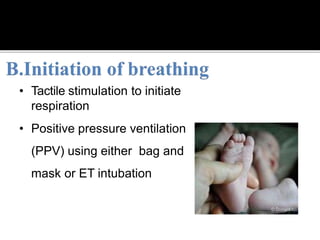
• Tactile stimulation to initiate
respiration
• Positive pressure ventilation
(PPV) using either bag and
mask or ET intubation
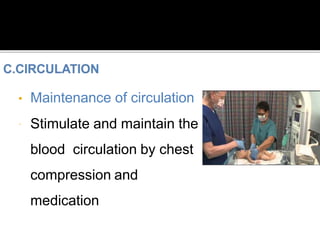
• Maintenance of circulation
 Stimulate and maintain the
blood circulation by chest
compression and
medication
• Immature lungs difficult to ventilate and also
more vulnerable to injury by PPV
• Immature blood vessels in the brain that are
prone to hemorrhage
• Thin skin and large BSA– Rapid heat loss
• Increased susceptibility to infection
• Increased risk of hypovolemic shock related to
small blood volume
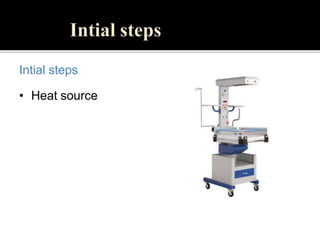
Intial steps
• Heat source
 Receiving the newborn baby in a
prewarmed towel and placing the baby
on the preheated Radient warmer.
 If warmer is not available, room heater or a
bulb of 200 w can be used,which should be
fixed in a suitable places. Never allow the
baby to become hypothermic
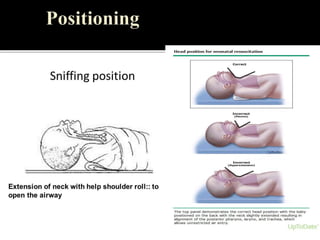
• Positioning of the baby on the back with the neck
slightly extended sniffing position hyperextension or
under extension should be prevented which may
decrease air entry.
• To maintain correct position . Shoulder roll may be
useful elevating shoulder ¾ to1 inch off the matters
• If the neonate has copious secreation head should
be turned oneside
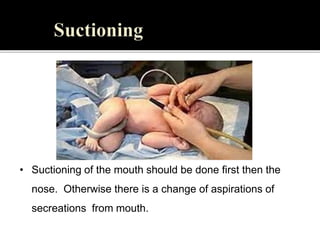
• Suctioning of the mouth should be done first then the
nose. Otherwise there is a change of aspirations of
secreations from mouth.
• Suctioning should be done carefully to prevent stimulation of
posterior pharynx which can lead to bradycardia and apnea.
• Vigoious and continuous suction to be avoided.
• Suction pressure to be kept around 80 to100 mmHg(100-130
water).
• Tracheal suctioning may be needed through endotracheal
tube in meconium stained liquor.
• Suction tube is inserted 5cm for mouth,3cm for nostrils
• Suction for less than 20 seconds
• Drying the baby whole body and head quickly
and removing the wet linen immediately
• The baby is then placed further on a prewarmed
towel to reduce heat loss
• Drying the baby prevent evaporate heat loss and
provide gentle stimulation which may help to
initiate respiration
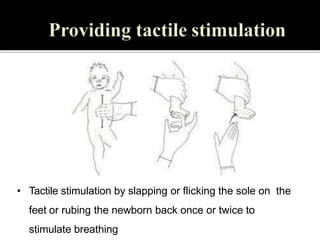
• Tactile stimulation by slapping or flicking the sole on the
feet or rubing the newborn back once or twice to
stimulate breathing
• Continued use of tactile stimulation in a newborn does
not respond may be harmful and wastage of valuable
time.
• The baby is not taking respiration spontaneously may
breathe after one or two tactile stimulation only.
• Free flow Oxygen by over the newborn nose so
that the baby breaths Oxygen enriched air
• This can be given by using Oxygen mask or
cupped hand at the flow rate of 5 liters per
minute
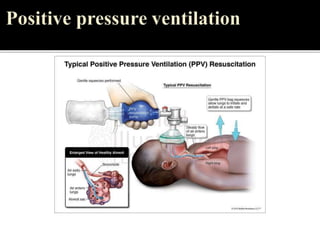
• The newborn has no spontaneous breathing
then PPV should be starter with bag and mask
• If the baby is taking respiration spontaneously
but heart rate is below 100 beats per minute at
that condition also PPV should be started
immediately
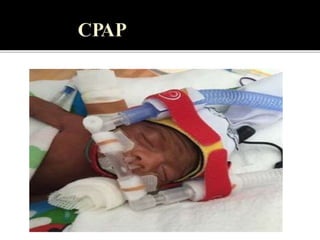
• It recommended in preterm infants are breathing
spontaneously but with difficulties
• Starting newborn on CPAP decrease the rate of
intubation and mode of ventilation, surfactant
use and duration of ventilation but increase rate
of pneumothorax.
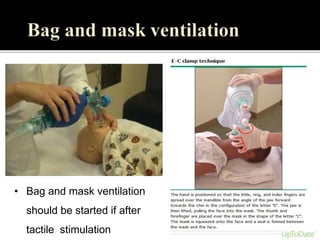
• Bag and mask ventilation
should be started if after
tactile stimulation
 The newborn is still apneic or gasping
 Having spontaneous respiration but heart rate is below 100
beats per minute.
Bag and mask ventilation, the babys neck should be slightly
extended to ensure open airway. Mask to be placed in position
and seal to be checked by 3 to 3 ventilation.
Place the mask covering tip of the chin, the mouth and nose.
 Rise of chest to be observed and if chest does not rise
then reapply mask , reposition baby’s head , suction if
needed and ventilate with slightly open mouth and
increased pressure.
 Ventilation should be done at the rate of 40-60 breaths
per minute. Follow a squeeze two ,three squeeze
sequence.
• Bag and mask ventilation should be initiated with air only. Then
Oxygen tubing from the oxygen source and the oxygen reservoir to be
attached to increase the oxygen concentration even up to 100percent
during BMV.
• After 15 to 30 seconds ventilation, the baby again should be evaluated if
the heart rate is above 100 beats per minute and spontaneous
respiration is present then provide tactile stimulation. Monitor heart rate
respiration and colour. If no breathing establishes continue ventilation.
• If heart rate is not increased with ventilation then check adequacy
of ventilation and start chest compression.
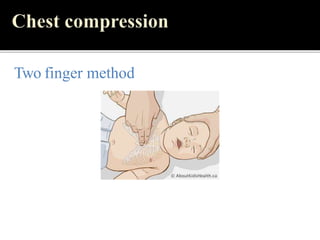
Two finger method
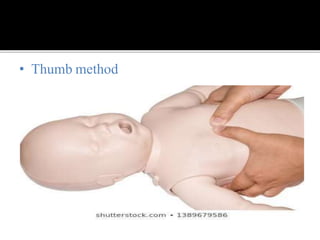
• Thumb method
• Chest compression must always be performed along with
ventilation and 100 percent oxygen. It is indicated if after 15-
30seconds of PPV with 100 percent oxygen, the heart rate is
below 60 beats per minute and not increasing.
• Chest compression or external cardiac massage is given to
increase the intrathoracic pressure and to circulate blood to
the vital organs of the body.
Started when HR<60 per minute despite adequate
ventilation with 100% oxygen for 30 sec
The pressure is applied to the lower third of the sternum
to depress it ½ to ¾ inches.
2 techniques:
2 thumb-encircling hands technique
Compression with 2 fingers ,second hand supporting
the back
3:1 ratio::[ 90 comp:30 ventilations]
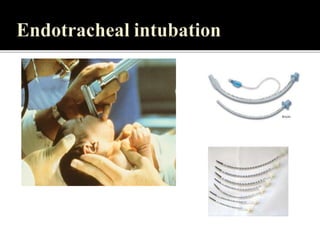
 Endotracheal intubation is a specialized and skilled
procedure. It’s indicated
 Prolonged PPV is required
 Bag and mask ventilation is ineffective
 Tracheal suction is needed
 The tube should be selected and must have vocal Cord
guide
 It is cut at 13 cm and the connector to be replaced.
 Laryngoscope should be in working condition and of
appropriate size
• Neonates should be positioned on a flat surface
with the neck slightly extended
• The procedure is usually performed by
neonatologist or anesthesiologist or any doctor
skilled with this technique.
• Preparation of the positioning ,assisting during
the procedure are the important responsibilities
of the nursing personnel. Only small number of
neonates required ET intubation
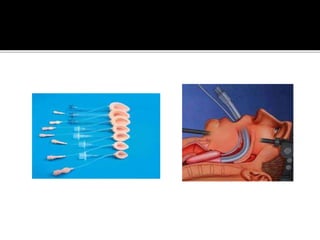
Soft mask, fits over laryngeal inlet
when inflated, occludes the oesophageal
opening
Done when BMV is unsuccessful &
tracheal intubation is unsuccessful or not
feasible
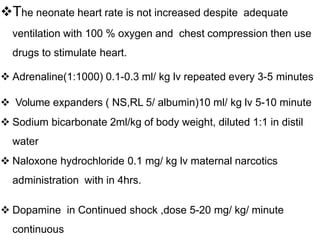
The neonate heart rate is not increased despite adequate
ventilation with 100 % oxygen and chest compression then use
drugs to stimulate heart.
 Adrenaline(1:1000) 0.1-0.3 ml/ kg lv repeated every 3-5 minutes
 Volume expanders ( NS,RL 5/ albumin)10 ml/ kg lv 5-10 minute
 Sodium bicarbonate 2ml/kg of body weight, diluted 1:1 in distil
water
 Naloxone hydrochloride 0.1 mg/ kg lv maternal narcotics
administration with in 4hrs.
 Dopamine in Continued shock ,dose 5-20 mg/ kg/ minute
continuous
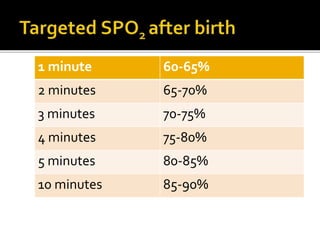
1 minute 60-65%
2 minutes 65-70%
3 minutes 70-75%
4 minutes 75-80%
5 minutes 80-85%
10 minutes 85-90%
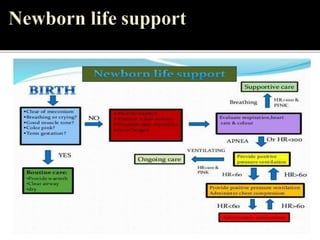
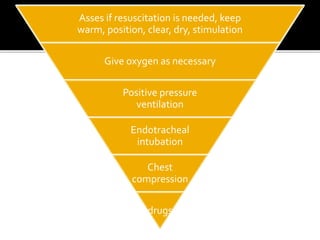
Asses if resuscitation is needed, keep
warm, position, clear, dry, stimulation
Give oxygen as necessary
Positive pressure
ventilation
Endotracheal
intubation
Chest
compression
drugs
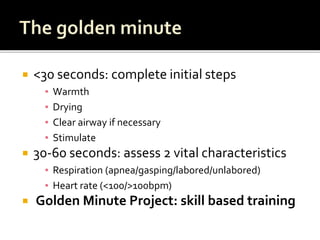
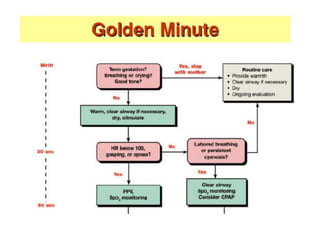
 <30 seconds: complete initial steps
▪ Warmth
▪ Drying
▪ Clear airway if necessary
▪ Stimulate
 30-60 seconds: assess 2 vital characteristics
▪ Respiration (apnea/gasping/labored/unlabored)
▪ Heart rate (<100/>100bpm)
 Golden Minute Project: skill based training
• Babies are require resuscitation at risk for deterioration after
their vital signs have returned to normal
• Closely monitor the neonate until the breathing on his/ her
own
• Assist in intubating the child and connect with oxygen
source.
• Start lv infusion as prescribed
• Monitor the child continuously.
 Conditions with certainly early death
 Extreme prematurity(GA<23 weeks)
 Birth weight<400g
 Anencephaly
 Chromosomal abnormality:Trisomy 13
 High rate of survival
 Acceptable morbidity
 GA≥ 25 weeks
 Those with most congenital malformations
 Newborn with no detectable heart rate,
consider stopping NNR if the heart rate
remains undetectable for 10 minutes
• Neonatal resuscitation training in all facilities
reduces term ,intrapartum related deaths 30
percent . Expert opinion supports smaller effects of
neonatal resuscitation on preterm mortality in
facilities and basic resuscitation.
• Adele pillitteri (2010), Maternal and child Health Nursing,
6th edition, Lippincott Williams and Wilkins publications.
• Lowdermilk Perry (2007), Maternity and Womens Health
Care, 9th edition, Mosby Elsevier publications.
• Wong Perry, Hockenberry and Lowdermilk Wilson
(2006), Maternal Child Nursing Care, 3rd edition, Mosby
Elsevier publications.
• Emily Wone Mckineey, Sharon Smith Murray, Jeen
Weiler Ashwill (2009), Maternal Child Nursing, 3rd
edition, Saunders Elsevier publications.
Neonatal resuscitation TABC ..........pptx

Neonatal resuscitation TABC ..........pptx

  • 2.
    UNIT : III NURSINGCARE OF A NEONATE
  • 3.
    Effective resuscitation atbirth can prevent large proportion of deaths. The need for all clinical guidelines on basic new born resuscitation suitable for settings with limited resources it universally recognised.
  • 4.
    • Neonatal resuscitationis defined at the set of intervention at the time of birth to support the establishment of breathing and circulation.
  • 5.
    • To restorebreathing and blood circulation • To maintain perfusion of oxygenated blood to cells
  • 6.
    • Ante natalfactors • Intranatal factors
  • 7.
    • Maternal diabetes •Maternal infection • Hydromnias • Post term gestation • Maternal drug abuse like rrspiridone, lithium carbonate
  • 8.
    • Abnormal presentation •Premature labor • Early rupture of membrane • Fetal bradycardia • Cord prolapse • Meconium stained aminiotic fluid
  • 9.
    • Every birthas high risk all resuscitation arrangement and essential to be kept ready. • At least one health personnel should be skilled in neonatal resuscitation, who should present at the delivery room . • Heat Sourse should be kept ready to use. • The resuscitation room/ area in the delivery room must be well lighted,warm with arrangement for resuscitation. • The essential articles must be checked by the nursing personnel in every day shift. • Resuscitation procedure should be performed with full
  • 10.
     Mucous aspirator Meconium aspirator  Mechanical suction apparatus  Suction catheter 10F or 12F  Feeding tube 6 F ,10 or 20 ml syringe • Suction equipment
  • 11.
    • Neonatal resuscitationbag • Oxygen source with flow meter • Oxygen reservoir and tubing • Face mask should be appropriate size for both term and preterm Bag and mask Equipments
  • 12.
    • Neonatal laryngoscopewith stright blade( no.00- 0: for preterm,no:1 for term babies) • Extra bulb and batteries for laryngoscope • Entotracheal tube ( size- 2.5,3.0,3.5,4.0mm ID) • Stylet • scissors
  • 13.
    • Epinephrine • Naloxonehydrochloride • Normal saline • Ringer’ s lactatae solution • Sodium bicarbonate • Albumin • Dopamine
  • 14.
    • Watch withsecond hand • Towel shoulder roll • Prewarmed linen • Radient warmer or heat source • Stethoscope • Syringes(1,2,5,10,20,50 ml)Needles • Umblical catheter • Three way stopclocks • Gloves • Gauze • Thermometer • Scalp vein set • Air way tube • Sport light
  • 15.
    • The componentsof the neonatal resuscitation procedure are described as the acronym TABCs of Resuscitation. • T: Maintenance of temperature • Provision of radiant heat source Drying the baby Removing wet linen
  • 16.
    • Position ofnewborn • Suction the mouth and nose • If necessary insert the an endotracheal tube to ensure the airway
  • 17.
    • Tactile stimulationto initiate respiration • Positive pressure ventilation (PPV) using either bag and mask or ET intubation
  • 18.
    • Maintenance ofcirculation  Stimulate and maintain the blood circulation by chest compression and medication
  • 20.
    • Immature lungsdifficult to ventilate and also more vulnerable to injury by PPV • Immature blood vessels in the brain that are prone to hemorrhage • Thin skin and large BSA– Rapid heat loss • Increased susceptibility to infection • Increased risk of hypovolemic shock related to small blood volume
  • 21.
  • 22.
     Receiving thenewborn baby in a prewarmed towel and placing the baby on the preheated Radient warmer.  If warmer is not available, room heater or a bulb of 200 w can be used,which should be fixed in a suitable places. Never allow the baby to become hypothermic
  • 24.
    • Positioning ofthe baby on the back with the neck slightly extended sniffing position hyperextension or under extension should be prevented which may decrease air entry. • To maintain correct position . Shoulder roll may be useful elevating shoulder ¾ to1 inch off the matters • If the neonate has copious secreation head should be turned oneside
  • 25.
    • Suctioning ofthe mouth should be done first then the nose. Otherwise there is a change of aspirations of secreations from mouth.
  • 26.
    • Suctioning shouldbe done carefully to prevent stimulation of posterior pharynx which can lead to bradycardia and apnea. • Vigoious and continuous suction to be avoided. • Suction pressure to be kept around 80 to100 mmHg(100-130 water). • Tracheal suctioning may be needed through endotracheal tube in meconium stained liquor. • Suction tube is inserted 5cm for mouth,3cm for nostrils • Suction for less than 20 seconds
  • 27.
    • Drying thebaby whole body and head quickly and removing the wet linen immediately • The baby is then placed further on a prewarmed towel to reduce heat loss • Drying the baby prevent evaporate heat loss and provide gentle stimulation which may help to initiate respiration
  • 28.
    • Tactile stimulationby slapping or flicking the sole on the feet or rubing the newborn back once or twice to stimulate breathing
  • 29.
    • Continued useof tactile stimulation in a newborn does not respond may be harmful and wastage of valuable time. • The baby is not taking respiration spontaneously may breathe after one or two tactile stimulation only.
  • 31.
    • Free flowOxygen by over the newborn nose so that the baby breaths Oxygen enriched air • This can be given by using Oxygen mask or cupped hand at the flow rate of 5 liters per minute
  • 33.
    • The newbornhas no spontaneous breathing then PPV should be starter with bag and mask • If the baby is taking respiration spontaneously but heart rate is below 100 beats per minute at that condition also PPV should be started immediately
  • 35.
    • It recommendedin preterm infants are breathing spontaneously but with difficulties • Starting newborn on CPAP decrease the rate of intubation and mode of ventilation, surfactant use and duration of ventilation but increase rate of pneumothorax.
  • 36.
    • Bag andmask ventilation should be started if after tactile stimulation
  • 37.
     The newbornis still apneic or gasping  Having spontaneous respiration but heart rate is below 100 beats per minute. Bag and mask ventilation, the babys neck should be slightly extended to ensure open airway. Mask to be placed in position and seal to be checked by 3 to 3 ventilation. Place the mask covering tip of the chin, the mouth and nose.
  • 38.
     Rise ofchest to be observed and if chest does not rise then reapply mask , reposition baby’s head , suction if needed and ventilate with slightly open mouth and increased pressure.  Ventilation should be done at the rate of 40-60 breaths per minute. Follow a squeeze two ,three squeeze sequence.
  • 39.
    • Bag andmask ventilation should be initiated with air only. Then Oxygen tubing from the oxygen source and the oxygen reservoir to be attached to increase the oxygen concentration even up to 100percent during BMV. • After 15 to 30 seconds ventilation, the baby again should be evaluated if the heart rate is above 100 beats per minute and spontaneous respiration is present then provide tactile stimulation. Monitor heart rate respiration and colour. If no breathing establishes continue ventilation. • If heart rate is not increased with ventilation then check adequacy of ventilation and start chest compression.
  • 40.
  • 41.
  • 42.
    • Chest compressionmust always be performed along with ventilation and 100 percent oxygen. It is indicated if after 15- 30seconds of PPV with 100 percent oxygen, the heart rate is below 60 beats per minute and not increasing. • Chest compression or external cardiac massage is given to increase the intrathoracic pressure and to circulate blood to the vital organs of the body.
  • 43.
    Started when HR<60per minute despite adequate ventilation with 100% oxygen for 30 sec The pressure is applied to the lower third of the sternum to depress it ½ to ¾ inches. 2 techniques: 2 thumb-encircling hands technique Compression with 2 fingers ,second hand supporting the back 3:1 ratio::[ 90 comp:30 ventilations]
  • 46.
     Endotracheal intubationis a specialized and skilled procedure. It’s indicated  Prolonged PPV is required  Bag and mask ventilation is ineffective  Tracheal suction is needed  The tube should be selected and must have vocal Cord guide  It is cut at 13 cm and the connector to be replaced.  Laryngoscope should be in working condition and of appropriate size
  • 47.
    • Neonates shouldbe positioned on a flat surface with the neck slightly extended • The procedure is usually performed by neonatologist or anesthesiologist or any doctor skilled with this technique. • Preparation of the positioning ,assisting during the procedure are the important responsibilities of the nursing personnel. Only small number of neonates required ET intubation
  • 48.
    Soft mask, fitsover laryngeal inlet when inflated, occludes the oesophageal opening Done when BMV is unsuccessful & tracheal intubation is unsuccessful or not feasible
  • 51.
    The neonate heartrate is not increased despite adequate ventilation with 100 % oxygen and chest compression then use drugs to stimulate heart.  Adrenaline(1:1000) 0.1-0.3 ml/ kg lv repeated every 3-5 minutes  Volume expanders ( NS,RL 5/ albumin)10 ml/ kg lv 5-10 minute  Sodium bicarbonate 2ml/kg of body weight, diluted 1:1 in distil water  Naloxone hydrochloride 0.1 mg/ kg lv maternal narcotics administration with in 4hrs.  Dopamine in Continued shock ,dose 5-20 mg/ kg/ minute continuous
  • 52.
    1 minute 60-65% 2minutes 65-70% 3 minutes 70-75% 4 minutes 75-80% 5 minutes 80-85% 10 minutes 85-90%
  • 53.
    Asses if resuscitationis needed, keep warm, position, clear, dry, stimulation Give oxygen as necessary Positive pressure ventilation Endotracheal intubation Chest compression drugs
  • 54.
     <30 seconds:complete initial steps ▪ Warmth ▪ Drying ▪ Clear airway if necessary ▪ Stimulate  30-60 seconds: assess 2 vital characteristics ▪ Respiration (apnea/gasping/labored/unlabored) ▪ Heart rate (<100/>100bpm)  Golden Minute Project: skill based training
  • 56.
    • Babies arerequire resuscitation at risk for deterioration after their vital signs have returned to normal • Closely monitor the neonate until the breathing on his/ her own • Assist in intubating the child and connect with oxygen source. • Start lv infusion as prescribed • Monitor the child continuously.
  • 57.
     Conditions withcertainly early death  Extreme prematurity(GA<23 weeks)  Birth weight<400g  Anencephaly  Chromosomal abnormality:Trisomy 13
  • 58.
     High rateof survival  Acceptable morbidity  GA≥ 25 weeks  Those with most congenital malformations
  • 59.
     Newborn withno detectable heart rate, consider stopping NNR if the heart rate remains undetectable for 10 minutes
  • 60.
    • Neonatal resuscitationtraining in all facilities reduces term ,intrapartum related deaths 30 percent . Expert opinion supports smaller effects of neonatal resuscitation on preterm mortality in facilities and basic resuscitation.
  • 61.
    • Adele pillitteri(2010), Maternal and child Health Nursing, 6th edition, Lippincott Williams and Wilkins publications. • Lowdermilk Perry (2007), Maternity and Womens Health Care, 9th edition, Mosby Elsevier publications. • Wong Perry, Hockenberry and Lowdermilk Wilson (2006), Maternal Child Nursing Care, 3rd edition, Mosby Elsevier publications. • Emily Wone Mckineey, Sharon Smith Murray, Jeen Weiler Ashwill (2009), Maternal Child Nursing, 3rd edition, Saunders Elsevier publications.