Neonatal
Resuscitation
Presented By
Dr. Akshay Golwalkar
Moderated By
Dr. Sunil Gavhane
FACTS
• 90% Don’t require any intervention
• 10% require intervention
• 1 % need major resuscitation
• Preterms are at high risk
How often do we use our resuscitation
skills?
Primary causes of death*
18 %Other causes
09 %Malformation
29 %Perinatal hypoxia
17 %Infection
27 %Prematurity
DeathsCause
*Text book of Neonatal Resuscitation 6th
edition
Alveoli are fluid
filled
Blood vessels are
constricted
After birth
Fluid in the
alveoli is
absorbed
Alveoli
• Expand
• Get filled with Air
1.
2.
Pulmonary vessels dilate, causing
increased blood flow to lungs
Requirements
• Personnel
– At least one trained person for all
deliveries
– Two persons, if high risk; or for
advanced resuscitation
Bag, Mask,
& Oxygen
Suction
Equipment
Laryngoscope
and ETT Tube
Warmer &
Blankets
Resuscitation
•Is the newborn term?
•Is the newborn
breathing or crying?
•Does the newborn
have good muscle tone?
•Dry & remove
wet cloth
•Clear airway if
necessary
•Wrap in
prewarmed dry
cloth
•Breast feeds
•Ongoing
Evalution
YE
S
Baby is Delivered
( Ask)
Routine Care
Dry & Remove wet linen
Routine Care
• Vigorous term infants with no risk factors
• Babies who required but responded to initial
steps, They now can stay with Mother
• Skin to skin contact recommended
• Clear airway, dry newborn, provide ongoing
evaluation:
– Breathing
– Activity
– Color
• Transfer to New Born Nursery
Positioning
Clear Airway, if necessary
Clear airways
(if necessary)
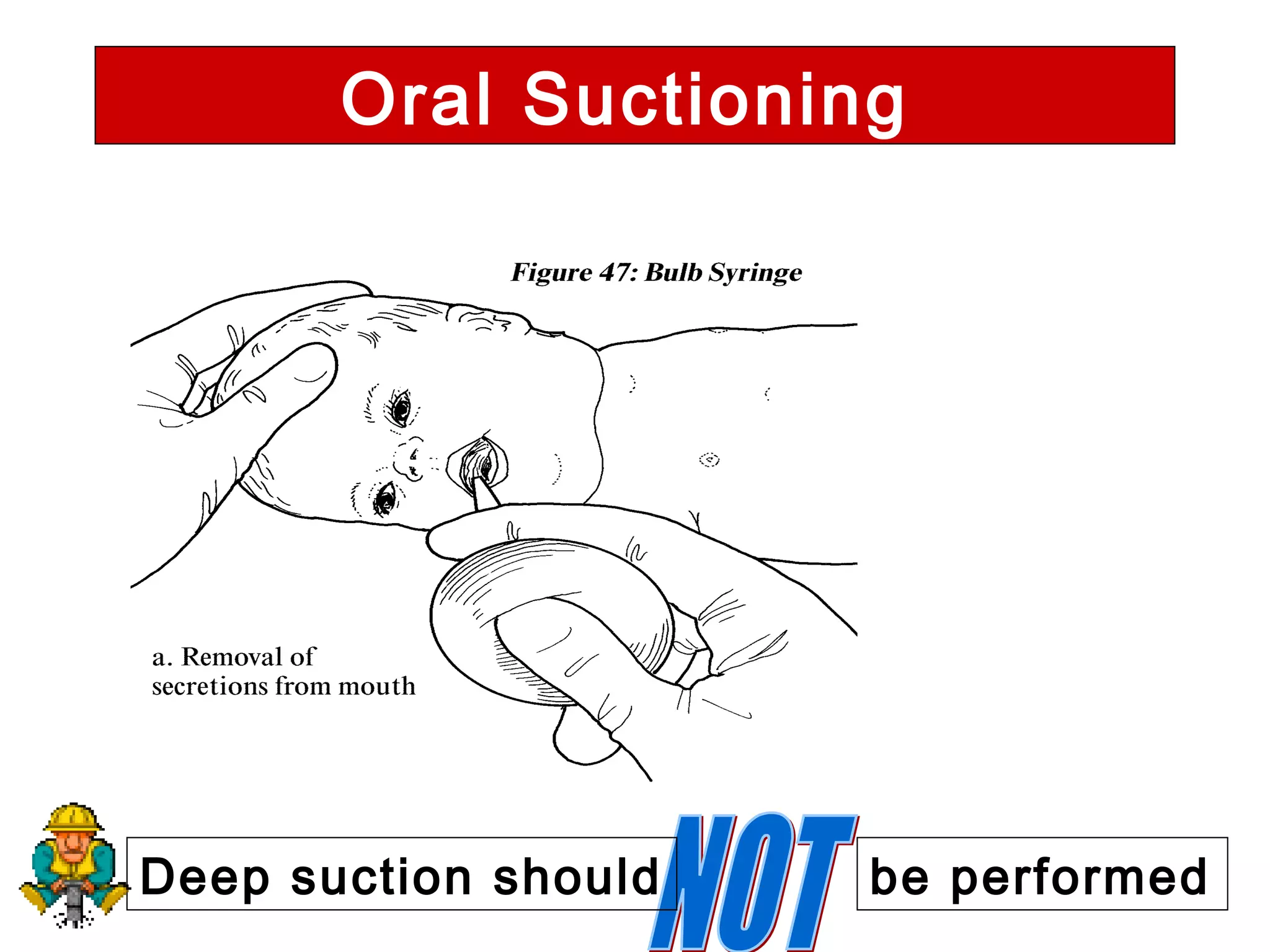
Oral Suctioning
Deep suction should be performed
Stimulate
• Breathing :
Regular / Gasping / Irregular / Absent
• Heart Rate : >100/m OR< 100/m OR Absent
• SpO2
EVALUATE
Pulse Oximetry: Resuscitation
monitor
• Advantages
o Not affected by
acrocyanosis
o Be patient and
get a reading
Supplemental oxygen
Free-flow oxygen cannot be given reliably
by a mask attached to a self-inflating bag
PPV/Bag & mask ventilation
•HR below 100
•Apnoea/gasping
YE
S
•Start PPV
•Consider SpO2
monitering
Indications for Bag & Mask
ventilation
• Apnea or gasping respiration
OR
• Heart rate < 100 bpm
OR
• Saturation below target values despite
free flow supplemental oxygen
Key point
The most important and effective
action in neonatal resuscitation is
EFFECTIVE VentilationEFFECTIVE Ventilation
Selecting equipment
• Size of bag (200-750 ml)
: To deliver a tidal volume of 6-8 ml/kg
• Oxygen capability :
Oxygen source, reservoir
Oxygen Reservoirs
Safety features
Pop-up valve
Testing the self-inflating bag
• Squeeze against your palm
– Pressure felt
– Pressure release valve
– Pressure manometer
– Re-inflation
Without Reservoir
With Reservoir
Self inflating bag
• Advantages
• Easier to use
• Pressure release valve
• Don’t not need a gas source to inflate
Self inflating bag
• Disadvantages
• Requires a reservoir to deliver 100%
oxygen
• Can not be used to deliver 100% free flow
oxygen
Masks
• Cushioned/Non-cushioned
• Round/Anatomical shaped
• Size 0 or 1
The surface on which the baby is
placed should always be warm
as well as flat, firm and clean
POSITION
Correct position of mask
Positioning
• Positioning the infant & resuscitator
Forming & checking the seal
Ventilation rate and
pressure
Evaluation-Decision-Evaluation-Decision-
Action cycleAction cycle
Evaluation
Action Decision
30 sec30 sec
Signs of Effective
Ventilation
Sign of response to ventilation:Sign of response to ventilation:
• Improved heart rate
Signs of improvement in newborn:Signs of improvement in newborn:
• Improved heart rate, color, breathing, tone, and
saturation
Contraindications
• Diaphragmatic hernia
• Non -vigorous baby born through
meconium stained liquor
No improvement
• Is chest rise adequate?
• Is adequate oxygen being
administered?
MR. SOPAMR. SOPA
•M- Adjust Mask on the face
•R- Reposition the head to open airway
oRe-attempt to ventilate…if not effective then
•S- Suction mouth then nose
•O- Open mouth and lift jaw forward
oRe-attempt to ventilate…if not effective then
•P- Gradually increase Pressure every few breaths until
visible chest rise is noted
oMax Pip 40cmH2O If still not effective then…
•A- Alternative Airway (ETT or LMA)
When to stop ?
• Heart rate above 100/min
• Spontaneous breathing
• Baby in Post Resuscitation care
Chest Compressions
Its a 2 personnel job
Indication
If after 30 seconds of EFFECTIVE bag
and mask ventilation with 100% oxygen,
Heart Rate is below 60 per minute
Indications
• Pump out blood from the heart during
compression and fill up blood in the heart
during release
• Must always be accompanied by ventilation
with 100% oxygen
Principle
Compress Release
Heart Heart
sternum
Mechanism of Chest
Compressions
sternum
• Position
– Neck slightly extended with firm support for the
back
– Lower 1/3rd
of sternum between nipple line &
sternum
• Pressure required – depth
– 1/3rd
of the AP diameter of chest
• Rate
– 90/min
Components
Two-finger method
Techniques of Chest
Compressions
Thumb method
Thumb Technique
• Easier with right
hand for right
handed
• Index and middle
or ring fingers
• Other hand used to
support the back
• Pressure applied
vertically
2 Finger Technique
2 Finger Technique
Don’t lift your fingers/thumbs
• Advantages
• Better control of depth
• Less tiring
• Superior generation of peak systolic & coronary
perfusion pressure
• Nails do not hinder performance
• Disadvantages
• Difficult when baby is big
• Umbilicus difficult to canulate
Preferred method - Thumb
Rate
• 3 Chest Compressions then 1 ventilation
• 90 Chest Compressions to 30 ventilations in
one minute
Adequacy
• Palpate femoral/carotid pulse
Rate and Adequacy
• Consists of 3 compression & one ventilation
• 120 events in 60 seconds
• 1 cycles in 2 seconds
• ONE- AND – TWO – AND – THREE – ANDONE- AND – TWO – AND – THREE – AND
- BREATH- BREATH
Cycle of events
• No pressure to be
applied on ribs,
Xipisternum,
abdomen
• Do not lift
thumbs/fingers
Precautions
Dangers
• Broken ribs
• Lacerated liver
• Pneumothorax
Chest Compressions
• HR 60 per minute or more Stop CC, continue
BMV at 40-60/min
• If no improvement, check :
– Effectiveness of BMV
– Oxygen is 100%
– Technique of CC is correct
Evaluation after 30 sec of
CC & BMV
When to stop
chest compressions
• When heart rate is 60 per minute or more
Key points
• 2 personnel job
• Ensure 100 % oxygen
• Ensure adequate chest movement
during ventilation
• Co-ordinate B & M with CC at 3 : 1
• Check HR every 30 seconds
• Use thumb or 2 finger technique
Intubation
Indications for intubation
• Meconium suctioning in non vigorous baby
• Diaphragmatic hernia
• Prolonged or ineffective ventilation
• Elective
– VLBW
– with CC
Intubation equipment
Preparing laryngoscope
• No. 1 for full term
• No. 0 for preterm / LBW
• No. 00 for extremely preterm (optional)
3.5
3.0
2.5
Stylet
>2000 gm
1000-2000 gm
<1000 gm
Selecting endotracheal tube
Tube Size
(ID mm)
Weight
(gm)
Gest. Age
(Wks)
2.5 < 1000 < 28
3.0 1000-2000 28-34
3.5 2000-3000 35-38
4.0 >3000 > 38
ID=Internal Diameter
Preparing endotracheal tube
• Shorten the tube to 13 cm
• Replace ET tube connector
• Insert stylet (optional)
Additional items
Tape : For securing the tube
Suction equipment
Oxygen
• For free flow oxygen during intubation
• For Use with the resuscitation bag
Resuscitation Bag and Mask
• To ventilate the infant in between intubation
• To check tube placement
Positioning the infant
• On a flat surface
• Head in midline
• Neck slightly extended
• Optimal viewing of glottis
Intubation view
Vocal cord guide
Lip reference mark: (6 + weight in kilos)
cm
9-10 cm at the lip for
this term infant
Tube in Rt. Main bronchus
• Breath sounds only on right chest
• No air heard entering stomach
• No gastric distention
Action
Withdraw the tube, recheck
Tube in esophagus
• No breath sounds heard
• Air heard entering stomach
• Gastric distention may be seen
• No mist in tube
Action
Remove the tube, oxygenate the infant with a
bag and mask, reintroduce ET tube
Complications of intubation
• Hypoxia
• Bradycardia
• Apnea
• Pneumothorax
• Soft tissue injury
• Infection
Minimizing hypoxia during
intubation
• Providing free-flow
oxygen (Assistant’s
responsibility)
• Limiting each intubation
attempt to 20 seconds
CPR Medications
2:1000 newborns
MEDICATIONS
No drugs for me!No drugs for me!
MEDICATIONS
• Epinephrine
• Volume expansion
Neonatal Resuscitation
No role of
• Atropine
• Calcium
• Dexamethasone
• Dextrose
• Intra cardiac adrenaline
• Naloxone
Epinephrine
• Formulation 1:1000
• Dilution 1:10000 (Ten times)
0.2 ml in 1.8 ml
• Load 1 ml (in 1ml syringe)
• Dose 0.1-0.3 ml/kg
• Route IV (preferable)
• Rate Rapid bolus
Epinephrine
Follow up: if HR < 60 or 0
• Repeat epinephrine q 3-5 minutes
• Ensure:
effective ventilation
effective chest compressions
endotracheal intubation
(if not done already)
• Consider using volume expander
What is expected response
• After 30 seconds of administration and
continued PPV and CC
– HR should increase to > 60 bpm
• If no response repeat the dose every 3-5
minutes
• Repeat doses should preferably be give IV
“If the baby appears to be in shock
and is not responding to
resuscitation, administration of a
volume expander may be indicated”
!
Shock - HypovolemiaShock - Hypovolemia
Signs of Hypovolemia
• Pallor persisting beyond oxygenation
• Weak pulses
• Low blood pressure
• Lack of response to resuscitation
Hypovolemia is a common but often
unrecognized cause of need for
resuscitation
Volume Expansion
• Indicated when there is no response to
resuscitation and there is evidence of
blood loss or hypovolemia
• Repeated doses may be necessary if
there is minimal response after the first
dose
• Umbilical vein remains preferred route
but intraosseous acceptable
Medication Administration via
Umbilical Vein
• Preferred route for
intravenous access
• 3.5F or 5F end-hole
catheter
• Sterile technique
Placing catheter inPlacing catheter in
umbilical veinumbilical vein
Volume Expanders
• Normal saline
• Ringer’s lactate
• Whole blood (O Neg cross matched
with mother’s blood)
Normal saline
Indications
• Evidence or suspicion of acute blood
loss with signs of hypovolemia and/or
baby responding poorly to resuscitation
• Dose – 10ml/kg
• Route – Umbilical vein
• Preparation – large syringe
• Rate of administration – 5-10 minutes
In premature babies: Rapid boluses may induce ICH
Normal saline
Volume expanders
• Effect : Volume expansion, correction
of metabolic acidosis
• Expectation : Better BP & pulses, less
pallor
• Follow up : If signs of hypoperfusion
persist, repeat volume
expander, consider sodium
bicarbonate or dopamine
!! THANK YOU !!

Neonatal resuscitation 2012 AG

Editor's Notes

  • #31 This is a critically important skill and the single most important step in the resuscitation of the compromised newborn. The success of resuscitation may be dependent on the effectiveness of this procedure.
  • #104 To place a catheter in the umbilical vein, Clean the cord with antiseptic. Place a loose tie of umbilical tape around the base of the cord. Pre-fill a 3.5F or 5F single end-hole catheter with normal saline. Connect catheter to stopcock and syringe. Close the stopcock to the catheter to prevent fluid loss and air entry. Using sterile technique, Cut the cord with the scalpel below the clamp about 1 to 2 cm from the skin line. The umbilical vein will be seen as a large, thin-walled structure, usually at the 11- to 12-o’clock position. Insert the catheter into the umbilical vein. The course of the vein will be up toward the heart, so this is the direction you should point the catheter. Instructor Tip: Keep all umbilical venous catheter insertion supplies together in one sealed bag or tray. To prevent injury, stop compressions and alert team members when scalpel is being used.