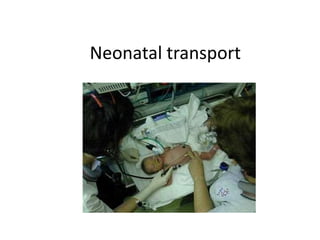
Neonatal transport
Definition
• Newborn transport is used to
move premature and other sick infants
from hospitals without specialist, intensive
care facilities require for optimal care of the
baby to hospitals with neonatal intensive
care and other specialist services.
Out born newborns
• A significant number of neonates require
emergent transfer to a tertiary care center,
often because of medical, surgical, or rapidly
emerging postpartum problems. These are
termed “outborn” neonates, because they
have been born somewhere besides the
facility to which they’ve been transferred.
TRANSFER
• Transfer can be within the hospital; to ICU
• Transfer can be to other hospital
Neonatal transfer types
• Emergency: unplanned
• Elective : planned and informed
How can we transfer?
• The short distance transport within the
hospital can be accomplished in a
transport incubator.
• The use of plastic basket with perforated
sides coupled with careful placing of hot
water bottles is recommended for use in
the rural setting.
• The baby can be wrapped in tin foil or
covered with several layers of cotton.
• Themocele (polystyrene) box is an
effective insulator and can be used in
community.
• Skin to skin contact with mother or a
care taker is a useful modality of
transport in rural areas or resource poor
settings.
Indications of neonatal transport
• Preterm infant with a birth weight
<1500g or gestation <32 weeks
• Respiratory distress requiring CPAP or
assisted ventilation
• Severe hypoxic-ischemic encephalopathy
• Life threatening sepsis
• Intractable seizures
• Bleeding neonate
• Congenital anomalies or surgical neonate
• Inborn errors of metabolism
• Severe jaundice
• Procedures or diagnostic facilities
unavailable at parent hospital.
Transport equipments
1. Transport incubator with multi channel
vital signs monitor for recording
temperature, heart rate, NIBP, oxygen
saturation
2. CPAP facility with nasal prongs and
portable ventilator
3. Airway equipment: suction devices,
oral airways, bag and mask,
laryngoscopes (size 00,0 and 1 blades)
4. Infusion facilities: infusates, infusion
pumps, glucometer
5. oxygen, compressed air cylinder, oxygen
mask, hood, heat and light, sources of
electric powers and adapters.
6. disposables: catheters (5,6,7,8,10,12Fr),
syringes, needles, feeding tubes (8 &
10Fr), alcohol, betadine swabs,
micropore tape, gloves etc.
7. Instrument tray for ET intubation,
vascular access, insertion of chest tubes,
NG tube etc
8. Life saving drugs
Note
• All the equipment should have a battery
back up and should be kept fully charged
all the time.
• Enough O2 supply should be carried
which should last during the period of
journey.
Transport team
• The neonate needing special or intensive
care should be transported by a skilled
transport team.
• Teams include at least,
a) One senior resident
b) One specially trained neonatal nurse
Principles of safe transport
• Sugar
• Temperature
• Airway
• Blood pressure
• Lab work
• Emotional support
• Sugar
• Arterial circulatory support
• Family support
• Environment
• Respiratory support
• Temperature
• Oxygenation (airway and breathing)
• Perfusion
• Sugar
Protocols
i. Maintain airway, oxygenation, thermal
stability and tissue perfusion
ii. Stop oral feeding and start parenteral
feeding with 10% of dextrose.
iii. Ensure umbilical or peripheral venous
access
iv. Insert an NG tube and decompress the
stomach
v. Maintain adequate blood glucose level
vi. Obtain culture samples and administer
first dose of antibiotics.
vii. Obtain a recent chest skiagram as a
base line and to check the position of
catheters and tubes.
viii. Take the family member or parents
along with the baby whenever feasible.
ix. When required transport team should
undertake life saving procedures (like ET
tube insertion, chest tube insertion etc)
x. administer life saving drugs like
surfactant and prostaglandins
xi. The referring hospital should prepare a
detailed transport note including copies
of obstetric and neonatal charts for the
transport team.
xii. Monitor the baby’s color and
temperature.
Arrival at the receiving NICU
• The transport team should remain in
constant touch with the referral NICU
during the course of journey.
• The team should brief the NICU care
givers regarding the status of the baby
and immediate clinical concerns.
• Hand over all the documents.
• The referring hospital and parents should be
informed about the safe arrival and latest
condition of the baby.
• The inventory of transport equipment should
be checked, medications and essential
supplies should be restocked for the next
transport service.

Neonatal transport

  • 1.
  • 2.
    Definition • Newborn transportis used to move premature and other sick infants from hospitals without specialist, intensive care facilities require for optimal care of the baby to hospitals with neonatal intensive care and other specialist services.
  • 3.
    Out born newborns •A significant number of neonates require emergent transfer to a tertiary care center, often because of medical, surgical, or rapidly emerging postpartum problems. These are termed “outborn” neonates, because they have been born somewhere besides the facility to which they’ve been transferred.
  • 4.
    TRANSFER • Transfer canbe within the hospital; to ICU • Transfer can be to other hospital
  • 5.
    Neonatal transfer types •Emergency: unplanned • Elective : planned and informed
  • 6.
    How can wetransfer? • The short distance transport within the hospital can be accomplished in a transport incubator. • The use of plastic basket with perforated sides coupled with careful placing of hot water bottles is recommended for use in the rural setting.
  • 7.
    • The babycan be wrapped in tin foil or covered with several layers of cotton. • Themocele (polystyrene) box is an effective insulator and can be used in community. • Skin to skin contact with mother or a care taker is a useful modality of transport in rural areas or resource poor settings.
  • 8.
    Indications of neonataltransport • Preterm infant with a birth weight <1500g or gestation <32 weeks • Respiratory distress requiring CPAP or assisted ventilation • Severe hypoxic-ischemic encephalopathy • Life threatening sepsis • Intractable seizures • Bleeding neonate
  • 9.
    • Congenital anomaliesor surgical neonate • Inborn errors of metabolism • Severe jaundice • Procedures or diagnostic facilities unavailable at parent hospital.
  • 10.
    Transport equipments 1. Transportincubator with multi channel vital signs monitor for recording temperature, heart rate, NIBP, oxygen saturation 2. CPAP facility with nasal prongs and portable ventilator 3. Airway equipment: suction devices, oral airways, bag and mask, laryngoscopes (size 00,0 and 1 blades)
  • 11.
    4. Infusion facilities:infusates, infusion pumps, glucometer 5. oxygen, compressed air cylinder, oxygen mask, hood, heat and light, sources of electric powers and adapters. 6. disposables: catheters (5,6,7,8,10,12Fr), syringes, needles, feeding tubes (8 & 10Fr), alcohol, betadine swabs, micropore tape, gloves etc.
  • 12.
    7. Instrument trayfor ET intubation, vascular access, insertion of chest tubes, NG tube etc 8. Life saving drugs
  • 13.
    Note • All theequipment should have a battery back up and should be kept fully charged all the time. • Enough O2 supply should be carried which should last during the period of journey.
  • 14.
    Transport team • Theneonate needing special or intensive care should be transported by a skilled transport team. • Teams include at least, a) One senior resident b) One specially trained neonatal nurse
  • 15.
    Principles of safetransport • Sugar • Temperature • Airway • Blood pressure • Lab work • Emotional support
  • 16.
    • Sugar • Arterialcirculatory support • Family support • Environment • Respiratory support
  • 17.
    • Temperature • Oxygenation(airway and breathing) • Perfusion • Sugar
  • 18.
    Protocols i. Maintain airway,oxygenation, thermal stability and tissue perfusion ii. Stop oral feeding and start parenteral feeding with 10% of dextrose. iii. Ensure umbilical or peripheral venous access iv. Insert an NG tube and decompress the stomach v. Maintain adequate blood glucose level
  • 19.
    vi. Obtain culturesamples and administer first dose of antibiotics. vii. Obtain a recent chest skiagram as a base line and to check the position of catheters and tubes. viii. Take the family member or parents along with the baby whenever feasible. ix. When required transport team should undertake life saving procedures (like ET tube insertion, chest tube insertion etc)
  • 20.
    x. administer lifesaving drugs like surfactant and prostaglandins xi. The referring hospital should prepare a detailed transport note including copies of obstetric and neonatal charts for the transport team. xii. Monitor the baby’s color and temperature.
  • 21.
    Arrival at thereceiving NICU • The transport team should remain in constant touch with the referral NICU during the course of journey. • The team should brief the NICU care givers regarding the status of the baby and immediate clinical concerns. • Hand over all the documents.
  • 22.
    • The referringhospital and parents should be informed about the safe arrival and latest condition of the baby. • The inventory of transport equipment should be checked, medications and essential supplies should be restocked for the next transport service.