Epilepsy


                                   Dr. Kalpana Malla
                                       MD Pediatrics
                           Manipal Teaching Hospital

Download more documents and slide shows on The Medical Post [ www.themedicalpost.net ]
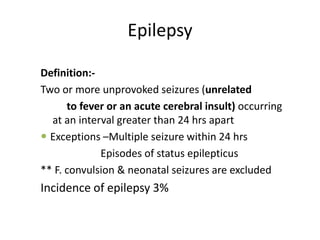
Epilepsy

Definition:-
Two or more unprovoked seizures (unrelated
      to fever or an acute cerebral insult) occurring
  at an interval greater than 24 hrs apart
 Exceptions –Multiple seizure within 24 hrs
             Episodes of status epilepticus
** F. convulsion & neonatal seizures are excluded
Incidence of epilepsy 3%
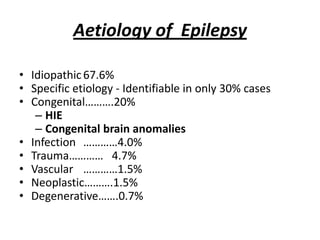
Aetiology of Epilepsy

• Idiopathic 67.6%
• Specific etiology - Identifiable in only 30% cases
• Congenital……….20%
   – HIE
   – Congenital brain anomalies
• Infection …………4.0%
• Trauma………… 4.7%
• Vascular …………1.5%
• Neoplastic……….1.5%
• Degenerative…….0.7%
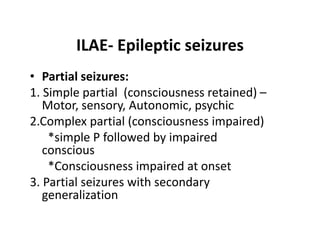
ILAE- Epileptic seizures
• Partial seizures:
1. Simple partial (consciousness retained) –
   Motor, sensory, Autonomic, psychic
2.Complex partial (consciousness impaired)
    *simple P followed by impaired
   conscious
    *Consciousness impaired at onset
3. Partial seizures with secondary
   generalization
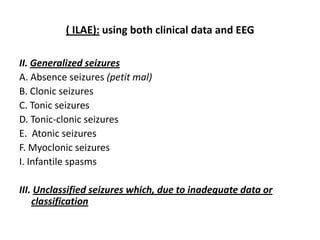
( ILAE): using both clinical data and EEG

II. Generalized seizures
A. Absence seizures (petit mal)
B. Clonic seizures
C. Tonic seizures
D. Tonic-clonic seizures
E. Atonic seizures
F. Myoclonic seizures
I. Infantile spasms

III. Unclassified seizures which, due to inadequate data or
    classification
ILAE epilepsy & Epileptic syndromes

   1. Localised - Simple Partial S
                Complex Partial S
     Syndromes:-
    a) Idiopathic age related -Benign
         childhood focal epilepsy with
         centrotemporal spikes (rolandic E)

    b) Symptomatic- chronic progressive E
                 Epilepsia partalis continua
ILAE epilepsy & Epileptic syndromes
     2. Generalized – Same
        Syndromes :
     A) Idiopathic age related – childhood
        absence,
                                juvenile absence
     B) Cryptogenic -West syndrome (infantile
                        spasms)
                     - Lennox-Gastaut
        Syndrome
                      - Myoclonic seizures
Simple Partial seizures
• Motor activity is the most common
  symptom
• Tend to involve the face, neck, extremities
• Automatism do not occur, some c/o Aura
• Persists -10-20 sec
• Remain conscious can verbalize
• No postictal phase
• EEG-spikes or sharp waves uni or bilaterally
  or multifocal spikes
Complex partial S
• Aura may be +
• Brief blank stare or sudden cessation/ pause
  in activity
• Period of altered consciousness may be brief
  & infrequent
• Automatisms are common 50-75%-
• In infancy -lip smacking, chewing, swallowing
  ,excessive salivation (alimentary
  Automatisms)
Complex partial S
• In older children-semipurposeful
  uncoordinated and unplanned
  gestures-picking & pulling at
  clothing or bed sheets, rubbing
  objects, walking or running in
  nondirective , repetitive , fearful
  fashion
• Secondary generalization may be +
• Duration 1-2 min
Generalized seizures
1.Absence S (petit-mal),simple, typical :-
    -Sudden cessation of motor activity with
     blank facial expression & flickering of
     the eyelids
   - Seizures are subtle - first clue to absence S
  is often unexplained "daydreaming" and a
  decline in school performance recognized
  by a teacher
Absence S (petit-mal),simple, typical

        - Common age - 4 to 8 yrs or early adolescence,
        - Prevalent in girls
        - Incidence 15 to 20% of children
       - No aura, no postictal state
       - Duration 30 sec
       - Countless seizures in
          a day
Generalized seizures
Absence S (petit-
   mal),simple, typical……..
 - Body tone normal but head may fall
   slightly forward
  -Automatism frequently present
 -EEG-3/sec spike and generalized wave
   discharge
Atypical Absence Seizures

• Longer duration
• Seizure is accompanied by more obvious motor
  signs consisting of myoclonic movements of face,
  fingers and extremities, focal or lateralizing features
• Mental retardation may be present
• Less responsive to anticonvulsants
• The EEG - shows a generalized, slow spike-and-wave
  pattern with a frequency of =2- 2.5cycles/sec
2.Generalized tonic – clonic grand –mal)


     Aura – Due to partial onset of seizure
       , lasts sec –min eg olfactory
       hallucination, epigastric
       discomfort, deja-vu, jerking of one
       limb

     Tonic phase -rapid discharging of motor cortex cells
       cause tonic contraction of muscles throughout the
       body - skeletal muscle undergoes sustained spasm
Tonic phase….
•     Skeletal muscle undergoes sustained spasm
    - Laryngeal muscles ,muscles of expiration - forces air
      out of the lungs through a partially closed glottis -
      produce "ictal cry." (shrill cry)
     - Respirations are impaired, secretions pool in the
      oropharynx, and cyanosis develops
    - Muscle rigidity: more in antigravity muscles
         uprolling of eyes or deviated to sides
Tonic phase….

• Contraction of the jaw muscles - biting of the tongue.
• Lasts 10-30 sec
Generalized tonic – clonic grand –mal)


      Clonic phase- 1-5 min
         - Gradually slowing discharge of cortical
           cells, rhythmic clonic contractions
            alternating with relaxation of muscle
            groups
        - Marked enhancement of sympathetic tone - increases
        in heart rate, blood pressure, pupil dilated, Loss of
        sphincter control
Postictal phase
• Characterized by :
- Semicomatose- Unresponsiveness - deep sleep
   for 30min to 2hrs
       •   Muscular flaccidity, loss of corneal reflex
       •   Extensor plantar responses
       •   Loss of sphincter control -incontinence , tongue biting
       •   Lasts 30 min – 2 hrs
Generalized tonic – clonic grand –mal)
     Post-ictal – 30 min – 2 hrs
         Deep unconsciousness, flaccid
       limbs, loss
         of corneal reflexes, extensor plantar
         responses, Excessive salivation cause stridorous
       breathing and partial airway obstruction
      - Patients gradually regain consciousness
     • Bi-frontal headache, confusion, aching
       muscles ,sometimes automatic
       behavior, occasional violence (2-
       21/2hours)
Postictal confusion


•   Bifrontal headache
•   Confusion
•   Aching muscles
•   Sometimes automatic behavior
•   Occasinal violence
•   Lasts - 2-2 ½ hours
GTCS - Precipitated by

- Infections
 - Excessive fatique
 - Emotional stress
- Various drugs -theophylline, anti-
  psychotropic drugs, cipro, benzodiazepines,
  amphetamine, cocaine, alcohol, flumazenil
  - Forgetting to take anticonvulsants
The EEG
During the tonic phase - shows a
     - progressive increase in generalized low-voltage fast
       activity, followed by generalized high-amplitude,
       polyspike discharges
During clonic phase - the high-amplitude activity is typically
       interrupted by slow waves to create a spike-and-wave
       pattern

The postictal EEG - shows diffuse slowing that gradually recovers as
  the patient awakens
3.Myoclonic epilepsies of childhood
   • Repetitive seizures with brief ,symmetric
     muscular contractions with loss of body tone
     and falling or slumping forward
   • Subgroups:
   A. Benign myoclonus of infancy
     -confined to neck, trunk, extremities
      - EEG normal
      - Good prognosis - improves by age
        2yrs
      - No medications needed
B. Typical myoclonic epilepsy of early childhood


            -Normal birth history, normal
               milestones
            -starts at 6 mo -4 yrs peak age-2 ½ yrs
            -Family history + in 1/3rd cases
            -EEG- fast spike waves
            -50% seizure free few yrs after
               treatment
            -Learning language problem, emotional,
               behavioral disorder
            - MR may occur in some
C. Complex myoclonic epilepsies
    • Begin-1st yr of life,
    • Starts as generalized seizure associated
      with URTI
    • Presents as status epilepticus-poor
      prognosis
    • 1/3rd have delayed development,
    • H/o birth asphyxia ,microcephaly
    • No family h/o epilepsy
    • EEG- interictal slow spike waves
    • Refractory to anticonvulsants
D. Juvenile myoclonic epilepsy (janz syndrome)


          • Begin at age 12-16 yrs
          • Initially hair combing, tooth brushing
            become difficult
          • Few yrs later with myoclonus have GTC
            seizure
          • EEG –abnormal
          • Responds to valproate required
            lifelong
E. Progressive myoclonic epilepsies


   • Neurologic abnormalities-cerebellar &
     extrapyramidal signs ++
   • Mental deterioration is characteristic
     feature
   • Genetic disorder –grave prognosis
   • EEG-abnormal
   • Valproic acid + clonazepam is effective
4.Infantile spasms

• 4-8 mo of life
• Brief symmetrical contractions of
  neck, trunk, extremities-sudden
  dropping of head & flexion of arms
  - ‘Salaam fit’
• EEG-Hypsarrhythmic pattern –
  diffuse high voltage slow spike and
  chaotic activity
4.Infantile spasms

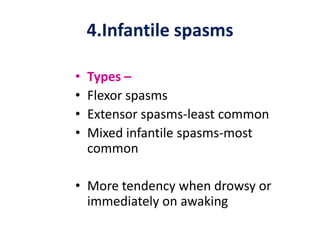
•   Types –
•   Flexor spasms
•   Extensor spasms-least common
•   Mixed infantile spasms-most
    common

• More tendency when drowsy or
  immediately on awaking
4.Infantile spasms

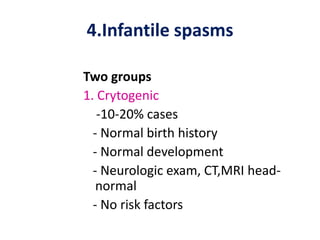
Two groups
1. Crytogenic
   -10-20% cases
  - Normal birth history
  - Normal development
  - Neurologic exam, CT,MRI head-
   normal
  - No risk factors
4.Infantile spasms

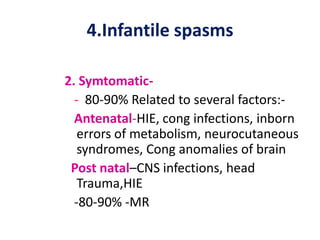
2. Symtomatic-
  - 80-90% Related to several factors:-
  Antenatal-HIE, cong infections, inborn
   errors of metabolism, neurocutaneous
   syndromes, Cong anomalies of brain
 Post natal–CNS infections, head
   Trauma,HIE
  -80-90% -MR
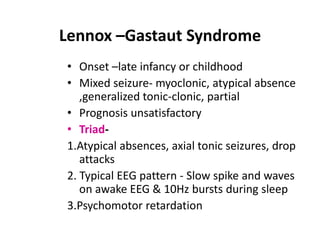
Lennox –Gastaut Syndrome
• Onset –late infancy or childhood
• Mixed seizure- myoclonic, atypical absence
   ,generalized tonic-clonic, partial
• Prognosis unsatisfactory
• Triad-
1.Atypical absences, axial tonic seizures, drop
   attacks
2. Typical EEG pattern - Slow spike and waves
   on awake EEG & 10Hz bursts during sleep
3.Psychomotor retardation
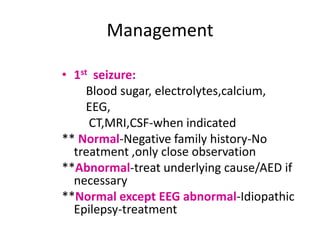
Management

• 1st seizure:
     Blood sugar, electrolytes,calcium,
     EEG,
     CT,MRI,CSF-when indicated
** Normal-Negative family history-No
  treatment ,only close observation
**Abnormal-treat underlying cause/AED if
  necessary
**Normal except EEG abnormal-Idiopathic
  Epilepsy-treatment
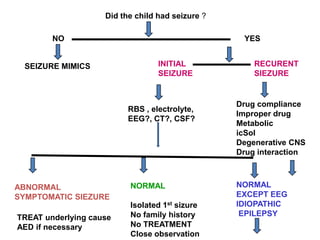
Did the child had seizure ?

        NO                                         YES


  SEIZURE MIMICS                  INITIAL             RECURENT
                                  SEIZURE             SIEZURE


                                                  Drug compliance
                          RBS , electrolyte,
                                                  Improper drug
                          EEG?, CT?, CSF?
                                                  Metabolic
                                                  icSol
                                                  Degenerative CNS
                                                  Drug interaction


ABNORMAL                  NORMAL                  NORMAL
SYMPTOMATIC SIEZURE                               EXCEPT EEG
                          Isolated 1st sizure     IDIOPATHIC
TREAT underlying cause    No family history        EPILEPSY
AED if necessary          No TREATMENT
                          Close observation
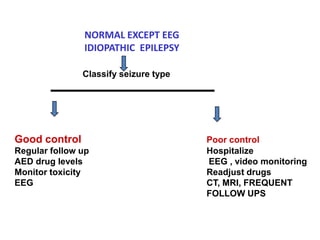
NORMAL EXCEPT EEG
               IDIOPATHIC EPILEPSY

               Classify seizure type


Good control                           Poor control
Regular follow up                      Hospitalize
AED drug levels                        EEG , video monitoring
Monitor toxicity                       Readjust drugs
EEG                                    CT, MRI, FREQUENT
                                       FOLLOW UPS
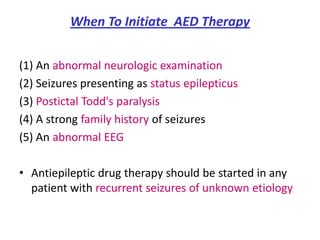
When To Initiate AED Therapy


(1) An abnormal neurologic examination
(2) Seizures presenting as status epilepticus
(3) Postictal Todd's paralysis
(4) A strong family history of seizures
(5) An abnormal EEG

• Antiepileptic drug therapy should be started in any
  patient with recurrent seizures of unknown etiology
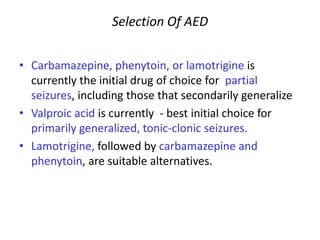
Selection Of AED


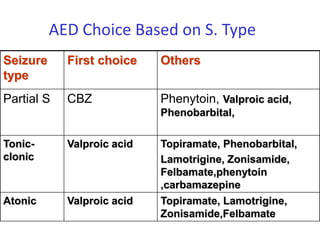
• Carbamazepine, phenytoin, or lamotrigine is
  currently the initial drug of choice for partial
  seizures, including those that secondarily generalize
• Valproic acid is currently - best initial choice for
  primarily generalized, tonic-clonic seizures.
• Lamotrigine, followed by carbamazepine and
  phenytoin, are suitable alternatives.
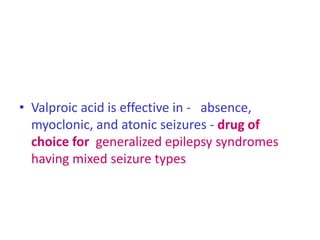
• Valproic acid is effective in - absence,
  myoclonic, and atonic seizures - drug of
  choice for generalized epilepsy syndromes
  having mixed seizure types
Treatment
1.Establish diagnosis
2. Decide about need for AED
3. Choice of most suitable drug-age, type
   of seizure, economic condition of
   patient
4.Proper F/U
**Go for monotherapy
**start with small dose & gradually
   increase to maintenance dose over few
   weeks
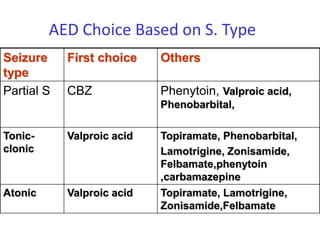
AED Choice Based on S. Type
Seizure     First choice    Others
type
Partial S   CBZ             Phenytoin, Valproic acid,
                            Phenobarbital,

Tonic-      Valproic acid   Topiramate, Phenobarbital,
clonic                      Lamotrigine, Zonisamide,
                            Felbamate,phenytoin
                            ,carbamazepine
Atonic      Valproic acid   Topiramate, Lamotrigine,
                            Zonisamide,Felbamate
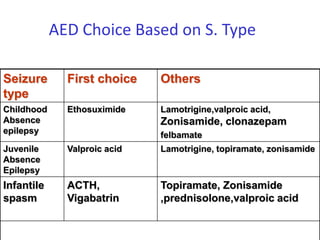
AED Choice Based on S. Type

Seizure       First choice    Others
type
Childhood     Ethosuximide    Lamotrigine,valproic acid,
Absence                       Zonisamide, clonazepam
epilepsy                      felbamate
Juvenile      Valproic acid   Lamotrigine, topiramate, zonisamide
Absence
Epilepsy
Infantile     ACTH,           Topiramate, Zonisamide
spasm         Vigabatrin      ,prednisolone,valproic acid
AED Choice Based on S. Type
Seizure     First choice    Others
type
Partial S   CBZ             Phenytoin, Valproic acid,
                            Phenobarbital,

Tonic-      Valproic acid   Topiramate, Phenobarbital,
clonic                      Lamotrigine, Zonisamide,
                            Felbamate,phenytoin
                            ,carbamazepine
Atonic      Valproic acid   Topiramate, Lamotrigine,
                            Zonisamide,Felbamate
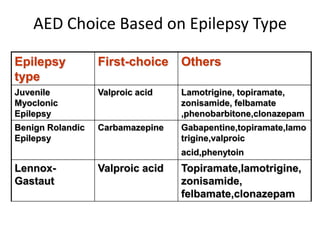
AED Choice Based on Epilepsy Type

Epilepsy          First-choice    Others
type
Juvenile          Valproic acid   Lamotrigine, topiramate,
Myoclonic                         zonisamide, felbamate
Epilepsy                          ,phenobarbitone,clonazepam
Benign Rolandic   Carbamazepine   Gabapentine,topiramate,lamo
Epilepsy                          trigine,valproic
                                  acid,phenytoin
Lennox-           Valproic acid   Topiramate,lamotrigine,
Gastaut                           zonisamide,
                                  felbamate,clonazepam
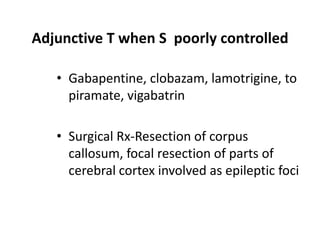
Adjunctive T when S poorly controlled

   • Gabapentine, clobazam, lamotrigine, to
     piramate, vigabatrin

   • Surgical Rx-Resection of corpus
     callosum, focal resection of parts of
     cerebral cortex involved as epileptic foci
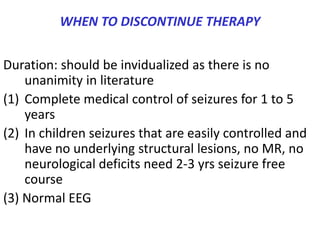
WHEN TO DISCONTINUE THERAPY


Duration: should be invidualized as there is no
    unanimity in literature
(1) Complete medical control of seizures for 1 to 5
    years
(2) In children seizures that are easily controlled and
    have no underlying structural lesions, no MR, no
    neurological deficits need 2-3 yrs seizure free
    course
(3) Normal EEG
Thank you
Download more documents and slide shows on The Medical Post
               [ www.themedicalpost.net ]

Epilepsy

  • 1.
    Epilepsy Dr. Kalpana Malla MD Pediatrics Manipal Teaching Hospital Download more documents and slide shows on The Medical Post [ www.themedicalpost.net ]
  • 2.
    Epilepsy Definition:- Two or moreunprovoked seizures (unrelated to fever or an acute cerebral insult) occurring at an interval greater than 24 hrs apart  Exceptions –Multiple seizure within 24 hrs Episodes of status epilepticus ** F. convulsion & neonatal seizures are excluded Incidence of epilepsy 3%
  • 3.
    Aetiology of Epilepsy •Idiopathic 67.6% • Specific etiology - Identifiable in only 30% cases • Congenital……….20% – HIE – Congenital brain anomalies • Infection …………4.0% • Trauma………… 4.7% • Vascular …………1.5% • Neoplastic……….1.5% • Degenerative…….0.7%
  • 4.
    ILAE- Epileptic seizures •Partial seizures: 1. Simple partial (consciousness retained) – Motor, sensory, Autonomic, psychic 2.Complex partial (consciousness impaired) *simple P followed by impaired conscious *Consciousness impaired at onset 3. Partial seizures with secondary generalization
  • 5.
    ( ILAE): usingboth clinical data and EEG II. Generalized seizures A. Absence seizures (petit mal) B. Clonic seizures C. Tonic seizures D. Tonic-clonic seizures E. Atonic seizures F. Myoclonic seizures I. Infantile spasms III. Unclassified seizures which, due to inadequate data or classification
  • 6.
    ILAE epilepsy &Epileptic syndromes 1. Localised - Simple Partial S Complex Partial S Syndromes:- a) Idiopathic age related -Benign childhood focal epilepsy with centrotemporal spikes (rolandic E) b) Symptomatic- chronic progressive E Epilepsia partalis continua
  • 7.
    ILAE epilepsy &Epileptic syndromes 2. Generalized – Same Syndromes : A) Idiopathic age related – childhood absence, juvenile absence B) Cryptogenic -West syndrome (infantile spasms) - Lennox-Gastaut Syndrome - Myoclonic seizures
  • 8.
    Simple Partial seizures •Motor activity is the most common symptom • Tend to involve the face, neck, extremities • Automatism do not occur, some c/o Aura • Persists -10-20 sec • Remain conscious can verbalize • No postictal phase • EEG-spikes or sharp waves uni or bilaterally or multifocal spikes
  • 9.
    Complex partial S •Aura may be + • Brief blank stare or sudden cessation/ pause in activity • Period of altered consciousness may be brief & infrequent • Automatisms are common 50-75%- • In infancy -lip smacking, chewing, swallowing ,excessive salivation (alimentary Automatisms)
  • 10.
    Complex partial S •In older children-semipurposeful uncoordinated and unplanned gestures-picking & pulling at clothing or bed sheets, rubbing objects, walking or running in nondirective , repetitive , fearful fashion • Secondary generalization may be + • Duration 1-2 min
  • 11.
    Generalized seizures 1.Absence S(petit-mal),simple, typical :- -Sudden cessation of motor activity with blank facial expression & flickering of the eyelids - Seizures are subtle - first clue to absence S is often unexplained "daydreaming" and a decline in school performance recognized by a teacher
  • 12.
    Absence S (petit-mal),simple,typical - Common age - 4 to 8 yrs or early adolescence, - Prevalent in girls - Incidence 15 to 20% of children - No aura, no postictal state - Duration 30 sec - Countless seizures in a day
  • 13.
    Generalized seizures Absence S(petit- mal),simple, typical…….. - Body tone normal but head may fall slightly forward -Automatism frequently present -EEG-3/sec spike and generalized wave discharge
  • 14.
    Atypical Absence Seizures •Longer duration • Seizure is accompanied by more obvious motor signs consisting of myoclonic movements of face, fingers and extremities, focal or lateralizing features • Mental retardation may be present • Less responsive to anticonvulsants • The EEG - shows a generalized, slow spike-and-wave pattern with a frequency of =2- 2.5cycles/sec
  • 15.
    2.Generalized tonic –clonic grand –mal) Aura – Due to partial onset of seizure , lasts sec –min eg olfactory hallucination, epigastric discomfort, deja-vu, jerking of one limb Tonic phase -rapid discharging of motor cortex cells cause tonic contraction of muscles throughout the body - skeletal muscle undergoes sustained spasm
  • 16.
    Tonic phase…. • Skeletal muscle undergoes sustained spasm - Laryngeal muscles ,muscles of expiration - forces air out of the lungs through a partially closed glottis - produce "ictal cry." (shrill cry) - Respirations are impaired, secretions pool in the oropharynx, and cyanosis develops - Muscle rigidity: more in antigravity muscles uprolling of eyes or deviated to sides
  • 17.
    Tonic phase…. • Contractionof the jaw muscles - biting of the tongue. • Lasts 10-30 sec
  • 18.
    Generalized tonic –clonic grand –mal) Clonic phase- 1-5 min - Gradually slowing discharge of cortical cells, rhythmic clonic contractions alternating with relaxation of muscle groups - Marked enhancement of sympathetic tone - increases in heart rate, blood pressure, pupil dilated, Loss of sphincter control
  • 19.
    Postictal phase • Characterizedby : - Semicomatose- Unresponsiveness - deep sleep for 30min to 2hrs • Muscular flaccidity, loss of corneal reflex • Extensor plantar responses • Loss of sphincter control -incontinence , tongue biting • Lasts 30 min – 2 hrs
  • 20.
    Generalized tonic –clonic grand –mal) Post-ictal – 30 min – 2 hrs Deep unconsciousness, flaccid limbs, loss of corneal reflexes, extensor plantar responses, Excessive salivation cause stridorous breathing and partial airway obstruction - Patients gradually regain consciousness • Bi-frontal headache, confusion, aching muscles ,sometimes automatic behavior, occasional violence (2- 21/2hours)
  • 21.
    Postictal confusion • Bifrontal headache • Confusion • Aching muscles • Sometimes automatic behavior • Occasinal violence • Lasts - 2-2 ½ hours
  • 22.
    GTCS - Precipitatedby - Infections - Excessive fatique - Emotional stress - Various drugs -theophylline, anti- psychotropic drugs, cipro, benzodiazepines, amphetamine, cocaine, alcohol, flumazenil - Forgetting to take anticonvulsants
  • 23.
    The EEG During thetonic phase - shows a - progressive increase in generalized low-voltage fast activity, followed by generalized high-amplitude, polyspike discharges During clonic phase - the high-amplitude activity is typically interrupted by slow waves to create a spike-and-wave pattern The postictal EEG - shows diffuse slowing that gradually recovers as the patient awakens
  • 24.
    3.Myoclonic epilepsies ofchildhood • Repetitive seizures with brief ,symmetric muscular contractions with loss of body tone and falling or slumping forward • Subgroups: A. Benign myoclonus of infancy -confined to neck, trunk, extremities - EEG normal - Good prognosis - improves by age 2yrs - No medications needed
  • 25.
    B. Typical myoclonicepilepsy of early childhood -Normal birth history, normal milestones -starts at 6 mo -4 yrs peak age-2 ½ yrs -Family history + in 1/3rd cases -EEG- fast spike waves -50% seizure free few yrs after treatment -Learning language problem, emotional, behavioral disorder - MR may occur in some
  • 26.
    C. Complex myoclonicepilepsies • Begin-1st yr of life, • Starts as generalized seizure associated with URTI • Presents as status epilepticus-poor prognosis • 1/3rd have delayed development, • H/o birth asphyxia ,microcephaly • No family h/o epilepsy • EEG- interictal slow spike waves • Refractory to anticonvulsants
  • 27.
    D. Juvenile myoclonicepilepsy (janz syndrome) • Begin at age 12-16 yrs • Initially hair combing, tooth brushing become difficult • Few yrs later with myoclonus have GTC seizure • EEG –abnormal • Responds to valproate required lifelong
  • 28.
    E. Progressive myoclonicepilepsies • Neurologic abnormalities-cerebellar & extrapyramidal signs ++ • Mental deterioration is characteristic feature • Genetic disorder –grave prognosis • EEG-abnormal • Valproic acid + clonazepam is effective
  • 29.
    4.Infantile spasms • 4-8mo of life • Brief symmetrical contractions of neck, trunk, extremities-sudden dropping of head & flexion of arms - ‘Salaam fit’ • EEG-Hypsarrhythmic pattern – diffuse high voltage slow spike and chaotic activity
  • 30.
    4.Infantile spasms • Types – • Flexor spasms • Extensor spasms-least common • Mixed infantile spasms-most common • More tendency when drowsy or immediately on awaking
  • 31.
    4.Infantile spasms Two groups 1.Crytogenic -10-20% cases - Normal birth history - Normal development - Neurologic exam, CT,MRI head- normal - No risk factors
  • 32.
    4.Infantile spasms 2. Symtomatic- - 80-90% Related to several factors:- Antenatal-HIE, cong infections, inborn errors of metabolism, neurocutaneous syndromes, Cong anomalies of brain Post natal–CNS infections, head Trauma,HIE -80-90% -MR
  • 33.
    Lennox –Gastaut Syndrome •Onset –late infancy or childhood • Mixed seizure- myoclonic, atypical absence ,generalized tonic-clonic, partial • Prognosis unsatisfactory • Triad- 1.Atypical absences, axial tonic seizures, drop attacks 2. Typical EEG pattern - Slow spike and waves on awake EEG & 10Hz bursts during sleep 3.Psychomotor retardation
  • 34.
    Management • 1st seizure: Blood sugar, electrolytes,calcium, EEG, CT,MRI,CSF-when indicated ** Normal-Negative family history-No treatment ,only close observation **Abnormal-treat underlying cause/AED if necessary **Normal except EEG abnormal-Idiopathic Epilepsy-treatment
  • 35.
    Did the childhad seizure ? NO YES SEIZURE MIMICS INITIAL RECURENT SEIZURE SIEZURE Drug compliance RBS , electrolyte, Improper drug EEG?, CT?, CSF? Metabolic icSol Degenerative CNS Drug interaction ABNORMAL NORMAL NORMAL SYMPTOMATIC SIEZURE EXCEPT EEG Isolated 1st sizure IDIOPATHIC TREAT underlying cause No family history EPILEPSY AED if necessary No TREATMENT Close observation
  • 36.
    NORMAL EXCEPT EEG IDIOPATHIC EPILEPSY Classify seizure type Good control Poor control Regular follow up Hospitalize AED drug levels EEG , video monitoring Monitor toxicity Readjust drugs EEG CT, MRI, FREQUENT FOLLOW UPS
  • 37.
    When To InitiateAED Therapy (1) An abnormal neurologic examination (2) Seizures presenting as status epilepticus (3) Postictal Todd's paralysis (4) A strong family history of seizures (5) An abnormal EEG • Antiepileptic drug therapy should be started in any patient with recurrent seizures of unknown etiology
  • 38.
    Selection Of AED •Carbamazepine, phenytoin, or lamotrigine is currently the initial drug of choice for partial seizures, including those that secondarily generalize • Valproic acid is currently - best initial choice for primarily generalized, tonic-clonic seizures. • Lamotrigine, followed by carbamazepine and phenytoin, are suitable alternatives.
  • 39.
    • Valproic acidis effective in - absence, myoclonic, and atonic seizures - drug of choice for generalized epilepsy syndromes having mixed seizure types
  • 40.
    Treatment 1.Establish diagnosis 2. Decideabout need for AED 3. Choice of most suitable drug-age, type of seizure, economic condition of patient 4.Proper F/U **Go for monotherapy **start with small dose & gradually increase to maintenance dose over few weeks
  • 41.
    AED Choice Basedon S. Type Seizure First choice Others type Partial S CBZ Phenytoin, Valproic acid, Phenobarbital, Tonic- Valproic acid Topiramate, Phenobarbital, clonic Lamotrigine, Zonisamide, Felbamate,phenytoin ,carbamazepine Atonic Valproic acid Topiramate, Lamotrigine, Zonisamide,Felbamate
  • 42.
    AED Choice Basedon S. Type Seizure First choice Others type Childhood Ethosuximide Lamotrigine,valproic acid, Absence Zonisamide, clonazepam epilepsy felbamate Juvenile Valproic acid Lamotrigine, topiramate, zonisamide Absence Epilepsy Infantile ACTH, Topiramate, Zonisamide spasm Vigabatrin ,prednisolone,valproic acid
  • 43.
    AED Choice Basedon S. Type Seizure First choice Others type Partial S CBZ Phenytoin, Valproic acid, Phenobarbital, Tonic- Valproic acid Topiramate, Phenobarbital, clonic Lamotrigine, Zonisamide, Felbamate,phenytoin ,carbamazepine Atonic Valproic acid Topiramate, Lamotrigine, Zonisamide,Felbamate
  • 44.
    AED Choice Basedon Epilepsy Type Epilepsy First-choice Others type Juvenile Valproic acid Lamotrigine, topiramate, Myoclonic zonisamide, felbamate Epilepsy ,phenobarbitone,clonazepam Benign Rolandic Carbamazepine Gabapentine,topiramate,lamo Epilepsy trigine,valproic acid,phenytoin Lennox- Valproic acid Topiramate,lamotrigine, Gastaut zonisamide, felbamate,clonazepam
  • 45.
    Adjunctive T whenS poorly controlled • Gabapentine, clobazam, lamotrigine, to piramate, vigabatrin • Surgical Rx-Resection of corpus callosum, focal resection of parts of cerebral cortex involved as epileptic foci
  • 46.
    WHEN TO DISCONTINUETHERAPY Duration: should be invidualized as there is no unanimity in literature (1) Complete medical control of seizures for 1 to 5 years (2) In children seizures that are easily controlled and have no underlying structural lesions, no MR, no neurological deficits need 2-3 yrs seizure free course (3) Normal EEG
  • 47.
    Thank you Download moredocuments and slide shows on The Medical Post [ www.themedicalpost.net ]