Dr. Niran Oyekale fiima
President / CEO, Commit Technology & Consult Limited
+234(0)7031055234, (0)8183428803 commitechng@gmail.com
The Paradigm Shift
From
The Industrial Age
To
The Information Age
To
The Creativity Age
These changes,
among others, are ushering us
toward
a world
where knowledge, power, and
productive capability will be
more dispersed than at any time in
our history— a world
where value creation will be fast, fluid,
and
The Implication
……..Something Worth Pondering on?
Think about the closing of one school
year and begin the transformation into
another, file away just one number: 65
percent…..
…..fully 65 percent of
today’s basic school pupils may end
up doing work that hasn’t been
invented yet.
Source: Cathy N. Davidson, co-director of the annual MacArthur Foundation
Think back 50 years
…. could educators then have
predicted how the Internet, which
emerged globally in 1994, or the
mobile phone, which appeared a few
years later, would change the world?
Think a moment about this generation…
These technologies
have not just become tools
of learning, but networking and
knowledge sharing, as well as
innovation and
entrepreneurship….
Think a moment further about this
generation…
Think Again……..
A Fast Changing World…
……..changing so fast
That the replication of more of
the same knowledge and skills of the
other days will not suffice to address
the challenges of today, not to talk of
the future…
Imagine….
A generation ago, teachers could expect that what they
taught would last their students a
lifetime.
Rapid
economic and social changes
demand Nigeria to prepare the
citizenry
for jobs that are yet to be created,
technologies that have not yet
been invented
and problems that we don't yet
know will arise.
Reality of Time
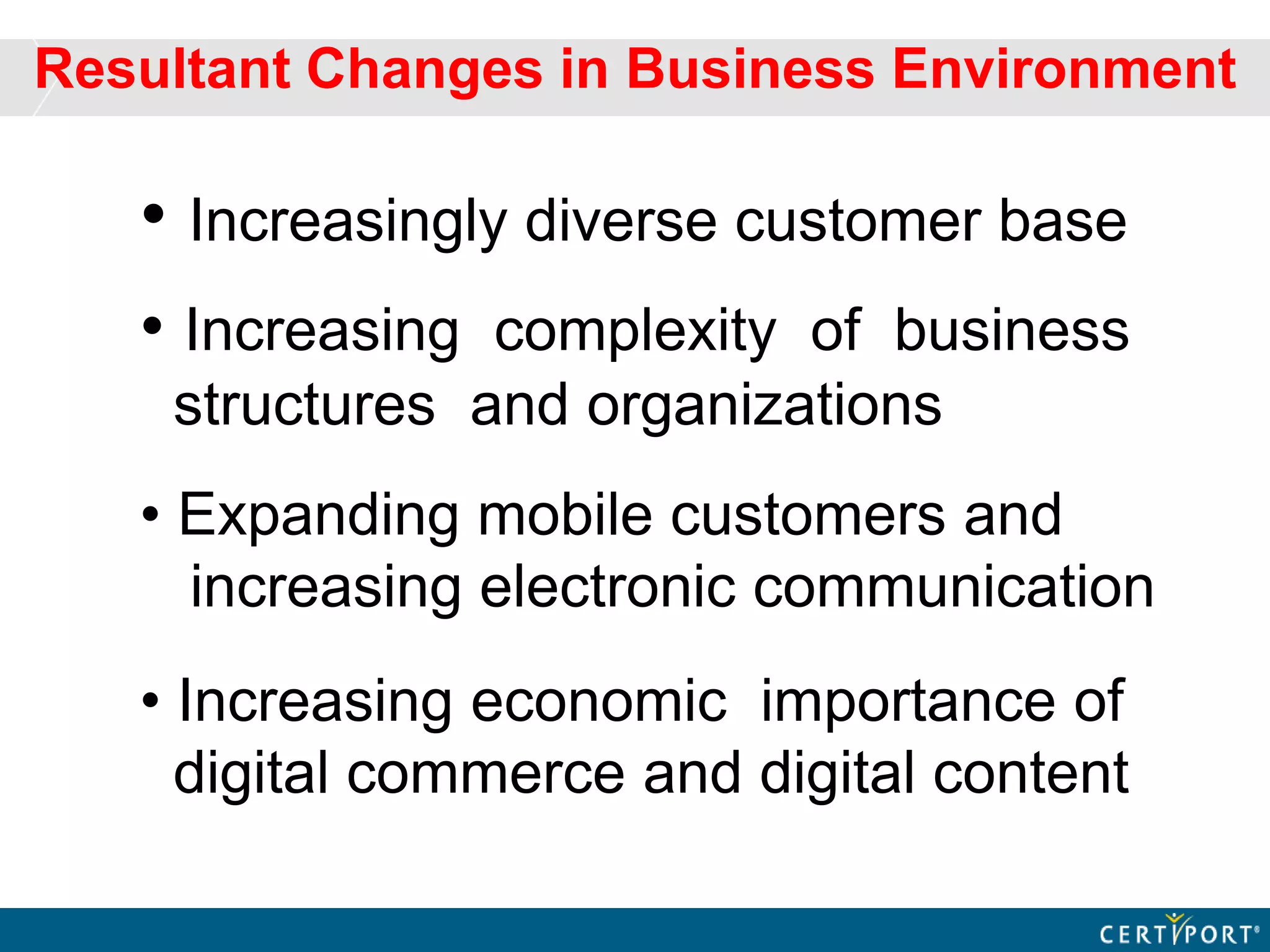
• Increasingly diverse customer base
• Increasing complexity of business
structures and organizations
• Expanding mobile customers and
increasing electronic communication
• Increasing economic importance of
digital commerce and digital content
Resultant Changes in Business Environment
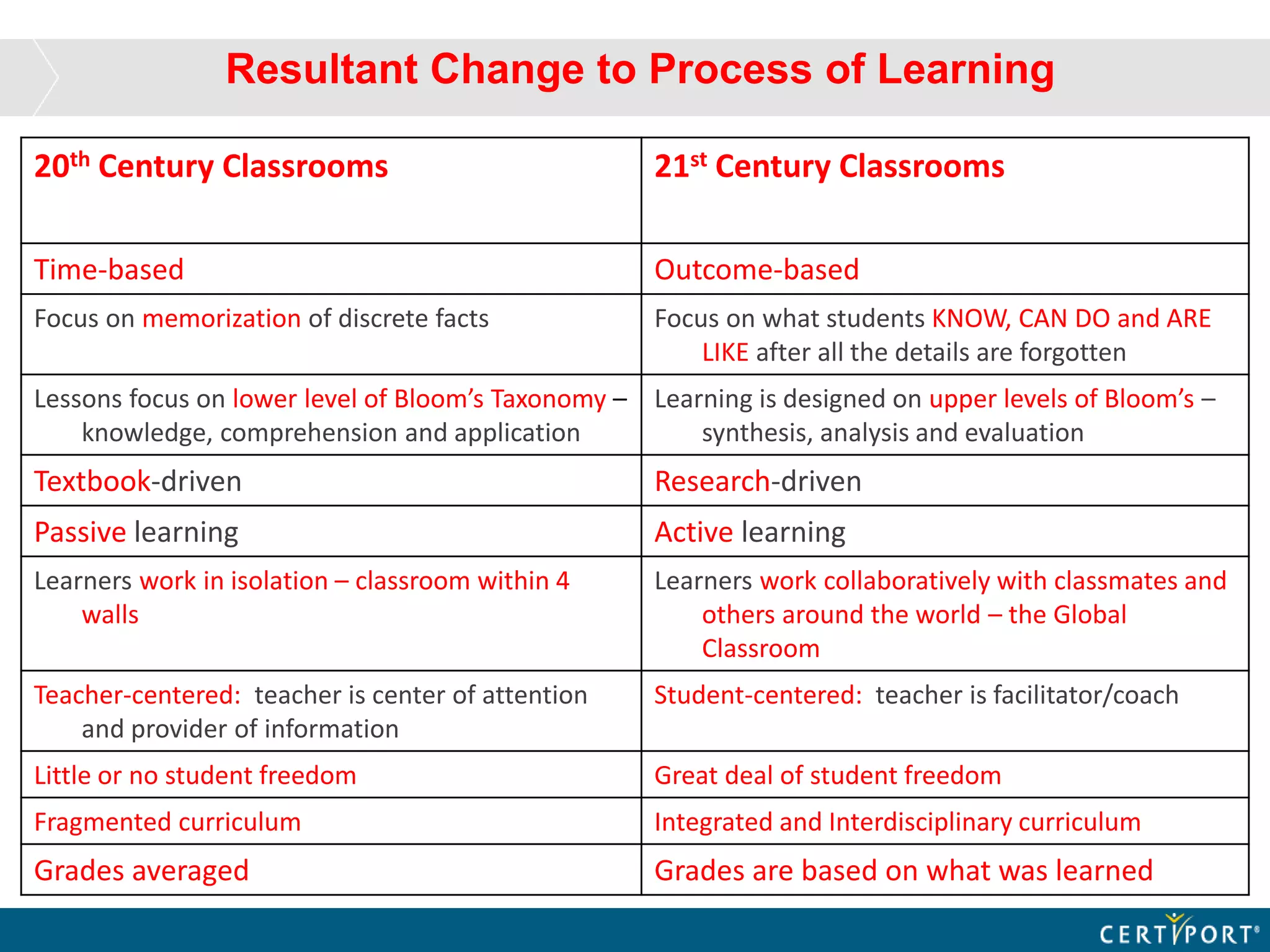
Resultant Change to Process of Learning
20th Century Classrooms 21st Century Classrooms
Time-based Outcome-based
Focus on memorization of discrete facts Focus on what students KNOW, CAN DO and ARE
LIKE after all the details are forgotten
Lessons focus on lower level of Bloom’s Taxonomy –
knowledge, comprehension and application
Learning is designed on upper levels of Bloom’s –
synthesis, analysis and evaluation
Textbook-driven Research-driven
Passive learning Active learning
Learners work in isolation – classroom within 4
walls
Learners work collaboratively with classmates and
others around the world – the Global
Classroom
Teacher-centered: teacher is center of attention
and provider of information
Student-centered: teacher is facilitator/coach
Little or no student freedom Great deal of student freedom
Fragmented curriculum Integrated and Interdisciplinary curriculum
Grades averaged Grades are based on what was learned
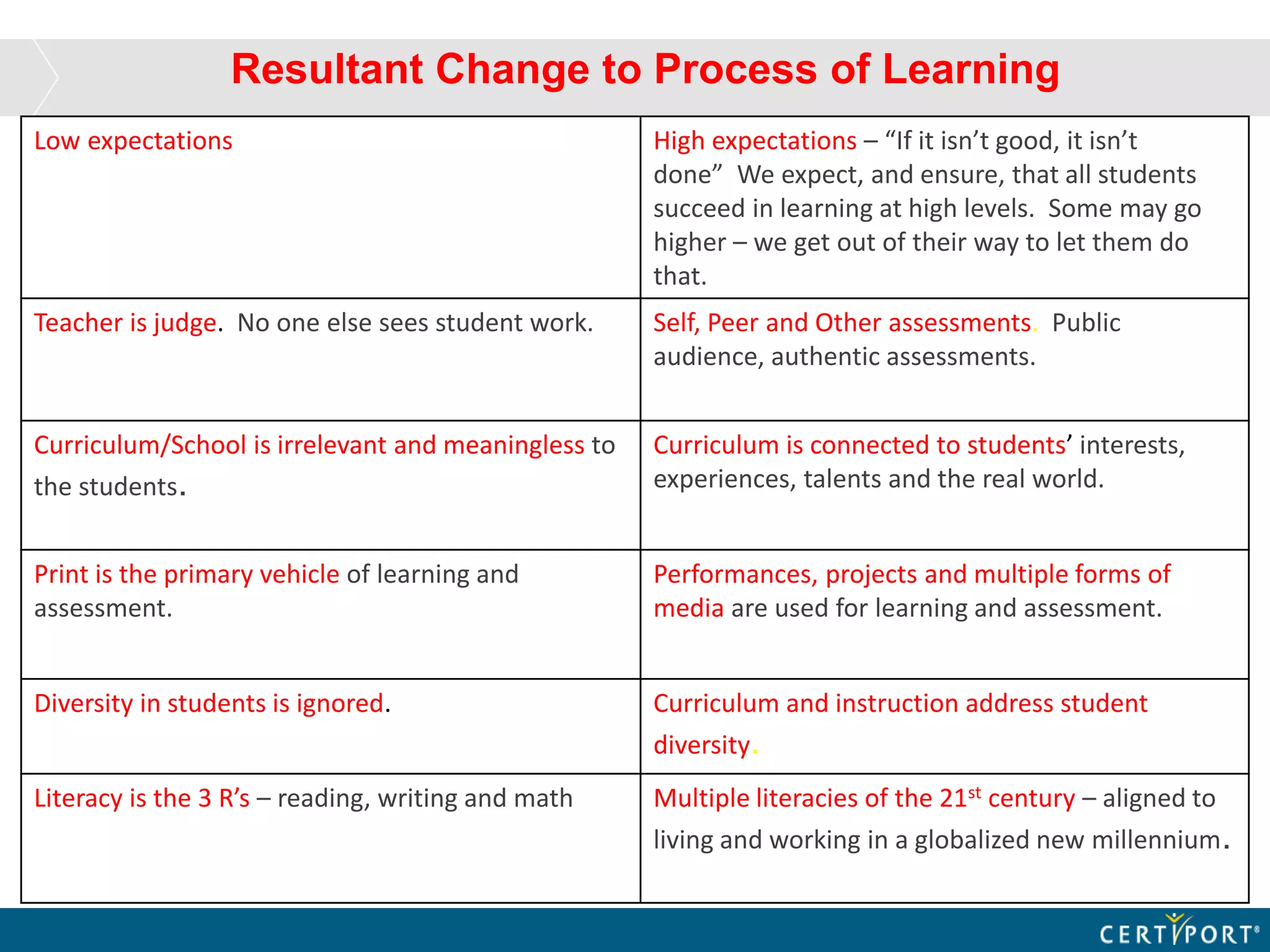
Resultant Change to Process of Learning
Low expectations High expectations – “If it isn’t good, it isn’t
done” We expect, and ensure, that all students
succeed in learning at high levels. Some may go
higher – we get out of their way to let them do
that.
Teacher is judge. No one else sees student work. Self, Peer and Other assessments. Public
audience, authentic assessments.
Curriculum/School is irrelevant and meaningless to
the students.
Curriculum is connected to students’ interests,
experiences, talents and the real world.
Print is the primary vehicle of learning and
assessment.
Performances, projects and multiple forms of
media are used for learning and assessment.
Diversity in students is ignored. Curriculum and instruction address student
diversity.
Literacy is the 3 R’s – reading, writing and math Multiple literacies of the 21st century – aligned to
living and working in a globalized new millennium.
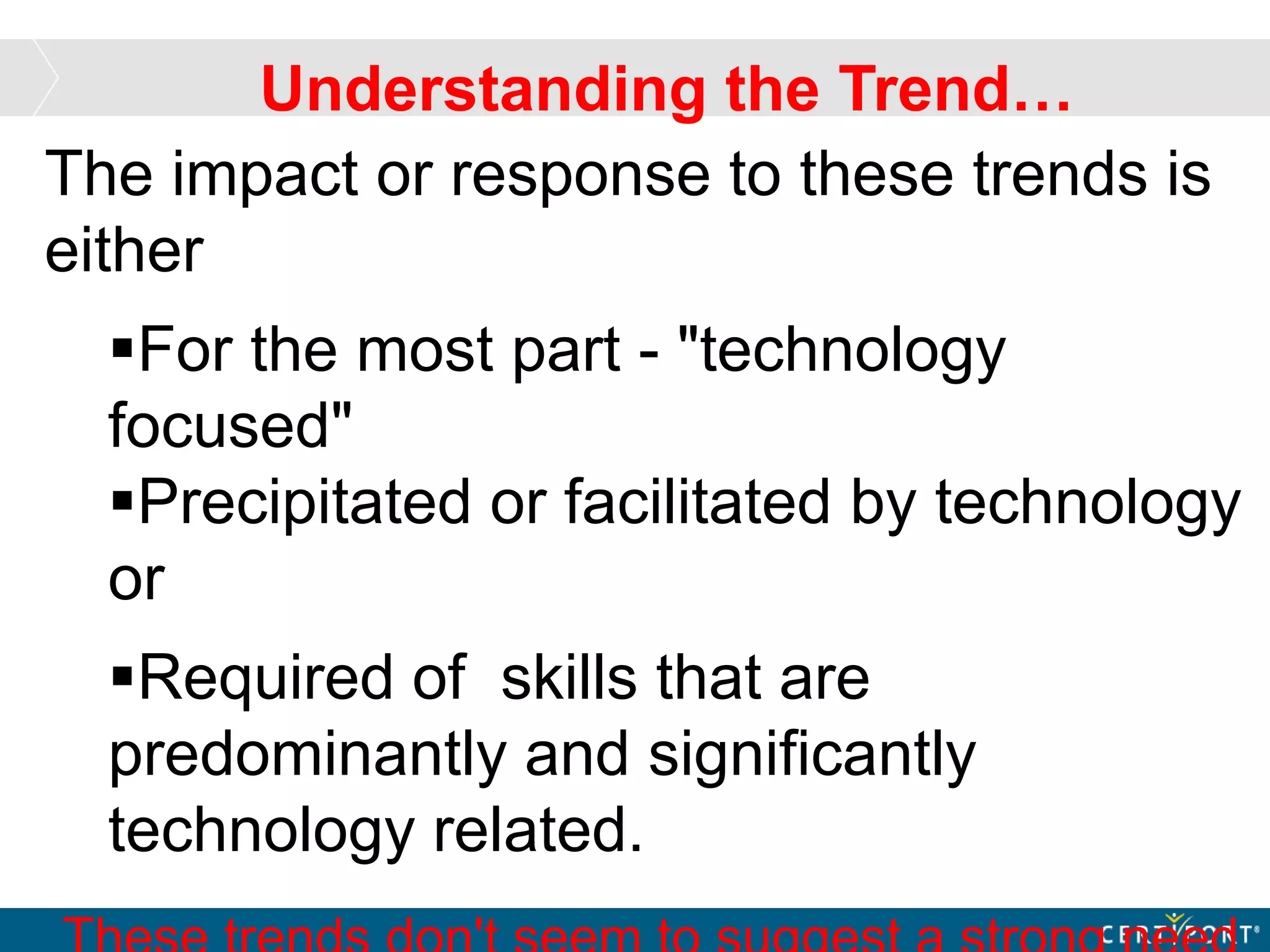
The impact or response to these trends is
either
For the most part - "technology
focused"
Precipitated or facilitated by technology
or
Required of skills that are
predominantly and significantly
technology related.
Understanding the Trend…
Fluency
o Attained when an act is accomplished with no
noticeable cognitive or mental effort.
o Having a mastery of certain skills to the point of
not requiring conscious attention.
Digital fluency
o An evolving aptitude that empowers the individual
to
effectively and ethically interpret information,
discover meaning, design content, construct
knowledge,
and communicate ideas in a digitally connected
world.
Understanding the New Language
• Tremendous understanding of the
past
and current situations
• Adaptability to the digital age
• Imbibing new sets of global best
practices
• Re-tooling and re-skilling to global
standards
Success Determinants
IT capability to
leverage technology
for business differentiation
G
A
P
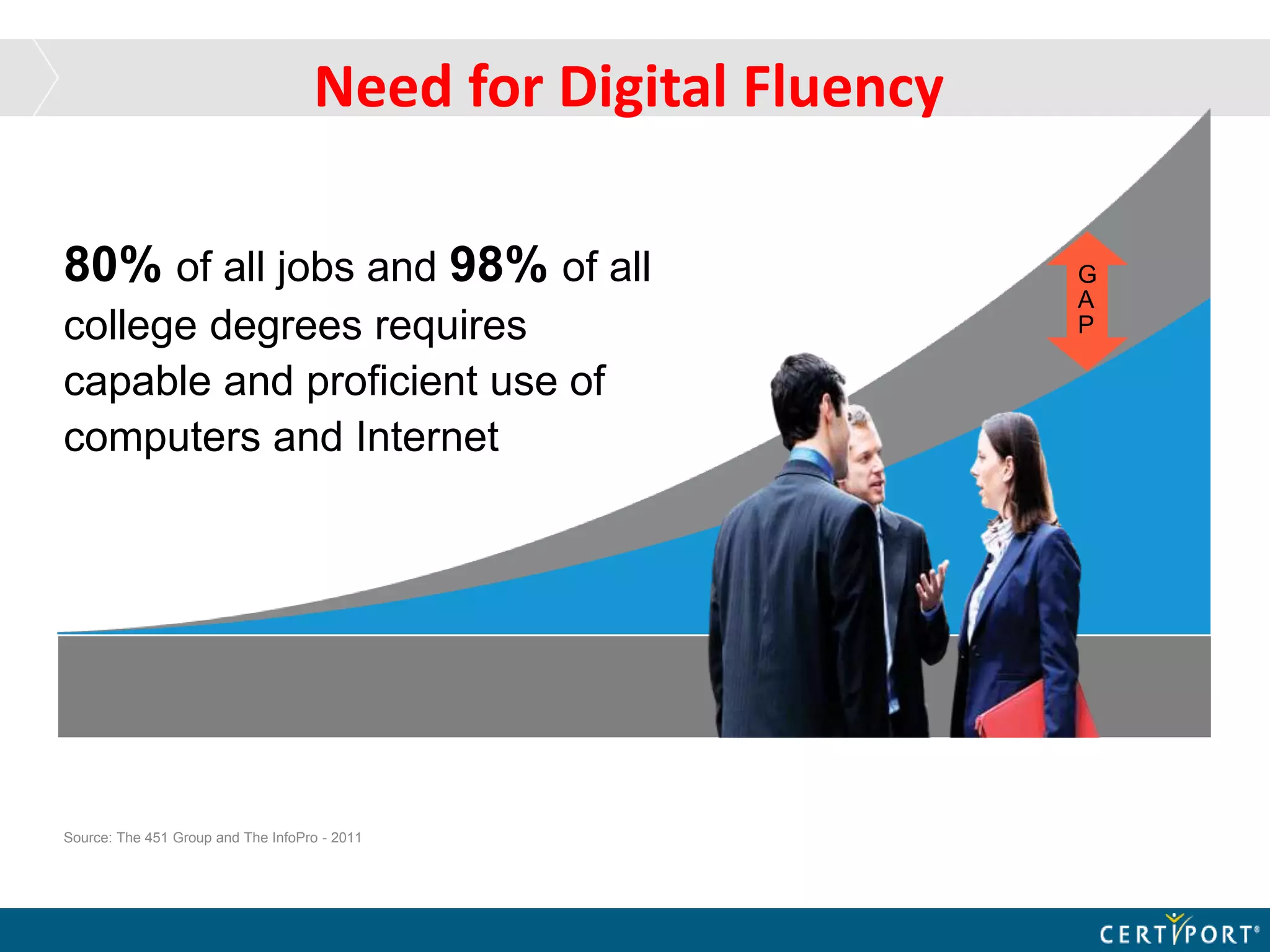
Need for Digital Fluency
Source: The 451 Group and The InfoPro - 2011
80% of all jobs and 98% of all
college degrees requires
capable and proficient use of
computers and Internet
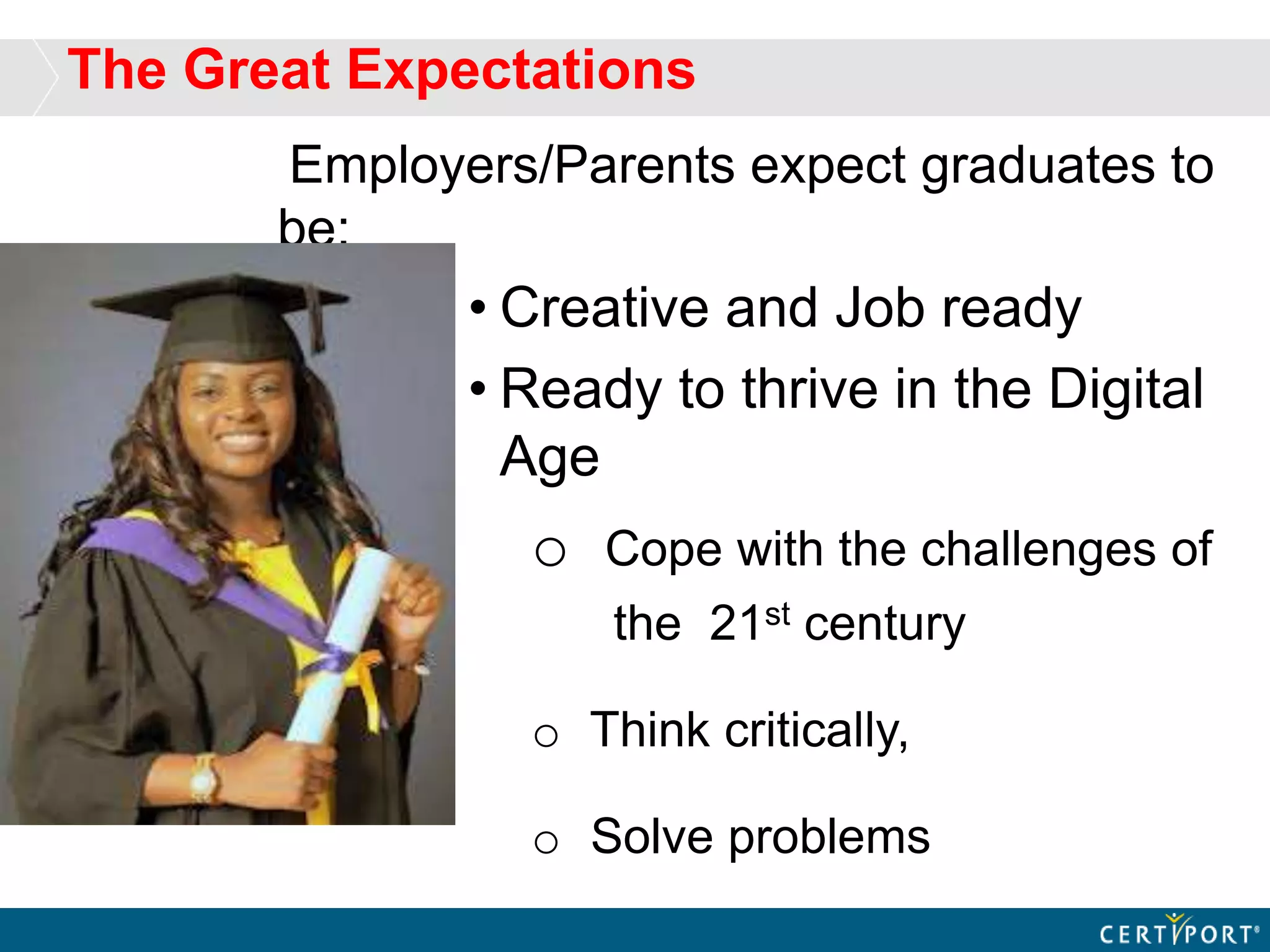
The Great Expectations
Employers/Parents expect graduates to
be:
• Creative and Job ready
• Ready to thrive in the Digital
Age
o Cope with the challenges of
the 21st century
o Think critically,
o Solve problems
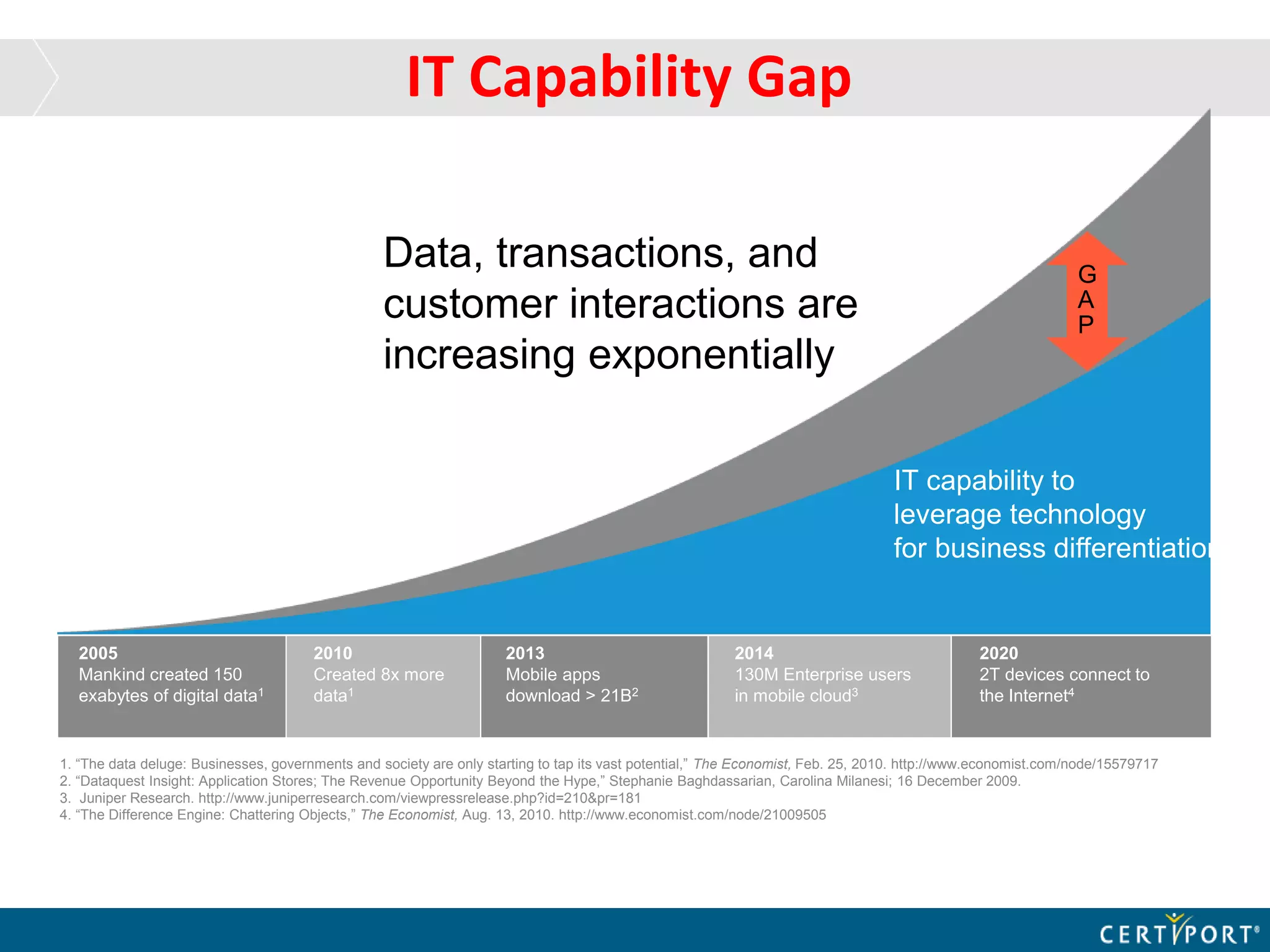
IT Capability Gap
Data, transactions, and
customer interactions are
increasing exponentially
2005
Mankind created 150
exabytes of digital data1
2010
Created 8x more
data1
2013
Mobile apps
download > 21B2
2014
130M Enterprise users
in mobile cloud3
2020
2T devices connect to
the Internet4
IT capability to
leverage technology
for business differentiation
G
A
P
IT capability to
leverage technology
for business differentiation
1. “The data deluge: Businesses, governments and society are only starting to tap its vast potential,” The Economist, Feb. 25, 2010. http://www.economist.com/node/15579717
2. “Dataquest Insight: Application Stores; The Revenue Opportunity Beyond the Hype,” Stephanie Baghdassarian, Carolina Milanesi; 16 December 2009.
3. Juniper Research. http://www.juniperresearch.com/viewpressrelease.php?id=210&pr=181
4. “The Difference Engine: Chattering Objects,” The Economist, Aug. 13, 2010. http://www.economist.com/node/21009505
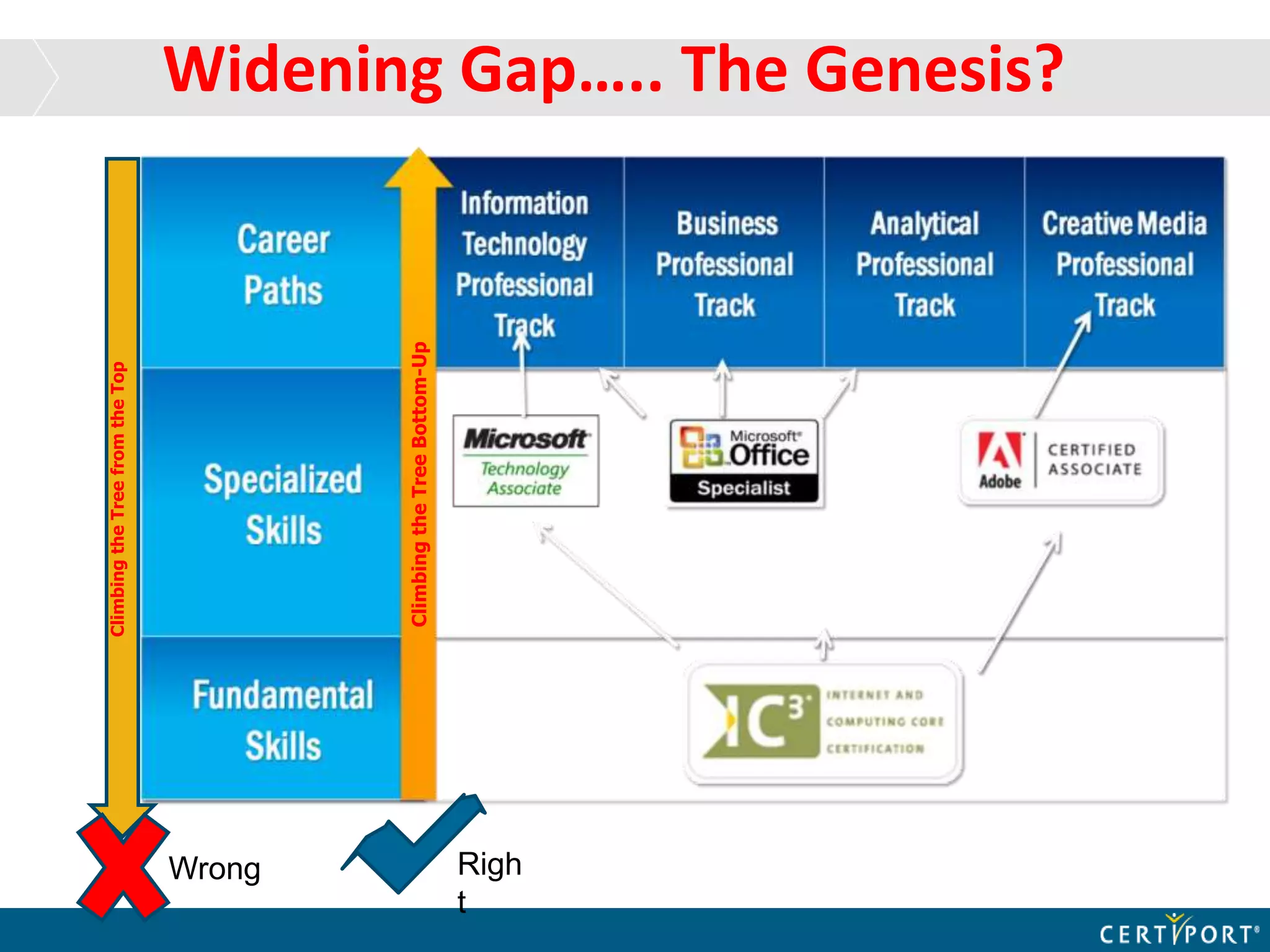
Widening Gap….. The Genesis?ClimbingtheTreefromtheTop
ClimbingtheTreeBottom-Up
Wrong Righ
t
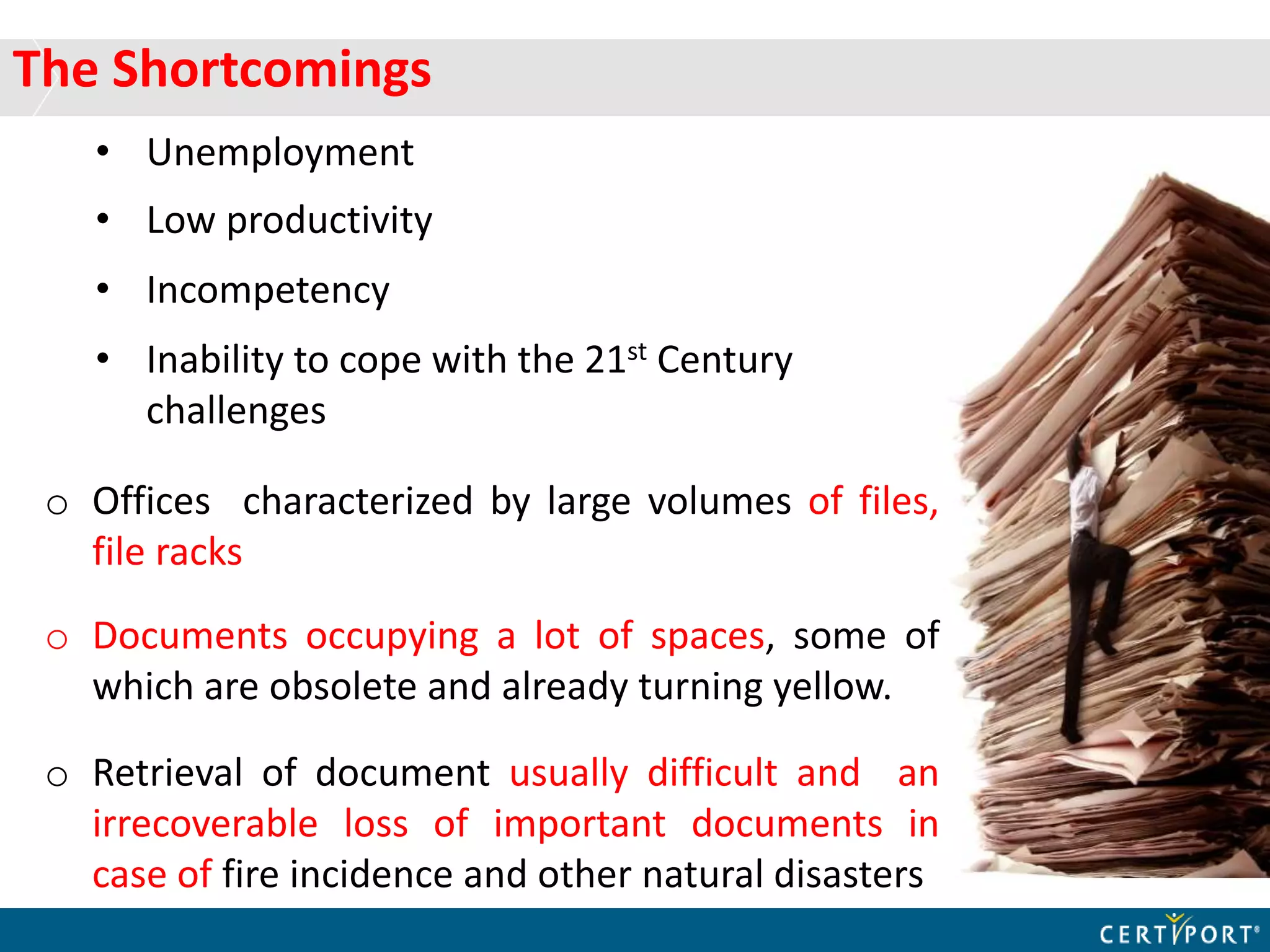
The Shortcomings
• Unemployment
• Low productivity
• Incompetency
• Inability to cope with the 21st Century
challenges
o Offices characterized by large volumes of files,
file racks
o Documents occupying a lot of spaces, some of
which are obsolete and already turning yellow.
o Retrieval of document usually difficult and an
irrecoverable loss of important documents in
case of fire incidence and other natural disasters
The LINKAGE
Researches show that:
21st Century Skills = Innovative TP X
Access to
Technology
21st century skills can mean the
difference
between being successful in school or
struggling every day, and having a
career, or simply getting a job.
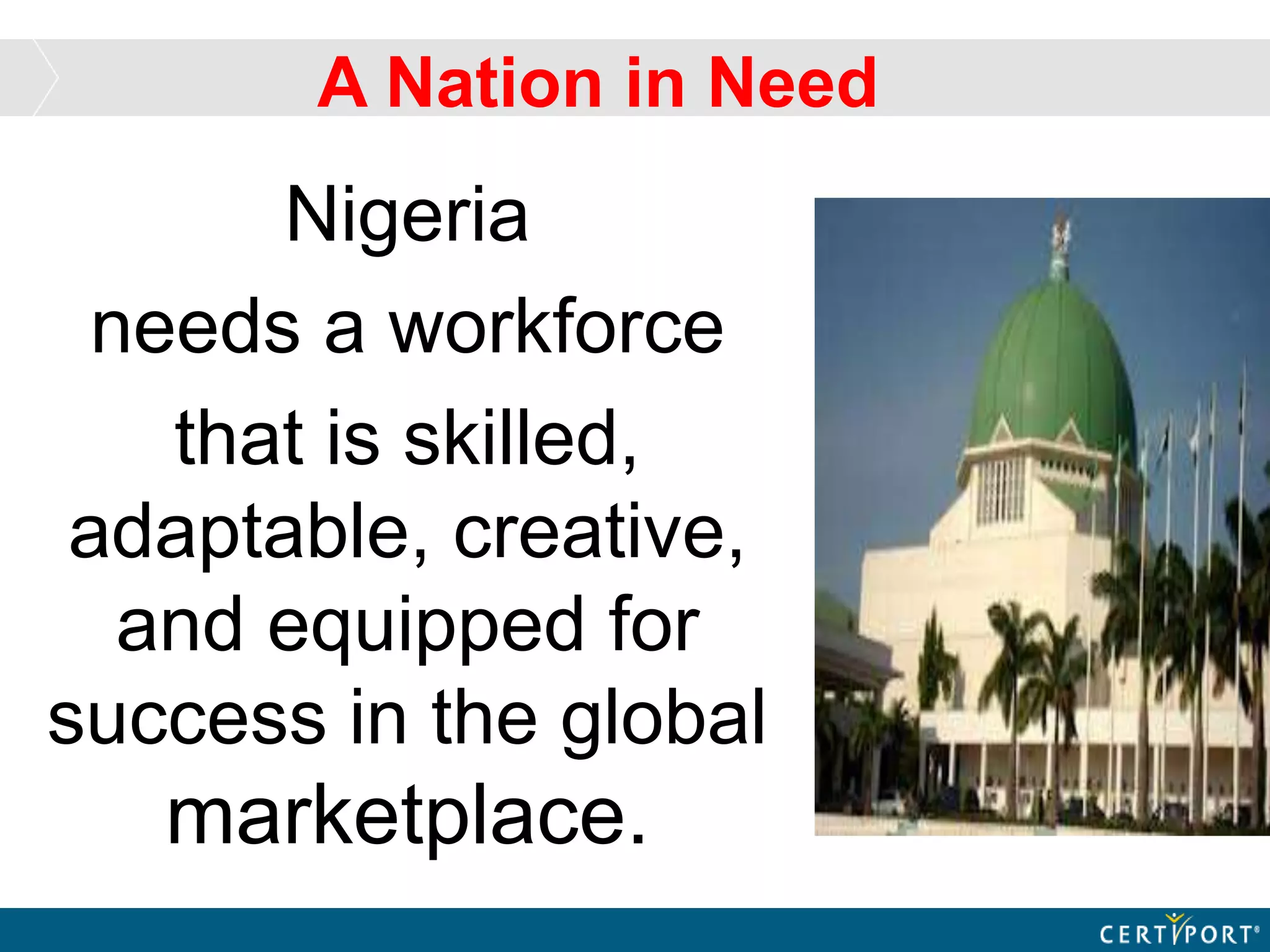
Nigeria
needs a workforce
that is skilled,
adaptable, creative,
and equipped for
success in the global
marketplace.
A Nation in Need
Nigeria must go beyond the 3R’s to:
• Have adaptive and practical skills required to
function
within the community, participate fully in global
digital
society
• Acquire meaningful literacy within a social
context
• Facilitate access to cultural, economic and
political
structures
• Recognize that new ways of seeing and thinking
Going the Extra Miles
• Empower the workforce by
enhancing their ICT skills to
benefit employers and the
nation as a whole
• Eradicate digital illiteracy
among them and thus enhance
the use of IT.
• Develop a large and highly-
skilled IT community that will
be one of the economic drivers
of the local economy
Creating the Standard
The generation of
• Significant economic and social benefits
• Capacity to remain abreast of technology
developments
• Effective use of technology to increase
productivity and competitiveness in all
sectors of the economy and operations,
Can only be achieved if we provide the
appropriate framework and inspiration for
establishing a digitally literate workforce.
Providing the Link
More Importantly
The significant rapid changes in society,
the transformation of education—
where and how learning takes place and
the changing roles of students and teachers
in the learning process
can only be capitalized upon if we
provide the framework and inspiration for
establishing a digitally literate teaching
force.
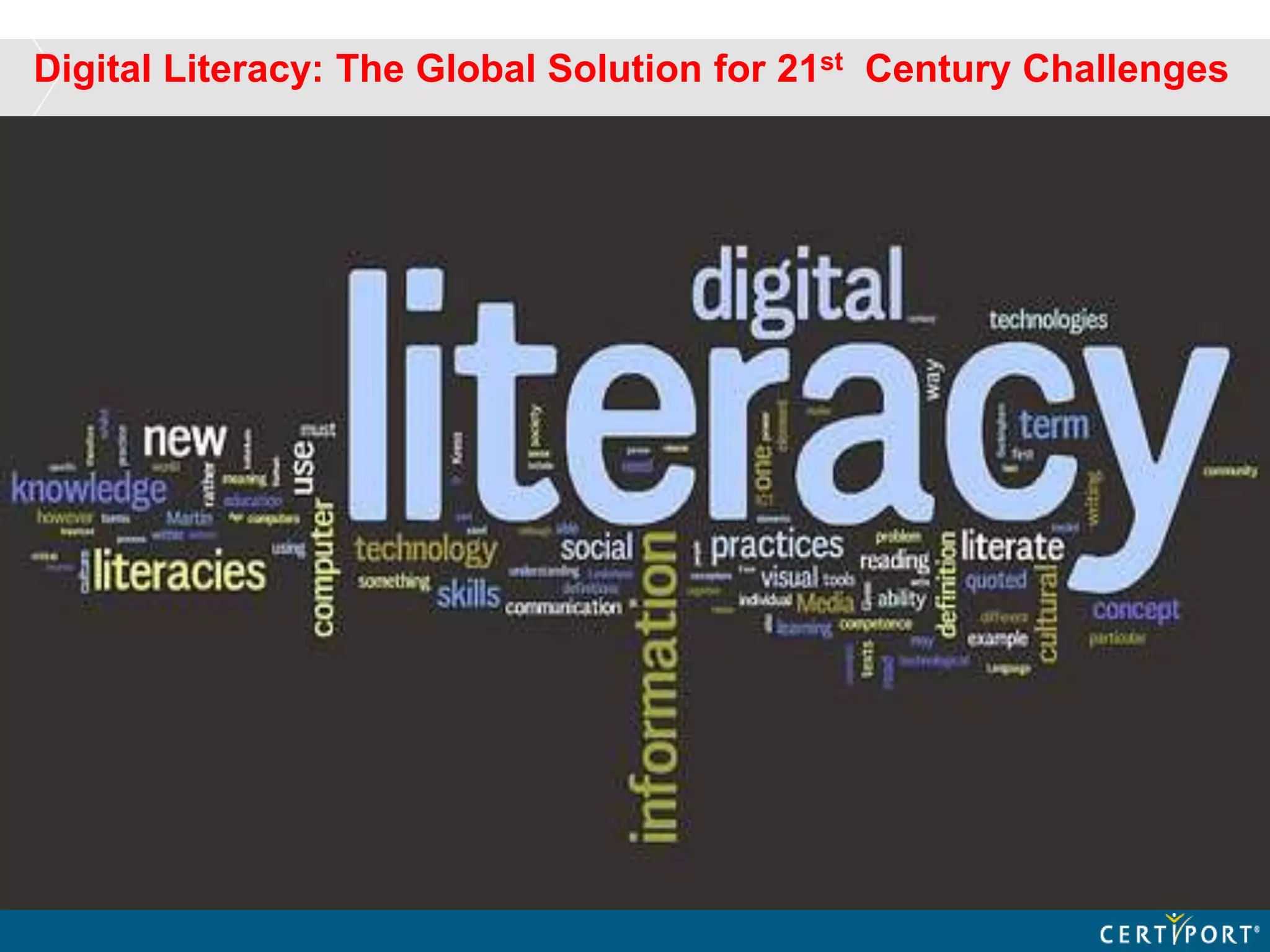
Digital Literacy: The Global Solution for 21st Century Challenges
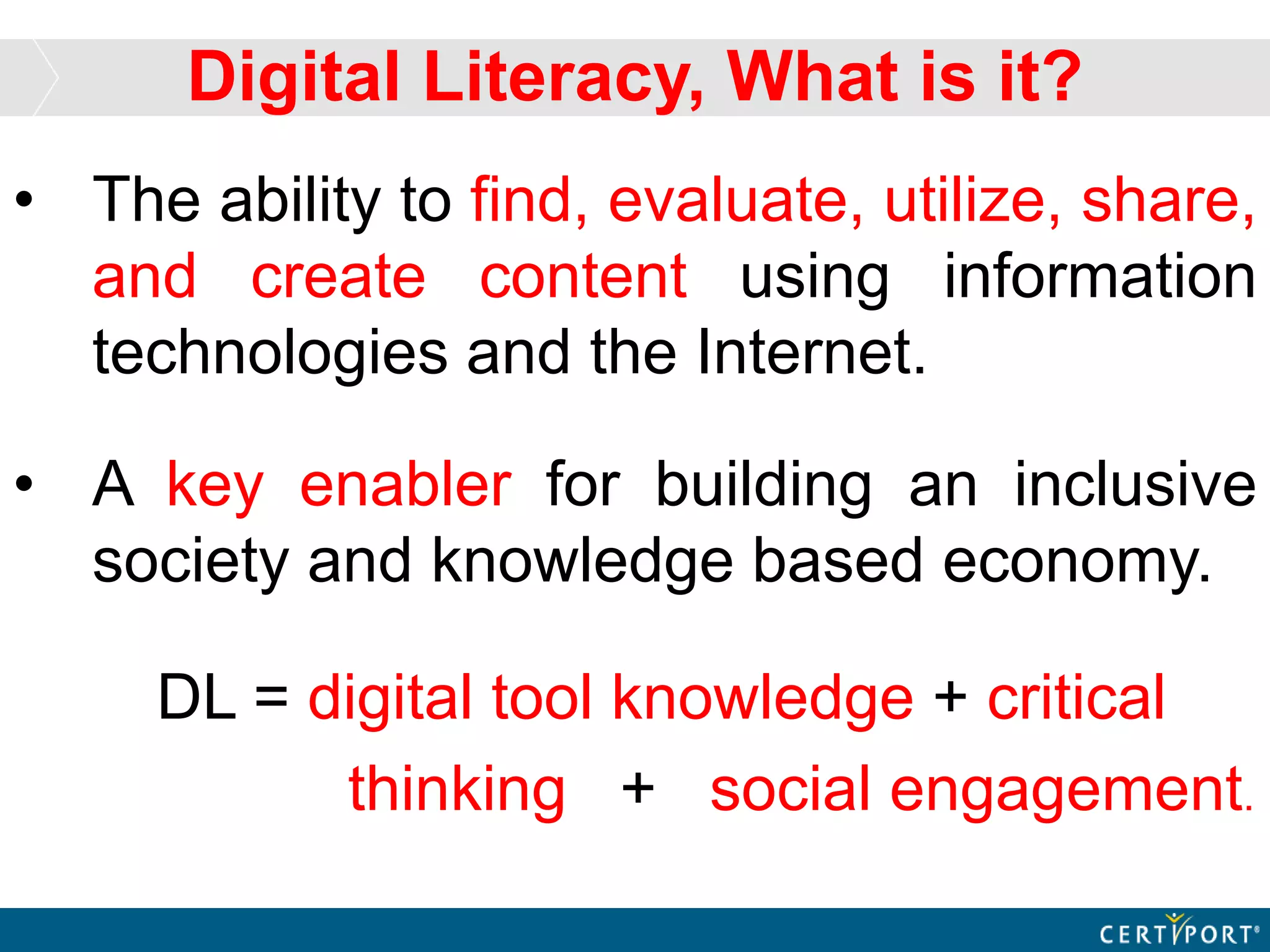
• The ability to find, evaluate, utilize, share,
and create content using information
technologies and the Internet.
• A key enabler for building an inclusive
society and knowledge based economy.
DL = digital tool knowledge + critical
thinking + social engagement.
Digital Literacy, What is it?
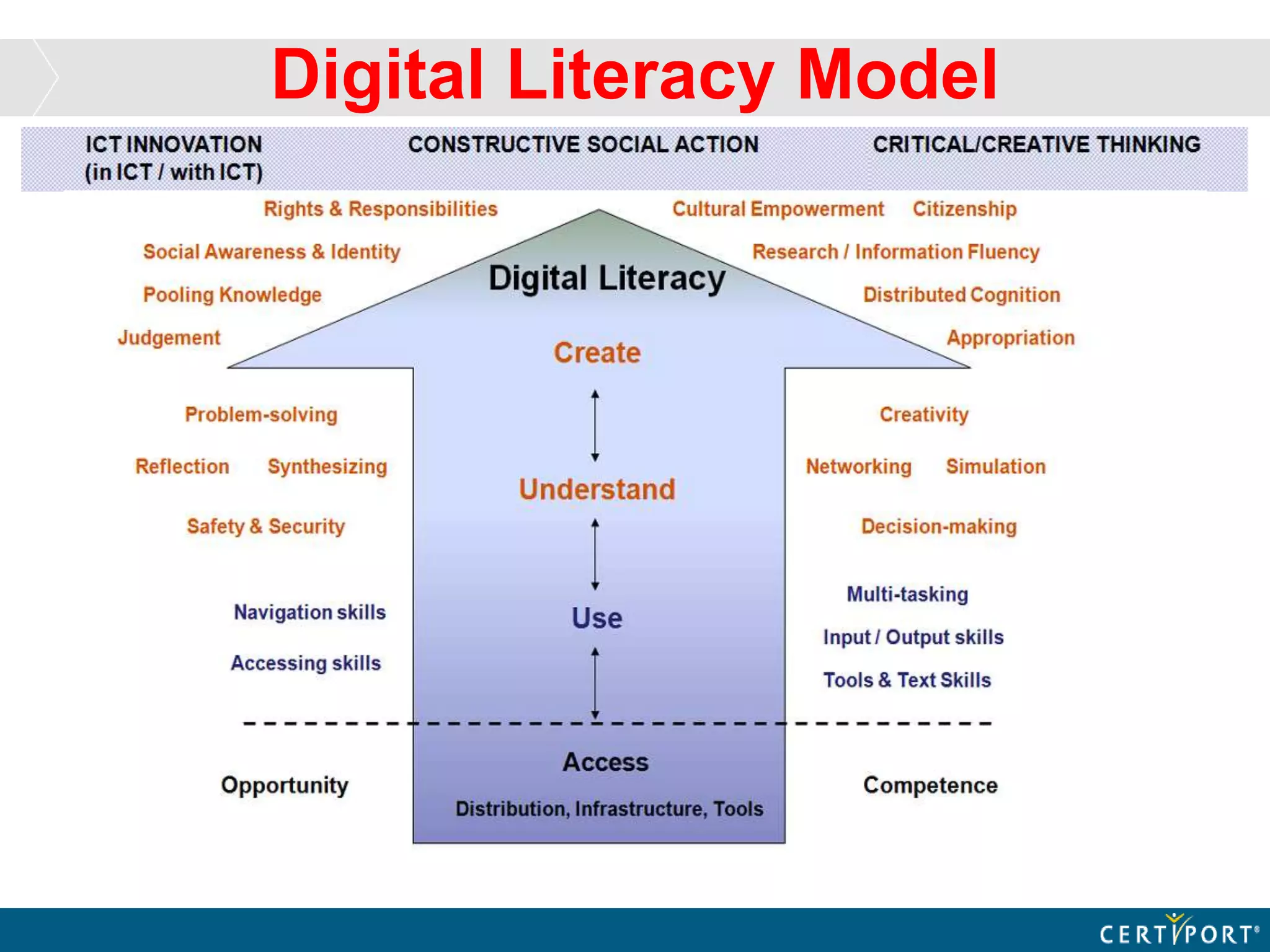
Digital Literacy Model
• Do Nigeria workforce have the
skills they need to use digital
technologies?
• If they possess any, how are these
skills acquired?
• What types of support, training,
and professional development do
they need?
The BIG Questions
The Challenges
• Bridging the gap between technology skills and
innovative teaching
• Going beyond traditional software training to
providing
a scaffold that helps educators and personnel of
all skill
levels acquire knowledge.
• Shortage of digitally literate teachers
• Inadequate ICT training exercise;
usually ad‐hoc, short‐term
absence of a comprehensive framework of
Individuals
tend to over-assess their ICT
capability when applying for
employment.
and where there is no agreed
standard around particular skill sets,
there may be a mismatch between the
candidate’s actual ability and the
employer’s
Mismatch Galore
• Far reaching benefits touch every
aspect of society and the economy
• Requirement for the immediate
empowerment of our Population
The Internet and Computing Core
Certification (IC3) credential is its universal
test.
Digital Literacy, Global Priority
33
4/23/2015
INTERNET &
COMPUTING CORE CERTIFICATION:
The Global Test of Digital Literacy
The stepping-stone into the ICT certification
pathway, a fundamental tool for measuring
proficiency in the latest key technologies for
study, work and life.
IC3 was created by Certiport, Inc. in 2000 to
address the need for a globally recognized
and accepted standard of basic computing
knowledge considered fundamental to
academic learning and a minimum
requirement for employment -Wikipedia.
IC3, The Stepping Stone
IC3 is based on global best practices and
requirements of education, test development
and industry,
• laying down foundational preparation for
every job and career, every field of study,
and
even social and personal lives that are
increasingly impacted by technology.
• The single best solution for verifying and
validating skills attainment and mastery in
digital literacy
As Espoused by GDLC
Standing out with IC3
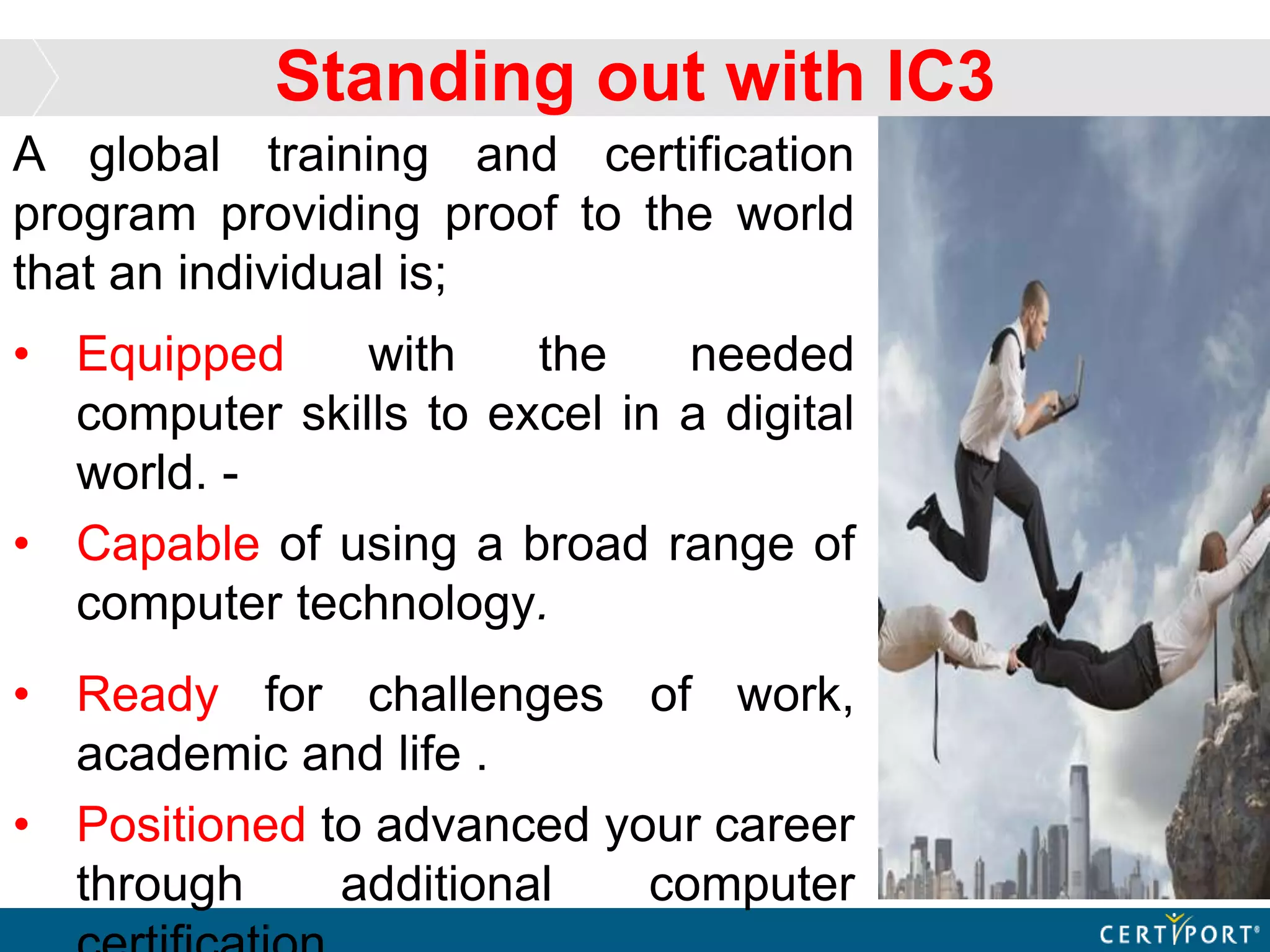
A global training and certification
program providing proof to the world
that an individual is;
• Equipped with the needed
computer skills to excel in a digital
world. -
• Capable of using a broad range of
computer technology.
• Ready for challenges of work,
academic and life .
• Positioned to advanced your career
through additional computer
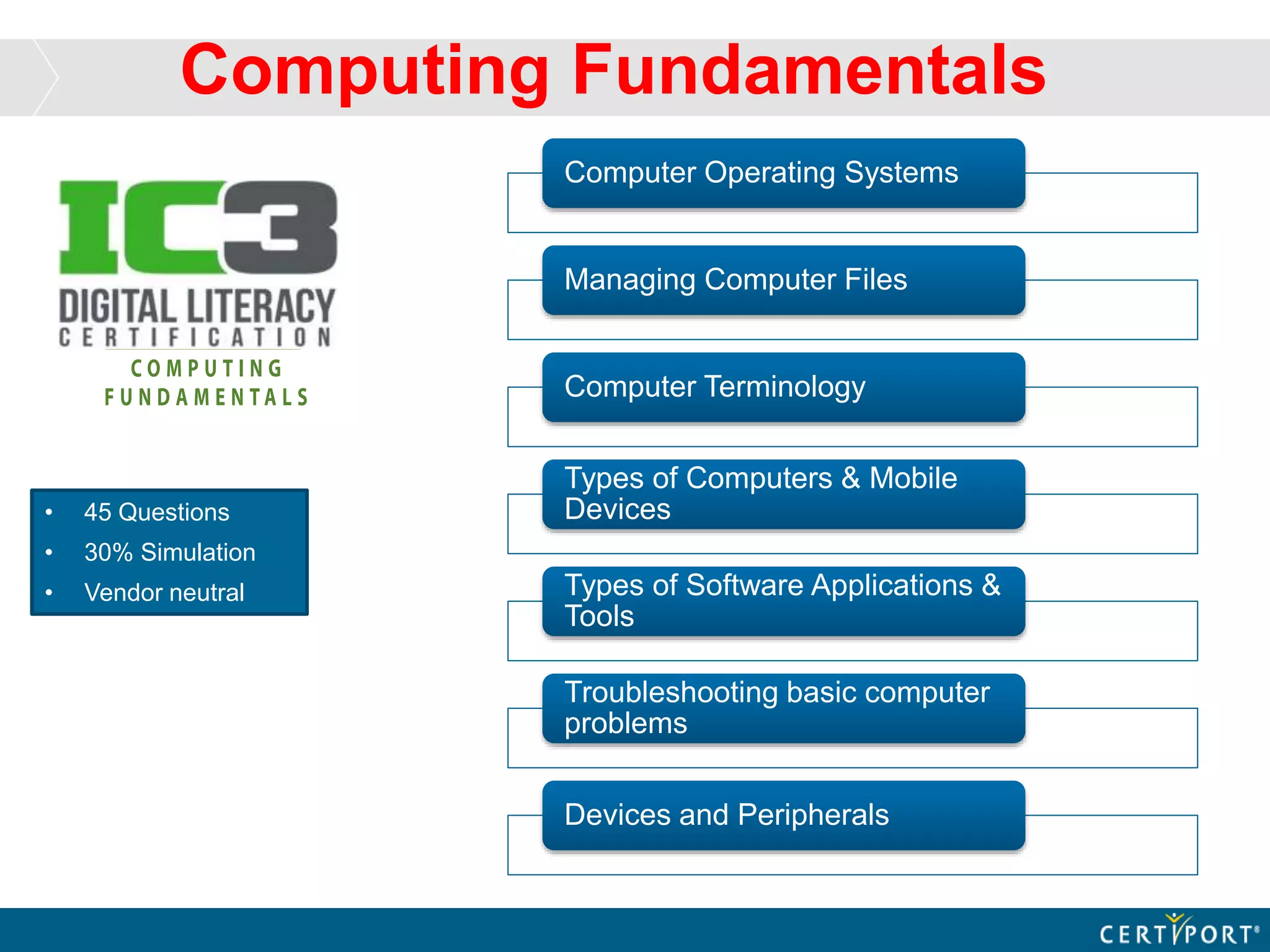
Computing Fundamentals
• 45 Questions
• 30% Simulation
• Vendor neutral
Computer Operating Systems
Managing Computer Files
Computer Terminology
Types of Computers & Mobile
Devices
Types of Software Applications &
Tools
Troubleshooting basic computer
problems
Devices and Peripherals
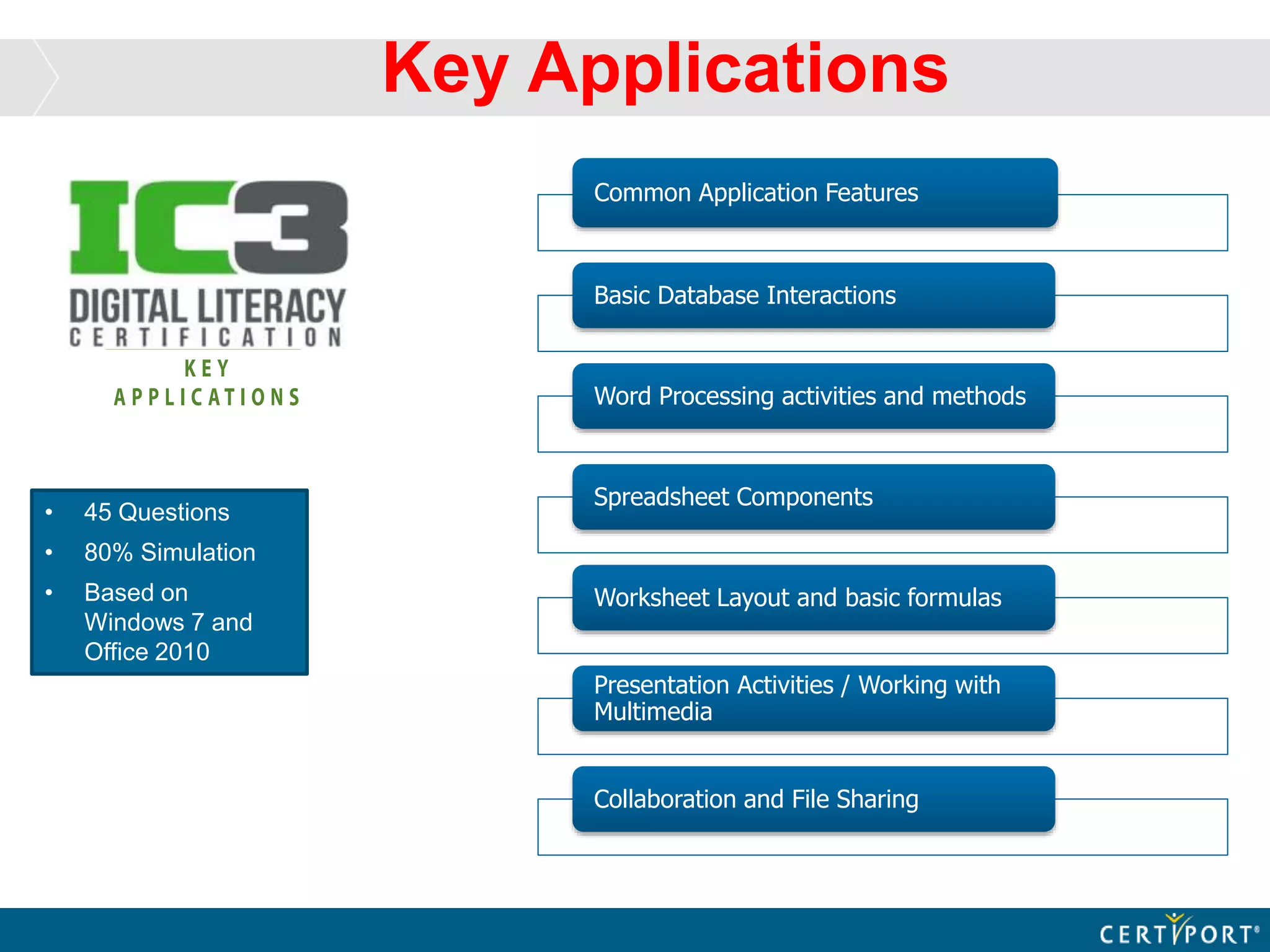
Key Applications
• 45 Questions
• 80% Simulation
• Based on
Windows 7 and
Office 2010
Common Application Features
Basic Database Interactions
Word Processing activities and methods
Spreadsheet Components
Worksheet Layout and basic formulas
Presentation Activities / Working with
Multimedia
Collaboration and File Sharing
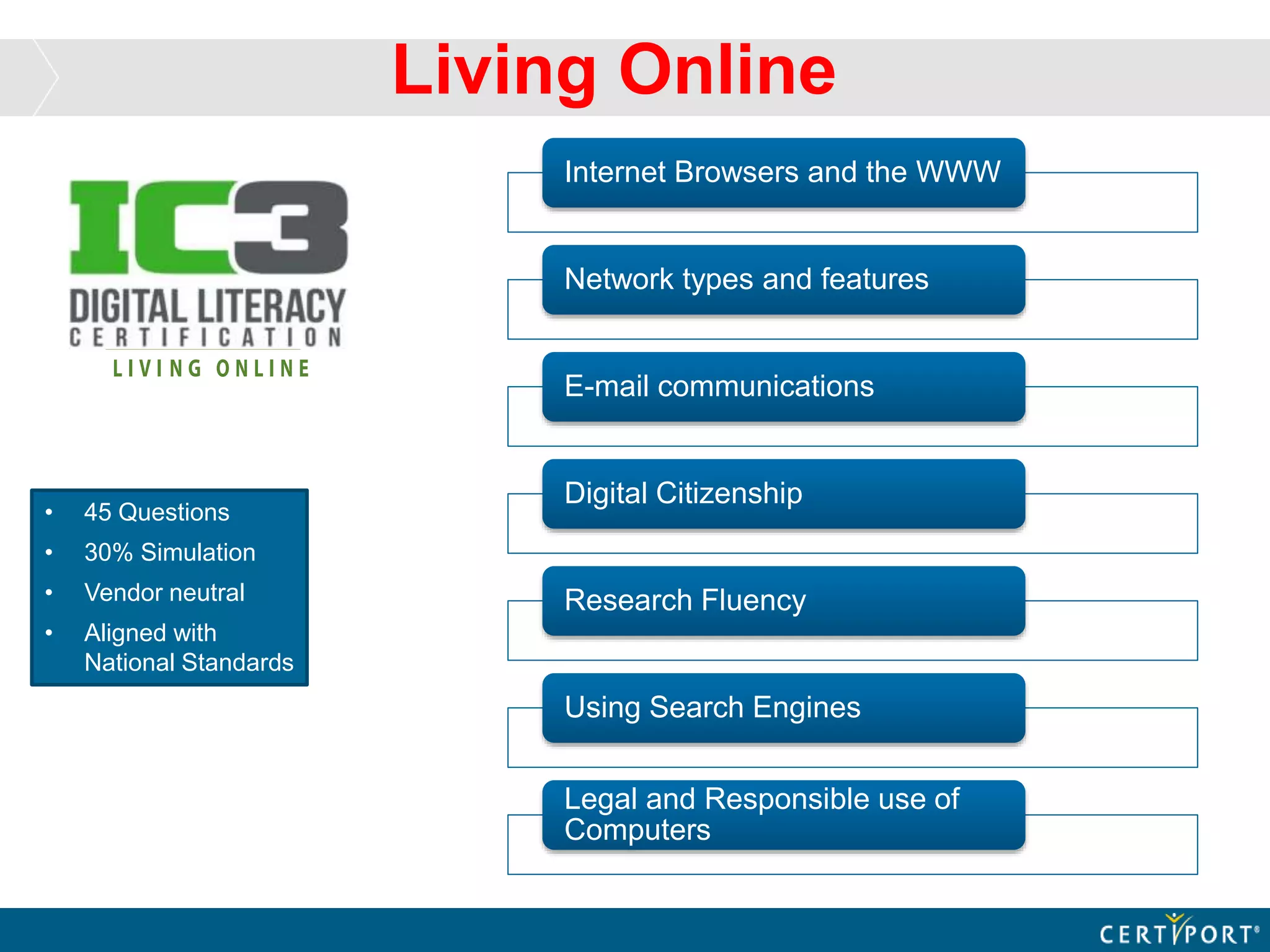
Living Online
• 45 Questions
• 30% Simulation
• Vendor neutral
• Aligned with
National Standards
Internet Browsers and the WWW
Network types and features
E-mail communications
Digital Citizenship
Research Fluency
Using Search Engines
Legal and Responsible use of
Computers
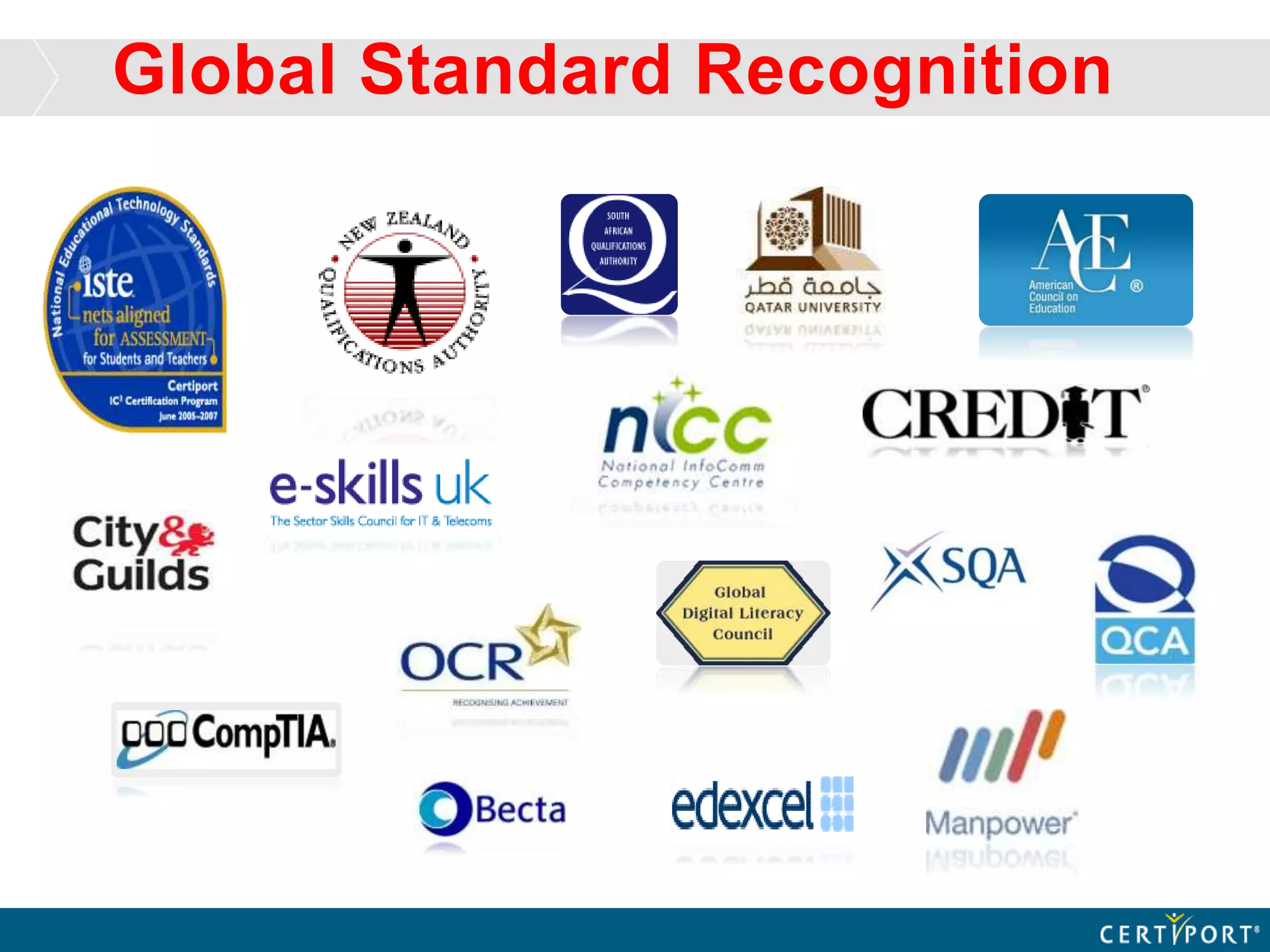
Global Standard Recognition
Recognized in Nigeria
The IC3 is well-respected internationally, endorsed
and recommended by
NITDA - National Information Technology
Development Agency
CPN - Computer Professionals
(Registration Council of) Nigeria
NUC - National Universities Commission
TRCN - Teachers Registration Council of Nigeria
IC3…… the Missing Link
From digital literacy certification
in IC3, to professionally
recognized skills certification on
MCE, MOS, MTA, MCP, Adobe,
HP, Autodesk products, IC
Health etc.
IC3 provides the pathway to a
fulfilling and valuable career in
many different fields.
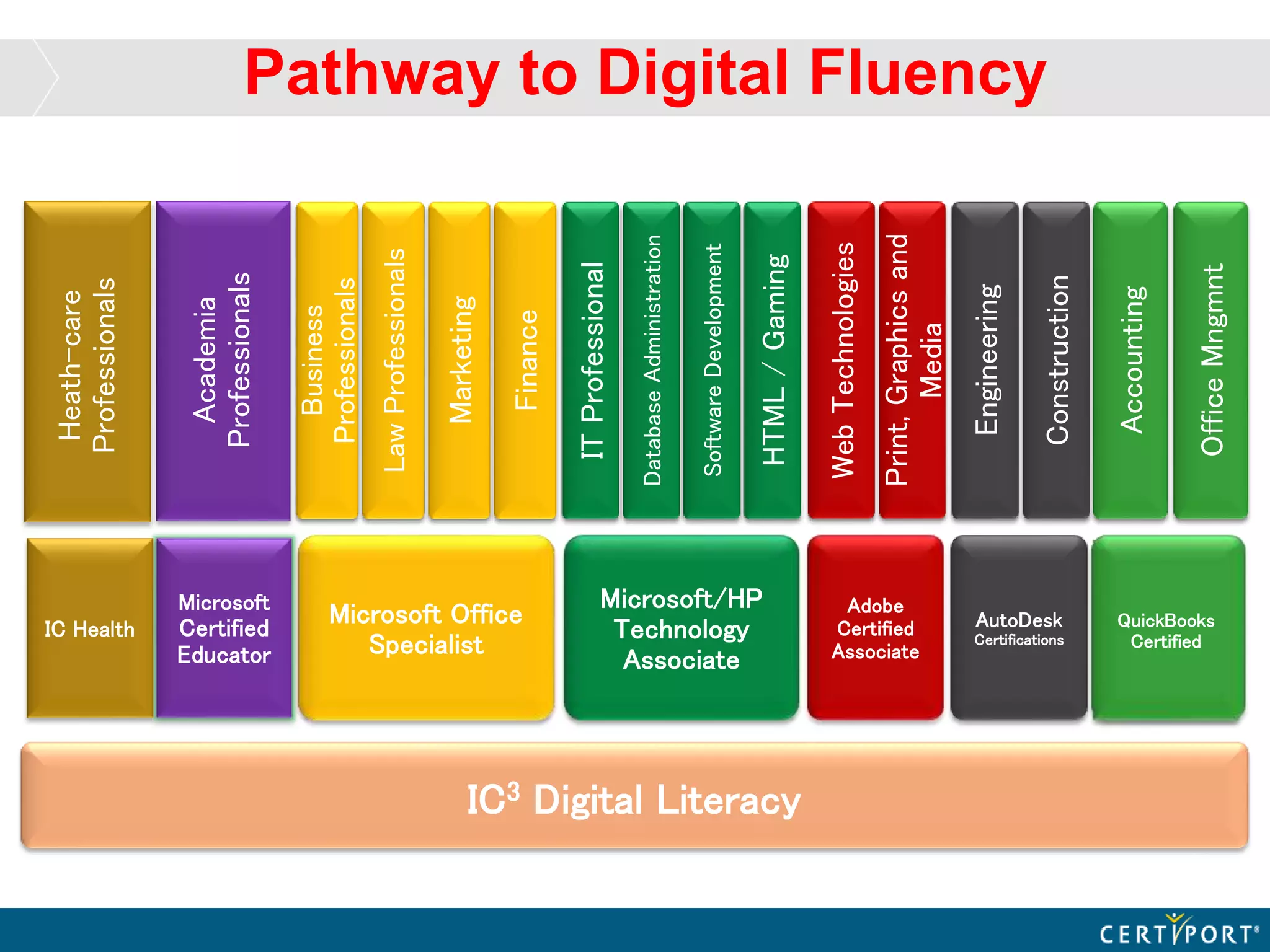
IC3 Digital Literacy
ITProfessional
DatabaseAdministration
SoftwareDevelopment
HTML/Gaming
Microsoft/HP
Technology
Associate
WebTechnologies
Print,Graphicsand
Media
Adobe
Certified
Associate
Engineering
Construction
AutoDesk
Certifications
Accounting
QuickBooks
Certified
OfficeMngmnt
Business
Professionals
LawProfessionals
Marketing
Finance
Microsoft Office
Specialist
Microsoft
Certified
Educator
IC Health
Heath-care
Professionals
Academia
Professionals
Pathway to Digital Fluency
Training for Success
Training to be a Versatilist to continuously
adapt, learn and grow in a fast-changing
world
“Versatilists are able to apply a depth of
skill to a progressively widening scope of
situations and experiences, equally at ease
with technical issues as with business
strategy.”
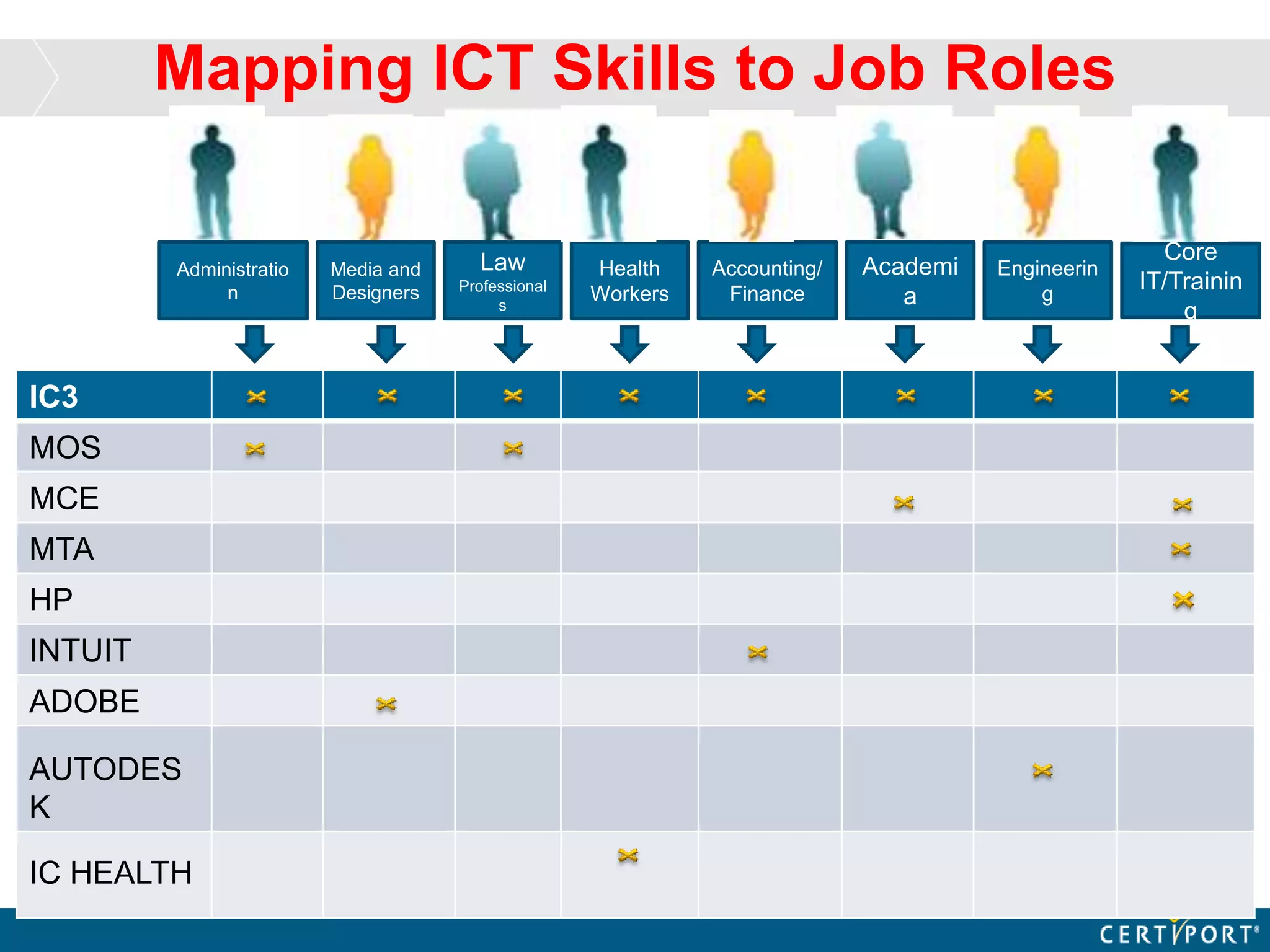
Core
IT/Trainin
g
IC3
MOS
MCE
MTA
HP
INTUIT
ADOBE
AUTODES
K
IC HEALTH
Administratio
n
Media and
Designers
Law
Professional
s
Health
Workers
Accounting/
Finance
Academi
a
Engineerin
g
Mapping ICT Skills to Job Roles
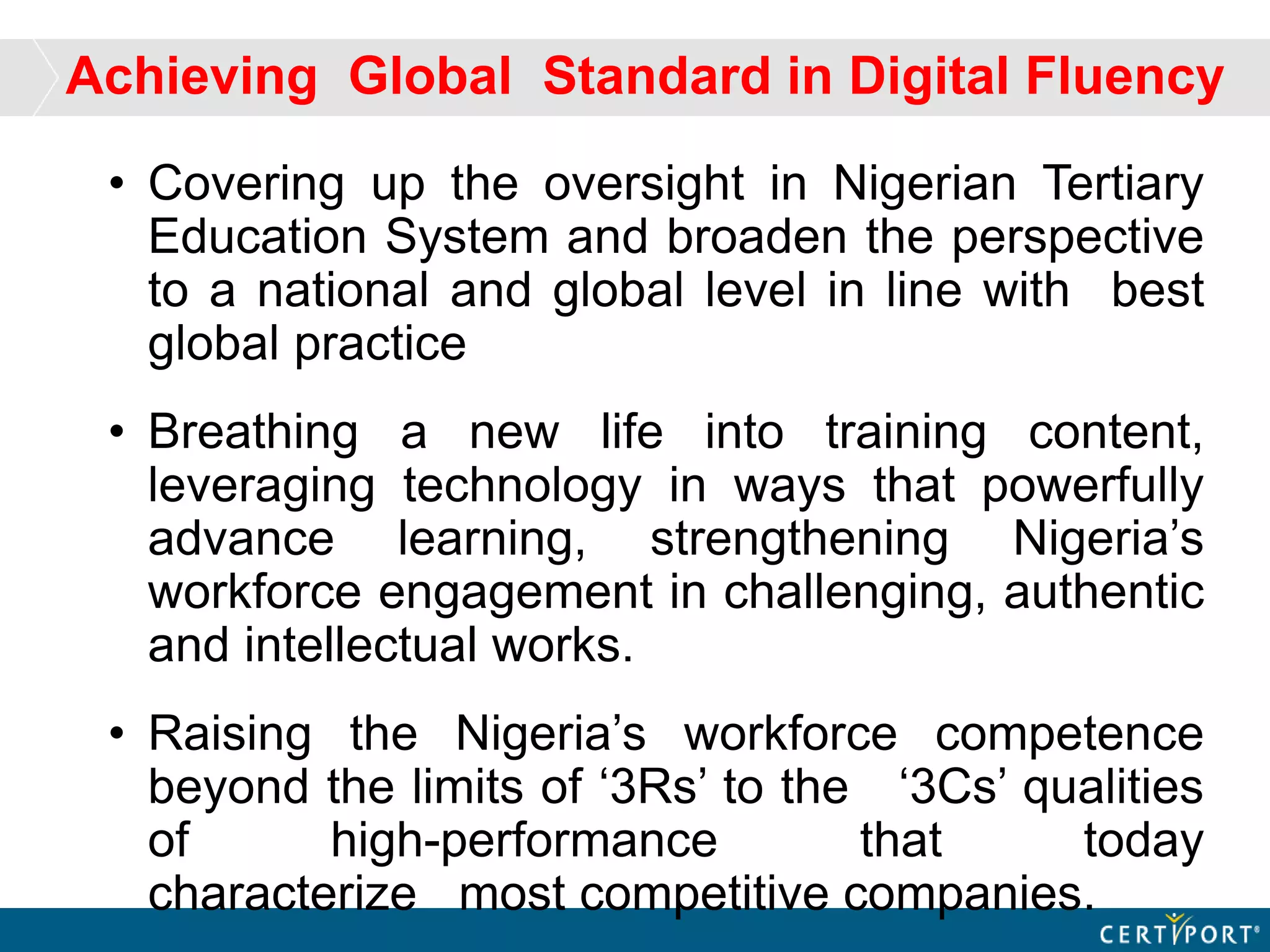
Achieving Global Standard in Digital Fluency
• Covering up the oversight in Nigerian Tertiary
Education System and broaden the perspective
to a national and global level in line with best
global practice
• Breathing a new life into training content,
leveraging technology in ways that powerfully
advance learning, strengthening Nigeria’s
workforce engagement in challenging, authentic
and intellectual works.
• Raising the Nigeria’s workforce competence
beyond the limits of ‘3Rs’ to the ‘3Cs’ qualities
of high-performance that today
characterize most competitive companies.
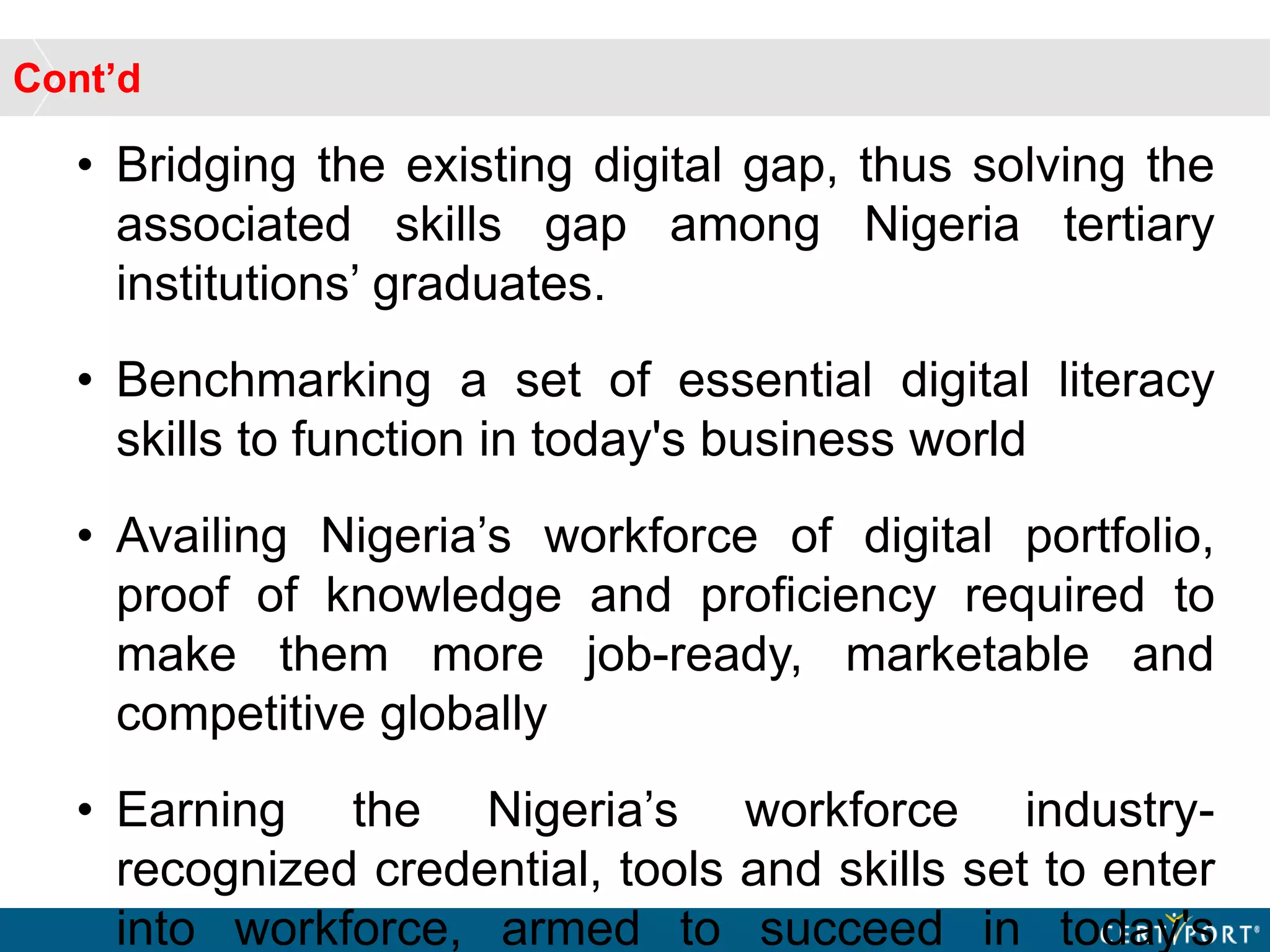
Cont’d
• Bridging the existing digital gap, thus solving the
associated skills gap among Nigeria tertiary
institutions’ graduates.
• Benchmarking a set of essential digital literacy
skills to function in today's business world
• Availing Nigeria’s workforce of digital portfolio,
proof of knowledge and proficiency required to
make them more job-ready, marketable and
competitive globally
• Earning the Nigeria’s workforce industry-
recognized credential, tools and skills set to enter
into workforce, armed to succeed in today's
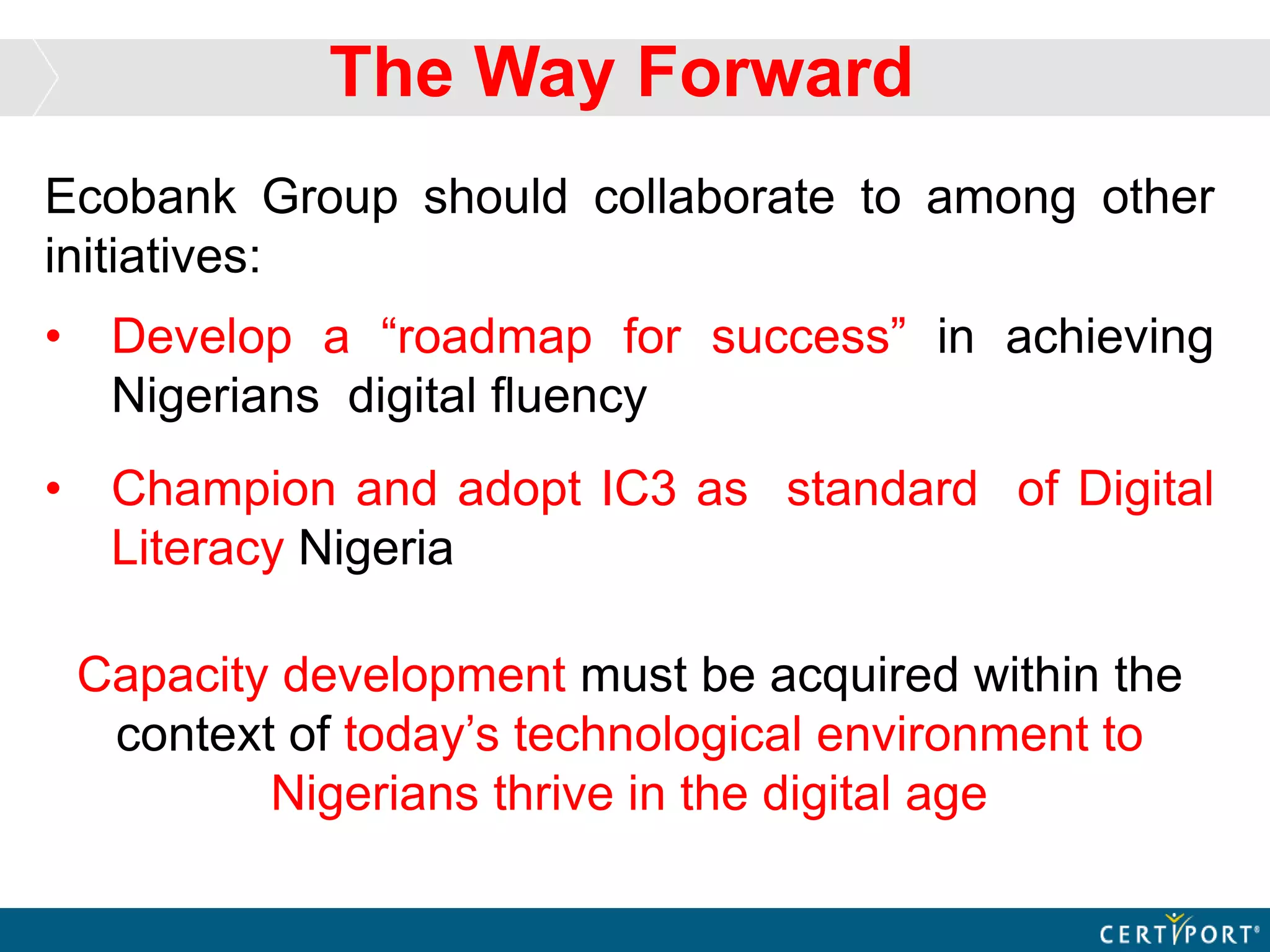
Ecobank Group should collaborate to among other
initiatives:
• Develop a “roadmap for success” in achieving
Nigerians digital fluency
• Champion and adopt IC3 as standard of Digital
Literacy Nigeria
Capacity development must be acquired within the
context of today’s technological environment to
Nigerians thrive in the digital age
The Way Forward
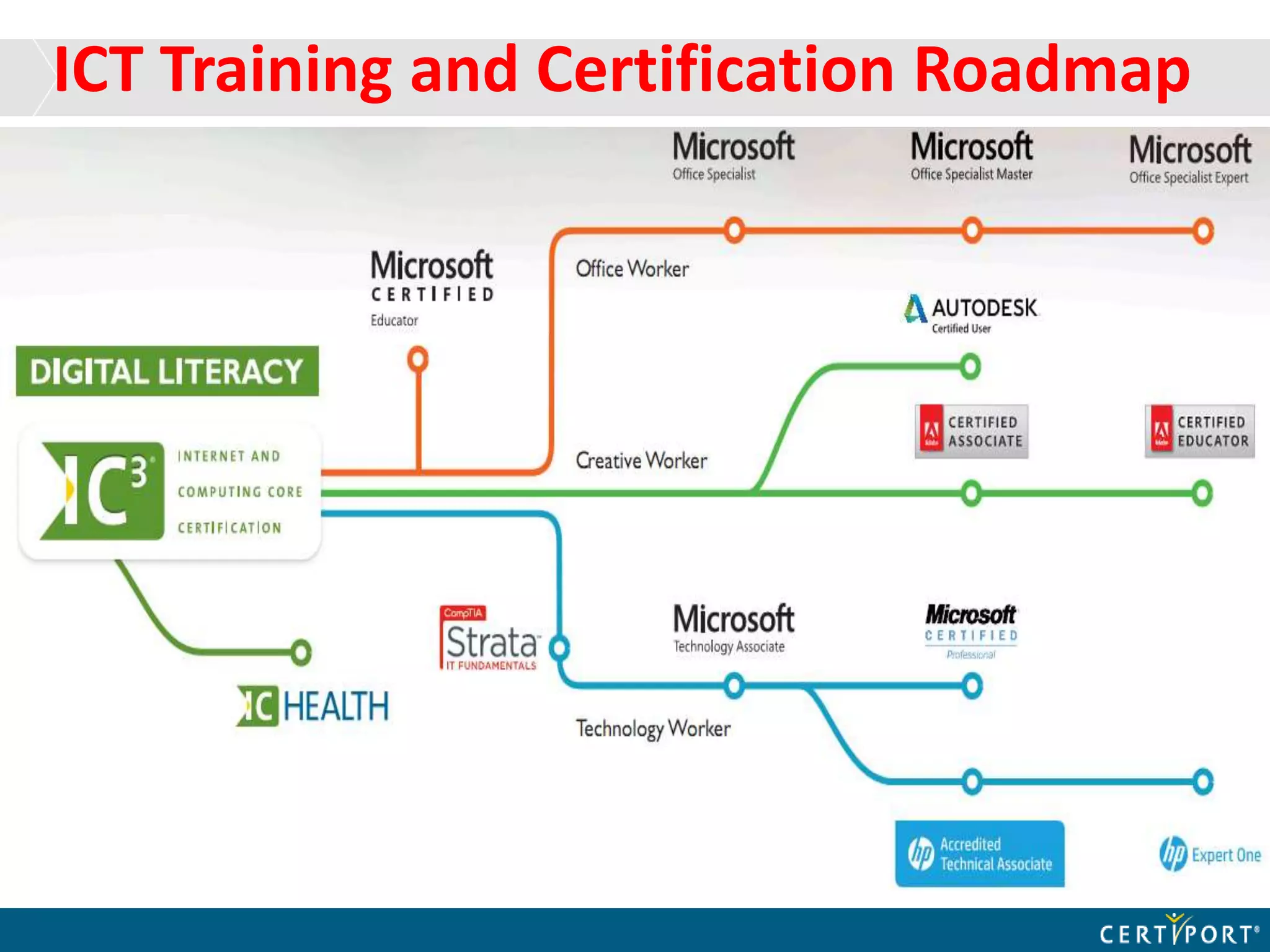
ICT Training and Certification Roadmap
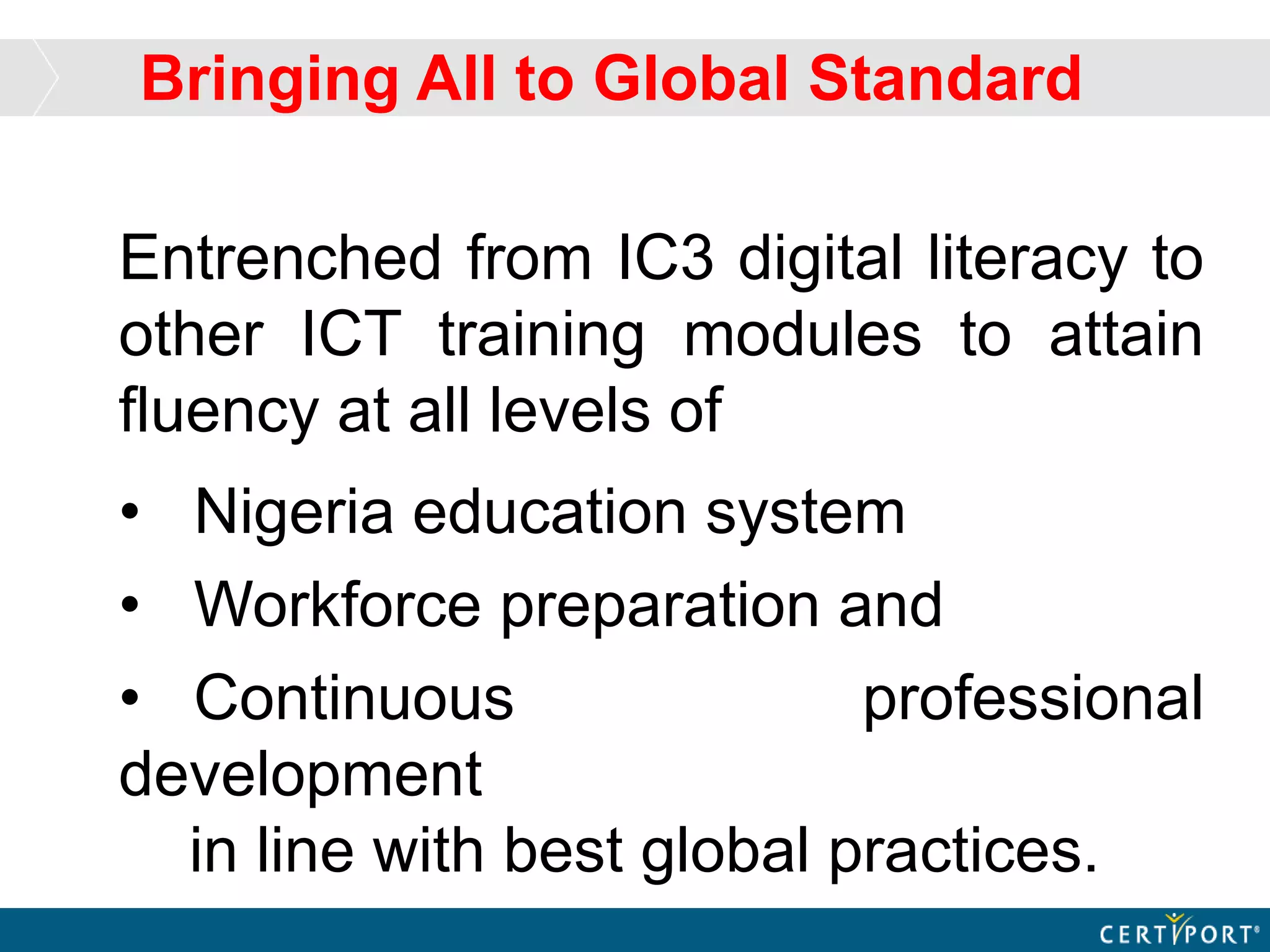
Entrenched from IC3 digital literacy to
other ICT training modules to attain
fluency at all levels of
• Nigeria education system
• Workforce preparation and
• Continuous professional
development
in line with best global practices.
Bringing All to Global Standard
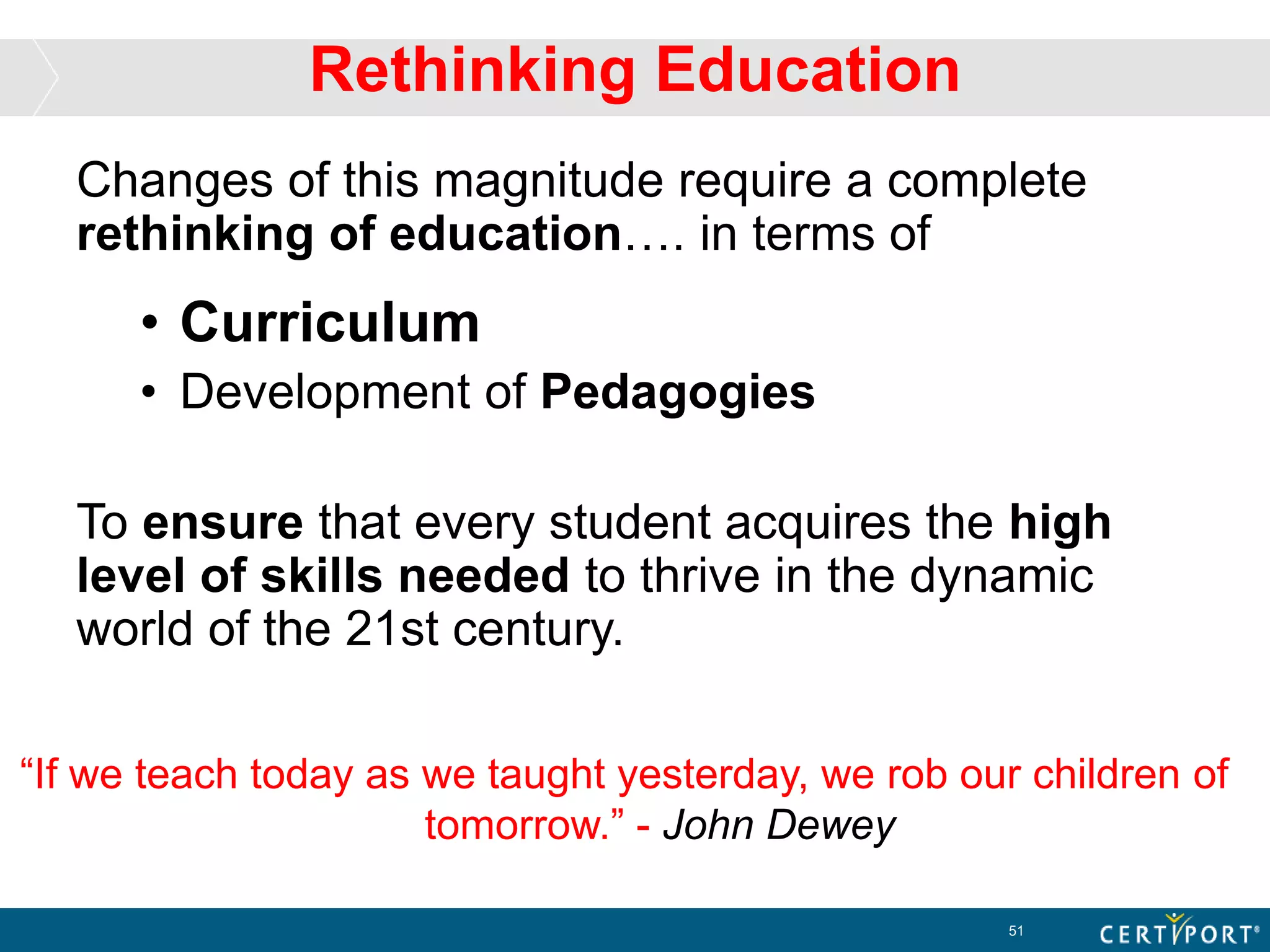
Rethinking Education
Changes of this magnitude require a complete
rethinking of education…. in terms of
• Curriculum
• Development of Pedagogies
To ensure that every student acquires the high
level of skills needed to thrive in the dynamic
world of the 21st century.
51
“If we teach today as we taught yesterday, we rob our children of
tomorrow.” - John Dewey
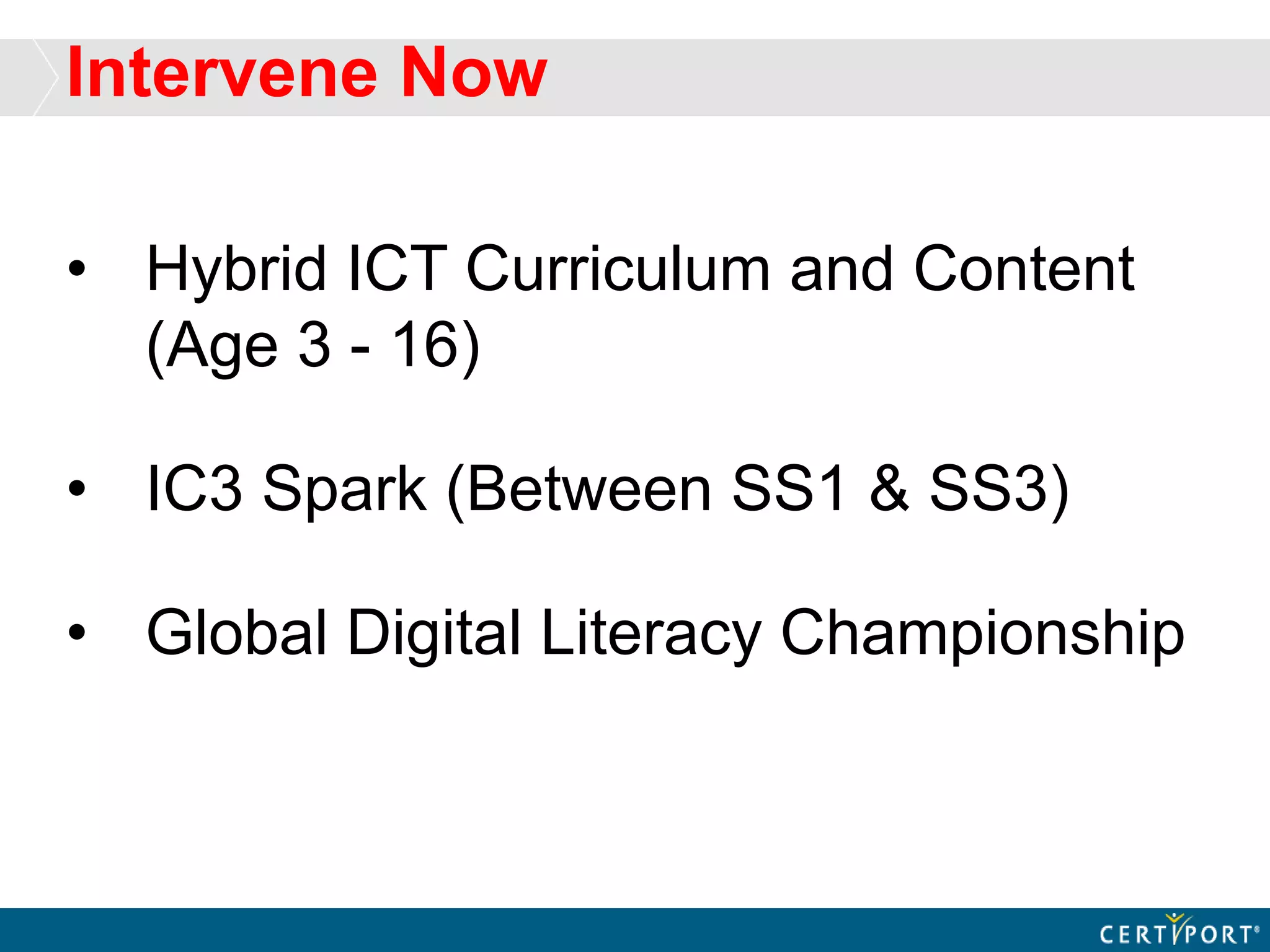
• Hybrid ICT Curriculum and Content
(Age 3 - 16)
• IC3 Spark (Between SS1 & SS3)
• Global Digital Literacy Championship
Intervene Now
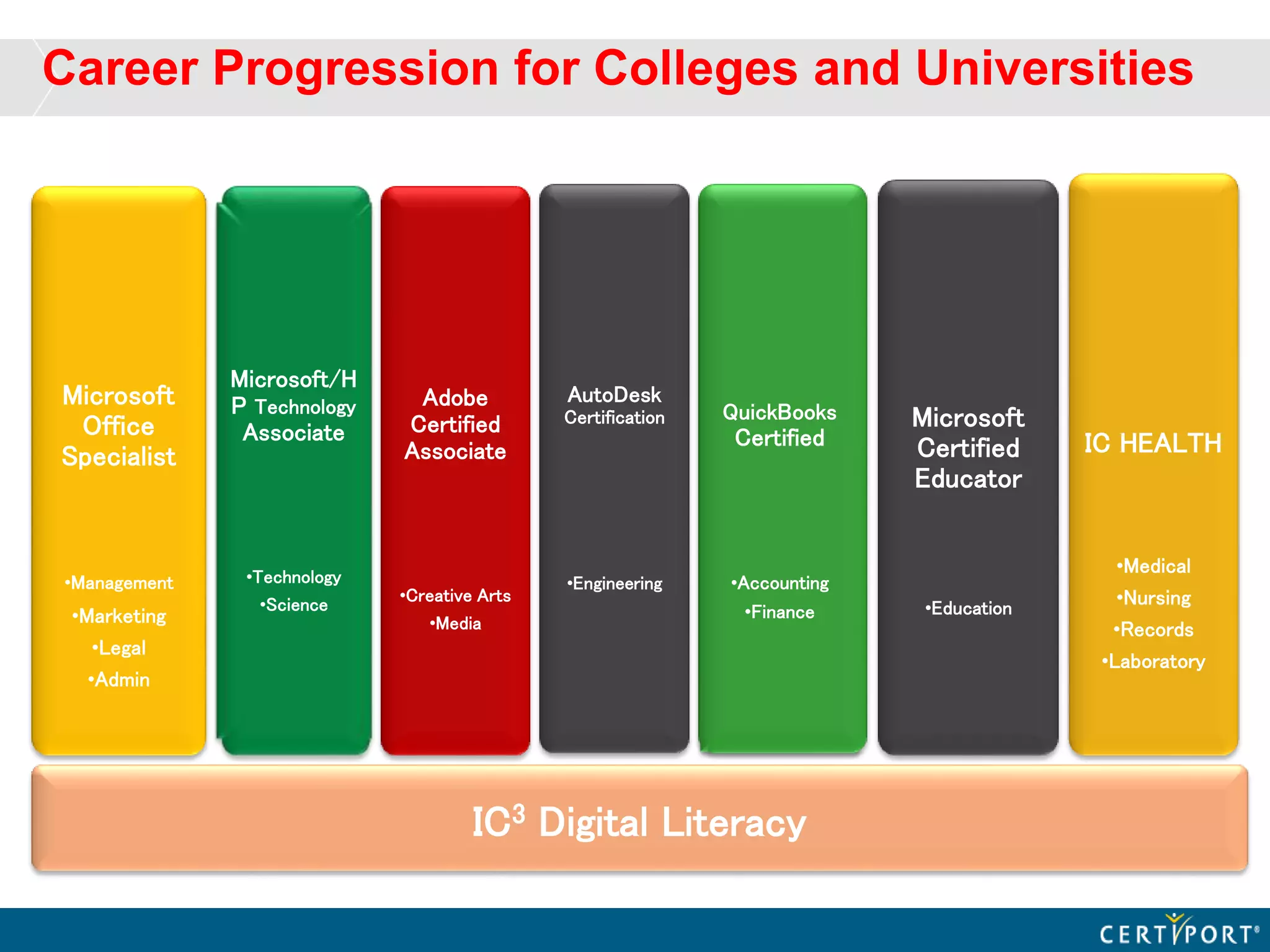
Career Progression for Colleges and Universities
Microsoft/H
P Technology
Associate
•Technology
•Science
Adobe
Certified
Associate
•Creative Arts
•Media
AutoDesk
Certification
•Engineering
QuickBooks
Certified
•Accounting
•Finance
IC3 Digital Literacy
Microsoft
Office
Specialist
•Management
•Marketing
•Legal
•Admin
Microsoft
Certified
Educator
•Education
IC HEALTH
•Medical
•Nursing
•Records
•Laboratory
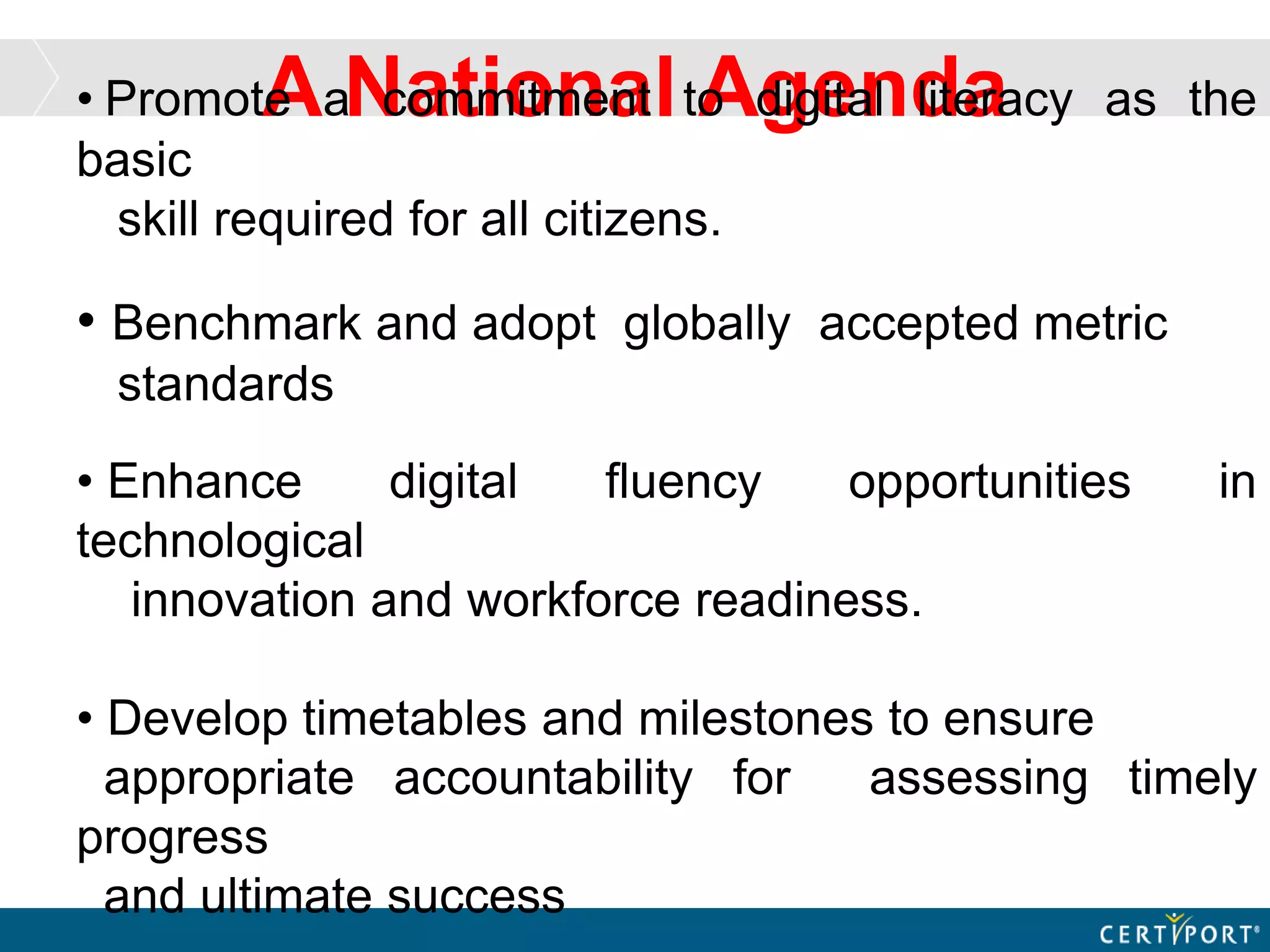
A National Agenda• Promote a commitment to digital literacy as the
basic
skill required for all citizens.
• Benchmark and adopt globally accepted metric
standards
• Enhance digital fluency opportunities in
technological
innovation and workforce readiness.
• Develop timetables and milestones to ensure
appropriate accountability for assessing timely
progress
and ultimate success
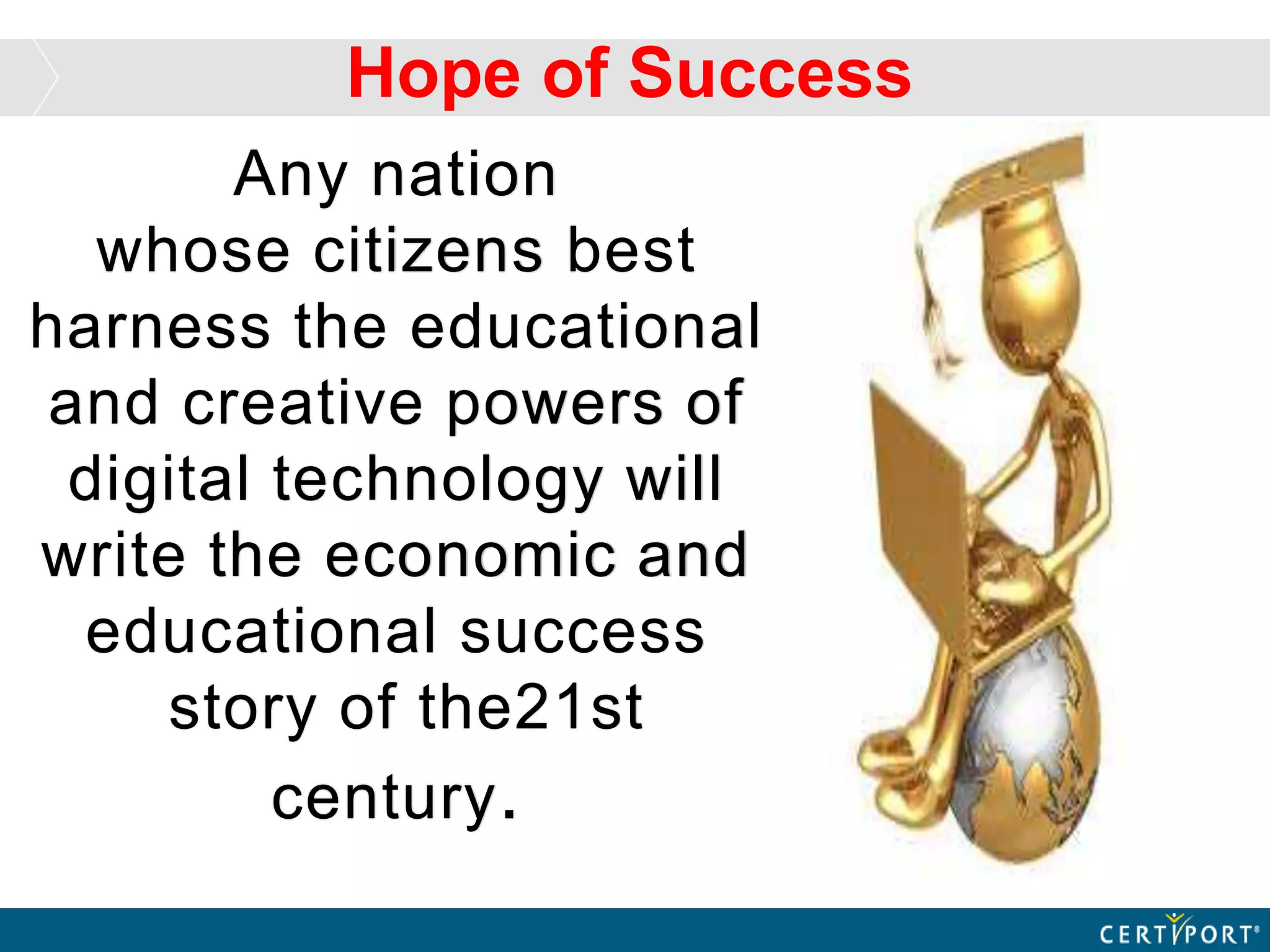
Any nation
whose citizens best
harness the educational
and creative powers of
digital technology will
write the economic and
educational success
story of the21st
century.
Hope of Success
Investments
in people are fundamental
to social and economic development. But,
investments in technology
will do a little to improve the way
we work , learn and socialize
unless they are matched by efforts to build
capacity of the Nigerians to harness the
opportunities that
ICT offers.
Capacity Development… the Solution
The ‘3Cs’ is it…
Aside the basic skills of literacy and
numeracy, every Nigerian must also master
the "three C's" …Communication,
Collaboration, and Creative Problem
Solving.
And beyond attain technological
fluency, and, most of all, the skills and
attitudes needed to be a lifelong learner.
57
A Clarion Call
Position Nigeria
to do more to keep pace with
rapid technology, research, and
Societal changes to ensure that her
workforce and
student-graduates will be ready to thrive in
today’s knowledge based, global
society and have a prove of
specific digital skills to
fill job openings.
In Nigeria today
digital literacy is assumed.
This forces individuals to learn
fundamental skills by trial and error,
and non-systematic learning of core
computer competencies means that
many people have big gaps in their
understanding of how
the basics work.
A Worrisome Assumption
M A K E I C 3
T H E F O U N D A T I O N OF
Y O U R V I S I O N F O R
N A T I O N A L
S U C C E S S ! ! !
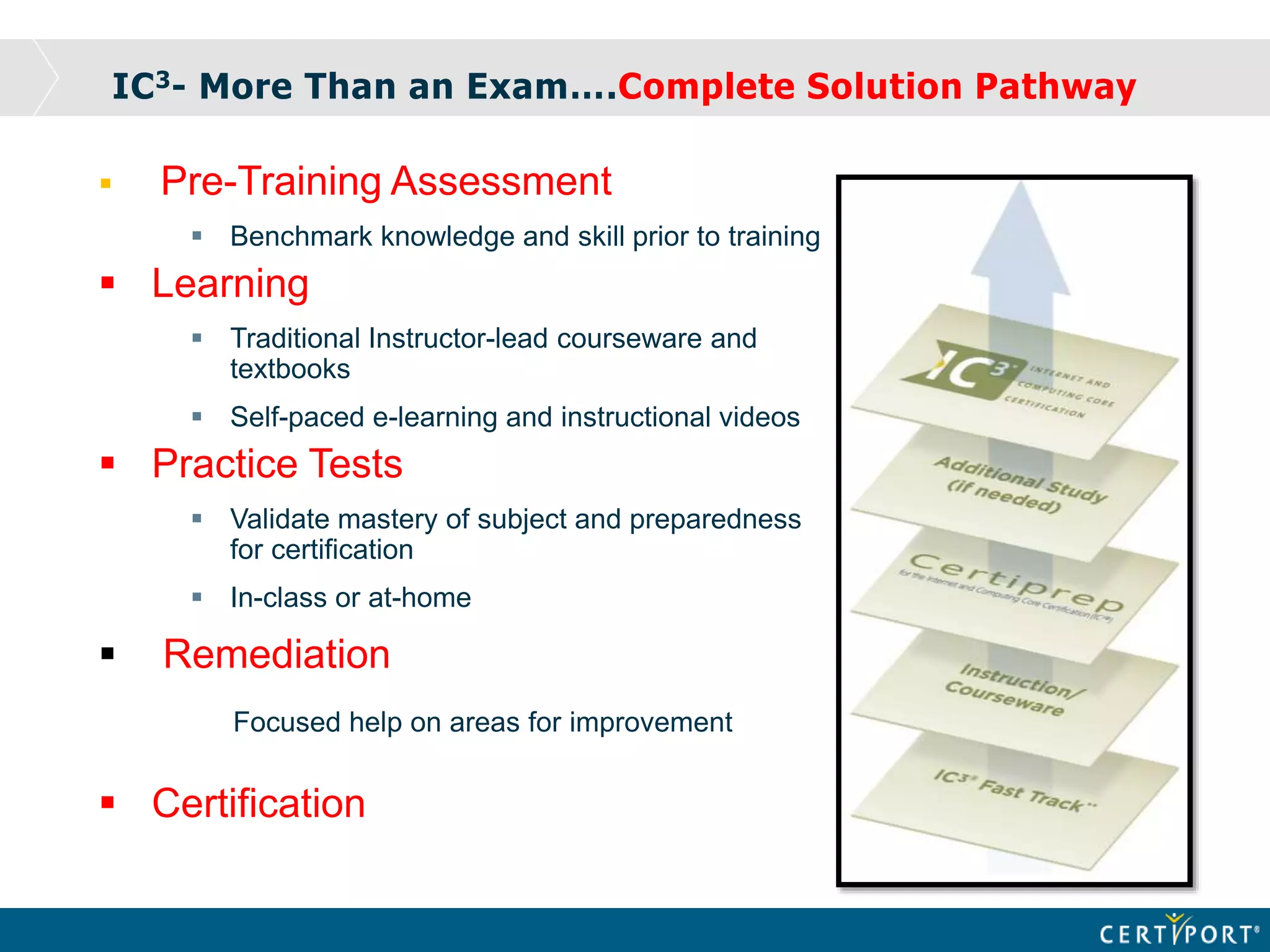
IC3- More Than an Exam….Complete Solution Pathway
 Pre-Training Assessment
 Benchmark knowledge and skill prior to training
 Learning
 Traditional Instructor-lead courseware and
textbooks
 Self-paced e-learning and instructional videos
 Practice Tests
 Validate mastery of subject and preparedness
for certification
 In-class or at-home
 Remediation
Focused help on areas for improvement
 Certification
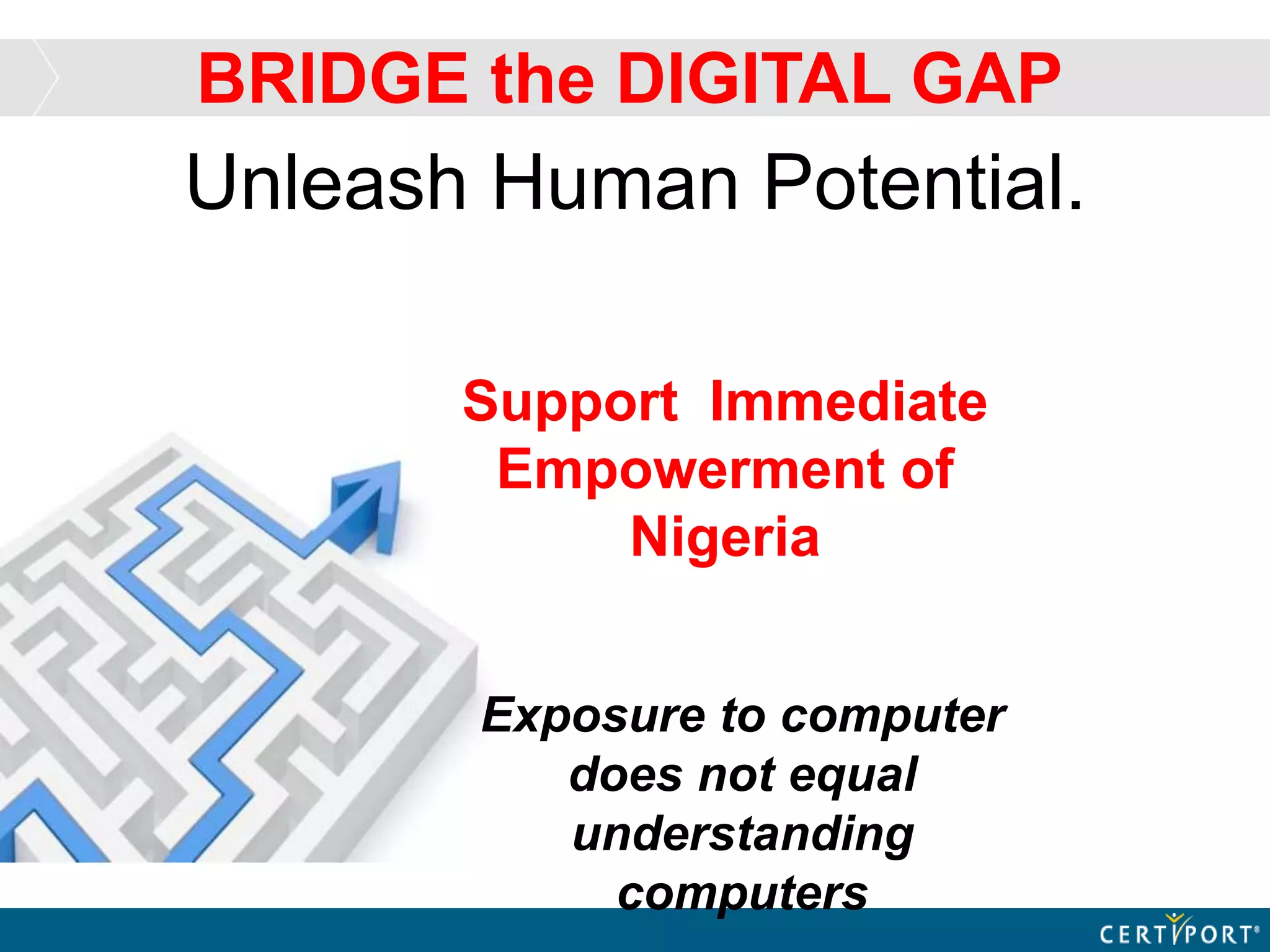
Unleash Human Potential.
Exposure to computer
does not equal
understanding
computers
BRIDGE the DIGITAL GAP
Support Immediate
Empowerment of
Nigeria
Improving digital literacy
isn’t about having individuals work
harder
—it’s about ensuring they know how to
work smarter,
understand the rules of the game,
waste
less time trying to make things
work, and eventually be
more productive.
Productivity Jump Is It !!!
User testing is the key
to the process of retooling and
skilling of the workforce
to determine their varying stages of
ability
and see first-hand how they
use computers.
Your Competency in Doubt?
Aspire to possess
in a step to foster equal
opportunities
in the information revolution,
digital economy and be truly
equipped for
the mandate of
21st century
Take a Leap Today !!!
Be Competitive !!!
Initiate yourself, workforce and students into
today’s digital world
Equip all with the critical entry-level
skills needed to be an effective user of
the latest computer and internet
technologies to achieve school, career
and educational objectives, expand
productivity and improve profitability .
Some final thoughts…..
“For tomorrow belongs to
the people who prepare for it
today”
African Proverb
67
The decision is ours to either
RESTART
OR
SHUTDOWN
68
God Bless Nigeria !!!!!
Thank you!
Commit Technology & Consult Limited
Conclusion
It is an enormous task
to build the ICT infrastructure,
but more important to have a strategy for
developing the skills of workforce
by first addressing the digital
literacy needs of teachers and
FIX IT!
before addressing the needs of students.

Digital Literacy - 21st Century Workforce Development

  • 1.
    Dr. Niran Oyekalefiima President / CEO, Commit Technology & Consult Limited +234(0)7031055234, (0)8183428803 commitechng@gmail.com
  • 2.
    The Paradigm Shift From TheIndustrial Age To The Information Age To The Creativity Age
  • 3.
    These changes, among others,are ushering us toward a world where knowledge, power, and productive capability will be more dispersed than at any time in our history— a world where value creation will be fast, fluid, and The Implication
  • 4.
    ……..Something Worth Ponderingon? Think about the closing of one school year and begin the transformation into another, file away just one number: 65 percent….. …..fully 65 percent of today’s basic school pupils may end up doing work that hasn’t been invented yet. Source: Cathy N. Davidson, co-director of the annual MacArthur Foundation
  • 5.
    Think back 50years …. could educators then have predicted how the Internet, which emerged globally in 1994, or the mobile phone, which appeared a few years later, would change the world? Think a moment about this generation…
  • 6.
    These technologies have notjust become tools of learning, but networking and knowledge sharing, as well as innovation and entrepreneurship…. Think a moment further about this generation… Think Again……..
  • 7.
    A Fast ChangingWorld… ……..changing so fast That the replication of more of the same knowledge and skills of the other days will not suffice to address the challenges of today, not to talk of the future… Imagine…. A generation ago, teachers could expect that what they taught would last their students a lifetime.
  • 8.
    Rapid economic and socialchanges demand Nigeria to prepare the citizenry for jobs that are yet to be created, technologies that have not yet been invented and problems that we don't yet know will arise. Reality of Time
  • 9.
    • Increasingly diversecustomer base • Increasing complexity of business structures and organizations • Expanding mobile customers and increasing electronic communication • Increasing economic importance of digital commerce and digital content Resultant Changes in Business Environment
  • 10.
    Resultant Change toProcess of Learning 20th Century Classrooms 21st Century Classrooms Time-based Outcome-based Focus on memorization of discrete facts Focus on what students KNOW, CAN DO and ARE LIKE after all the details are forgotten Lessons focus on lower level of Bloom’s Taxonomy – knowledge, comprehension and application Learning is designed on upper levels of Bloom’s – synthesis, analysis and evaluation Textbook-driven Research-driven Passive learning Active learning Learners work in isolation – classroom within 4 walls Learners work collaboratively with classmates and others around the world – the Global Classroom Teacher-centered: teacher is center of attention and provider of information Student-centered: teacher is facilitator/coach Little or no student freedom Great deal of student freedom Fragmented curriculum Integrated and Interdisciplinary curriculum Grades averaged Grades are based on what was learned
  • 11.
    Resultant Change toProcess of Learning Low expectations High expectations – “If it isn’t good, it isn’t done” We expect, and ensure, that all students succeed in learning at high levels. Some may go higher – we get out of their way to let them do that. Teacher is judge. No one else sees student work. Self, Peer and Other assessments. Public audience, authentic assessments. Curriculum/School is irrelevant and meaningless to the students. Curriculum is connected to students’ interests, experiences, talents and the real world. Print is the primary vehicle of learning and assessment. Performances, projects and multiple forms of media are used for learning and assessment. Diversity in students is ignored. Curriculum and instruction address student diversity. Literacy is the 3 R’s – reading, writing and math Multiple literacies of the 21st century – aligned to living and working in a globalized new millennium.
  • 12.
    The impact orresponse to these trends is either For the most part - "technology focused" Precipitated or facilitated by technology or Required of skills that are predominantly and significantly technology related. Understanding the Trend…
  • 13.
    Fluency o Attained whenan act is accomplished with no noticeable cognitive or mental effort. o Having a mastery of certain skills to the point of not requiring conscious attention. Digital fluency o An evolving aptitude that empowers the individual to effectively and ethically interpret information, discover meaning, design content, construct knowledge, and communicate ideas in a digitally connected world. Understanding the New Language
  • 14.
    • Tremendous understandingof the past and current situations • Adaptability to the digital age • Imbibing new sets of global best practices • Re-tooling and re-skilling to global standards Success Determinants
  • 15.
    IT capability to leveragetechnology for business differentiation G A P Need for Digital Fluency Source: The 451 Group and The InfoPro - 2011 80% of all jobs and 98% of all college degrees requires capable and proficient use of computers and Internet
  • 16.
    The Great Expectations Employers/Parentsexpect graduates to be: • Creative and Job ready • Ready to thrive in the Digital Age o Cope with the challenges of the 21st century o Think critically, o Solve problems
  • 17.
    IT Capability Gap Data,transactions, and customer interactions are increasing exponentially 2005 Mankind created 150 exabytes of digital data1 2010 Created 8x more data1 2013 Mobile apps download > 21B2 2014 130M Enterprise users in mobile cloud3 2020 2T devices connect to the Internet4 IT capability to leverage technology for business differentiation G A P IT capability to leverage technology for business differentiation 1. “The data deluge: Businesses, governments and society are only starting to tap its vast potential,” The Economist, Feb. 25, 2010. http://www.economist.com/node/15579717 2. “Dataquest Insight: Application Stores; The Revenue Opportunity Beyond the Hype,” Stephanie Baghdassarian, Carolina Milanesi; 16 December 2009. 3. Juniper Research. http://www.juniperresearch.com/viewpressrelease.php?id=210&pr=181 4. “The Difference Engine: Chattering Objects,” The Economist, Aug. 13, 2010. http://www.economist.com/node/21009505
  • 18.
    Widening Gap….. TheGenesis?ClimbingtheTreefromtheTop ClimbingtheTreeBottom-Up Wrong Righ t
  • 19.
    The Shortcomings • Unemployment •Low productivity • Incompetency • Inability to cope with the 21st Century challenges o Offices characterized by large volumes of files, file racks o Documents occupying a lot of spaces, some of which are obsolete and already turning yellow. o Retrieval of document usually difficult and an irrecoverable loss of important documents in case of fire incidence and other natural disasters
  • 20.
    The LINKAGE Researches showthat: 21st Century Skills = Innovative TP X Access to Technology 21st century skills can mean the difference between being successful in school or struggling every day, and having a career, or simply getting a job.
  • 21.
    Nigeria needs a workforce thatis skilled, adaptable, creative, and equipped for success in the global marketplace. A Nation in Need
  • 22.
    Nigeria must gobeyond the 3R’s to: • Have adaptive and practical skills required to function within the community, participate fully in global digital society • Acquire meaningful literacy within a social context • Facilitate access to cultural, economic and political structures • Recognize that new ways of seeing and thinking Going the Extra Miles
  • 23.
    • Empower theworkforce by enhancing their ICT skills to benefit employers and the nation as a whole • Eradicate digital illiteracy among them and thus enhance the use of IT. • Develop a large and highly- skilled IT community that will be one of the economic drivers of the local economy Creating the Standard
  • 24.
    The generation of •Significant economic and social benefits • Capacity to remain abreast of technology developments • Effective use of technology to increase productivity and competitiveness in all sectors of the economy and operations, Can only be achieved if we provide the appropriate framework and inspiration for establishing a digitally literate workforce. Providing the Link
  • 25.
    More Importantly The significantrapid changes in society, the transformation of education— where and how learning takes place and the changing roles of students and teachers in the learning process can only be capitalized upon if we provide the framework and inspiration for establishing a digitally literate teaching force.
  • 26.
    Digital Literacy: TheGlobal Solution for 21st Century Challenges
  • 27.
    • The abilityto find, evaluate, utilize, share, and create content using information technologies and the Internet. • A key enabler for building an inclusive society and knowledge based economy. DL = digital tool knowledge + critical thinking + social engagement. Digital Literacy, What is it?
  • 28.
  • 29.
    • Do Nigeriaworkforce have the skills they need to use digital technologies? • If they possess any, how are these skills acquired? • What types of support, training, and professional development do they need? The BIG Questions
  • 30.
    The Challenges • Bridgingthe gap between technology skills and innovative teaching • Going beyond traditional software training to providing a scaffold that helps educators and personnel of all skill levels acquire knowledge. • Shortage of digitally literate teachers • Inadequate ICT training exercise; usually ad‐hoc, short‐term absence of a comprehensive framework of
  • 31.
    Individuals tend to over-assesstheir ICT capability when applying for employment. and where there is no agreed standard around particular skill sets, there may be a mismatch between the candidate’s actual ability and the employer’s Mismatch Galore
  • 32.
    • Far reachingbenefits touch every aspect of society and the economy • Requirement for the immediate empowerment of our Population The Internet and Computing Core Certification (IC3) credential is its universal test. Digital Literacy, Global Priority
  • 33.
    33 4/23/2015 INTERNET & COMPUTING CORECERTIFICATION: The Global Test of Digital Literacy
  • 34.
    The stepping-stone intothe ICT certification pathway, a fundamental tool for measuring proficiency in the latest key technologies for study, work and life. IC3 was created by Certiport, Inc. in 2000 to address the need for a globally recognized and accepted standard of basic computing knowledge considered fundamental to academic learning and a minimum requirement for employment -Wikipedia. IC3, The Stepping Stone
  • 35.
    IC3 is basedon global best practices and requirements of education, test development and industry, • laying down foundational preparation for every job and career, every field of study, and even social and personal lives that are increasingly impacted by technology. • The single best solution for verifying and validating skills attainment and mastery in digital literacy As Espoused by GDLC
  • 36.
    Standing out withIC3 A global training and certification program providing proof to the world that an individual is; • Equipped with the needed computer skills to excel in a digital world. - • Capable of using a broad range of computer technology. • Ready for challenges of work, academic and life . • Positioned to advanced your career through additional computer
  • 37.
    Computing Fundamentals • 45Questions • 30% Simulation • Vendor neutral Computer Operating Systems Managing Computer Files Computer Terminology Types of Computers & Mobile Devices Types of Software Applications & Tools Troubleshooting basic computer problems Devices and Peripherals
  • 38.
    Key Applications • 45Questions • 80% Simulation • Based on Windows 7 and Office 2010 Common Application Features Basic Database Interactions Word Processing activities and methods Spreadsheet Components Worksheet Layout and basic formulas Presentation Activities / Working with Multimedia Collaboration and File Sharing
  • 39.
    Living Online • 45Questions • 30% Simulation • Vendor neutral • Aligned with National Standards Internet Browsers and the WWW Network types and features E-mail communications Digital Citizenship Research Fluency Using Search Engines Legal and Responsible use of Computers
  • 40.
  • 41.
    Recognized in Nigeria TheIC3 is well-respected internationally, endorsed and recommended by NITDA - National Information Technology Development Agency CPN - Computer Professionals (Registration Council of) Nigeria NUC - National Universities Commission TRCN - Teachers Registration Council of Nigeria
  • 42.
    IC3…… the MissingLink From digital literacy certification in IC3, to professionally recognized skills certification on MCE, MOS, MTA, MCP, Adobe, HP, Autodesk products, IC Health etc. IC3 provides the pathway to a fulfilling and valuable career in many different fields.
  • 43.
  • 44.
    Training for Success Trainingto be a Versatilist to continuously adapt, learn and grow in a fast-changing world “Versatilists are able to apply a depth of skill to a progressively widening scope of situations and experiences, equally at ease with technical issues as with business strategy.”
  • 45.
  • 46.
    Achieving Global Standardin Digital Fluency • Covering up the oversight in Nigerian Tertiary Education System and broaden the perspective to a national and global level in line with best global practice • Breathing a new life into training content, leveraging technology in ways that powerfully advance learning, strengthening Nigeria’s workforce engagement in challenging, authentic and intellectual works. • Raising the Nigeria’s workforce competence beyond the limits of ‘3Rs’ to the ‘3Cs’ qualities of high-performance that today characterize most competitive companies.
  • 47.
    Cont’d • Bridging theexisting digital gap, thus solving the associated skills gap among Nigeria tertiary institutions’ graduates. • Benchmarking a set of essential digital literacy skills to function in today's business world • Availing Nigeria’s workforce of digital portfolio, proof of knowledge and proficiency required to make them more job-ready, marketable and competitive globally • Earning the Nigeria’s workforce industry- recognized credential, tools and skills set to enter into workforce, armed to succeed in today's
  • 48.
    Ecobank Group shouldcollaborate to among other initiatives: • Develop a “roadmap for success” in achieving Nigerians digital fluency • Champion and adopt IC3 as standard of Digital Literacy Nigeria Capacity development must be acquired within the context of today’s technological environment to Nigerians thrive in the digital age The Way Forward
  • 49.
    ICT Training andCertification Roadmap
  • 50.
    Entrenched from IC3digital literacy to other ICT training modules to attain fluency at all levels of • Nigeria education system • Workforce preparation and • Continuous professional development in line with best global practices. Bringing All to Global Standard
  • 51.
    Rethinking Education Changes ofthis magnitude require a complete rethinking of education…. in terms of • Curriculum • Development of Pedagogies To ensure that every student acquires the high level of skills needed to thrive in the dynamic world of the 21st century. 51 “If we teach today as we taught yesterday, we rob our children of tomorrow.” - John Dewey
  • 52.
    • Hybrid ICTCurriculum and Content (Age 3 - 16) • IC3 Spark (Between SS1 & SS3) • Global Digital Literacy Championship Intervene Now
  • 53.
    Career Progression forColleges and Universities Microsoft/H P Technology Associate •Technology •Science Adobe Certified Associate •Creative Arts •Media AutoDesk Certification •Engineering QuickBooks Certified •Accounting •Finance IC3 Digital Literacy Microsoft Office Specialist •Management •Marketing •Legal •Admin Microsoft Certified Educator •Education IC HEALTH •Medical •Nursing •Records •Laboratory
  • 54.
    A National Agenda•Promote a commitment to digital literacy as the basic skill required for all citizens. • Benchmark and adopt globally accepted metric standards • Enhance digital fluency opportunities in technological innovation and workforce readiness. • Develop timetables and milestones to ensure appropriate accountability for assessing timely progress and ultimate success
  • 55.
    Any nation whose citizensbest harness the educational and creative powers of digital technology will write the economic and educational success story of the21st century. Hope of Success
  • 56.
    Investments in people arefundamental to social and economic development. But, investments in technology will do a little to improve the way we work , learn and socialize unless they are matched by efforts to build capacity of the Nigerians to harness the opportunities that ICT offers. Capacity Development… the Solution
  • 57.
    The ‘3Cs’ isit… Aside the basic skills of literacy and numeracy, every Nigerian must also master the "three C's" …Communication, Collaboration, and Creative Problem Solving. And beyond attain technological fluency, and, most of all, the skills and attitudes needed to be a lifelong learner. 57
  • 58.
    A Clarion Call PositionNigeria to do more to keep pace with rapid technology, research, and Societal changes to ensure that her workforce and student-graduates will be ready to thrive in today’s knowledge based, global society and have a prove of specific digital skills to fill job openings.
  • 59.
    In Nigeria today digitalliteracy is assumed. This forces individuals to learn fundamental skills by trial and error, and non-systematic learning of core computer competencies means that many people have big gaps in their understanding of how the basics work. A Worrisome Assumption
  • 60.
    M A KE I C 3 T H E F O U N D A T I O N OF Y O U R V I S I O N F O R N A T I O N A L S U C C E S S ! ! !
  • 61.
    IC3- More Thanan Exam….Complete Solution Pathway  Pre-Training Assessment  Benchmark knowledge and skill prior to training  Learning  Traditional Instructor-lead courseware and textbooks  Self-paced e-learning and instructional videos  Practice Tests  Validate mastery of subject and preparedness for certification  In-class or at-home  Remediation Focused help on areas for improvement  Certification
  • 62.
    Unleash Human Potential. Exposureto computer does not equal understanding computers BRIDGE the DIGITAL GAP Support Immediate Empowerment of Nigeria
  • 63.
    Improving digital literacy isn’tabout having individuals work harder —it’s about ensuring they know how to work smarter, understand the rules of the game, waste less time trying to make things work, and eventually be more productive. Productivity Jump Is It !!!
  • 64.
    User testing isthe key to the process of retooling and skilling of the workforce to determine their varying stages of ability and see first-hand how they use computers. Your Competency in Doubt?
  • 65.
    Aspire to possess ina step to foster equal opportunities in the information revolution, digital economy and be truly equipped for the mandate of 21st century Take a Leap Today !!!
  • 66.
    Be Competitive !!! Initiateyourself, workforce and students into today’s digital world Equip all with the critical entry-level skills needed to be an effective user of the latest computer and internet technologies to achieve school, career and educational objectives, expand productivity and improve profitability .
  • 67.
    Some final thoughts….. “Fortomorrow belongs to the people who prepare for it today” African Proverb 67
  • 68.
    The decision isours to either RESTART OR SHUTDOWN 68 God Bless Nigeria !!!!!
  • 69.
  • 70.
    Conclusion It is anenormous task to build the ICT infrastructure, but more important to have a strategy for developing the skills of workforce by first addressing the digital literacy needs of teachers and FIX IT! before addressing the needs of students.

Editor's Notes

  • #16 IT challenge: the need for expertise The number-one inhibitor cited by business and IT leaders is sourcing the right expertise when and how companies need to acquire it. According to The InfoPro, when asked to name the number-one obstacle to adopting cloud services, ~60% of executives cited “Lack of staff skills/shortage of expertise.” They are reporting a competency gap; employees with relevant skills are difficult to come by. When you consider the rate of change in both business and technology that IT professionals must contend with in order to stay relevant, it’s no wonder this is the case. According to these leaders, two factors comprise this issue: Sourcing Businesses typically go about acquiring IT expertise in three ways: 1) they hire it, 2) they outsource it, or 3) they acquire it through service providers or cloud services. The IT organization of the future will be much smaller and more nimble, focusing internal resources on deeper and broader business expertise while leveraging service providers who bring deep technology expertise. This represents a whole different mindset for people entering the workforce. Many new IT professionals will become consultants on contract rather than employees. Different expertise (next page)
  • #18 All of this is driving a major shift in IT. In most organizations, IT is seen as an inhibitor to the rate of change and not as a catalyst. The biggest challenge CIOs face is the need to react much faster to business demands in order to use IT as a competitive differentiator. However, extensive HP research shows the typical IT department spends 70 percent of its budget on maintaining its existing infrastructure and only 30 percent on innovation to generate a competitive advantage for the business. As a result, CIOs are looking for new approaches that enable them to apply more resources toward proactively addressing their business needs. Through the use of cloud services, converged infrastructure, and strategic outsourcing, they can significantly reduce the time required to provision new services—from months to hours—while lowering the capital, deployment, and management costs to reallocate resources toward what truly differentiates.