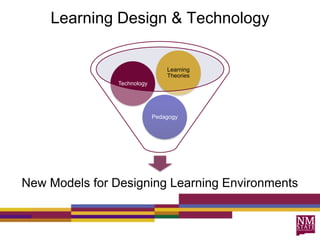
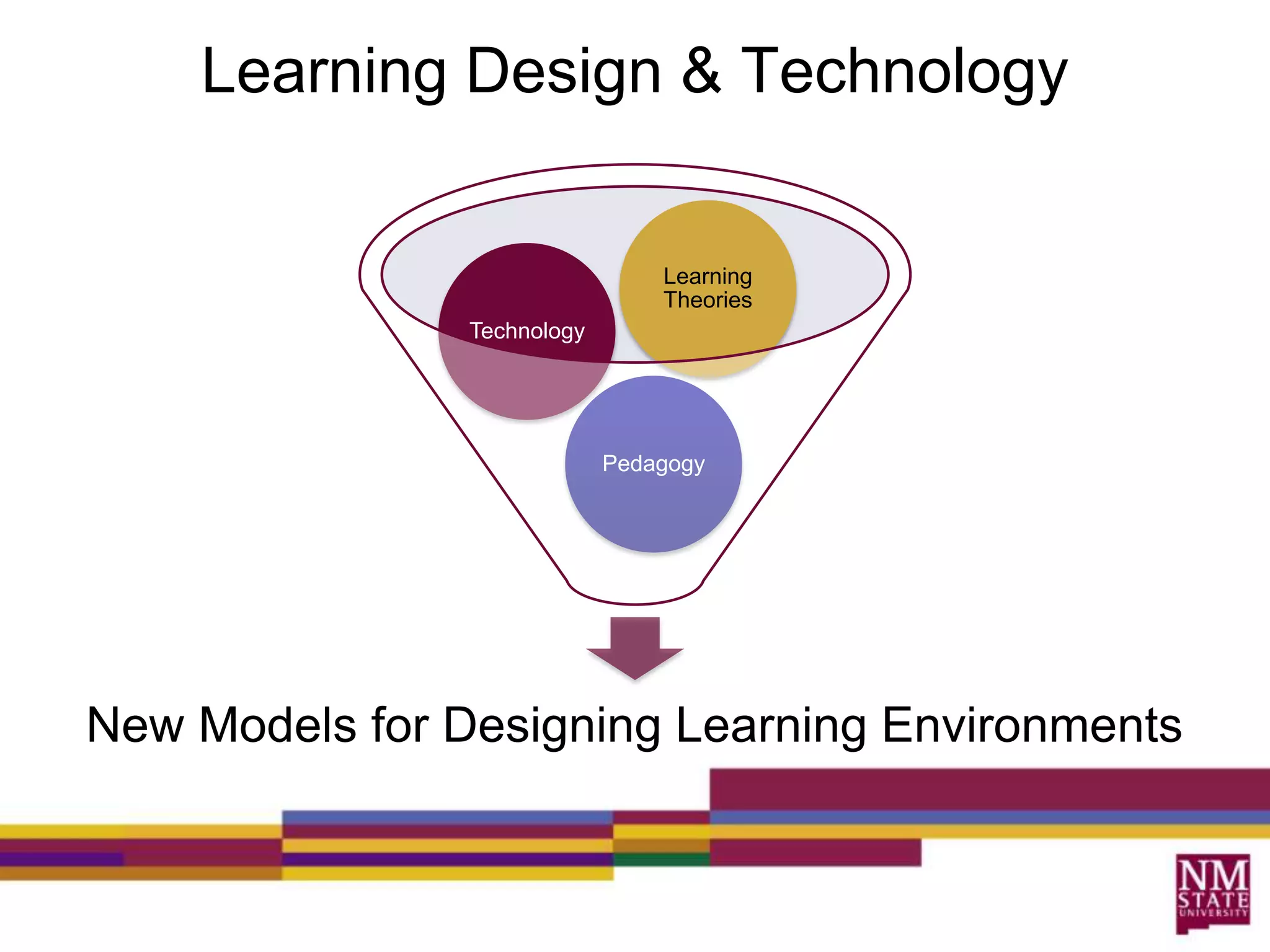


Learning Design & Technology
New Models for Designing Learning Environments
Pedagogy
Technology
Learning
Theories
Sainbainauu (Сайнбайнауу)
Hello 
This is me – Julia Parra aka Julia Wiggins (Second Life) aka @desertjul, etc…
LOL, I have so many identities, I'm not sure I remember them all. Could this be a
problem? InterWeb Identity Crisis?
Dr. Julia Parra – for more see http://juliaparra.com
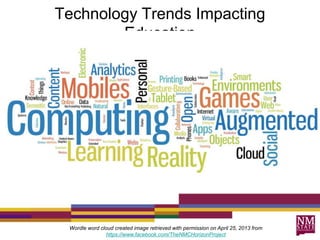
Technology Trends Impacting
Education
Wordle word cloud created image retrieved with permission on April 25, 2013 from
https://www.facebook.com/TheNMCHorizonProject
Technology Trends Impacting
Education
(Johnson, et al., 2012/2013; McIntosh, 2012; and personal experience)
• All things mobile & connected to the
Internet (mobile devices and tablets;
apps!)
• Cloud computing (store on others‟ servers)
Online Collaboration Tools
• Top Tools for collaborative group work are
Skype, Google Docs, and Adobe Connect.
(Parra, TBD)
Technology Trends Impacting
Education
(Johnson, et al., 2012/2013; McIntosh, 2012; and personal experience)
• Free and open educational resources
(OER) - ebooks/digital
content, video, courses, journals, etc.
– Johnathan Chung‟s Awesome List of Over
200 Free Online Educational Resources
http://goo.gl/8HLFw
– Julz Tools – http://bit.ly/julztools
OER - Video
• Khan Academy
– https://www.khanacademy.org/
• YouTube
– http://youtube.com for general search on any
topic
– YouTube EDU
http://www.youtube.com/education
– CREATE YOUR OWN!
Technology Trends Impacting
Education
(Johnson, et al., 2012/2013; McIntosh, 2012; and personal experience)
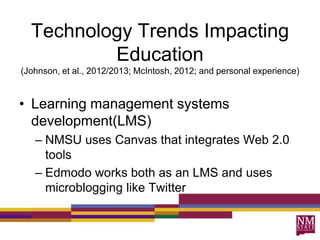
• Learning management systems
development(LMS)
– NMSU uses Canvas that integrates Web 2.0
tools
– Edmodo works both as an LMS and uses
microblogging like Twitter
Technology Trends Impacting
Education
(Johnson, et al., 2012/2013; McIntosh, 2012; and personal experience)
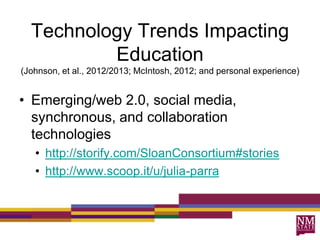
• Emerging/web 2.0, social media,
synchronous, and collaboration
technologies
• http://storify.com/SloanConsortium#stories
• http://www.scoop.it/u/julia-parra
Technology Trends Impacting
Education
(Johnson, et al., 2012/2013; McIntosh, 2012; and personal experience)
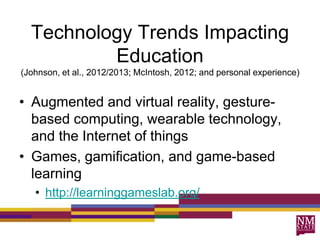
• Augmented and virtual reality, gesture-
based computing, wearable technology,
and the Internet of things
• Games, gamification, and game-based
learning
• http://learninggameslab.org/
Science & Art of Learning
• Pedagogy – structured, formal
K12 learning
• Andragogy – structured, formal
adult learning
Science & Art of Learning
Heutagogy
The study of self-directed learning;
includes unstructured, self-directed & self-
determined learning; focus on
metacognition, knowledge sharing,
creativity, original works, etc. (Hase&
Kenyon, 2000; Blaschke, 2012)
Learning Theories
• Learner & Learning Centered
• Transformative Learning &
Learning Community
• Constructivism & Social
Constructivism
Learning Theories
Connectivism
Learning Theory for the Digital Age – “the
thesis that knowledge is distributed across a
network of connections, and therefore that
learning consists of the ability to construct
and traverse those networks. It shares with
some other theories a core proposition, that
knowledge is not acquired, as though it were
a thing. Knowledge is, on this theory, literally
the set of connections formed by actions and
experience.” (Siemens &Downes, 2011)
Learning & Technology Models
Online, Blended, Hybrid, HyFlex Learning
Environments
Different blends of online & face-to-face;
synchronous & asynchronous; etc.
Research about Online &
Blended
• Using standards and innovative practices
to teach teachers to teach online changes
face-to-face teaching practices. These
teachers are able to more easily integrate
technology into their face-to-face teaching
and often end up teaching in blended
formats (Parra, 2010).
Research about Online &
Blended• The evidence is growing to “support the notion
that blended learning is more effective than
either face to face or online learning by
themselves. Further, between online and face to
face instruction, online is at least as good and
may even have the advantage in terms of
improving student achievement and potentially
expanding the amount of time (and quality time)
students spend learning(Nagel, 2009, para 1);
Means, Toyama, Murphy,Bakia, & Jones, 2010).
Standards- ISTE NETS
• International Society for Technology in Education (ISTE) National
Educational Technology Standards (NETS) for Administrators,
Teachers, Students, and Computer Science Teachers.
– The overarching purpose of the NETS is - “to set a standard of
excellence and best practices in learning, teaching, and leading with
technology in education.”
“The benefits of using the NETS include:
– Improving higher-order thinking skills, such as problem solving, critical
thinking, and creativity
– Preparing students for their future in a competitive global job market
– Designing student-centered, project-based, and online learning
environments
– Guiding systemic change in our schools to create digital places of
learning
– Inspiring digital age professional models for working, collaborating, and
decision making”
Access all the ISTE NETS standards at http://www.iste.org/standards.aspx
Standards- Quality Matters
(QM)• The Quality Matters Rubric for Higher Education
is a set of 8 general standards and 41 specific
standards used to evaluate the design of online
and blended courses. The Rubric is complete
with annotations that explain the application of
the standards and the relationship among
them. A scoring system and set of online tools
facilitate the evaluation by a team of reviewers.
– Access Quality Matters at
https://qualitymatters.org
Standards- iNACOL
• The International Association for K12
Online Learning provides many
resources for online and blended
learning, including research-based
standards for K12 online course
design and online teaching.
– Access iNACOL at http://www.inacol.org/
Learning & Technology Models
Bring Your Own Device (BYOD)
BYON (Network)
(Devaney, 2012; Ullman, 2013)
Students bring their own devices (laptops,
iPads, tablets, smart phones, etc.) for use
in classrooms.
Learning & Technology Models
Flipped Classrooms
(Tucker, 2012)
Use of online materials, such as videos, for
main content and hands-on work
(homework) done in classroom
Learning & Technology Models
Self-Organizing Learning Environments
(SOLEs)
“we live in a world where children can figure
things out by themselves. But the existing
teaching assumes that they cannot and,
therefore, have to be taught. That has to
change and we must „teach‟ as little as
possible.” ~ SugataMitra
Interview at http://gulfnews.com/news/world/india/indian-professor-calls-for-reinventing-education-system-1.1167649
Learning & Technology Models
Massive Open Online Course (MOOCs)
(de Waard, I., et al; 2011; Pappano, 2012)
Courses or classes offered and taught
online to anyone who wants to take them.
One Stanford MOOC, Introduction to
Artificial Intelligence had approximately
150,000 students signed up!
Resources from this
presentation
http://nmsumsue.pbworks.com/
Select Conference
Select Learning Design and
Technology
A Place for Further Resources
& Collaboration
http://nmsumsue.pbworks.com/
References
• Blaschke, Lisa Marie. "Heutagogy and lifelong learning:
a review of heutagogical practice and self-determined
learning." The International Review of Research in Open
and Distance Learning 13.1 (2012): 56-71. Retrieved
April 23, 2013 from
http://www.irrodl.org/index.php/irrodl/article/view/1076/20
87
• Hase, Stewart, and Chris Kenyon. "From andragogy to
heutagogy." Ultibase Articles 5.3 (2000): 1-10. Retrieved
April 23, 2013 from
http://www.psy.gla.ac.uk/~steve/pr/Heutagogy.html
References
• de Waard, I., Abajian, S., Gallagher, M., Hogue, R.,
Keskin, N., Koutropoulos, A., & Rodriguez, O. (2011).
Using mLearning and MOOCs to understand chaos,
emergence, and complexity in education. The
International Review Of Research In Open And Distance
Learning, 12(7), 94-115. Retrieved
fromhttp://www.irrodl.org/index.php/irrodl/article/view/104
6
• Devaney, L. (2012). How to make BYOD work for your
schools. eSchool News. Retrieved April 23, 2013 from
http://www.eschoolnews.com/2012/10/29/how-to-make-
byod-work-for-your-schools/?
References
• Johnson, L., Adams, S., & Cummins, M. (2012). The
NMC horizon report: 2012 higher education
edition. Austin, Texas: The New Media Consortium.
Retrieved April 24, 2013 from
http://www.nmc.org/publications/horizon-report-2012-
higher-ed-editiones-2013
• Johnson, L., Adams, S., Cummins, M., Estrada, V., Free
man, A., &Ludgate, H. (2013). NMC Horizon Report:
2013 Higher Education Edition. Austin, Texas: The New
Media Consortium. Retrieved April 24, 2013 from
http://www.nmc.org/publications/2013-horizon-report-
higher-ed
References
• Siemens, G. &Downes, S. “Connectivism& Connective
Knowledge 2011.” This is a MOOC retrieved April
23, 2013 from http://cck11.mooc.ca/index.html
• McIntosh, D. (2012). Trends in Learning Technologies to
Watch in 2013. eLearning Industry. Retrieved April
23, 2013 from http://elearningindustry.com/trends-
learning-technologies-2013
References
• Means, B., Toyama, Y., Murphy, R., Bakia, M., &
Jones, K. (2010). Evaluation of evidence-based
practices in online learning: A meta-analysis and review
of online learning studies.
http://www.educause.edu/library/resources/evaluation-
evidence-based-practices-online-learning-meta-analysis-
and-review-online-learning-studies
• Nagel, D. (2009). Meta-analysis: Is blended learning
most effective. The Journal.
http://thejournal.com/articles/2009/07/01/meta-analysis-
is-blended-learning-most-effective.aspx
References
• Pappano, L. (2012). The year of the MOOC. The New
York Times. Retrieved April 29, 2013 from
http://www.nytimes.com/2012/11/04/education/edlife/ma
ssive-open-online-courses-are-multiplying-at-a-rapid-
pace.html?pagewanted=all&_r=0
• Parra, J. L. (2010). Transforming Teachers and
Classrooms with Online Learning: The Impact of
Teacher Professional Development for Online Teaching
on Face-to-Face Classroom Teaching Practices (pp.
264). Saarbrücken: LAP LAMBERT Academic
Publishing. http://amzn.to/julzmonograph
References
• Parra, J. (TBD). Online tools for group work and
collaboration: supporting student learning, success, and
satisfaction. http://nmsumsue.pbworks.com/w/page/6602
4429/Learning%20Design%20and%20Technology
• Parra, J. (TBD). Phases and scaffolds for technology
and collaboration (PSTC): An online and blended course
design model in support of student learning and success.
http://nmsumsue.pbworks.com/w/page/66024429/Learni
ng%20Design%20and%20Technology
References
• Pathak, N. (2013). Indian professor calls for reinventing
education system. GulfNews.com. Retrieved April 29,
2013 from http://gulfnews.com/news/world/india/indian-
professor-calls-for-reinventing-education-system-
1.1167649
• Tucker, B. (2012). The flipped classroom. Education
Next, 12(1), 82-83. Retrieved April 29, 2013 from
http://educationnext.org/files/ednext_20121_BTucker.pdf

Learning Design and Technology

  • 1.
    Learning Design &Technology New Models for Designing Learning Environments Pedagogy Technology Learning Theories
  • 2.
    Sainbainauu (Сайнбайнауу) Hello  Thisis me – Julia Parra aka Julia Wiggins (Second Life) aka @desertjul, etc… LOL, I have so many identities, I'm not sure I remember them all. Could this be a problem? InterWeb Identity Crisis? Dr. Julia Parra – for more see http://juliaparra.com
  • 3.
    Technology Trends Impacting Education Wordleword cloud created image retrieved with permission on April 25, 2013 from https://www.facebook.com/TheNMCHorizonProject
  • 4.
    Technology Trends Impacting Education (Johnson,et al., 2012/2013; McIntosh, 2012; and personal experience) • All things mobile & connected to the Internet (mobile devices and tablets; apps!) • Cloud computing (store on others‟ servers)
  • 5.
    Online Collaboration Tools •Top Tools for collaborative group work are Skype, Google Docs, and Adobe Connect. (Parra, TBD)
  • 6.
    Technology Trends Impacting Education (Johnson,et al., 2012/2013; McIntosh, 2012; and personal experience) • Free and open educational resources (OER) - ebooks/digital content, video, courses, journals, etc. – Johnathan Chung‟s Awesome List of Over 200 Free Online Educational Resources http://goo.gl/8HLFw – Julz Tools – http://bit.ly/julztools
  • 7.
    OER - Video •Khan Academy – https://www.khanacademy.org/ • YouTube – http://youtube.com for general search on any topic – YouTube EDU http://www.youtube.com/education – CREATE YOUR OWN!
  • 10.
    Technology Trends Impacting Education (Johnson,et al., 2012/2013; McIntosh, 2012; and personal experience) • Learning management systems development(LMS) – NMSU uses Canvas that integrates Web 2.0 tools – Edmodo works both as an LMS and uses microblogging like Twitter
  • 11.
    Technology Trends Impacting Education (Johnson,et al., 2012/2013; McIntosh, 2012; and personal experience) • Emerging/web 2.0, social media, synchronous, and collaboration technologies • http://storify.com/SloanConsortium#stories • http://www.scoop.it/u/julia-parra
  • 12.
    Technology Trends Impacting Education (Johnson,et al., 2012/2013; McIntosh, 2012; and personal experience) • Augmented and virtual reality, gesture- based computing, wearable technology, and the Internet of things • Games, gamification, and game-based learning • http://learninggameslab.org/
  • 13.
    Science & Artof Learning • Pedagogy – structured, formal K12 learning • Andragogy – structured, formal adult learning
  • 14.
    Science & Artof Learning Heutagogy The study of self-directed learning; includes unstructured, self-directed & self- determined learning; focus on metacognition, knowledge sharing, creativity, original works, etc. (Hase& Kenyon, 2000; Blaschke, 2012)
  • 15.
    Learning Theories • Learner& Learning Centered • Transformative Learning & Learning Community • Constructivism & Social Constructivism
  • 16.
    Learning Theories Connectivism Learning Theoryfor the Digital Age – “the thesis that knowledge is distributed across a network of connections, and therefore that learning consists of the ability to construct and traverse those networks. It shares with some other theories a core proposition, that knowledge is not acquired, as though it were a thing. Knowledge is, on this theory, literally the set of connections formed by actions and experience.” (Siemens &Downes, 2011)
  • 17.
    Learning & TechnologyModels Online, Blended, Hybrid, HyFlex Learning Environments Different blends of online & face-to-face; synchronous & asynchronous; etc.
  • 18.
    Research about Online& Blended • Using standards and innovative practices to teach teachers to teach online changes face-to-face teaching practices. These teachers are able to more easily integrate technology into their face-to-face teaching and often end up teaching in blended formats (Parra, 2010).
  • 19.
    Research about Online& Blended• The evidence is growing to “support the notion that blended learning is more effective than either face to face or online learning by themselves. Further, between online and face to face instruction, online is at least as good and may even have the advantage in terms of improving student achievement and potentially expanding the amount of time (and quality time) students spend learning(Nagel, 2009, para 1); Means, Toyama, Murphy,Bakia, & Jones, 2010).
  • 20.
    Standards- ISTE NETS •International Society for Technology in Education (ISTE) National Educational Technology Standards (NETS) for Administrators, Teachers, Students, and Computer Science Teachers. – The overarching purpose of the NETS is - “to set a standard of excellence and best practices in learning, teaching, and leading with technology in education.” “The benefits of using the NETS include: – Improving higher-order thinking skills, such as problem solving, critical thinking, and creativity – Preparing students for their future in a competitive global job market – Designing student-centered, project-based, and online learning environments – Guiding systemic change in our schools to create digital places of learning – Inspiring digital age professional models for working, collaborating, and decision making” Access all the ISTE NETS standards at http://www.iste.org/standards.aspx
  • 21.
    Standards- Quality Matters (QM)•The Quality Matters Rubric for Higher Education is a set of 8 general standards and 41 specific standards used to evaluate the design of online and blended courses. The Rubric is complete with annotations that explain the application of the standards and the relationship among them. A scoring system and set of online tools facilitate the evaluation by a team of reviewers. – Access Quality Matters at https://qualitymatters.org
  • 22.
    Standards- iNACOL • TheInternational Association for K12 Online Learning provides many resources for online and blended learning, including research-based standards for K12 online course design and online teaching. – Access iNACOL at http://www.inacol.org/
  • 23.
    Learning & TechnologyModels Bring Your Own Device (BYOD) BYON (Network) (Devaney, 2012; Ullman, 2013) Students bring their own devices (laptops, iPads, tablets, smart phones, etc.) for use in classrooms.
  • 24.
    Learning & TechnologyModels Flipped Classrooms (Tucker, 2012) Use of online materials, such as videos, for main content and hands-on work (homework) done in classroom
  • 25.
    Learning & TechnologyModels Self-Organizing Learning Environments (SOLEs) “we live in a world where children can figure things out by themselves. But the existing teaching assumes that they cannot and, therefore, have to be taught. That has to change and we must „teach‟ as little as possible.” ~ SugataMitra Interview at http://gulfnews.com/news/world/india/indian-professor-calls-for-reinventing-education-system-1.1167649
  • 26.
    Learning & TechnologyModels Massive Open Online Course (MOOCs) (de Waard, I., et al; 2011; Pappano, 2012) Courses or classes offered and taught online to anyone who wants to take them. One Stanford MOOC, Introduction to Artificial Intelligence had approximately 150,000 students signed up!
  • 27.
    Resources from this presentation http://nmsumsue.pbworks.com/ SelectConference Select Learning Design and Technology
  • 28.
    A Place forFurther Resources & Collaboration http://nmsumsue.pbworks.com/
  • 29.
    References • Blaschke, LisaMarie. "Heutagogy and lifelong learning: a review of heutagogical practice and self-determined learning." The International Review of Research in Open and Distance Learning 13.1 (2012): 56-71. Retrieved April 23, 2013 from http://www.irrodl.org/index.php/irrodl/article/view/1076/20 87 • Hase, Stewart, and Chris Kenyon. "From andragogy to heutagogy." Ultibase Articles 5.3 (2000): 1-10. Retrieved April 23, 2013 from http://www.psy.gla.ac.uk/~steve/pr/Heutagogy.html
  • 30.
    References • de Waard,I., Abajian, S., Gallagher, M., Hogue, R., Keskin, N., Koutropoulos, A., & Rodriguez, O. (2011). Using mLearning and MOOCs to understand chaos, emergence, and complexity in education. The International Review Of Research In Open And Distance Learning, 12(7), 94-115. Retrieved fromhttp://www.irrodl.org/index.php/irrodl/article/view/104 6 • Devaney, L. (2012). How to make BYOD work for your schools. eSchool News. Retrieved April 23, 2013 from http://www.eschoolnews.com/2012/10/29/how-to-make- byod-work-for-your-schools/?
  • 31.
    References • Johnson, L.,Adams, S., & Cummins, M. (2012). The NMC horizon report: 2012 higher education edition. Austin, Texas: The New Media Consortium. Retrieved April 24, 2013 from http://www.nmc.org/publications/horizon-report-2012- higher-ed-editiones-2013 • Johnson, L., Adams, S., Cummins, M., Estrada, V., Free man, A., &Ludgate, H. (2013). NMC Horizon Report: 2013 Higher Education Edition. Austin, Texas: The New Media Consortium. Retrieved April 24, 2013 from http://www.nmc.org/publications/2013-horizon-report- higher-ed
  • 32.
    References • Siemens, G.&Downes, S. “Connectivism& Connective Knowledge 2011.” This is a MOOC retrieved April 23, 2013 from http://cck11.mooc.ca/index.html • McIntosh, D. (2012). Trends in Learning Technologies to Watch in 2013. eLearning Industry. Retrieved April 23, 2013 from http://elearningindustry.com/trends- learning-technologies-2013
  • 33.
    References • Means, B.,Toyama, Y., Murphy, R., Bakia, M., & Jones, K. (2010). Evaluation of evidence-based practices in online learning: A meta-analysis and review of online learning studies. http://www.educause.edu/library/resources/evaluation- evidence-based-practices-online-learning-meta-analysis- and-review-online-learning-studies • Nagel, D. (2009). Meta-analysis: Is blended learning most effective. The Journal. http://thejournal.com/articles/2009/07/01/meta-analysis- is-blended-learning-most-effective.aspx
  • 34.
    References • Pappano, L.(2012). The year of the MOOC. The New York Times. Retrieved April 29, 2013 from http://www.nytimes.com/2012/11/04/education/edlife/ma ssive-open-online-courses-are-multiplying-at-a-rapid- pace.html?pagewanted=all&_r=0 • Parra, J. L. (2010). Transforming Teachers and Classrooms with Online Learning: The Impact of Teacher Professional Development for Online Teaching on Face-to-Face Classroom Teaching Practices (pp. 264). Saarbrücken: LAP LAMBERT Academic Publishing. http://amzn.to/julzmonograph
  • 35.
    References • Parra, J.(TBD). Online tools for group work and collaboration: supporting student learning, success, and satisfaction. http://nmsumsue.pbworks.com/w/page/6602 4429/Learning%20Design%20and%20Technology • Parra, J. (TBD). Phases and scaffolds for technology and collaboration (PSTC): An online and blended course design model in support of student learning and success. http://nmsumsue.pbworks.com/w/page/66024429/Learni ng%20Design%20and%20Technology
  • 36.
    References • Pathak, N.(2013). Indian professor calls for reinventing education system. GulfNews.com. Retrieved April 29, 2013 from http://gulfnews.com/news/world/india/indian- professor-calls-for-reinventing-education-system- 1.1167649 • Tucker, B. (2012). The flipped classroom. Education Next, 12(1), 82-83. Retrieved April 29, 2013 from http://educationnext.org/files/ednext_20121_BTucker.pdf

Editor's Notes

  • #4 http://locomotivelabs.com/apps/ - Kid in Story
  • #5 http://locomotivelabs.com/apps/ - Kid in StoryGoogle Drive,
  • #6 Online tools for group work and collaboration: supporting student learning, success, and satisfaction
  • #7 http://locomotivelabs.com/apps/ - Kid in Story
  • #11 Canvas that integrated Web 2.0 toolsEdmodo that works both as LMS and microblogging like twitter
  • #12 Social media article
  • #13 http://www.logicalchoice.tv/Default.aspx?VID=47https://www.leapmotion.com/http://www.google.com/glass/start/how-it-feels/http://www.ub.edu/multimedia/iem/down/c8/Games_as_learning_machines.pdfhttp://www.edutopia.org/blog/gamifying-student-engagement-matthew-farber
  • #24 I require my F2F learners to bring their mobile devices and use them during classes. We access the online course/materials, conduct on the spot research, group work, present, etc. I do not require (I do have recommendations) books, rather I support the acquisition of mobile devices and check out any extra devices I have as needed.
  • #25 Flipping is one type of blending your course. I blend all my F2F courses, so some flipping applies.
  • #26 I apply this by providing learners the opportunity to help design their learning, by providing choice in assignments, and using mostly project-based and group work learning.